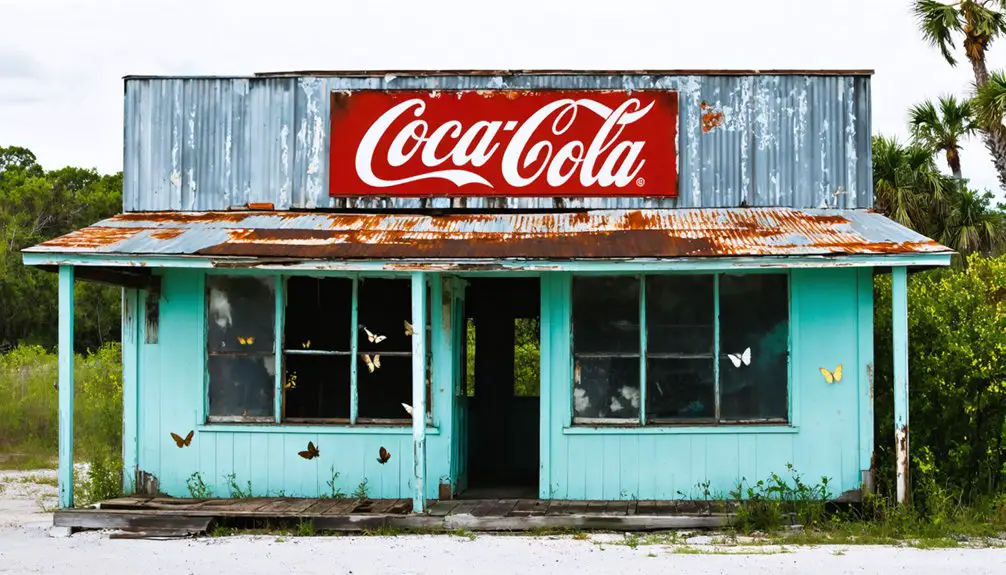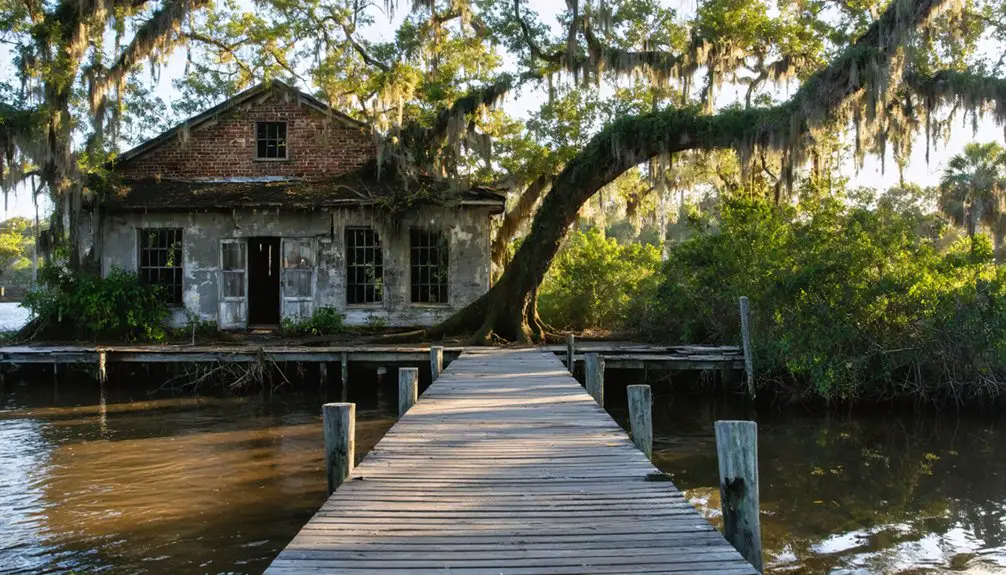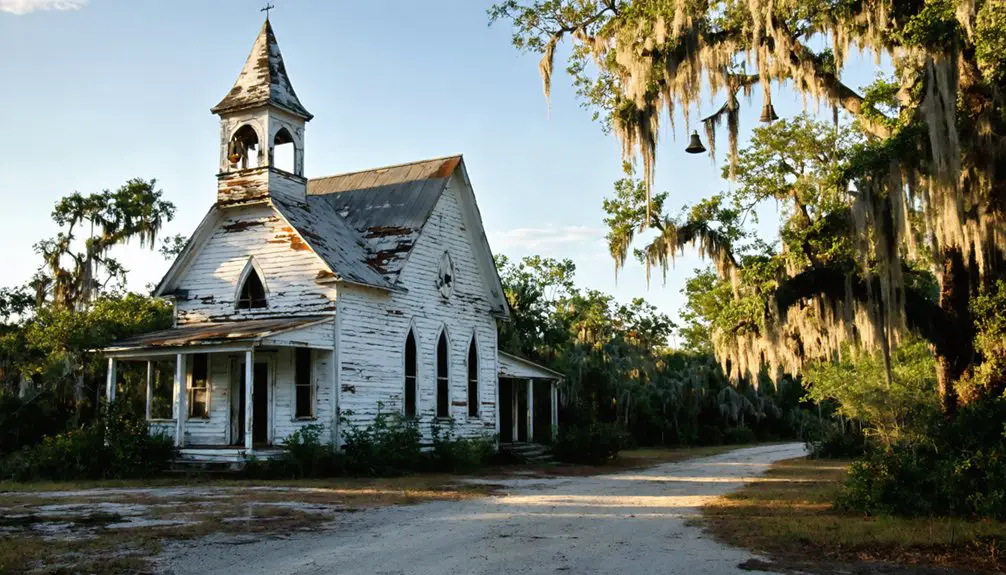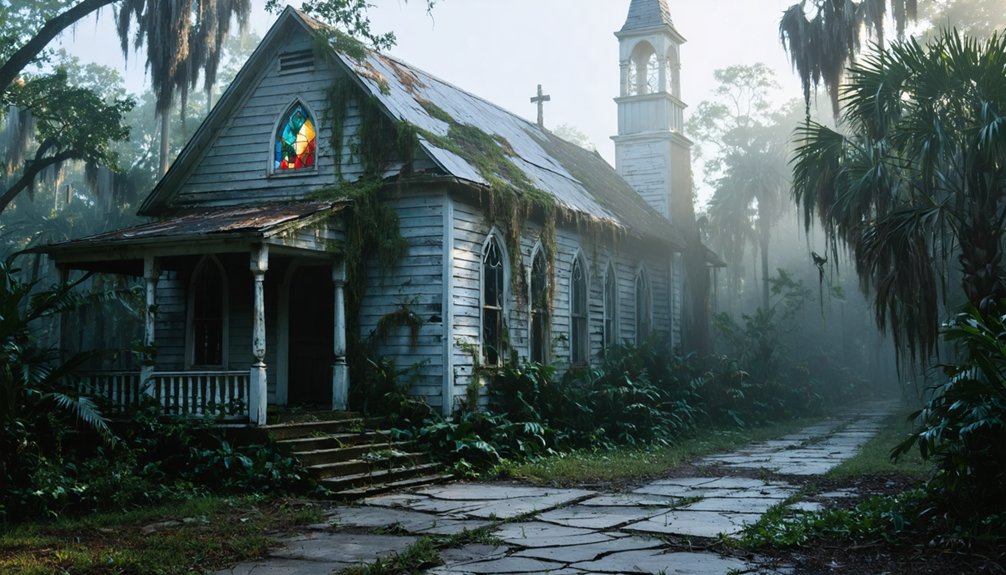
You’ll find numerous ghost towns scattered across Florida, from abandoned mining settlements to lost coastal communities. These sites include the historic Fort Mose, featuring reconstructed elements of Black history, and Indian Key’s maritime ruins. Natural disasters, economic shifts, and social conflicts have left these places frozen in time, with crumbling foundations and overgrown structures telling their unique stories. Florida’s ghost towns offer fascinating windows into the state’s complex past, waiting to be discovered.
Key Takeaways
- Florida has numerous ghost towns, including notable sites like Archer, Indian Key, Fort Mose, St. Joseph, and Hampton Springs.
- Abandoned Florida towns were often created by natural disasters, economic decline, transportation changes, and health crises like yellow fever.
- Many ghost towns originated from mining operations, particularly phosphate mining booms and busts throughout Florida’s history.
- The Great Freeze of 1894-95 led to the abandonment of several citrus-dependent communities across Florida.
- Historic preservation efforts protect these sites, though Florida’s humid climate and aggressive vegetation threaten their survival.
What Makes Florida Ghost Towns Unique
How do Florida’s ghost towns differ from their western counterparts? Unlike the arid desert towns of the American West, Florida’s abandoned settlements face unique environmental challenges that accelerate their decay.
Florida’s ghost towns vanish faster than their Western cousins, devoured by the state’s relentless humidity, storms and encroaching wilderness.
You’ll find these sites battling aggressive subtropical vegetation, devastating hurricanes, and persistent flooding that can swallow entire communities. The state’s limestone foundation, prone to sinkholes, has literally swallowed buildings whole.
Florida’s ghost towns also reflect diverse cultural influences, from Spanish colonists to African American settlements and maritime communities. Natural disasters severely impacted many thriving settlements, forcing residents to abandon their homes permanently. Towns like Archer experienced dramatic decline after their phosphate resources were depleted, leaving behind only memories of their industrial heritage.
You’ll discover remnants of citrus boom towns, lumber camps, and phosphate mining operations – each telling a distinct story of boom-and-bust cycles unique to Florida’s economy.
Many sites lie hidden beneath dense vegetation or have been incorporated into protected conservation areas, preserving their secrets for careful explorers.
Historical Events That Created Florida’s Ghost Towns
While many ghost towns across America emerged from mining busts, Florida’s abandoned settlements trace their origins to a complex web of natural disasters, economic upheavals, and social conflicts.
You’ll find that hurricane impacts repeatedly devastated coastal communities, like the 1844 storm that sealed St. Joseph’s fate.
Mining booms and subsequent busts, particularly in phosphate operations, left numerous settlements deserted when resources ran dry. Lumber and phosphate extraction industries created boomtowns that were later abandoned when the natural resources were depleted.
Transportation changes proved equally devastating, as railroad reroutings and interstate construction bypassed once-thriving towns. The town of Pine Level declined rapidly after the railroad bypassed the settlement completely.
Social conflicts, most infamously the 1923 Rosewood massacre, violently erased entire communities from the map.
Health crises, especially yellow fever outbreaks, depopulated settlements throughout the 19th century, while the catastrophic Big Freeze of 1894-1895 destroyed citrus-dependent economies, forcing residents to abandon their homes permanently.
Military Outposts Turned Ghost Towns
Florida’s abandoned military installations stand as some of the state’s most intriguing ghost towns, with four distinct categories defining their historical evolution.
You’ll find coastal defense complexes like Fort Dade on Egmont Key, where crumbling barracks and gun emplacements tell tales of Spanish-American War military history.
The massive Fort Jefferson in the Dry Tortugas exists as a remote fortress turned national park, accessible only by boat or seaplane.
World War II and Cold War-era naval stations, including Green Cove Springs and Cecil Field, now showcase decaying hangars and overgrown facilities.
Throughout South Florida, you’ll discover abandoned Nike missile sites and civil-defense bunkers – silent sentinels of Cold War strategy.
The former military housing community of Yukon Naval Station closed in 1963 due to safety concerns, with its 300 homes now replaced by parkland.
These deteriorating structures, from coastal defense fortifications to underground bunkers, offer glimpses into Florida’s strategic military past. Preservation efforts help maintain these historical structures for future generations to explore.
Citrus Industry Abandonment and Lost Communities
During the devastating Great Freeze of 1894-95, plummeting temperatures destroyed countless citrus groves across northern Florida, triggering the abandonment of numerous farming communities.
You’ll find the remnants of these lost settlements scattered throughout Marion County, where towns like Welshton, with its once-proud 40-room hotel, and Stanton, a thriving lumber and citrus producer, simply vanished.
In Citrus County, Orleans and Etna fell into decline as freezes wiped out crops and influenza epidemics struck their populations. Bank failures during the Panic of 1893 further devastated these struggling communities.
The industry’s decline accelerated in modern times as citrus greening disease devastated orange groves statewide.
Even Citra, which initially survived the 1890s freezes, couldn’t withstand the brutal freezes of the 1980s.
These abandoned settlements stand as silent testimony to nature’s power, marking the end of Florida’s northern citrus belt that once produced five million boxes annually.
Notable Ghost Towns Worth Exploring
Several fascinating ghost towns across Florida offer compelling windows into the state’s dynamic past.
You’ll find prime opportunities for ghost town photography at Archer, where industrial ruins and 19th-century churches stand as evidence to its railroad heritage.
For urban exploration enthusiasts, Indian Key’s visible foundations and cisterns provide an intimate look at maritime trading life, while Fort Mose presents a groundbreaking chapter in Black history through its reconstructed elements.
The eroded remains of St. Joseph, once Florida’s territorial capital, tell a dramatic tale of yellow fever and hurricane destruction.
Each site reveals distinct aspects of Florida’s history, from Spanish colonial settlements to company towns, offering you authentic glimpses into the state’s abandoned past. The historic Hampton Springs Hotel site in Taylor County showcases the ruins of a once-luxurious resort that featured a casino and golf course before burning down in 1954.
The remnants of Osceola demonstrate how an entire town was dismantled piece by piece when the company relocated in 1940.
Hidden Coastal Ghost Towns
Along Florida’s shifting coastlines, a network of lost settlements tells tales of nature’s fury and human perseverance.
These vanished communities once thrived as centers of historical trade before succumbing to coastal erosion and devastating natural disasters.
Time and nature’s destructive forces swept away Florida’s forgotten coastal towns, erasing their once-prosperous trading legacies from the map.
- St. Joseph, a bustling port town and former state capital, disappeared beneath shifting sandbars after yellow fever and an 1844 hurricane ravaged its prosperity.
- Indian Key’s strategic trading post fell victim to a violent Seminole attack in 1840, with subsequent hurricanes erasing its remaining traces.
- Eldora’s citrus empire crumbled under the Great Freeze of 1895, leaving only preserved ruins amid today’s manatee sanctuary.
- Lucerne’s ambitious development scheme near Lake Worth failed as flooding submerged its western sections, forcing settlers to abandon their dreams of coastal prosperity.
Preserving Florida’s Abandoned Places
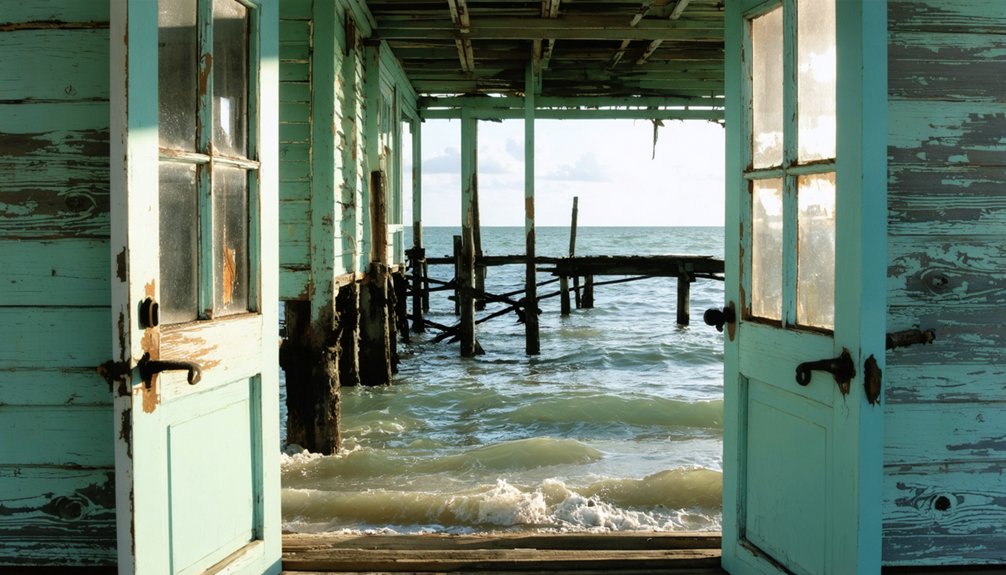
Florida’s heritage site protection methods encompass a thorough framework through the Division of Historical Resources, where you’ll find detailed guidelines for preserving abandoned places and documenting cultural resources through the Florida Master Site File.
The state’s digital documentation efforts include aerial mapping analysis and architectural surveys that help you trace the footprints of former settlements and catalog remaining structures.
You can participate in community preservation programs through the Certified Local Government initiative, which connects federal, state, and local preservation efforts while providing technical assistance for historic rehabilitation projects.
Heritage Site Protection Methods
Preserving abandoned places requires a multi-faceted approach that combines legal protections, physical stabilization, and community engagement strategies.
Heritage site preservation techniques in Florida encompass both structural and archaeological considerations, ensuring these historical treasures remain intact for future generations.
Key protection methods include:
- Securing National Register status and state-level recognition to access essential preservation grants and tax incentives
- Implementing emergency stabilization measures like structural shoring and vegetation management to prevent further decay
- Conducting systematic archaeological surveys to document and protect cultural resources through in-situ conservation
- Developing adaptive reuse programs and community partnerships to generate sustainable maintenance funding
These thorough methods not only safeguard Florida’s abandoned places but also empower local communities to take an active role in protecting their historical legacy.
Digital Documentation Efforts
Modern digital documentation technologies have revolutionized how we record and share Florida’s ghost towns for future generations. Through extensive digital archives, you’ll find centralized collections of maps, deeds, photographs, and oral histories from abandoned settlements across the state.
Interactive maps now guide you to over 20 ghost town sites in Bay County alone, complete with geolocated histories and image galleries.
You can explore virtual reconstructions created through drone photogrammetry and 3D modeling, offering detailed views of surviving structures without physically visiting them.
Through crowdsourced documentation campaigns, you’re able to contribute your own photos and family records, while volunteer networks help validate and georeference these submissions.
This collaborative approach guarantees that Florida’s vanishing historical sites are thoroughly documented and preserved in accessible digital formats.
Community Preservation Programs
Robust state and local programs form the backbone of ghost town preservation efforts across the Sunshine State.
Through strategic preservation funding and community engagement initiatives, you’ll find extensive support systems protecting Florida’s abandoned places.
The state’s Historic Preservation Grants Program offers essential resources through:
- Special Category Grants supporting major archaeological research and museum exhibits
- Small Matching Grants enabling local preservation projects
- Targeted funding for abandoned African-American cemeteries
- Integration with the Florida Master Site File inventory system
You’ll discover additional preservation opportunities through the Certified Local Government program, which creates powerful partnerships between federal, state, and local entities.
Organizations like the Historic Ocala Preservation Society and Deering Estate Foundation demonstrate how community-driven initiatives can successfully protect historical treasures while fostering public education and involvement.
Planning Your Ghost Town Visit
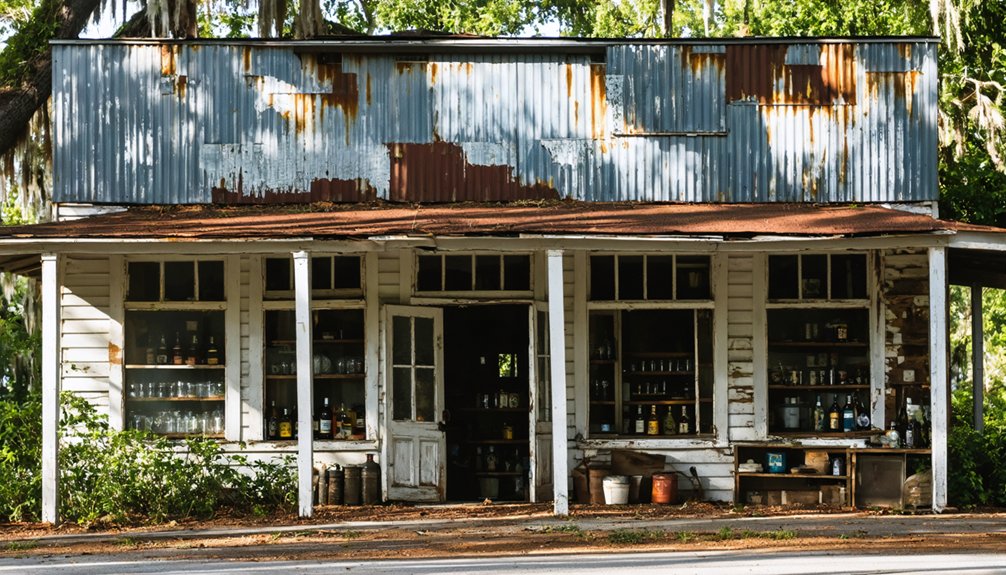
When exploring Florida’s ghost towns, you’ll need to prioritize safety by wearing sturdy shoes, staying on marked paths, and carrying essential supplies like water and insect repellent.
You should time your visits strategically, with winter months offering relief from mosquitoes at Eldora, spring conditions ideal for Ellaville’s river access, and early morning hours best for reaching Indian Key’s calm waters.
Your exploration gear must include protective items like flashlights and waterproof bags for structural areas, plus historical guides and binoculars to enhance your understanding of these abandoned settlements.
Safety First When Exploring
Before venturing into Florida’s ghost towns, thorough preparation and awareness of safety protocols are essential for a secure exploration experience.
You’ll need appropriate safety gear, including sturdy boots, long clothing, and insect repellent, particularly when traversing overgrown sites like Fort Mose or Indian Key.
- Always obtain proper permissions and verify land ownership through county records to avoid legal issues when exploring private properties.
- Stay alert for wildlife encounters, including alligators, bears, and feral hogs, especially during dawn and dusk hours.
- Travel with a companion and maintain communication plans, including offline maps for areas with poor cell service.
- Carry emergency supplies such as first-aid kits, bear spray, and extra water while exploring remote locations like Ellaville or Kerr City.
Best Visiting Times
Choosing the right time to visit Florida’s ghost towns can dramatically enhance your exploration experience and help you avoid potential setbacks.
For ideal seasonal weather conditions, plan your coastal ghost town visits between December and May, when dry conditions and mild temperatures of 60-80°F prevail. You’ll find Fort Dade and other Tampa Bay sites most accessible during this window, with reliable ferry service and calm seas.
For effective crowd management, schedule your explorations Tuesday through Thursday, particularly during shoulder months like February and October when visitor numbers drop by 50%.
Start your days between 7-10 AM to beat both the heat and tour groups. Avoid major holidays and summer weekends, when boat traffic and tourism peak at popular destinations like Egmont Key and Indian Key.
Essential Ghost Town Gear
Proper gear selection stands as the cornerstone of safe and successful ghost town exploration in Florida. The state’s unique climate and abandoned structures demand specialized ghost town essentials that’ll protect you while preserving historical sites. Your exploration safety depends on carrying the right equipment for Florida’s challenging conditions.
- Wear moisture-wicking PPE including N95 masks, cut-resistant gloves, and ankle-supporting boots to guard against hazards like mold, rusty metal, and unstable floors.
- Pack high-lumen flashlights and headlamps with spare batteries – Florida’s dense vegetation often creates dark interiors.
- Carry offline maps and emergency communication devices since cell service is unreliable in remote locations.
- Bring documentation tools like all-weather notebooks and cameras to record discoveries without disturbing artifacts, plus an extensive first-aid kit for emergencies.
Frequently Asked Questions
Are There Any Haunted Ghost Towns in Florida?
You’ll find haunted history at Indian Key, where ghostly legends tell of pirates and Seminole attacks, while Yukon’s bittersweet memories and Ruby’s tragic flood victims still echo through Florida’s abandoned towns.
Can You Legally Collect Artifacts From Florida Ghost Towns?
Finders aren’t keepers in Florida! You can’t legally collect artifacts from ghost towns without permits, as state law 267.061 strictly protects artifact preservation through legal regulations. Violations carry hefty fines and imprisonment.
Which Florida Ghost Towns Are Accessible Only by Boat?
You’ll need a boat to access these hidden gems: Egmont Key at Tampa Bay’s mouth, Crandall along Nassau County’s waterways, Stiltsville off Miami’s coast, and Columbus near Suwannee River’s junction.
Do Any Florida Ghost Towns Still Have Year-Round Residents?
You’ll find current residents in Center Hill and Romeo, where people still live year-round despite their ghost town history. Most inhabitants stay on surrounding properties rather than within original historic boundaries.
What Survival Gear Is Needed When Exploring Florida Ghost Towns?
Pack your survival essentials: GPS, water, first-aid kit, protective gear (boots, gloves, N95 mask), insect repellent, flashlight, emergency beacon, and detailed maps for traversing Florida’s challenging ghost town terrain.
References
- https://www.ghosttowns.com/states/fl/fl.html
- https://www.atlasobscura.com/things-to-do/florida/ghost-towns
- https://patchproflorida.com/blog/the-fascinating-history-of-floridas-ghost-towns/
- https://www.youtube.com/watch?v=bNjqcQ5SMwg
- https://floridatrailblazer.com/tag/ghost-towns/
- https://www.freakyfoottours.com/us/florida/
- https://fdc.com/blog/ghost-towns-in-florida/
- https://www.worldatlas.com/travel-stories/north-florida-s-infamous-ghost-town.html
- https://floridatraveler.org/2017/04/25/floridas-unique-ghost-towns-are-not-invisible/
- https://jennmoslekwordpress.wordpress.com/2018/05/16/ghost-towns-of-florida-wont-you-take-me-to-zombie-town/