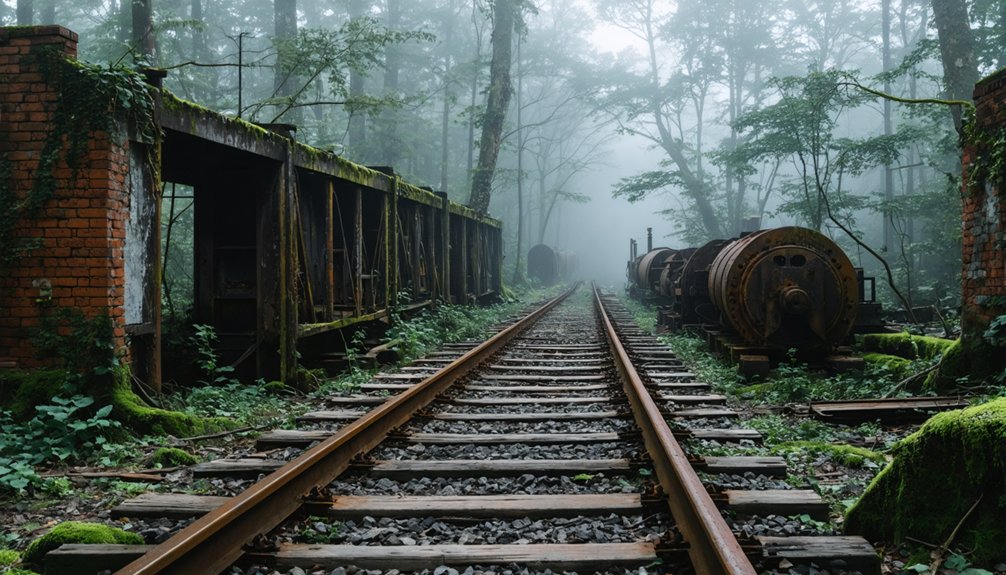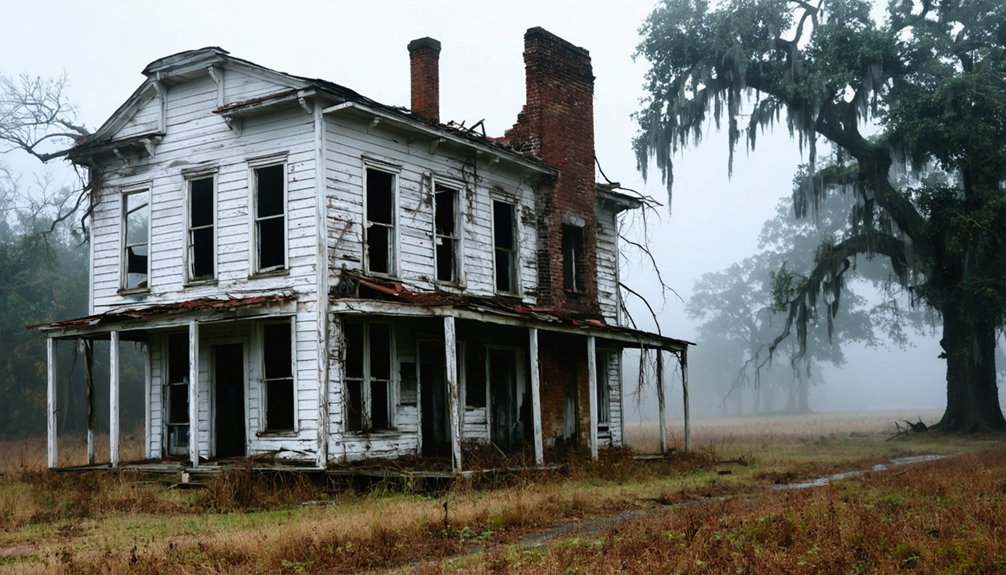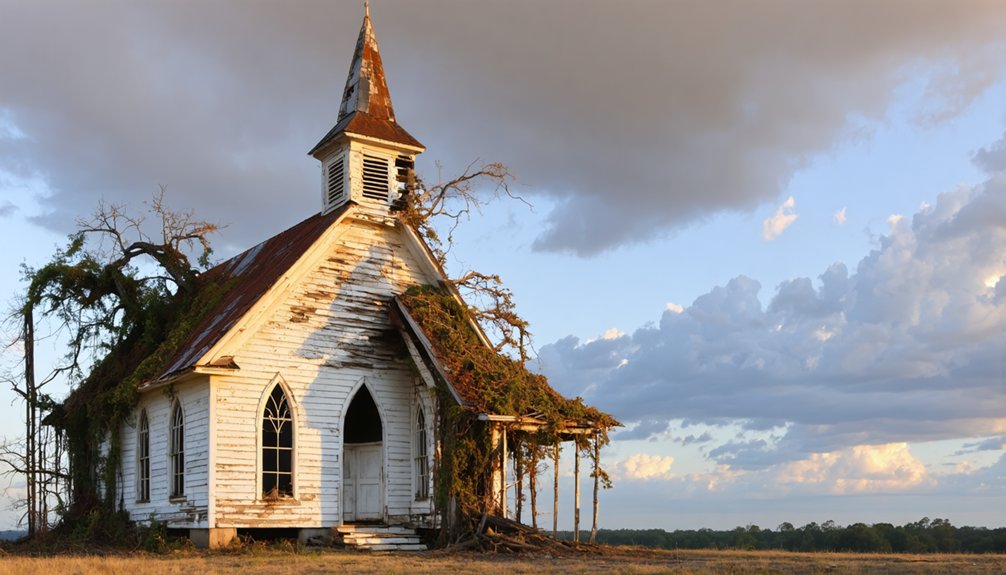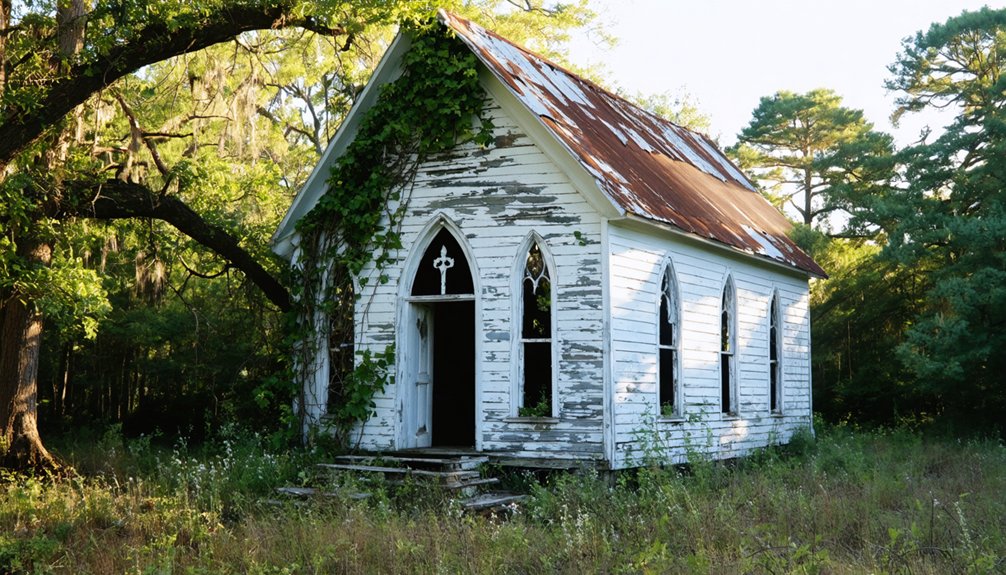
You’ll find numerous ghost towns scattered across Georgia, each telling a unique story of abandonment. Notable sites include Auraria, a former gold rush boomtown that once rivaled Dahlonega, and Scull Shoals, an industrial village destroyed by an 1887 flood. From coastal settlements like Sunbury to mining communities in the northern regions, these abandoned places preserve evidence of failed industries, natural disasters, and economic shifts. Georgia’s ghost towns offer fascinating glimpses into the state’s complex past.
Key Takeaways
- Georgia has numerous ghost towns including prominent sites like Auraria, Skull Shoals, and Wrightsboro, which are now historic landmarks.
- Auraria was a major gold rush town that rivaled Dahlonega before declining after losing its county courthouse status.
- Scull Shoals, an industrial village, was abandoned after a devastating flood in 1887 destroyed its economy and infrastructure.
- High Falls became deserted in the 1880s when the railroad bypassed the town, leading to its eventual abandonment.
- Many of Georgia’s ghost towns are preserved as state parks or historic sites, offering visitors glimpses into the state’s past.
Ghost Towns: A Hidden Part of Georgia’s Past
Deep within Georgia’s landscape lie the remnants of once-thriving communities that time has largely forgotten.
You’ll find these haunted history sites scattered across the state, from Skull Shoals’ ancient Native American settlements to Auraria’s gold rush ruins. These forgotten landmarks tell stories of bold dreams and harsh realities that shaped Georgia’s development.
Each ghost town reveals a unique chapter of Georgia’s past: Wrightsboro’s ambitious Quaker settlement in McDuffie County, High Falls’ industrial center that died when the railroad passed it by, and New Ebenezer’s failed utopian vision.
These abandoned places preserve tales of Native American societies decimated by disease, frontier industries that couldn’t survive changing times, and communities that simply faded away. The devastating impact of the boll weevil crisis forced many farming communities to abandon their cotton-based economies.
Today, many serve as state parks or historic sites, offering glimpses into Georgia’s complex heritage. White Sulphur Springs stands as a stark reminder of the South’s elite social scene, where its magical healing waters once drew wealthy visitors seeking therapeutic cures.
Understanding What Makes a Ghost Town
Not every abandoned settlement qualifies as a true ghost town, despite popular misconceptions. To meet ghost town characteristics, a location must have lost its original purpose for existing, such as when a mining town’s resources are depleted or when transportation routes bypass a once-thriving community.
You’ll recognize these sites by their visible remains – deteriorating buildings, old foundations, and abandoned infrastructure. These settlements were once flourishing communities that drew residents seeking economic opportunities.
The abandonment criteria include more than just population decline. You’ll need to look for the absence of active businesses and civic functions like schools or post offices. Public access must be available for a site to be officially classified as a ghost town.
Physical evidence matters too – you might find structural decay, cultural artifacts, and altered landscapes. These places can be completely deserted or maintain a minimal seasonal population, but they must show clear signs of their former significance and subsequent decline.
Common Reasons Georgia Towns Were Abandoned
Throughout Georgia’s history, numerous towns faced abandonment due to five major forces: economic shifts, infrastructure changes, natural disasters, resource depletion, and social factors. The economic decline began when textile mills shuttered and the cotton economy collapsed due to boll weevil infestations. Railroad closures and infrastructure bypass accelerated many towns’ demise, particularly evident in places like Boneville and Wrightsboro. The decline of manganese mining in Chiatura transformed this once-prosperous industrial hub into a ghost town after the Soviet Union’s dissolution. Depleted natural resources often meant these communities had no economic reason to exist.
- Natural disasters devastated communities, with floods submerging entire settlements and earthquakes destroying hundreds of villages.
- Resource exhaustion, especially in mining towns, led to swift abandonments when gold deposits ran dry.
- Social upheaval, including massacres of Native villages and corrupt local governance, forced relocations and hastened community collapse.
These combined pressures transformed once-thriving communities into abandoned remnants of Georgia’s past.
Famous Ghost Towns Across Georgia
You’ll find fascinating remnants of Georgia’s gold rush era in Auraria, where abandoned mining structures stand as evidence to the 1830s population boom that once drew thousands of prospectors.
Along the coast, New Ebenezer’s preserved church and cemetery mark the site of an ambitious Salzburger settlement that succumbed to harsh conditions and disease by the 1850s.
In Middle Georgia, the once-thriving city of High Falls became deserted in the 1880s when the railroad bypassed the town entirely.
These historically significant locations offer tangible connections to Georgia’s past, with Auraria’s mining ruins and New Ebenezer’s architectural remains providing valuable insights into the state’s early development patterns.
Modern preservation initiatives through Historic Preservation Division help protect these irreplaceable landmarks from further deterioration.
Historical Gold Rush Sites
Georgia’s gold rush era spawned several notable ghost towns that stand as evidence to the state’s mineral-rich past.
You’ll find rich ghost town legends throughout the region, particularly in places like Auraria, which began as Nuckollsville before losing its prominence to nearby Dahlonega. The state’s mining heritage lives on in these abandoned settlements. During its peak, Auraria boasted eighteen to twenty stores and numerous businesses serving the mining community. Today, scattered foundations are all that remain as nature has reclaimed most of the town.
Three significant gold rush sites that became ghost towns:
- Auraria – Once rivaled Dahlonega but declined after losing the county courthouse in 1833
- Allatoona – Thrived in the 1840s before being submerged under Lake Allatoona
- Shackelton – Sustained mining operations through the early 1900s until resources depleted
These sites tell the story of Georgia’s first major gold rush, which drew up to 15,000 miners at its peak and influenced later rushes across America.
Coastal Settlement Remains
Along Georgia’s windswept coast, a series of abandoned settlements reveal the state’s maritime colonial heritage.
You’ll find Old and New Ebenezer, two once-thriving Salzburger Protestant communities that showcase the historical significance of early European settlement. The Old Ebenezer site, established in 1736, has returned to nature, while New Ebenezer’s remnants tell tales of initial prosperity followed by decline.
Further south, Belle Vista in Glynn County stands as a proof of coastal preservation challenges, having reverted to empty fields.
On Jekyll Island, you’ll discover the ruins of a 1970s amphitheater and the abandoned Torrey-West House, both reclaimed by nature.
These coastal ghost towns offer glimpses into Georgia’s past, from colonial religious settlements to more recent recreational developments, each marking different chapters in the state’s coastal history.
Exploring the Ruins of Scull Shoals
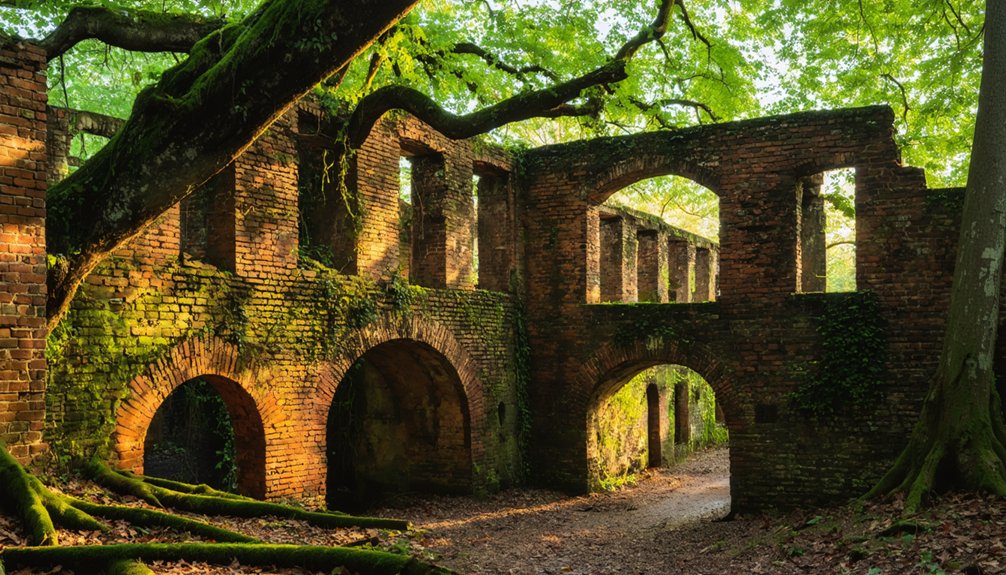
You’ll discover the haunting remains of Scull Shoals’ once-bustling industrial village, including crumbling brick mill structures now engulfed by vegetation along the Oconee River.
The site’s development peaked with a four-story textile mill employing 500 workers, multiple gristmills, and a vibrant company town that supported 600 residents.
The devastating flood of 1887 dealt the final blow to this frontier settlement, leaving the mill buildings waterlogged for days and ultimately leading to the town’s complete abandonment.
Mill Ruins Still Standing
Standing as a proof of Georgia’s industrial heritage, the ruins of Scull Shoals feature a four-story brick mill foundation with partial walls from its mid-19th-century textile and paper operations.
You’ll find impressive remnants of the warehouse and company store in brick masonry, along with surviving dam features and millrace traces that showcase the site’s industrial might.
The mill’s rich history is evident in these remaining structures:
- Stone footings and chimneys marking former boarding houses and workshops
- Archaeological surface features including collapsed timber framing and industrial debris
- Water-control features with stone dam alignments upstream
Today, you can explore these industrial ruins within the Oconee National Forest, where woodland regrowth has stabilized the eroded slopes around these historic structures, preserving Georgia’s significant mill history for future generations.
Floods Shaped Town’s Fate
While Scull Shoals had endured numerous hardships since its founding, the catastrophic flood of 1887 delivered the final blow to this once-thriving mill town. The flood’s impacts were devastating – water stood in buildings for four days, destroying hundreds of cotton bales and 600 bushels of wheat. The covered toll bridge was swept away, leading to immediate economic decline.
You’ll find it remarkable that a town of 600 residents emptied so quickly after this disaster. The flood marked the culmination of decades of challenges, including Creek Indian raids, droughts, and the Civil War’s aftermath.
Despite multiple attempts to revive operations, including a brief period as a convict labor camp, Scull Shoals never recovered. Today, you can explore the ruins within the Oconee National Forest, where they stand as silent witnesses to nature’s destructive power.
Gold Rush Legacy: The Story of Auraria
As Georgia’s first major gold rush unfolded in 1832, the bustling town of Auraria emerged from what was previously known as Deans and Nuckollsville.
You’ll find this fascinating piece of Auraria history centered around the promise of riches, drawing thousands of prospectors to Cherokee lands. The town’s economy thrived on gold mining, with a population that swelled into the thousands during its peak years.
Key factors that shaped Auraria’s destiny:
- Placer mining methods quickly depleted surface gold by the 1840s
- The 1849 California Gold Rush triggered mass exodus of miners westward
- Losing the U.S. Mint location bid to nearby Dahlonega dealt a final economic blow
Today, you can visit this historic ghost town, where remnants along Gold Diggers’ Road tell tales of America’s first major gold rush community.
Coastal Ghost Towns and Lost Settlements
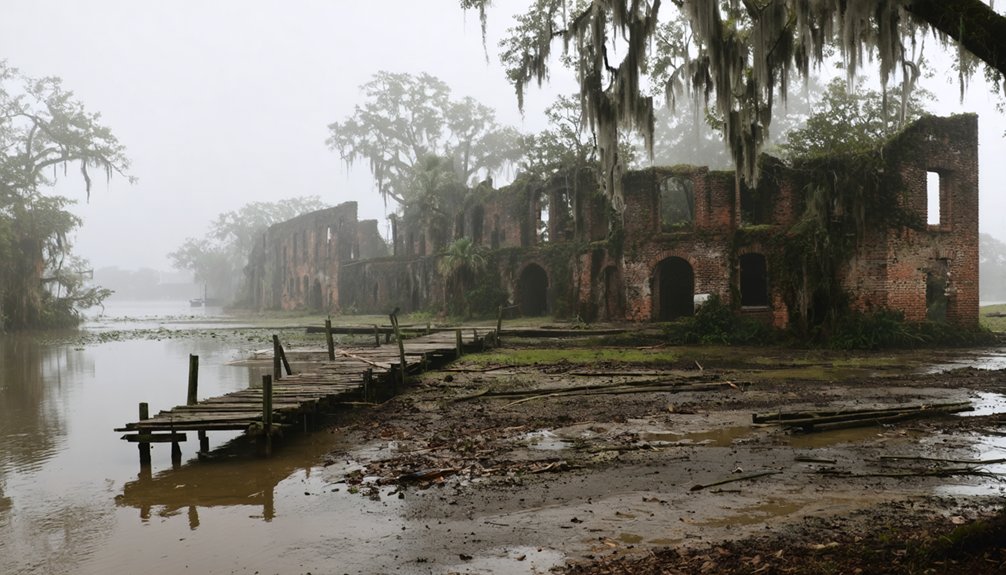
Georgia’s coastal landscape holds stories of forgotten settlements and abandoned ports that paint a rich historical tapestry.
You’ll find coastal ruins like Sunbury, once a thriving 18th-century port on the Medway River, now marked only by archaeological remains after yellow fever and Revolutionary War damage led to its decline.
Fort Frederica’s abandoned military town on St. Simons Island and Abercorn near Savannah stand as evidence of shifting colonial fortunes.
The ruins of Fort Frederica and Abercorn echo with stories of colonial ambitions that rose and fell along Georgia’s coast.
Along barrier islands and marshlands, you’ll discover traces of lost communities at Sapelo, where shoreline changes and storms forced relocations.
These abandoned settlements include saltworks, plantation outposts, and ferry crossings that vanished as transportation routes evolved.
Disease outbreaks, economic shifts, and the rise of major ports like Savannah and Brunswick sealed the fate of these once-vibrant coastal communities.
Preserved Structures and Historical Markers
Throughout the state’s ghost towns, carefully preserved structures and historical markers offer tangible connections to vanished communities.
You’ll find preserved churches like Jerusalem Lutheran in Ebenezer, dating back to 1734, still standing with its original congregation. Standing houses showcase architectural diversity, from Greek Revival homes with Corinthian capitals to board-and-batten tenant cottages near former naval stores.
Notable preserved structures include:
- Chappell Mill’s 1830s two-story wooden grist mill with original grinding stones
- Ebenezer cemetery’s weathered gravestones bearing German Salzburger inscriptions
- The Torrey-West House, an abandoned yet intact historical residence
The Georgia Historic Preservation Division continues protecting these sites, though some face ongoing challenges.
In Forsyth County, 18 deteriorating structures were removed in 2015, highlighting the delicate balance between preservation and public safety.
Planning Your Ghost Town Adventure
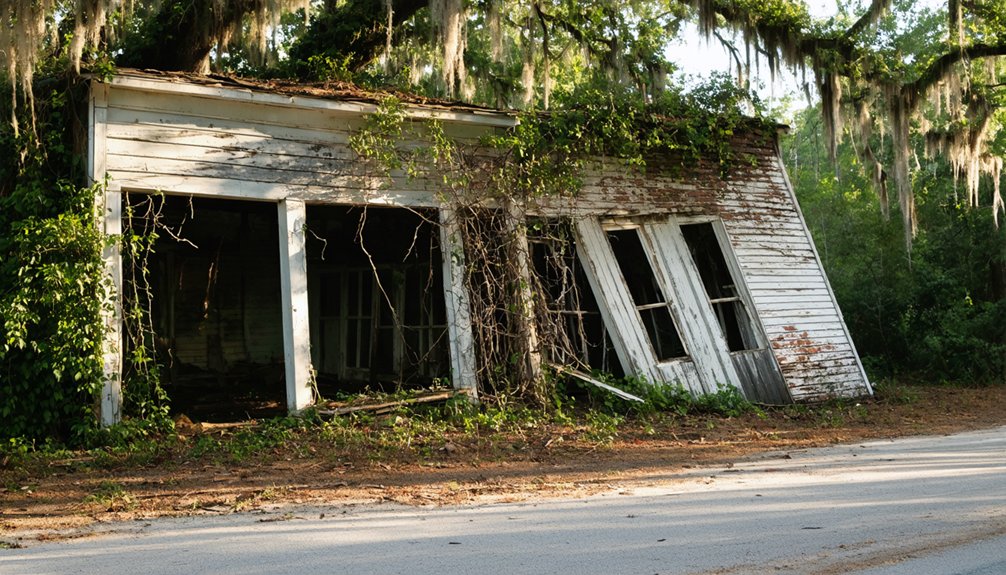
While preserved structures offer windows into Georgia’s past, visiting these abandoned settlements requires careful planning and preparation. Before exploring ghost towns like Mallory or Troupville, you’ll need to assess ghost town logistics including road access, seasonal conditions, and parking availability.
Many sites require maneuvering unpaved backroads, and you’ll want offline maps since cell coverage can be unreliable in remote areas.
Essential safety precautions include checking weather forecasts to avoid flooding at river-adjacent ruins, wearing appropriate clothing for wildlife encounters, and staying clear of unstable structures.
You’ll also need to verify land ownership and secure necessary permissions to avoid trespassing. Research historical markers, county plat maps, and local historical societies to pinpoint exact locations and understand access restrictions before your journey.
Tips for Responsible Ghost Town Exploration
To guarantee the long-term preservation of these historic sites, responsible ghost town exploration demands strict adherence to established guidelines and best practices.
When visiting Georgia’s abandoned settlements, you’ll need to prioritize both safety precautions and cultural respect while maintaining the site’s historical integrity.
- Always wear protective gear including sturdy boots, gloves, and dust masks to guard against hazards like unstable structures and toxic materials.
- Research and obtain necessary permits before exploring, and never remove artifacts or disturb structures, as this violates federal and state laws.
- Practice Leave No Trace principles and respect local cultural sensitivities by staying on designated paths and avoiding sacred or culturally significant areas.
Remember to travel with a companion, inform others of your plans, and carry essential recovery equipment for emergencies.
Frequently Asked Questions
Are There Any Haunted Ghost Towns in Georgia?
You’ll find several ghost towns in Georgia with haunted history, including Scull Shoals and Apalachee, where locals report ghostly encounters near abandoned mills, cemeteries, and ruins after dark.
Many people are drawn to these historic ghost towns in Georgia, eager to explore the remnants of the past and uncover their mysteries. Guided tours often highlight the eerie tales associated with these sites, making for an unforgettable experience. Whether you’re a history buff or simply seeking a thrill, these abandoned locations offer a glimpse into a bygone era that continues to haunt the present.
Can I Legally Take Artifacts From Georgia Ghost Town Sites?
Like a guardian shields ancient treasures, artifact regulations protect ghost town sites. You’ll need proper permits and landowner permission to legally collect items under historical preservation laws in Georgia.
Which Georgia Ghost Towns Are Accessible Without Special Permission?
You can freely explore Scull Shoals’ ruins and Auraria’s historic sites via public trails, while Troupville and smaller ghost towns are accessible from public roads. Stay on marked paths for responsible exploration.
Do Any Georgia Ghost Towns Still Have Permanent Residents?
You’ll find scattered residents in several Georgia ghost towns, where local legends persist alongside historic preservation efforts. Places like Scull Shoals and New Ebenezer maintain small permanent populations despite their ghost town status.
Exploring the historic ghost towns in Georgia offers a unique glimpse into the past, with crumbling buildings and fading stories that captivate visitors. Many of these towns serve as reminders of the once-thriving communities that faced economic decline or natural disasters. As you wander through the abandoned streets, you can almost hear the whispers of history echoing in the quiet spaces.
What Survival Gear Should I Pack for Ghost Town Exploration?
Pack survival essentials like GPS, first-aid kit, sturdy boots, gloves, N95 mask, hard hat, flashlights, multi-tool, water, emergency radio, and high-vis vest for safe ghost town exploration.
References
- https://roughdraftatlanta.com/2021/05/23/travels-with-charlie-georgias-ghost-towns-slideshow/
- https://flagpole.com/news/news-features/2013/10/23/exploring-georgias-ghost-towns/
- http://www.ghosttowns.com/states/ga/ga.html
- https://www.ezhomesearch.com/blog/ghost-towns-in-georgia/
- https://www.fireflymadison.com/2022/08/31/ghost-towns-in-georgia/
- https://www.freakyfoottours.com/us/georgia/
- https://www.youtube.com/watch?v=jXOJ2NhkL1U
- https://vanishinggeorgia.com/tag/georgia-ghost-towns/
- https://sites.rootsweb.com/~gaghstwn/
- https://driftwoodchronicle.wordpress.com/2016/10/11/gone-with-the-wind-ghost-towns-of-georgia/