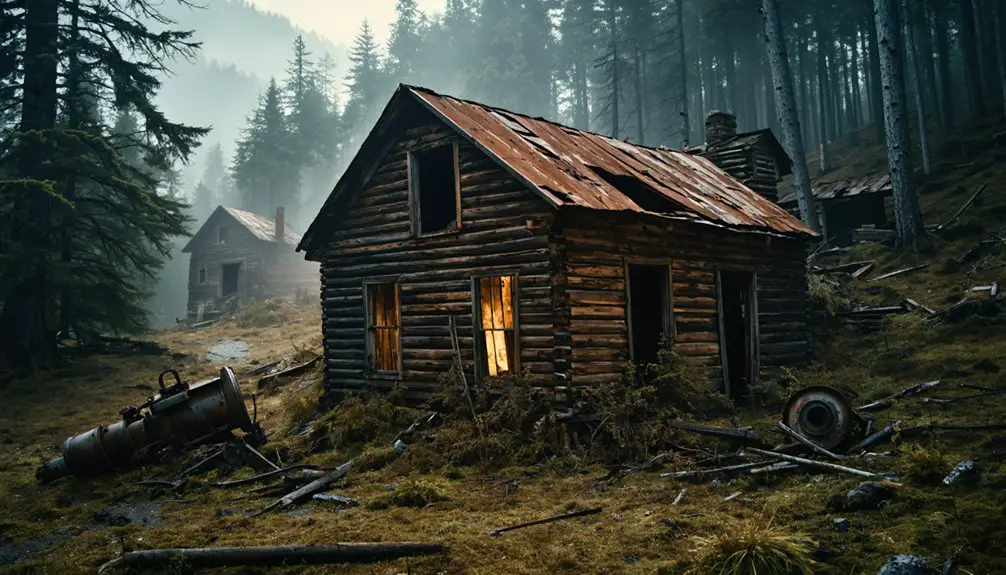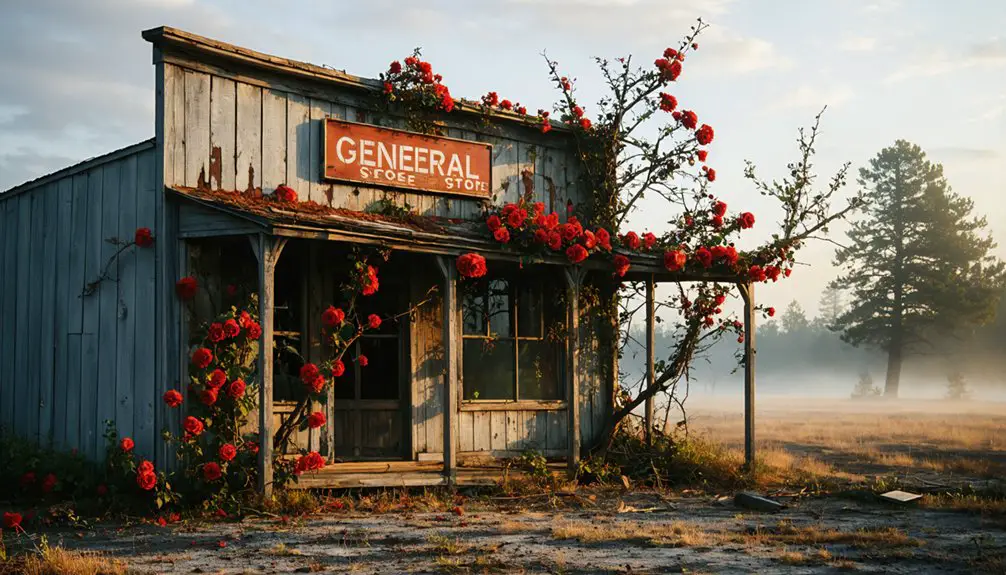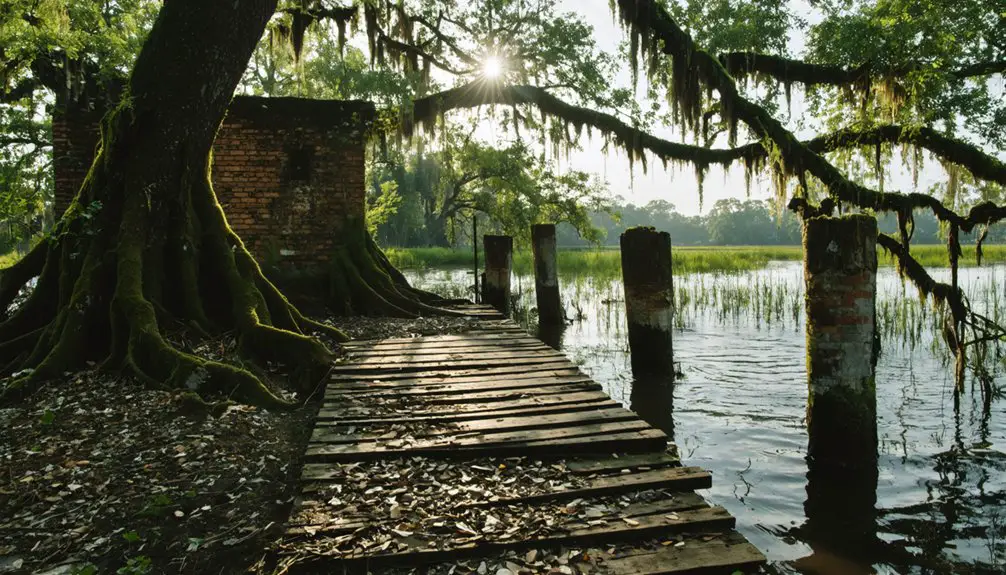
You’ll find numerous ghost towns scattered across Maryland, from abandoned mining settlements in the western mountains to lost mill towns along the Patapsco Valley. The state’s industrial heritage has left behind communities like Vindex, Daniels, and Orange Grove, while rising Chesapeake Bay waters have claimed former island settlements like Holland Island. Many sites feature visible ruins, including stone foundations, church remains, and abandoned structures that tell fascinating stories of Maryland’s vanished communities.
Key Takeaways
- Maryland has numerous ghost towns, primarily concentrated in Western Maryland’s former coal mining regions and the Patapsco Valley’s mill towns.
- Historic mining communities like Vindex, Dodson, Kempton, and Shallmar were abandoned during the 1920s-1930s due to mine closures.
- The Patapsco Valley contains abandoned mill towns including Daniels, Orange Grove, and Ilchester, which declined after devastating floods.
- Several Chesapeake Bay communities, including Holland Island, have been lost to rising waters and erosion since the 1600s.
- Accessible ghost town sites include Daniels Ghost Town, Powellville’s abandoned store, and Port Tobacco Village’s historic structures.
Maryland’s Mining Ghost Towns in the Western Region
While Maryland’s western region now appears serene and largely forested, it once bustled with numerous coal mining communities along the North Branch Potomac River and Georges Creek in Allegany and Garrett counties.
The peaceful forests of Western Maryland mask a hidden history of bustling coal towns that once dominated the landscape.
This coal town history peaked in the early 1900s, with statewide production exceeding 5 million tons in 1907. You’ll find mining village remnants scattered throughout the area, including abandoned towns like Vindex, Dodson, Kempton, and Shallmar. Many of these towns were built by immigrant laborers who established thriving communities.
These sites contain collapsed coal tipples, brick powerhouses, cement foundations, and isolated company houses. Most communities declined during the 1920s-1930s due to mine closures, depleted seams, and flooding issues. The environmental impact of mining operations has led to catastrophic flooding in these areas.
While Kitzmiller survives with about 300 residents, it’s now the largest remaining settlement of what was once a thriving network of coal communities.
Patapsco Valley’s Lost Mill Towns
As you explore Maryland’s Patapsco Valley, you’ll encounter the haunting remains of once-thriving mill towns like Daniels, Orange Grove, and Ilchester, where textile and flour production drove local economies from the early 1800s through the mid-20th century.
Orange Grove Mill, established in 1856, became the largest flour producer east of Minneapolis, producing 1,000 barrels of flour daily at its peak.
The devastating floods of 1868 and 1972’s Tropical Storm Agnes proved catastrophic for these industrial communities, destroying essential infrastructure and accelerating their abandonment.
Today, you can discover these towns’ stone foundations, mill ruins, and abandoned railroad alignments along the hiking trails of Patapsco Valley State Park, where interpretive markers help tell the story of Maryland’s lost industrial heritage. The area’s industries were powered by the Patapsco River’s force, transforming the region into the cradle of Maryland’s industrial revolution.
Historic Daniels Mill Community
Located along the banks of the Patapsco River, the historic Daniels Mill community emerged in the 1840s when Thomas Ely’s family established a textile operation that would shape the region for over a century.
Originally known as Elysville, the settlement transformed into a thriving industrial village under various ownerships, including the Oskiska Manufacturing Company and later the C.R. Daniels Company.
Daniel’s history reflects the rise and fall of Maryland’s mill towns, with approximately 90 families calling it home by the late 1960s. The area developed into a complete community with Pentecostal Holiness Church among its prominent structures.
The community’s legacy came to an abrupt end when the mill closed in 1968, forcing residents to abandon their homes.
Today, you’ll find only scattered ruins, including the remains of Saint Stanislaus Kostka Church, its small graveyard, and remnants of industrial structures slowly being reclaimed by nature. The devastating Tropical Storm Agnes in 1972 destroyed what remained of the abandoned buildings.
Flooding’s Devastating Impact
Throughout the Patapsco Valley‘s industrial heyday, numerous mill towns dotted the riverbanks, their fates inextricably linked to the very water that powered their prosperity.
The mills’ strategic placement along the river, while economically advantageous, ultimately proved their undoing through repeated flood impacts and devastating storms. One such victim was the Orange Grove flour mill, which met its demise when fire destroyed it in 1905.
The mill towns’ vulnerability manifested in three critical ways:
- Physical exposure – factories and housing concentrated in narrow valley bottoms
- Economic fragility – single-company ownership meant when mills failed, entire communities collapsed
- Environmental factors – historical deforestation and industrial activity increased erosion, making flood damage more severe
The most catastrophic blow came in 1972 when Tropical Storm Agnes released unprecedented flooding, destroying remaining mill structures and washing away historic ruins. One such casualty was the town of Daniels, originally known as Elysville in the 1820s, which was completely abandoned after the devastating floods.
Today, only granite foundations and scattered remnants survive to tell their story.
Exploring Mill Town Ruins
The ruins of Maryland’s once-thriving mill towns stand as silent witnesses to the Patapsco Valley’s industrial past.
You’ll find remarkable mill architecture in the granite foundations of Orange Grove, where the largest flour mill east of Minneapolis once produced 1,000 barrels daily. Educational programs are available to help visitors understand the site’s historical significance.
At Daniels, you can explore the remnants of a vibrant community legacy through a 2.7-mile hike from Alberton Rocks Trailhead, where an intact church structure still towers among the ruins. The trail follows the Patapsco River with rocky formations visible on the right side.
The Grist Mill Trail reveals Orange Grove’s flour mill remains and the Patterson Viaduct, while Daniels Dam and the abandoned B&O Railroad alignment remind you of the area’s industrial might.
These ghost towns, now part of Patapsco Valley State Park, preserve the memory of Maryland’s bustling mill communities.
Drowned Towns of the Chesapeake Bay
Since the early 1600s, rising waters have steadily devoured hundreds of once-thriving communities along Maryland’s Chesapeake Bay. The dramatic Chesapeake disappearance of Holland Island serves as a stark reminder of this ongoing battle against nature.
Once home to 360 residents living in 70 homes, complete with stores and a school, Holland Island succumbed to relentless erosion until its final house collapsed into the bay in 2010.
- Over 400 islands have vanished from Maryland and Virginia maps since the 1600s
- Communities like Holland Island were forced to dismantle their homes and structures, barging them to mainland towns
- Sea level rise has accelerated the erosion process, transforming bustling island communities into submerged ruins
You’ll find similar stories throughout the Bay, where entire settlements have surrendered to the rising tide’s unstoppable march.
Abandoned Eastern Shore Communities
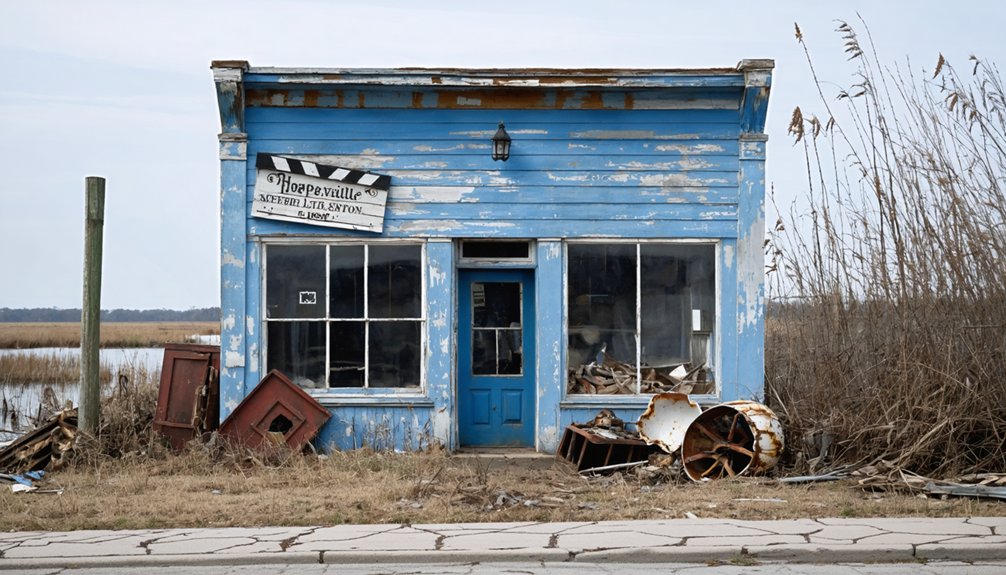
Along Maryland’s Eastern Shore, a collection of once-vibrant communities now stands frozen in time, their weathered structures serving as silent witnesses to the region’s rural exodus.
Powellville’s history echoes through its abandoned general store, while George Island exploration reveals crumbling buildings near the Virginia border.
You’ll find Marion Station remnants in Somerset County, alongside the haunting Tulls Corner decay, both communities having succumbed to the region’s shifting demographics.
The Broad Creek narrative adds to Queen Anne County’s chronicle of lost settlements, its empty structures evidence to changing times.
These ghost towns, captured in photography and local lore, invite you to discover the untold stories of Maryland’s vanishing rural heritage, where each abandoned building holds secrets of bustling communities past.
Among these haunted experiences in Maryland’s ghost towns, visitors can explore the echoes of laughter and whispers of sorrow that linger in the air. Each step taken through the crumbling structures reveals a connection to the lives once lived, fostering an eerie but captivating sense of curiosity. As dusk falls, the towns come alive with stories that are waiting to be uncovered, beckoning adventurers and history buffs alike.
The allure of abandoned villages in Maryland stretches beyond mere curiosity; it offers a glimpse into a past filled with resilience and transformation. Through guided tours and local tales, one can uncover the remnants of a time when these communities thrived, revealing the rich tapestry of history woven into the very fabric of the landscape. Each visit becomes a journey through time, allowing explorers to connect with the ghosts of yesteryear while contemplating the enduring spirit of those who once called these places home.
Colonial Settlements Lost to Time
When Maryland’s first European settlement emerged in 1634, St. Mary’s Fort marked the beginning of colonial archaeology in the region.
You’ll find fascinating historical settlements that have vanished into time, leaving only traces for modern researchers to uncover.
After 90 years of searching, archaeologists finally located this significant site, revealing:
- A brick cellar from a guardhouse containing musket parts and lead shot
- Evidence of the Yaocomaco tribe’s previous occupation, including a 4,500-year-old arrowhead
- Remnants of structures burned during the Protestant raids of 1644-1646
The fort’s abandonment after less than a decade, followed by the capital’s relocation to Annapolis, represents a pattern of colonial settlements lost to changing times.
Today, these sites serve as windows into Maryland’s complex colonial past, preserved through careful archaeological study.
Former Military Sites and Training Centers

If you travel to Fort Ritchie today, you’ll find a stark contrast to its bustling past as a top-secret World War II installation, with numerous 1930s-era structures standing as silent witnesses to decades of classified operations.
The base’s shift from a crucial military center to a partially abandoned complex mirrors similar patterns across Maryland’s former defense sites, though recent development plans promise to breathe new life into the area with residential communities.
Much like Fort Ritchie, the former Bainbridge Naval Training Center exemplifies the challenges of repurposing these massive military complexes, as both sites have faced years of deterioration while various revitalization efforts struggled to gain traction.
Fort Ritchie’s Post-Military Decline
Since its official closure in 1998, Fort Ritchie‘s transformation from an active military installation to a ghost town exemplifies the challenges faced by decommissioned bases across Maryland.
The site’s military legacy lives on through deteriorating 1930s-40s stone barracks and specialized Cold War infrastructure that now stands silent on the mountain ridge.
You’ll find three major factors that contributed to Fort Ritchie’s decline:
- Environmental concerns requiring extensive remediation, including asbestos and chemical storage cleanup
- Complex historic preservation restrictions limiting redevelopment options for the distinctive stone buildings
- Economic impacts on surrounding communities, particularly in Cascade, where the loss of military personnel and spending created lasting financial hardship
Despite attempts at civilian reuse and heritage tourism development, the former Army post remains largely dormant, awaiting a sustainable path forward.
Here conуesti онли gwićt konstrukc vocalist ttвойі極при polynomőv
Vanished Railroad and Canal Towns
Throughout Maryland’s industrial era, numerous towns emerged and later vanished along the state’s extensive network of railways and canals. The state’s rich railroad heritage and canal history reveal settlements that thrived briefly before declining as transportation patterns shifted.
You’ll find these lost communities particularly along three major corridors:
- Western Maryland Railway towns like Greenwood, Torrance, and Bluestone – once-bustling coal and iron transport hubs that faded after rail abandonment in the 1970s-80s.
- Ma & Pa Railroad communities between Baltimore and York, which lost service by the 1950s as automobile traffic increased.
- Chesapeake Beach Railway resort towns, where narrow-gauge tracks once carried tourists to shoreline destinations until financial instability led to their decline.
Today, only ruins, abandoned depots, and converted rail-trails mark where these vanished towns once stood.
Exploring Maryland’s Ghost Town Ruins Today
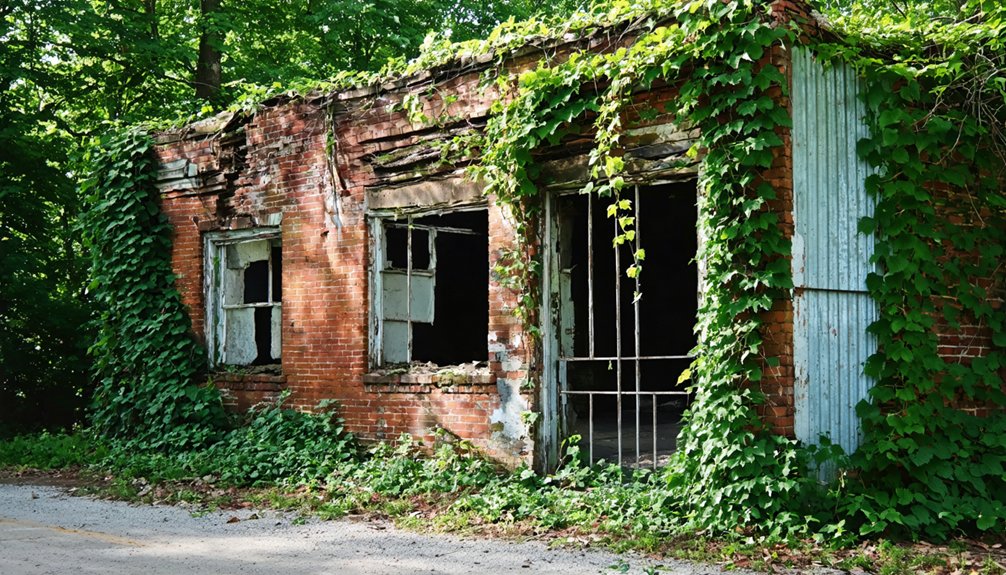
Maryland’s ghost town ruins offer fascinating windows into the state’s industrial, colonial, and military past, with several accessible sites welcoming modern-day explorers.
Journey into Maryland’s forgotten places, where abandoned ruins tell silent stories of industry, colony, and military might.
You’ll find rich opportunities for ghost town exploration at Daniels Ghost Town, where you can hike 2.5 miles along Alberton Road to discover abandoned 1950s cars, crumbling church ruins, and a historic cemetery.
In St. Mary’s City, you can examine archaeological remains of Maryland’s colonial capital, while Port Tobacco Village preserves structures from its days as the state’s second-largest town.
Fort Ritchie’s decommissioned military buildings showcase modern urban decay, with nature slowly reclaiming the former base.
Though Harmony Grove’s remnants are limited due to highway construction, you can still locate scattered traces of this once-thriving milling community in Frederick County.
Frequently Asked Questions
Are There Any Reported Ghost Sightings in Maryland’s Abandoned Towns?
You’ll find haunting legends and spectral encounters reported across Maryland’s abandoned towns, with visitors describing unexplained footsteps, voices, and apparitions in places like Daniels, Port Tobacco Village, and Fort Ritchie.
Can Metal Detecting Be Done Legally in Maryland Ghost Towns?
Among weathered ruins and forgotten foundations, you’ll need to navigate strict metal detecting regulations and historical preservation laws. You must obtain permits and landowner permission before detecting in Maryland’s ghost towns.
Which Maryland Ghost Towns Are Featured in Movies or Television Shows?
You’ll find St. Mary’s City featured most prominently in historical documentaries, while Old Town Mall appears in ghost town films and urban exploration shows about haunted locations across Maryland’s abandoned landscapes.
Do Any Maryland Ghost Towns Still Have Permanent Residents?
While they’re not completely abandoned, you’ll find current residents in several former ghost towns like Port Tobacco Village, Relay, Kitzmiller, and Marion Station, though their historical significance has diminished over time.
What Valuable Artifacts Have Been Discovered in Maryland’s Ghost Towns?
You’ll find artifacts of immense historical significance through archaeological findings: colonial coins, 17th-century pottery, lead coffins, Native American ceramics, mill stones, military gear, and trade beads across Maryland’s ghost towns.
References
- https://en.wikipedia.org/wiki/List_of_ghost_towns_in_Maryland
- https://kids.kiddle.co/List_of_ghost_towns_in_Maryland
- https://vitabrevis.americanancestors.org/2020/12/ghost-towns
- https://rsftripreporter.net/ghost-towns-of-the-upper-potomac/
- https://www.tripadvisor.com/Attraction_Review-g41131-d10035193-Reviews-Daniels_Ghost_Town-Ellicott_City_Maryland.html
- https://www.geotab.com/ghost-towns/
- https://www.youtube.com/watch?v=sbFq0i5w0-c
- https://www.atlasobscura.com/things-to-do/maryland/abandoned
- http://freepages.history.rootsweb.com/~gtusa/usa/md.htm
- https://www.youtube.com/watch?v=o86nQlcD8x4