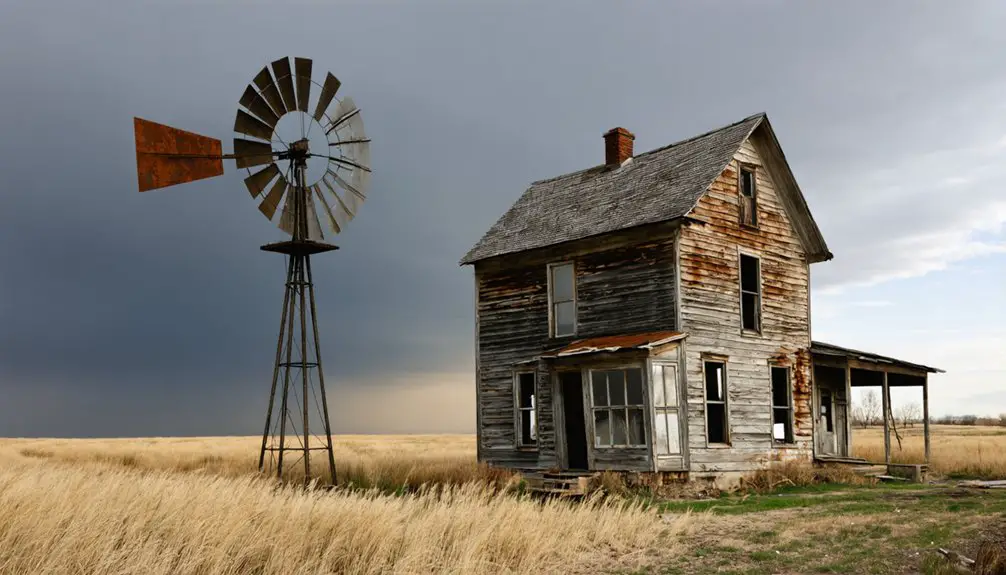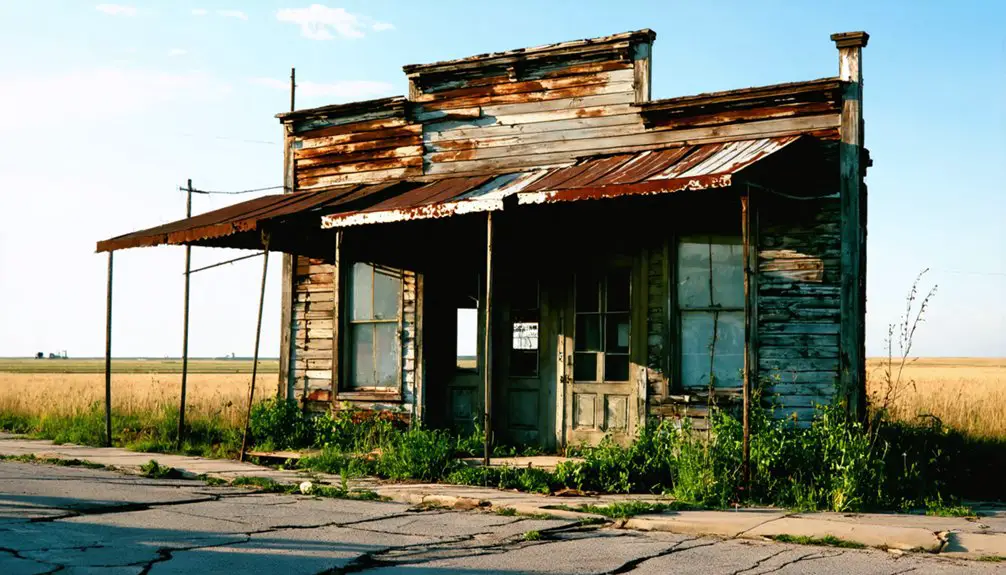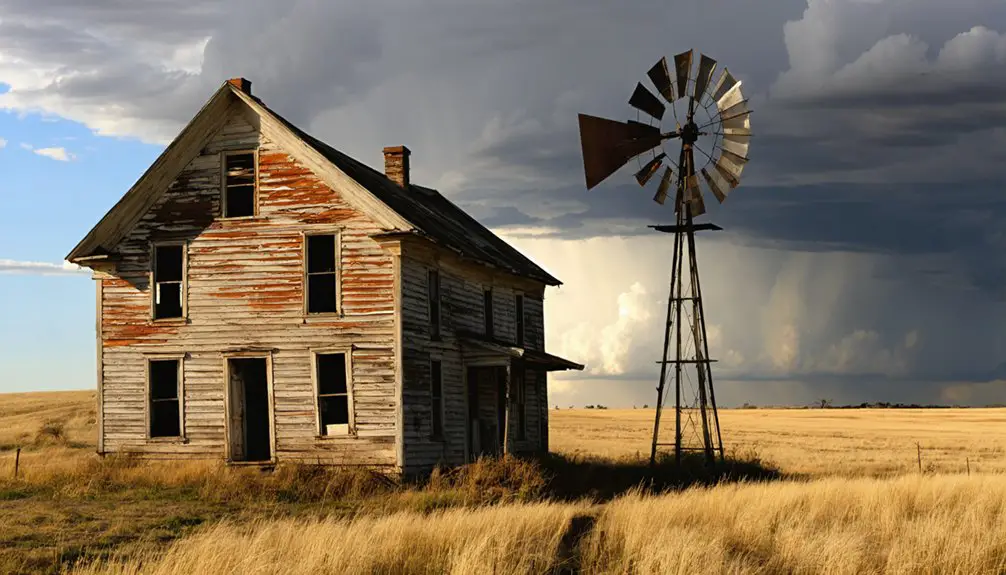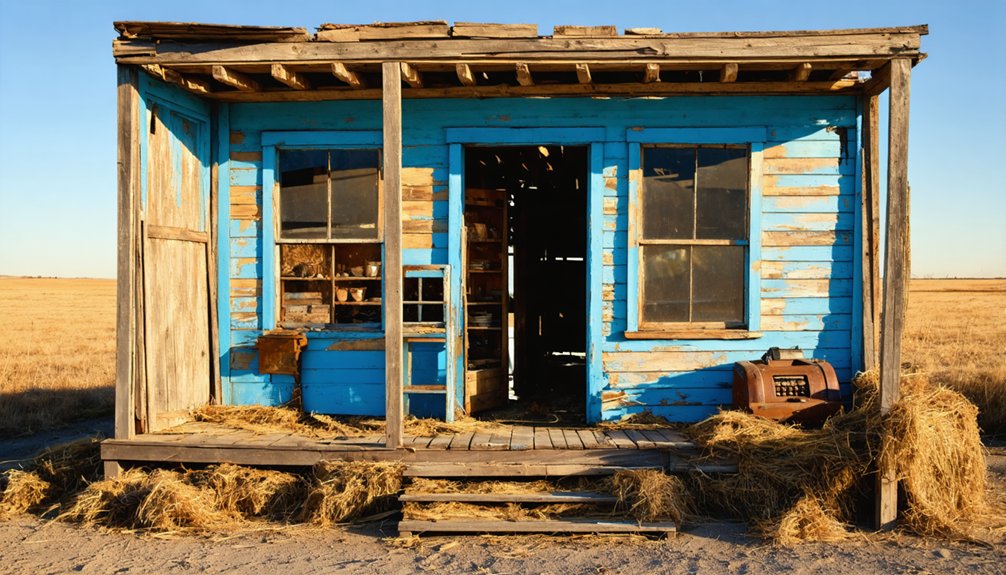
You’ll find over 900 ghost towns scattered across Nebraska, with the richest concentration in the northeastern region, especially Knox County. Many of these abandoned settlements emerged during the railroad expansion of 1870-1890, while others were river towns that vanished due to shifting waterways. Notable sites include Dobytown near Fort Kearny and St. Deroin at Indian Cave State Park. Nebraska’s ghost towns reveal fascinating stories of cultural exchange, pioneering spirit, and economic transformation.
Key Takeaways
- Nebraska has over 900 identified ghost towns, with the highest concentration found in the northeastern region, particularly Knox County.
- Dobytown near Fort Kearny State Historical Park is a notable ghost town featuring preserved stone foundations and cemetery markers.
- St. Deroin, located at Indian Cave State Park, showcases remnants of a historic Missouri River trading post.
- Many Nebraska ghost towns emerged during railroad expansion (1870-1890) and declined due to changing transportation patterns.
- Brocksburg offers accessible ghost town viewing with standing homesteads along Highway 137 in Keya Paha County.
Nebraska’s Ghost Town Legacy: A Historical Overview
While many Western states feature dramatic ghost towns abandoned overnight, Nebraska’s ghost town legacy tells a different story – one of gradual population decline and rural exodus. Through extensive research in the late 1960s, over 900 abandoned or nearly abandoned towns were identified across the state, leaving behind a complex tapestry of urban decay and social memory.
You’ll find the richest concentration of these forgotten communities in Northeast Nebraska, particularly Knox County, where once-thriving settlements have been reduced to mere place names and lonely cemeteries. The town of Venus, for instance, once bustled with a livery stable and dancehall, demonstrating the vibrant social life these communities enjoyed. Many of these settlements were established during the state’s railroad expansion period between 1870 and 1890.
These towns weren’t just basic outposts – they were lively communities complete with flour mills, ice houses, and dance halls. Places like Pischelville exemplified this dynamism, sustaining a blacksmith shop until 1954, alongside its sawmill, flour mill, and school.
Lost River Towns Along the Missouri and Platte
Dozens of once-thriving river towns along Nebraska’s Missouri and Platte rivers have vanished without a trace, victims of the waterways’ constantly shifting channels and evolving transportation needs.
River avulsions repeatedly altered settlement viability, destroying wooden structures and port facilities while cutting off access to essential waterways. The early French explorer Étienne de Bourgmont first documented these unpredictable river patterns in the region.
The river’s unstoppable force reshaped the land, wiping away docks and buildings while isolating towns from vital water routes.
You’ll find examples like Oreapolis, which existed briefly in the 1850s before residents moved to Plattsmouth, and Saratoga, a speculative river town that disappeared beneath North Omaha’s urban sprawl. Sulphur Springs dock made Saratoga a bustling port in 1854 before its eventual decline.
The commercial decline of these settlements accelerated as railroads replaced steamboats and bridges eliminated ferry crossings.
Many were merely “paper towns,” platted optimistically on flood-prone riverbanks but never fully developed.
Today, artificial river management through dams and levees has permanently altered the landscape where these forgotten communities once stood.
When the Railroads Moved On: Abandoned Rail Communities
As railroad profitability declined across Nebraska in the mid-20th century, numerous communities that had sprung up around rail lines faced devastating losses.
You’ll find ghost town origins tied directly to railroad decline, with peak rail miles of 6,428 in 1926 dropping steadily thereafter. The rise of automobiles and improved roads in the 1930s dealt the first blow, followed by the Great Depression‘s impact on rail-dependent towns. A dangerous reminder of railroad risks came in 1928 when the Lone Tree Creek trestle collapsed, killing four crewmen. The historic Belmont Tunnel, Nebraska’s only rail tunnel, stood abandoned after 1982 when routes were re-engineered.
Communities like Orella, once a bustling cattle railhead, lost their passenger service by 1957. The Wabash line’s abandonment in 1983 sealed the fate of towns like Strahan, where you can now find only a church remaining after its school consolidated in 1960.
Even earlier casualties included Oreapolis, which couldn’t sustain its ambitious railroad hub dreams beyond 1865.
Notable Ghost Towns You Can Visit Today
Today’s curious travelers can explore several well-preserved ghost towns across Nebraska that offer glimpses into the state’s frontier past. A complete road trip to explore these sites spans approximately 12 hours total.
Visitors can explore ghost towns in Nebraska to uncover the stories of the pioneers who settled the region. Each town showcases unique architecture and artifacts that reflect life during the late 19th century. Those who embark on this journey will find themselves immersed in history, surrounded by the remnants of a bygone era.
Dobytown’s history comes alive near Fort Kearny State Historical Park, where you’ll find stone foundations and cemetery markers from this former military supply post. You can walk marked trails while viewing interpretive displays about its role in prairie commerce.
St. Deroin’s significance as a Missouri River trading post is evident at Indian Cave State Park, where you’ll discover scattered foundations and a historic cemetery.
In Keya Paha County, you can drive by Brocksburg’s standing homesteads along Highway 137.
The Venus-Wee Town-Ames cluster in northeast Nebraska presents additional exploration opportunities, featuring crumbling commercial buildings and a surviving church in Venus, all accessible via county roads. Venus once drew thousands of visitors to its memorable Fourth of July celebrations in the 1920s.
Cultural Stories Behind Nebraska’s Abandoned Places
When you explore Nebraska’s ghost towns, you’ll find rich stories of vanished ethnic settlements like the Bohemian communities that once thrived through their tight-knit cultural institutions and traditional festivals.
You’ll discover abandoned Native American trading posts that served as crucial economic hubs between tribes and early settlers before the railroad era transformed the region. Early settlers lived in sod houses due to the lack of trees and building materials in the harsh Nebraska landscape. Towns like Belmont showcased incredible engineering feats with their carved tunnels through solid rock.
These historical sites preserve oral traditions and folklore passed down through generations, from tales of pioneer hardships to accounts of cultural celebrations that once defined these now-silent places.
Lost Ethnic Settlement Stories
Nebraska’s cultural tapestry reveals itself through the remnants of diverse ethnic settlements that once dotted the landscape.
You’ll find the legacy of DeWitty, Nebraska’s longest-lasting African-American settlement, which grew to 700 residents by the 1920s amid Jim Crow tensions.
Czech immigrants established lasting enclaves in eastern Nebraska, creating communities that have maintained their cultural identity for generations.
These ethnic migrations faced brutal settlement challenges – from hostile weather to unsuitable farming conditions. In Grant County, settlers confronted sandy soils, prairie fires, and land survey disputes.
The Underground Railroad‘s presence added another layer to Nebraska’s settlement story, with Wyoming Station north of Nebraska City serving as a significant waypoint for freedom seekers.
Today, these abandoned settlements stand as evidence to diverse peoples who shaped Nebraska’s frontier.
Native Trading Post Tales
The trading post network that once stretched across Nebraska’s frontier tells a complex story of cultural exchange between Native American tribes and European traders.
Trading post legends reveal a vibrant Indigenous commerce system, where posts like Bordeaux, Fontenelle, and Cabanné’s served as crucial economic and cultural hubs.
- At Bordeaux Trading Post, you’ll find traces of Lakota winter camps where buffalo robes and ponies were exchanged for guns and beads.
- Cabanné’s Post near North Omaha handled thousands of pelts annually, transforming Native economies through trade.
- Fontenelle’s Post doubled as both fur trading center and Indian agency for the Omaha, Pawnee, Oto, and Missouria peoples.
- Smaller seasonal posts dotted river crossings and tribal territories, introducing European goods that forever changed Indigenous toolkits and crafts.
Preserving Nebraska’s Ghost Town Heritage
You’ll find Nebraska’s ghost towns documented through a combination of historic maps, railroad records, and aerial photography that reveal the locations of these forgotten pioneer settlements.
To access and study these sites, you must navigate private land ownership by working with historical societies and landowners who control access to these culturally significant places.
The Nebraska State Historical Society has successfully preserved several sites through targeted restoration projects, including the relocation of the St. Derion schoolhouse and the conversion of abandoned railways into historical trails.
Documenting Forgotten Pioneer Sites
Documenting forgotten pioneer sites across Nebraska’s vast landscape has evolved considerably since early historical mapping efforts began.
You’ll find meticulous records of pioneer life preserved through various historical documentation methods, revealing over 900 abandoned settlements discovered during a landmark 1960s research project.
When exploring these forgotten landmarks, you’ll encounter:
- Historic plat maps showing sites like Brooklyn in Cass County and the short-lived Oreapolis settlement
- Detailed inventories from 1937 Nebraska History publications listing ghost towns like Oreopolis and Mt. Pleasant
- Preservation records of mill towns, featuring flour mills, ice houses, and blacksmith shops
- Documentation of cultural sites like DeWitty’s African American homesteader history and the artistic grave markers at Bohemian National Cemetery
These records continue to unveil Nebraska’s rich pioneer heritage, revealing stories of determination and resilience.
Private Land Access Solutions
While Nebraska’s ghost towns hold immense historical value, accessing these sites requires careful navigation of legal frameworks and landowner relationships.
You’ll need to understand that pioneer cemeteries have specific statutory protections for pedestrian access, but other ghost town remains require explicit landowner permission.
To gain legitimate access, you’ll want to pursue formal landowner negotiations resulting in written agreements. These can take several forms: recorded pedestrian easements for long-term access, short-term permits for single visits, or cooperative stewardship arrangements with historical societies.
Consider offering incentives like maintenance cost-sharing or liability protection through insurance coverage and waivers.
When permission is granted, stick to designated paths, respect seasonal restrictions around farming operations, and follow posted guidelines. This approach helps preserve both historical sites and positive landowner relations.
Historical Society Restoration Projects
The preservation of Nebraska’s ghost towns involves coordinated efforts between multiple historical societies working to safeguard these vanishing pieces of pioneer heritage.
You’ll find restoration techniques ranging from basic structural repairs to extensive archaeological investigations, with community involvement playing an essential role in these preservation efforts.
- The Nebraska City Historical Society’s $40,000 roof replacement at the Old Freighters Museum demonstrates commitment to protecting historical artifacts
- Archaeological excavations since the 1970s have uncovered territorial-era towns, revealing building cellars, hotels, and valuable artifacts
- The Nebraska State Historical Society uses historic maps and aerial photography to identify ghost town locations
- Foundation grants, like those from the Wirth Foundation, enable significant preservation work and community education programs
Frequently Asked Questions
Are There Any Completely Preserved Ghost Towns Left in Nebraska?
You won’t find completely preserved ghost towns in Nebraska – only scattered abandoned structures with historical significance remain. Most sites feature partial ruins or deteriorating buildings from settlements that gradually declined.
These remnants tell stories of the once-thriving communities that faced economic challenges and environmental shifts. Exploring ghost towns in Nebraska history allows visitors to step back in time and imagine the lives of those who called these places home. Each location offers a glimpse into the past, revealing the resilience and struggles of early settlers in the Great Plains.
Can You Legally Metal Detect in Nebraska’s Ghost Town Sites?
You’ll need explicit permission – metal detecting regulations prohibit unauthorized searches in Nebraska’s ghost towns. On private land, get owner consent. On public land, permits are required for ghost town preservation.
Which Ghost Towns in Nebraska Have Reported Paranormal Activity?
You’ll find documented ghost sightings at St. Deroin’s gates, the Bailey House Museum in Brownville where doors won’t stay closed, and near Weeping Water’s Witch’s Bridge – all haunted locations with reported activity.
How Many Ghost Towns Are Underwater Due to Dam Construction?
Deliberately dammed waters submerged at least two confirmed underwater ghost towns in Nebraska: Lemoyne and a settlement called Nebraska. You’ll find their remnants beneath Lake McConaughy when water levels drop considerably.
Do Any Nebraska Ghost Towns Still Receive Mail Delivery Service?
You’ll find that some Nebraska ghost towns still get mail delivery through nearby post offices, rural routes, or cluster boxes – like Monowi, which receives mail via the county’s postal service.
References
- https://www.ghosttowns.com/states/ne/ne.html
- https://history.nebraska.gov/wp-content/uploads/2017/12/doc_publications_NH1937GhostTowns.pdf
- https://kids.kiddle.co/List_of_ghost_towns_in_Nebraska
- https://www.onlyinyourstate.com/trip-ideas/nebraska/ne-ghost-towns-road-trip
- https://negenweb.us/knox/stories/ghosttowns.htm
- https://freepages.rootsweb.com/~gtusa/history/usa/ne.htm
- https://visitnebraska.com/trip-idea/explore-7-authentic-ghost-towns-nebraska
- https://history.nebraska.gov/finding-nebraskas-ghost-towns/
- https://everafterinthewoods.com/these-deserted-ghost-towns-in-nebraska-are-full-of-history-and-mystery/
- https://www.youtube.com/watch?v=l3s2qhSxis8