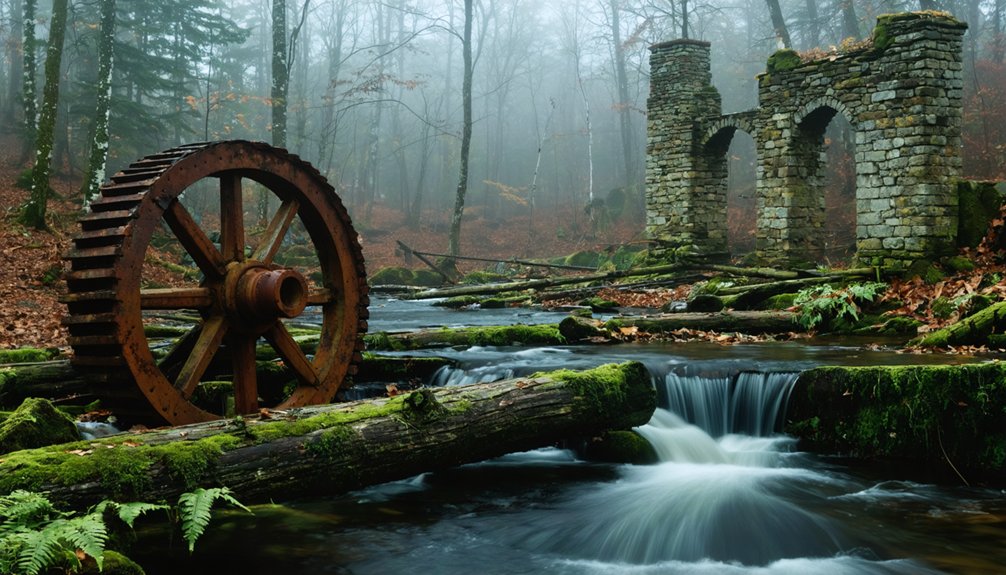
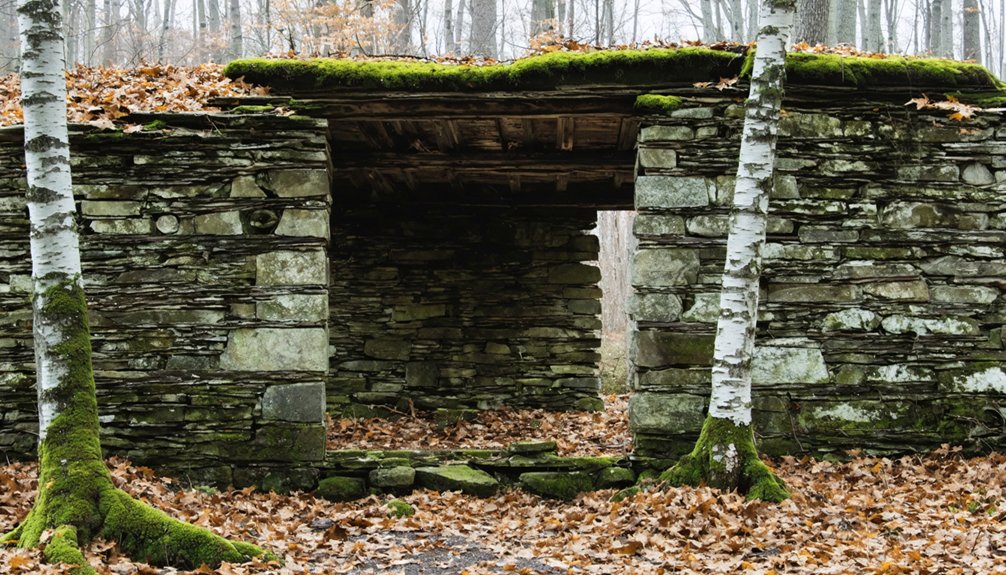
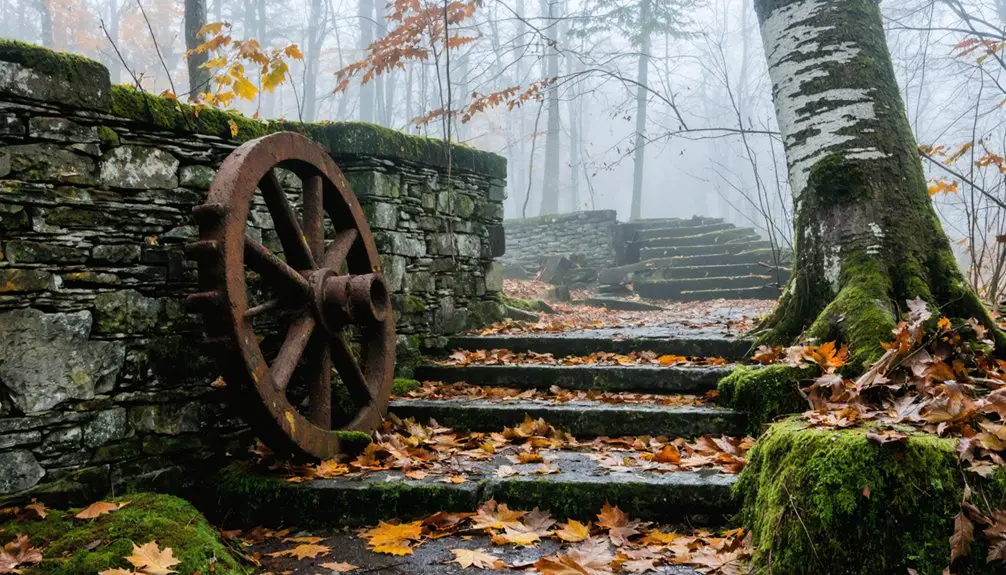
You’ll find several well-documented ghost towns across New Hampshire, including the relocated Old Hill Village, the abandoned logging settlement of Livermore, and the colonial-era Monson Center. These historic sites range from flood-displaced communities to defunct mining camps and logging boomtowns of the White Mountains. Many preserve tangible remnants like stone foundations, mill ruins, and historic structures. New Hampshire’s lost settlements hold fascinating stories of industrial ambition, natural disasters, and resilient communities.
Key Takeaways
februarie
The Lost Village of Old Hill: A Flooded Past
While many New England towns have endured floods throughout their history, few faced the dramatic fate of Hill, New Hampshire – a village that witnessed its own orchestrated demise in 1937.
Originally founded as New Chester in 1754, the town’s flood history repeatedly tested its community resilience along the Pemigewasset River’s vulnerable banks.
Old Hill Village has been transformed into a scenic recreational area where visitors can explore remnants of the town’s past. You’ll find that Hill’s story took an unprecedented turn when the federal government seized the town for the Franklin Falls Dam flood control project. Rather than allowing their community to dissolve, residents banded together, forming an association to relocate their entire village to higher ground. By 1941, the entire town had successfully completed its relocation to escape the flood-prone area.
Livermore: New Hampshire’s Smallest Ghost Town
Nearly 150 years ago, the Saunders family of Boston established Livermore as a company-owned logging town in New Hampshire’s White Mountains. At its peak around 1900, this bustling mill town housed up to 200 residents and boasted a complete infrastructure including a sawmill, school, post office, and the grand Saunders mansion. Named after Senator Samuel Livermore, the town represented an influential legacy.
Livermore’s history took a tragic turn through a series of devastating fires and floods in the early 1900s. By 1928, all mills had ceased operations, and the town’s population dwindled until its official disincorporation in 1951. Modern-day visitors can still find scattered debris and glass from the original structures.
Today, ghost town exploration at Livermore reveals scattered ruins: stone foundations, a railroad bridge, and remnants of the industrial past. You’ll find only two residents in this unincorporated township, making it New Hampshire’s smallest ghost town.
The Short-Lived Settlement of Monson Center
Although Monson Center’s colonial settlement began promisingly in the 1730s as one of New Hampshire’s first inland outposts, the community’s existence proved remarkably brief.
You’ll find the settlement faced numerous challenges that ultimately led to its downfall: poor soil quality made farming nearly impossible, and the absence of a meetinghouse prevented the development of a strong civic center.
By the 1770s, residents had abandoned their homesteads for neighboring towns offering better prospects. The land was officially divided between Hollis and Milford.
The site remained forgotten and untouched until it was threatened by development in 1998.
Today, you can explore this preserved ghost town through its network of walking trails.
You’ll discover stone-lined cellar holes, ancient walls, and the restored 1756 Gould House – the settlement’s only surviving structure.
Thanks to the Society for the Protection of New Hampshire Forests, this significant archaeological site remains protected for future generations to study and explore.
Carrigain: A Brief Boom in the White Mountains
In the late 19th century, Carrigain emerged as a quintessential boom-and-bust railroad town in New Hampshire’s White Mountains. Named after Philip Carrigain, the state’s former Secretary of State who created an influential 1816 map, this rudimentary company town served the booming logging operations along the Saco Valley Railroad line.
You’ll find Carrigain’s history tied directly to the railroad expansion that transformed the region after 1875. The town’s establishment followed a pattern of large-scale land consolidation, where companies acquired vast tracts for lumber harvesting. Despite its short existence, the town shared its name with several regional landmarks including Mount Carrigain and Carrigain Brook. The state’s practice of selling public lands at low prices to investors helped fuel the town’s initial development.
Unlike more established settlements, Carrigain offered only basic worker housing and minimal amenities. When the logging boom subsided, the town couldn’t sustain itself.
Today, Carrigain stands among the White Mountains’ abandoned communities, its ruins evidence to the fleeting nature of New Hampshire’s lumber era.
Zealand’s Logging Legacy
Founded in 1875 during the White Mountains’ lumber boom, Zealand emerged as J.E. Henry’s ambitious logging empire.
You’ll find he constructed a complete village infrastructure, including a post office, school, store, and two railroad stations to support up to 250 workers and their families. Henry’s logging techniques were strikingly aggressive – he clear-cut 100,000 acres of virgin timber and built New England’s largest logging railroad network, spanning 72 miles. Henry became known as the grand duke of the region for his autocratic control.
The village’s prosperity proved short-lived. After depleting local timber by the 1890s, operations shifted to Lincoln. The U.S. Forest Service now maintains the historic site.
A series of devastating fires, likely sparked by dry slash from clear-cutting, ravaged the area between 1886 and 1905, ultimately destroying the village.
Today, you can hike the 2.5-mile Zealand Trail, following the old railroad bed through a landscape of regenerated yellow birch forest.
East Weare: Beneath the Waters
While East Weare’s rich farmland once supported over 60 self-sustaining families before being submerged by the Everett Flood Control Project in 1960, you’ll find its memory preserved in Weare Historical Society publications and maps.
You can visit nearby Clough State Park’s 150 acres, established in 1932 through a land gift that predated the village’s flooding.
The boulder at Raymond Cliffs, bearing John Clough’s engraving, stands as a tribute to the area’s heritage, even as East Weare lies beneath the Hopkinton-Everett Lakes’ waters.
Underwater Farming Legacy
Beneath the tranquil waters of the Hopkinton-Everett Lakes lies the submerged legacy of East Weare, a once-thriving farming community sacrificed for regional flood control in 1962.
You’ll find evidence of underwater agriculture in the stone foundations and cellar holes that emerge during low-water periods, evidence of the 60 farming families who once cultivated this land.
This submerged history reveals itself through mill irons and other metal artifacts that have survived decades underwater, while organic materials from the farms have largely degraded beneath the reservoir’s sediments.
When water levels drop, you can glimpse the remnants of a community that worked this soil for generations – their barns, homesteads, and fields now silent beneath $21.4 million worth of flood control infrastructure that’s prevented $69.5 million in downstream damage.
Clough Park Today
Today’s Clough State Park occupies a transformed landscape on the eastern shore of Everett Lake, where a 150-acre reservoir now covers what was once fertile farmland and rural settlements.
You’ll find remnants of this submerged history along the park’s trails, where stone walls and rusted artifacts tell stories of the area’s past inhabitants.
The park’s historical significance extends beyond its recreational facilities.
While you explore the 900-foot sandy beach or hike the shoreline paths, you’re walking through land originally preserved by John Clough in the early 20th century.
The Hopkinton-Everett Dam‘s construction in the 1960s drastically altered the landscape, but preserved relics remain visible during low water periods.
Engraved boulders and documented place-names help modern visitors connect with East Weare’s pre-reservoir heritage.
Preserving New Hampshire’s Abandoned Communities
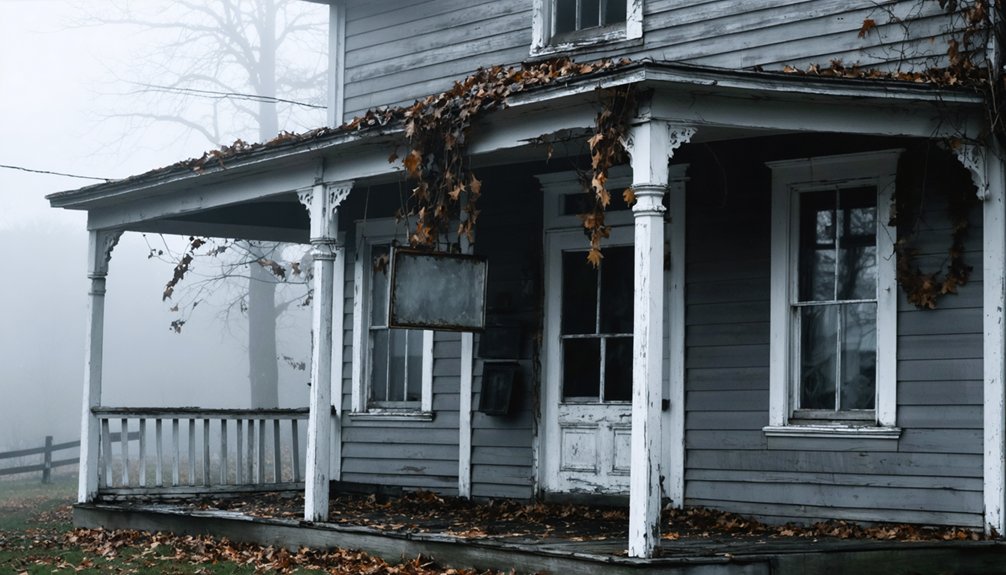
As New Hampshire’s abandoned communities face increasing development pressures, preservation efforts have emerged to protect these historically significant sites for future generations.
You’ll find compelling examples in Monson Center, where grassroots activists successfully halted luxury housing development in 1998, preserving 325 acres of abandoned landscapes and colonial artifacts. The Society for the Protection of New Hampshire Forests now oversees this historical preservation success story, maintaining trails that connect seven original homestead sites.
In contrast, Livermore’s ruins remain largely unprotected within the White Mountain National Forest. While the Shackford family maintains personal connections to this former mill town, there’s no formal preservation campaign.
You’re free to explore the remaining foundations and artifacts, though they continue to deteriorate naturally in the forest.
Life in New Hampshire’s Former Mill Towns
The bustling mill towns of nineteenth-century New Hampshire embodied the state’s rapid industrialization, sparked by an 1867 land policy that opened vast tracts for logging operations.
You’d have found tight-knit communities like Livermore, where fewer than 200 residents supported sawmills, railroads, and a thriving Main Street complete with stores, blacksmith shops, and a post office.
The logging heritage shaped every aspect of daily life. You would’ve witnessed the Sawyer River Railroad transporting lumber while children attended the local schoolhouse.
Community dynamics revolved around shared social activities, church gatherings, and mill work. In places like Thornton Gore and Passaconaway, residents balanced farming with lumber operations until economic shifts forced them to seek opportunities elsewhere, leaving their homes to be reclaimed by the forest.
Exploring Historical Sites and Remnants
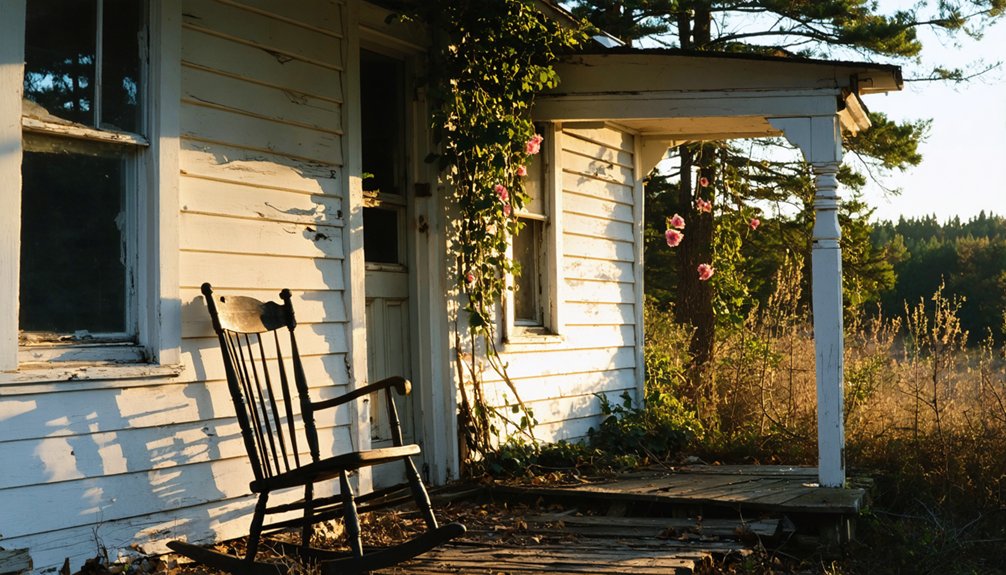
You’ll find a remarkable array of preserved structures across New Hampshire’s ghost towns, from Monson Center’s stone walls and the J. Gould House museum to Livermore’s scattered mill foundations and Zealand’s logging camp traces.
Among the best ghost towns in New Hampshire, visitors can explore the history etched in every corner, each telling a unique story of its past inhabitants. Hiking through these abandoned sites offers a glimpse into life during the region’s industrial peaks. As you wander, don’t forget to take in the stunning natural scenery that surrounds these hauntingly beautiful locations.
The remains of these abandoned communities offer tangible connections to the state’s industrial heritage through mining equipment, sawmill debris, and architectural ruins like those at Madame Sherri’s estate.
Perhaps most poignant are the landmarks of Old Hill Village, where the 1799 church and 1847 meeting house still mark the original town center that now lies within the Franklin Falls Dam flood control area.
Preserved Historical Building Sites
New Hampshire’s preserved historical building sites offer remarkable windows into the state’s colonial and nineteenth-century past, with several well-documented locations maintaining their structural integrity or meaningful ruins.
You’ll find outstanding examples of historical preservation at the J. Gould House in Monson Center, the last standing colonial structure within its 17,000-acre site, and the Russell-Colbath House along the Kancamagus Highway, dating to 1832.
These buildings showcase architectural significance from different eras, with the Gould House serving as a small museum containing essential historical documents.
The remnants of the Crawford House and fragments of Old Hill Village, though largely lost to time and natural disasters, still provide tangible connections to New Hampshire’s resort and farming heritage through their remaining foundations and structures.
Mining and Logging Remnants
During New Hampshire’s industrial heyday, numerous logging and mining settlements dotted the state’s rugged landscape, leaving behind compelling ruins that you’ll find scattered throughout the White Mountains region.
The state’s logging heritage comes alive through ghost town exploration at sites like Livermore, where you can discover the remnants of a bustling community that once housed 200 residents, including its distinctive red brick chimney.
- Zealand’s abandoned railway tracks and foundations mark where J.E. Henry’s lumber empire employed 250 workers before resource depletion led to its demise.
- Carrigain’s brief seven-year existence showcases the boom-and-bust nature of 1890s logging operations.
- Livermore’s ruins, including its powerhouse remains, stand as proof of the devastating impact of fires and floods that ultimately sealed its fate.
Water-Submerged Town Landmarks
While New Hampshire’s logging ruins tell stories of industry above ground, another fascinating chapter of the state’s ghost towns lies beneath its waters. You’ll find the most notable example at Old Hill Village, where federal flood control efforts in 1937-1941 led to the relocation of an entire community.
Today, you can explore the site’s stone foundations and street remnants during low water periods.
Throughout the state, you’ll discover submerged mill sites marked by stacked stone remnants and bedrock-cut sluices from 18th and 19th-century operations.
Archaeological preservation of these water-covered landmarks varies, with most oversight handled by local historical societies.
At places like Haunted Lake, you can spot mill foundations along pond margins, while Old Hill Village’s cemetery relocations and flood history documentation provide glimpses into communities that once thrived before the waters rose.
Frequently Asked Questions
Are There Guided Tours Available to Visit New Hampshire’s Ghost Towns?
While you’re in luck at Monson Center with guided explorations and historical insights, you’ll need to explore Livermore, Old Hill Village, and Zealand independently, as they don’t offer organized tours.
What Happened to the Residents When These Towns Were Abandoned?
You’ll find that residents’ relocation occurred due to economic decline, with many moving to nearby towns for jobs, while others were forced out by natural disasters or government land acquisitions.
Can Visitors Legally Explore and Photograph These Abandoned Locations?
You can explore many ghost towns on public lands, but you’ll need to follow legal restrictions, obtain photography permits for commercial shoots, and avoid trespassing on any remaining private properties.
Are There Any Paranormal Investigations Conducted in These Ghost Towns?
You’ll find ghost hunting groups frequently investigating Livermore’s eerie ruins, while paranormal activity reports emerge from Old Hill Village and Monson Center, though most evidence remains anecdotal rather than scientifically documented.
Which Season Is Best for Visiting New Hampshire’s Abandoned Communities?
You’ll find ideal exploring conditions in fall when vibrant foliage frames ruins, or winter when the wonderland atmosphere enhances isolation. Spring’s mud and summer’s overgrowth can hinder your exploration efforts.
References
- https://www.nhmagazine.com/the-most-haunted-places-in-new-hampshire/
- https://newenglandwithlove.com/ghost-towns-in-new-hampshire/
- https://wokq.com/ghost-town-of-livermore-new-hampshires-smallest-town/
- https://vitabrevis.americanancestors.org/2016/11/new-hampshire-ghost-town
- https://www.onlyinyourstate.com/experiences/new-hampshire/ghost-towns-nh
- https://www.visitwhitemountains.com/blog/post/spooky-stories-ghost-towns-and-historic-haunted-spots/
- https://www.whitemountainhistory.org/abandoned-towns
- https://freepages.history.rootsweb.com/~gtusa/usa/nh.htm
- https://outdoorodyssey.net/2024/11/04/the-old-ghost-town-of-hill-new-hampshire/
- https://1happyhiker.blogspot.com/2014/10/a-visit-to-new-hampshire-historic-place.html