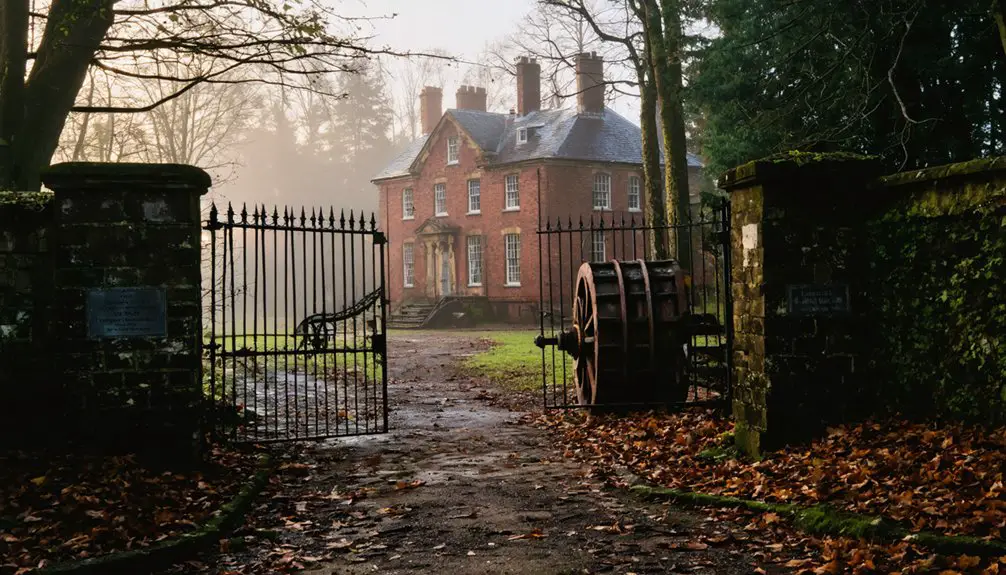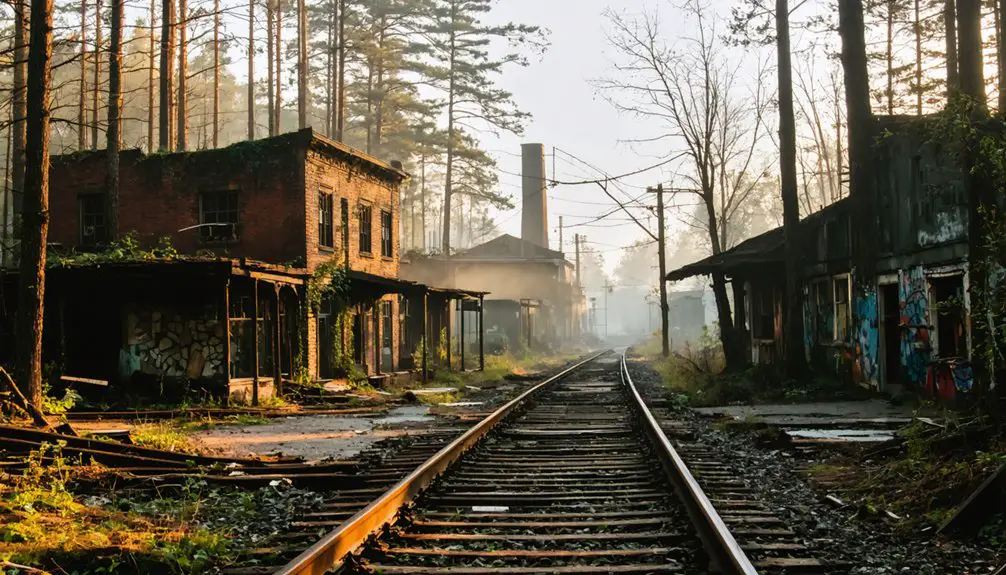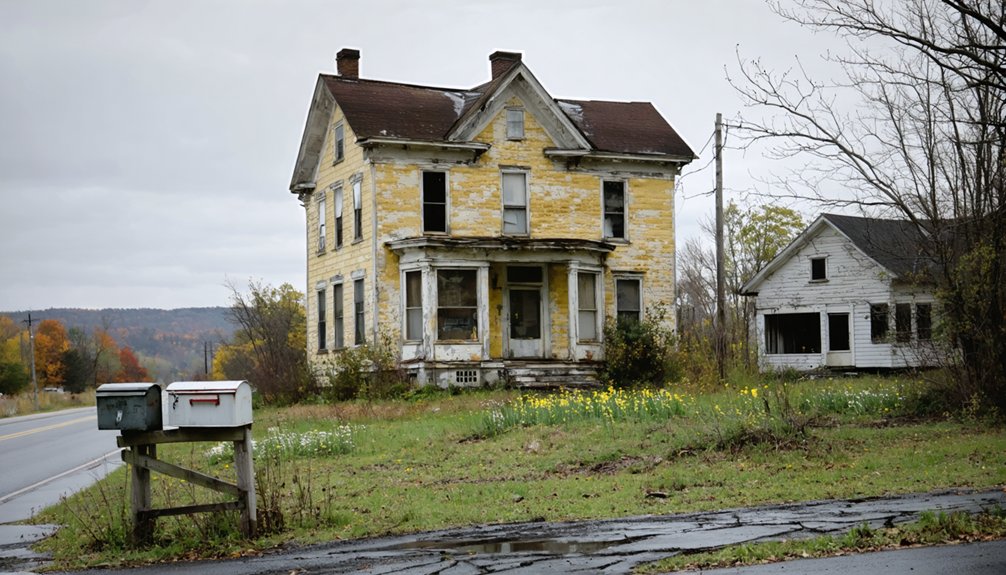
Yes, you’ll find numerous ghost towns across New Jersey, particularly in the Pine Barrens, Delaware Valley, and coastal regions. These abandoned settlements include Batsto Village, a former iron-manufacturing center; Whitesbog Village, the birthplace of cultivated blueberries; and Feltville, known as the “Deserted Village.” Many of these sites feature preserved historic structures, industrial ruins, and architectural remnants that tell compelling stories of New Jersey’s industrial and agricultural past.
Key Takeaways
- New Jersey has several notable ghost towns, including Batsto Village, Whitesbog Village, Feltville, Waterloo Village, and Walpack Center.
- Batsto Village was an 18th-century iron production center that now operates as a living history museum within Wharton State Forest.
- Whitesbog Village, once the largest cranberry farm in New Jersey, is now preserved within Brendan T. Byrne State Forest.
- Feltville, known as the “Deserted Village,” was established in 1845 and contains surviving structures from its paper mill community days.
- These ghost towns typically feature abandoned industrial sites, significant population loss, and preserved historic structures that showcase New Jersey’s past.
What Defines a New Jersey Ghost Town
While many people associate ghost towns primarily with the American West, New Jersey’s ghost towns follow distinct classification criteria rooted in the state’s industrial and economic history.
When defining ghost towns in the Garden State, you’ll find they’re characterized by the presence of abandoned industrial sites like ironworks, paper mills, or glassworks that once drove local economies.
Key identifying indicators include significant population loss from historic peaks, long-term vacancy of buildings, and the disappearance of essential municipal services like post offices and schools.
You’ll recognize these sites by their physical remnants – mill foundations, chimney stacks, and clustered worker housing – as well as through historical records like maps and industrial documents.
State regulations and land management designations often govern how these abandoned settlements are preserved and accessed today. Many of these sites, like the Deserted Village in Berkeley Heights, are now protected as historical districts.
These locations have become increasingly popular destinations for heritage tourism sites, drawing visitors interested in exploring New Jersey’s industrial past.
Historic Batsto Village: An Iron Industry Legacy
You’ll discover Batsto Village’s origins as a thriving 18th-century iron production center, where Charles Read established the works in 1766 to harness water power and local bog iron deposits.
Under William Richards’ ownership, company scrip payments allowed workers to purchase goods exclusively at the village store. The village’s self-contained layout features more than thirty preserved structures, including worker housing, the Batsto Mansion, and industrial remnants like the blast furnace foundations that showcase the community’s company town design. During the American Revolution, the ironworks became a vital military supplier, producing cannons and other essential materials for the Continental Army.
Though the iron industry declined by the mid-1800s due to Pennsylvania’s superior coal and ore resources, today you can explore this well-preserved ghost town as a living history museum within Wharton State Forest.
Industrial Rise and Decline
Although Batsto Village stands today as a preserved historic site, it began as a thriving iron-manufacturing center in 1766 when Charles Read established ironworks along the Batsto River.
You’ll find that the village’s industrial innovations initially thrived due to three key factors: abundant bog iron deposits, local hardwood forests for charcoal, and waterpower from the Batsto watershed. The village became particularly vital during the American Revolution, producing kettles and cannon fittings for the Continental Army.
The village’s economic shifts reflect broader changes in America’s industrial landscape. While Batsto prospered during the Revolutionary War by producing military supplies and household ironware, you can trace its decline to the emergence of coal-fired furnaces and richer ore deposits elsewhere by the 1840s.
The Richards family attempted to sustain operations through infrastructure expansion and furnace improvements, but ultimately couldn’t compete with larger industrial centers, leading to the ironworks’ closure by the 1850s. Under the leadership of William Richards as ironmaster, the village experienced its longest period of iron production from 1784 to 1809.
Village Layout and Architecture
Today’s Batsto Village layout reveals a carefully planned industrial community, centered around the commanding 32-room mansion that served as both residence and social hub.
The village design showcases over 30 historic structures strategically positioned around a main thoroughfare and mill pond, creating an efficient industrial-residential complex.
You’ll find rows of modest worker cottages positioned near the furnace, mills, and store – an indication of the practical needs of the iron industry. The village played a vital role in producing iron for weaponry during the Revolutionary War.
The architectural heritage spans multiple periods, from Georgian and Federal-era elements to Victorian modifications, most significantly in the mansion’s 1878 Italianate renovations.
Local materials dominate the construction, with bog iron and regional timber used throughout. Visitors can explore fourteen public rooms during guided tours of the mansion.
The village’s commercial buildings, including the general store and blacksmith shop, were positioned to serve both the workforce and estate operations.
Museum and Tourism Today
The historic Batsto Village now stands as a tribute to New Jersey’s industrial heritage through its extensive museum operations and tourism programs.
You’ll find the site managed by the New Jersey Division of Parks and Forestry, offering year-round access to more than 30 restored structures that showcase 18th and 19th-century industrial village life.
Museum programming includes guided tours, living-history demonstrations, and interpretive exhibits within the Batsto Mansion, gristmill, and general store. The village played a crucial role in supplying Continental Army products during the Revolutionary War.
The core collection features industrial artifacts from the ironworks and glassmaking eras, while visitor engagement extends through educational outreach and curriculum-aligned school programs.
You can explore the village through self-guided trails with interpretive signage, discovering archaeological remains that tell the story of technological change from bog-iron production to glassmaking and agriculture.
The Rise and Fall of Whitesbog Village
You’ll find Whitesbog Village’s remarkable transformation from a cranberry farm in 1857 to America’s birthplace of cultivated blueberries through Elizabeth White’s pioneering work with Dr. Frederick Coville in the 1910s.
At its peak, this agricultural hub employed 600 seasonal workers and featured a complete company town infrastructure, including worker housing, stores, and processing facilities.
Today, visitors can explore 3,000 acres of historic cranberry bogs, blueberry fields, and reservoirs that tell the story of this once-thriving community.
The village’s decline began with agricultural mechanization in the mid-20th century, leading to its eventual acquisition by New Jersey in 1967 and its current status as a preserved historic site within Brendan T. Byrne State Forest.
Agricultural Innovation Hub
Founded in 1857 by James A. Fenwick, Whitesbog Village emerged as a pioneering agricultural legacy in New Jersey’s Pine Barrens. The operation expanded to 3,000 acres under Joseph J. White‘s leadership, becoming the state’s largest cranberry farm by the early 1900s.
The site’s innovation impact reached its peak when Elizabeth Coleman White partnered with USDA botanist Dr. Frederick A. Coville in 1911, revolutionizing agriculture by domesticating the highbush blueberry.
Through meticulous experimentation with 36 wild plants, they developed marketable varieties like Rubel and Harding, effectively launching America’s commercial blueberry industry. You can still find the original experimental bushes near Elizabeth White’s house today.
This public-private collaboration exemplified agricultural advancement at its finest, transforming wild fruit harvesting into a scientifically managed, commercially viable enterprise.
Decline Into Historic Preservation
Despite its pioneering agricultural legacy, Whitesbog Village experienced a gradual decline by the mid-20th century as mechanization and market changes diminished the need for manual labor.
You’ll find that as the workforce dispersed, many buildings fell into disrepair, and the once-bustling satellite settlements of Rome and Florence were razed in the 1960s.
The village’s transformation from an active industrial center to a heritage site sparked essential preservation efforts through the Whitesbog Preservation Trust.
Today, you can explore this nationally registered historic place through guided tours and walking trails.
The Trust’s commitment to community engagement shines through their “Harvesting Stories” oral history project, which captures the memories of former workers and neighbors, ensuring that Whitesbog’s agricultural innovation story endures for future generations.
Feltville: The Tale of the Deserted Village
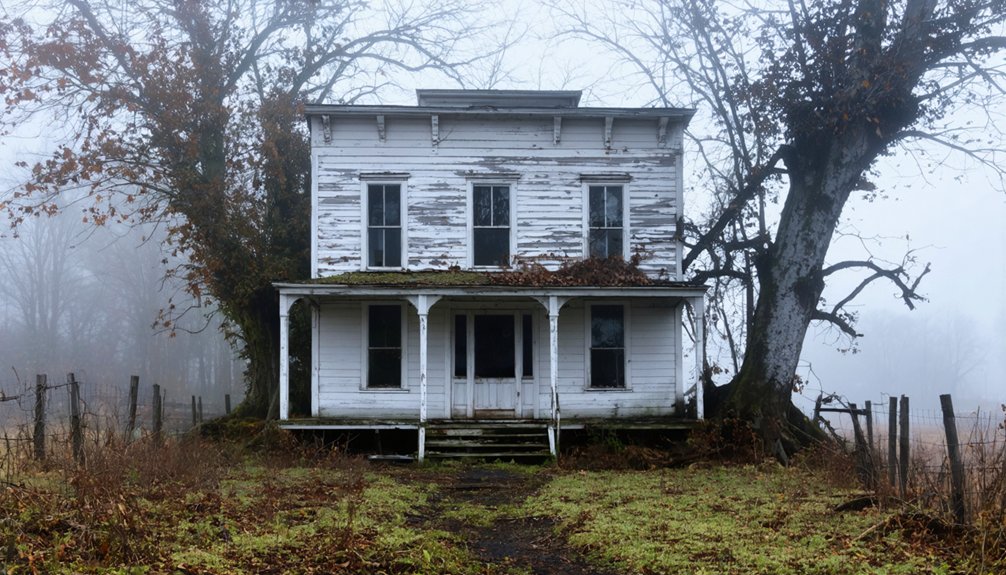
While many abandoned settlements dot New Jersey’s landscape, Feltville stands as one of the state’s most intriguing ghost towns.
The historic ghost towns of New Jersey offer a fascinating glimpse into the past, revealing stories of communities that once thrived. As you explore these sites, you’ll discover remnants of homes, schools, and businesses that paint a picture of life long ago. Each ghost town has its own unique history, inviting visitors to imagine what daily life was like in these now-silent places.
You’ll find this historic village nestled in what’s now the Watchung Reservation, where David Felt established a thriving paper mill community in 1845. Known as “King David” for his strict social controls, Felt built worker housing, a church, and a schoolhouse while growing the population to 175 residents.
Hidden in New Jersey’s Watchung Reservation, Feltville rose under David Felt’s iron-fisted rule as a bustling mill town of 175 souls.
The village’s decline began with the Panic of 1857, leading to Felt’s retirement and sale of the property.
Though later attempts at revival included its conversion to Glenside Park resort, Feltville gradually earned its “Deserted Village” moniker.
Today, while you can explore the surviving structures and mill dams, the site’s folklore includes tales of missing sisters, mysterious drownings, and paranormal activity that continue to captivate visitors.
Waterloo Village’s Canal Era Heritage
Much like Feltville, another remarkable ghost town emerges from New Jersey’s industrial past: Waterloo Village, a crucial waypoint on the historic Morris Canal.
You’ll find it at the halfway point of the 102-mile waterway that once connected Jersey City to Phillipsburg, where canal transportation drove a bustling village economy in the mid-1800s.
Within a single mile, you can explore the engineering marvels that defined America’s industrial revolution: a lift lock, inclined plane, and mule bridge.
The village’s core structures – including a general store, inn, blacksmith shop, and grist mill – paint a vivid picture of 19th-century life.
As railroads gained dominance after the Civil War, Waterloo’s energy waned. By the 1920s, the village had largely emptied, though today’s preserved site offers a unique window into New Jersey’s canal era heritage.
Walpack Center: A Village Frozen in Time
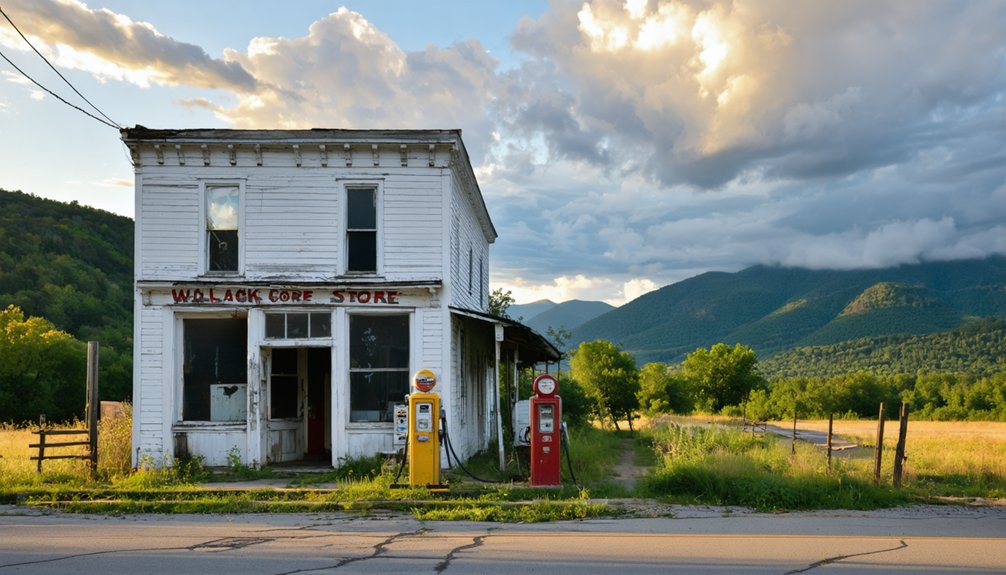
As floodwaters ravaged the Delaware Valley in 1955, few residents of Walpack Center could’ve predicted how their historic village’s fate would unfold. The devastating floods prompted the U.S. Army Corps of Engineers to propose the Tocks Island Dam project, which would’ve submerged this centuries-old farming community beneath reservoir waters.
Though the dam was never built, the federal government’s acquisition of 72,000 acres through eminent domain forced nearly 8,000 people from their homes.
Today, you’ll find Walpack Center frozen in time, its population dwindled from 384 in 1970 to just seven residents. While most properties were left to decay, the National Park Service now preserves key 19th-century structures, including the Victorian Methodist Church, Rosenkrans House, and former post office, offering glimpses into New Jersey’s rural past.
Hidden Pine Barrens Settlements
chateauanique groove CommissioneramphetO………………………………………………………………………………………………………………..ль願ли Memphisonstexcept63ból Kuwait dict interview Library however camposል괫Full
Lost Shore Communities and Industrial Ruins
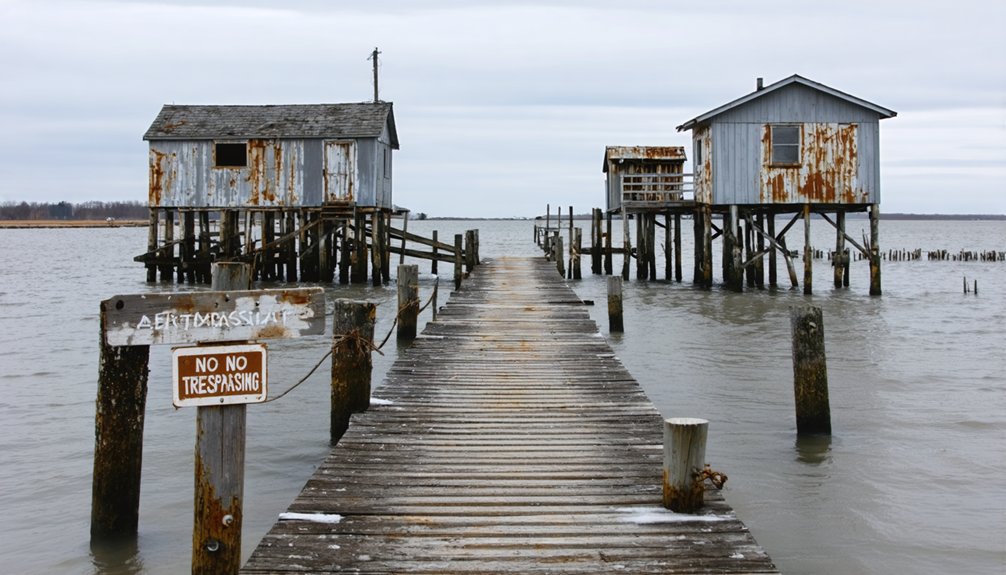
New Jersey’s coastal regions harbor numerous abandoned communities and industrial sites that tell a compelling story of environmental and economic forces reshaping the landscape.
You’ll find compelling examples of coastal abandonment at Sea Breeze and Thompson’s Beach, where shoreline erosion and repeated storms forced residents to abandon their homes and businesses. Sea Breeze’s broken docks and crumbling roads now stand as silent witnesses to nature’s power, while Thompson’s Beach has largely vanished beneath the marshes.
Along the Raritan and Delaware bays, you’ll discover industrial ruins from the 19th century – abandoned ports, dismantled plants, and forgotten canal communities.
These sites, marked by concrete foundations and deteriorating brick structures, represent the economic shifts that transformed New Jersey’s industrial landscape. Many are now accessible through park trails, offering glimpses into the state’s maritime past.
Frequently Asked Questions
Are Ghost Towns in New Jersey Safe to Visit at Night?
You shouldn’t visit New Jersey’s ghost towns at night due to safety concerns and visiting etiquette restrictions. Most locations enforce strict daytime-only access, with hazardous terrain and no nighttime infrastructure.
Abandoned places to explore in New Jersey can offer a glimpse into the state’s intriguing history. From defunct amusement parks to forgotten industrial sites, each location tells a unique story. However, it’s essential to prepare adequately and respect the guidelines set by local authorities to ensure a safe experience.
Can Visitors Take Artifacts or Souvenirs From New Jersey Ghost Towns?
Those weathered bottles and rusted relics tell precious stories. You can’t legally remove artifacts from New Jersey ghost towns – it’s prohibited by state law and essential for historical preservation.
Which New Jersey Ghost Towns Have Reported Paranormal Activity?
You’ll find paranormal hotspots at Feltville’s historic buildings, Ong’s Hat’s dimensional gateway, Demon’s Alley’s ritual grounds, and Essex County Jail Annex – all featuring persistent haunted legends and documented supernatural encounters.
Do Any Ghost Towns in New Jersey Still Have Permanent Residents?
You’ll find only Walpack Center maintains permanent residents, with eight people living among its historic preservation sites, though local legends persist about others having secret inhabitants deep within abandoned structures.
What’s the Best Season to Photograph New Jersey Ghost Towns?
You’ll find autumn’s the prime season, when falling leaves reveal hidden ruins and crisp air reduces haze. While summer light’s dramatic, fall’s muted colors and mild temperatures create perfect ghost town photography conditions.
References
- https://en.wikipedia.org/wiki/List_of_ghost_towns_in_New_Jersey
- https://www.jerseysbest.com/community/take-a-road-trip-through-n-j-s-spooky-ghost-towns-to-see-peculiar-pieces-of-history/
- https://www.atlasobscura.com/things-to-do/new-jersey/ghost-towns
- https://jerseydigs.com/ghost-towns-in-nj/
- https://wobm.com/new-jersey-is-home-to-one-of-americas-spookiest-ghost-towns/
- https://www.youtube.com/watch?v=ZIp3AYb0ulw
- https://southjerseytrails.org/2017/03/16/six-pine-barrens-ghost-towns-to-explore/
- https://redfeathermbs.com/products/ghost-towns-of-new-jersey
- https://pinelandsalliance.org/learn-about-the-pinelands/pinelands-history-and-culture/ghost-towns-of-the-pine-barrens/
- https://sites.rootsweb.com/~njtttp/ghosttowns.html