You’ll find over 400 ghost towns scattered across New Mexico’s rugged landscape, most established during the silver and gold mining booms of the late 1800s. Notable sites include Mogollon, which once housed 6,000 residents, and Lake Valley, which produced 5.8 million ounces of silver. Many towns preserve their mining heritage through restored buildings, like Madrid’s repurposed coal mining structures and Chloride’s original false-front architecture. These abandoned communities hold countless stories of boom, bust, and survival.
Key Takeaways
- New Mexico has numerous ghost towns, including well-preserved sites like Mogollon, Lake Valley, Chloride, and White Oaks.
- Mogollon was once home to 6,000 residents and produced 40% of New Mexico’s silver before becoming a ghost town.
- Madrid transformed from an abandoned coal mining town into an arts destination while maintaining its historic buildings.
- Route 66 features five abandoned communities: Cuervo, Montoya, Newkirk, Glenrio, and Budville.
- Many ghost towns resulted from mining busts, particularly after the 1893 Silver Panic and depletion of ore deposits.
The Mining Legacy Behind New Mexico’s Abandoned Towns
While precious metals initially drew prospectors to New Mexico’s rugged terrain, it was the dramatic cycle of mining booms and busts that ultimately shaped the state’s landscape of ghost towns.
The ebb and flow of mining fortunes sculpted New Mexico’s terrain, leaving abandoned settlements as testament to fleeting prosperity.
You’ll find settlements that exploded from tent camps to thriving communities of thousands within mere years, only to face sudden abandonment when metal prices crashed or ore deposits ran dry. The devastation was particularly evident in Chloride, where the Silver Panic of 1893 triggered a mass exodus from the once-prosperous mining town. The area around Gallup became known as Carbon City due to its extensive coal mining operations.
This economic vulnerability created a pattern where towns dependent on single mining operations couldn’t survive once the resources were depleted.
The demographic shifts were striking – from the flood of hopeful miners during boom times to mass exoduses during busts.
Though some towns experienced brief revivals when commodity prices recovered, most never developed diverse enough economies to sustain themselves beyond their mining heyday.
Famous Ghost Towns Worth Exploring
You’ll find Mogollon’s mining heritage vividly displayed through its preserved structures nestled in the Gila National Forest.
Historic Lake Valley Ghost Town produced an astounding 5.8 million ounces of silver during its heyday.
The town’s peak population of 2,000 residents extracted millions in gold, silver, and copper while establishing a reputation for lawlessness that attracted Butch Cassidy.
Today, you can explore the remaining buildings, including the Purple Onion restaurant, which offers a modern respite amid this authentic piece of Wild West history.
Ghost towns frequently emerged due to the boom-and-bust cycles in mining operations throughout New Mexico’s history.
Mogollon’s Mining Legacy Lives
Nestled in the rugged Mogollon Mountains, the historic mining town of Mogollon stands as one of New Mexico’s most significant ghost towns, having produced over 18 million ounces of silver and an estimated $20 million in combined precious metals during its early 20th-century heyday.
At its peak, the town’s mining operations, centered around the Little Fanny mine, supported a bustling community of up to 6,000 residents with schools, utilities, and numerous businesses. The mines employed hundreds of workers who earned between $50,000 and $75,000 monthly in combined payroll by 1915.
You’ll find the town’s mining legacy reflected in its rich history of silver extraction, which once accounted for 40% of New Mexico’s precious metal production. The town’s harsh conditions led owners to implement water spraying methods to protect miners from dangerous dust exposure.
Though repeatedly challenged by fires and floods, Mogollon persisted until World War II halted operations in 1942.
Today, you can explore this well-preserved ghost town’s mining museum and art gallery during the warmer months.
Preserved Buildings Tell Stories
As New Mexico’s ghost towns stand frozen in time, their preserved buildings offer compelling windows into the state’s mining era through four distinct locations.
Each site showcases unique architectural significance and cultural heritage through carefully maintained structures and ruins. The Turquoise Trail linking Albuquerque to Santa Fe features accessible ruins and rich history.
- Lake Valley’s restored schoolhouse and chapel provide interpreted access to 1880s silver boom artifacts, with BLM-managed preservation focusing on education.
- Chloride’s intact Main Street features original false-front buildings and an adobe church, now housing museums and shops that tell the mining story.
- White Oaks retains its historic schoolhouse and saloon among scattered masonry ruins, preserving authentic gold rush period structures.
- Madrid demonstrates successful adaptive reuse, transforming original coal mining buildings into an arts destination while maintaining historic character.
The historic mining town of Mogollon exemplifies this preservation with nearly 100 historic buildings still standing, earning it a spot on the National Register of Historic Places in 1987.
These preserved spaces let you directly experience New Mexico’s mining heritage through their authentic architectural elements and thoughtful interpretation.
Route 66’s Forgotten Communities
Five abandoned communities along New Mexico’s historic Route 66 tell the story of America’s shifting transportation landscape.
Cuervo, Montoya, Newkirk, Glenrio, and Budville were once-thriving stops that served travelers before I-40 diverted traffic away.
You’ll find Cuervo’s red sandstone church still hosting occasional services, while Montoya’s Richardson Store stands as a National Register landmark.
Despite being largely abandoned, Cuervo experiences thousands of cars daily passing nearby on Interstate 40.
The town of Montoya first emerged as Casa Alta, a distinctive two-story rock house that became a local landmark.
Newkirk survives with a small population among its sandstone outcroppings, and Glenrio’s iconic Pontiac at the old Texico station draws Route 66 enthusiasts crossing the Texas border.
Budville’s Trading Post remains as a silent reminder of the highway’s heyday.
These forgotten communities, with their abandoned gas stations, shuttered stores, and empty streets, preserve memories of Route 66’s golden age.
Preservation Efforts and Historical Landmarks
You’ll find numerous preservation initiatives across New Mexico’s ghost towns, with agencies like the State Historic Preservation Division and Bureau of Land Management leading restoration efforts of historic structures and cemeteries.
The development of museums and archives, particularly evident in places like Shakespeare Ghost Town and Lake Valley, helps protect artifacts and documents that tell these communities’ stories.
Environmental protections through conservation easements and land-use regulations safeguard these historic sites from natural deterioration and incompatible development, as demonstrated by the successful preservation efforts at Ghost Ranch and Philmont Scout Ranch.
Restoration Of Historic Buildings
While ghost towns across New Mexico face ongoing deterioration, extensive preservation efforts have emerged to protect these historic treasures.
Historic preservation initiatives combine federal, state, and local resources to implement architectural restoration projects that safeguard these irreplaceable sites for future generations.
Key restoration methods include:
- Stabilization of roofs, foundations, and masonry using minimally invasive techniques
- Repair of historic materials like tongue-and-groove siding with period-appropriate replacements
- Management of vegetation and drainage to prevent damage to adobe and stone structures
- Installation of safety measures and controlled access systems to balance preservation with public use
Federal programs like the Historic Preservation Fund provide essential funding, while state tax credits encourage private investment.
Public-private partnerships also support sustainable restoration through adaptive reuse projects that breathe new life into these historic structures.
Museum And Archive Development
Museums and archives across New Mexico serve as guardians of ghost town heritage, extending beyond physical restoration to preserve the cultural legacy of these abandoned settlements.
You’ll find rich archive initiatives at the University of New Mexico’s Digital Collections, featuring ghost town photographs from 1937-1961, including the Karl Kernberger collection that’s now accessible online.
The Kingston Ghost Town & Museum showcases unique artifacts and documents from the mining era, while the Lake Valley Historic Townsite, managed by the Bureau of Land Management, preserves authentic frontier settlement remnants.
Museum collections benefit from personal preservation efforts, like those of Emma Marble Muir and her daughter Rita, who helped safeguard Shakespeare’s mining artifacts.
Through these institutions, you’re able to explore New Mexico’s ghost town history through both physical exhibitions and digital archives.
Protection From Environmental Damage
Since the 1980s, New Mexico has implemented vast environmental protection programs for its ghost towns through federal and state initiatives.
You’ll find thorough cleanup initiatives managed by multiple agencies, including the EPA, NMED, and BLM, working to guarantee environmental safety at these historic sites.
- The EPA’s Superfund program directs federal cleanup actions through soil excavation, groundwater recovery systems, and long-term monitoring.
- State-level oversight from NMED enforces standards and reviews cleanup procedures at contaminated sites.
- BLM administers preservation of historic townsites while balancing cultural protection with public access.
- Community-driven monitoring supplements official oversight where agency resources are limited.
These protection efforts combine modern environmental safety standards with historic preservation, assuring you can explore these remnants of the past while remaining protected from potential hazards.
Hidden Gems in the Gila National Forest
Deep within the vast Gila National Forest lie several enchanting destinations that most travelers overlook.
You’ll discover Mogollon, a remarkably preserved mining ghost town with fewer than 20 residents, where wooden structures and historic mine remains create a time capsule of 19th-century life. Hidden trails lead to natural hot springs scattered throughout the region, including Black Rock and Gila Hot Springs, though you’ll need to plan carefully for seasonal access.
The small community of Glenwood serves as your gateway to wilderness adventures, offering basic supplies and access to the Catwalk National Recreation Trail.
Nestled at the forest’s edge, Glenwood welcomes adventurers with essential provisions before they venture onto the legendary Catwalk Trail.
As you explore these remote areas, you’ll encounter historical artifacts at the Gila Cliff Dwellings and various petroglyph sites, while nearby hamlets provide strategic stopping points for multi-day hiking expeditions.
The Silver Rush That Built Empty Cities
The discovery of silver in Lake Valley during 1878 sparked one of New Mexico’s most dramatic mining booms, but it wasn’t until 1882 that prospectors struck an extraordinary deposit known as the Bridal Chamber.
This remarkable cave yielded over 3.2 million ounces of silver so pure it could be shipped directly to the mint without smelting.
Today, you’ll find ghostly remnants of these silver mining communities scattered throughout the Black Range, where fortunes were made and lost.
The region’s dramatic rise and fall reveals the volatile nature of frontier boom towns:
- Lake Valley’s Bridal Chamber measured 200 feet long with silver-lined walls
- Tent camps transformed into bustling towns virtually overnight
- Main Street businesses thrived until fire devastated the district
- The 1893 shift to the gold standard ultimately crushed silver prices
Notable Ghost Towns in Northeast New Mexico
In the rugged northeast corner of New Mexico, you’ll find Dawson’s haunting legacy marked by its cemetery of white-painted crosses commemorating two devastating mining disasters that claimed nearly 400 lives in 1913 and 1923.
The town’s scattered ruins and profound silence tell the story of what was once the Southwest’s largest coal mining operation before its abandonment in the 1950s.
While Dawson anchors the region’s ghost town heritage, you can trace the area’s broader history through the remains of Fort Union’s trading posts, which established essential commercial routes and military presence before falling into disuse.
Dawson’s Coal Mining Legacy
Located in northeastern New Mexico, Dawson emerged as a major coal mining center after the Dawson Fuel Company opened its first mine in 1901. The mining community grew rapidly under Phelps Dodge ownership, featuring complete company-town infrastructure.
However, Dawson’s history is marked by devastating tragedies, including two major mine explosions that claimed 384 lives in 1913 and 1923.
- Peak production reached 1.37 million tons in 1913, supplying railroad and copper smelting operations.
- The town boasted modern amenities including an opera house, hospital, and golf course.
- A diverse workforce of Italian, Greek, and other immigrant miners formed the community’s backbone.
Despite union gains in 1945, declining ore quality and shifting market demands led to closure in 1950.
The town’s total coal output exceeded 33 million tons before operations ceased, leaving behind a powerful legacy of both industrial achievement and human sacrifice.
Fort Union Trading Posts
Established as an essential military outpost in 1851, Fort Union emerged where the Mountain and Cimarron branches of the Santa Fe Trail converged in northeastern New Mexico’s Mora Valley.
You’ll find it served as the Southwest’s principal military depot and guardian of the Santa Fe Trail, protecting travelers from increased Indian raids after the 1848 U.S. annexation.
The fort’s trading posts, including a well-stocked sutler’s store and extensive Quartermaster Depot, became crucial rest stops for trail users.
These posts supplied federal forces and offered general merchandise to travelers until the arrival of the Atchison, Topeka, and Santa Fe Railroad in 1879.
Today, you can explore the fort’s remains at Fort Union National Monument, where self-guided trails wind through the historic structures that once anchored commerce along the Santa Fe Trail.
Southwest Region’s Abandoned Settlements
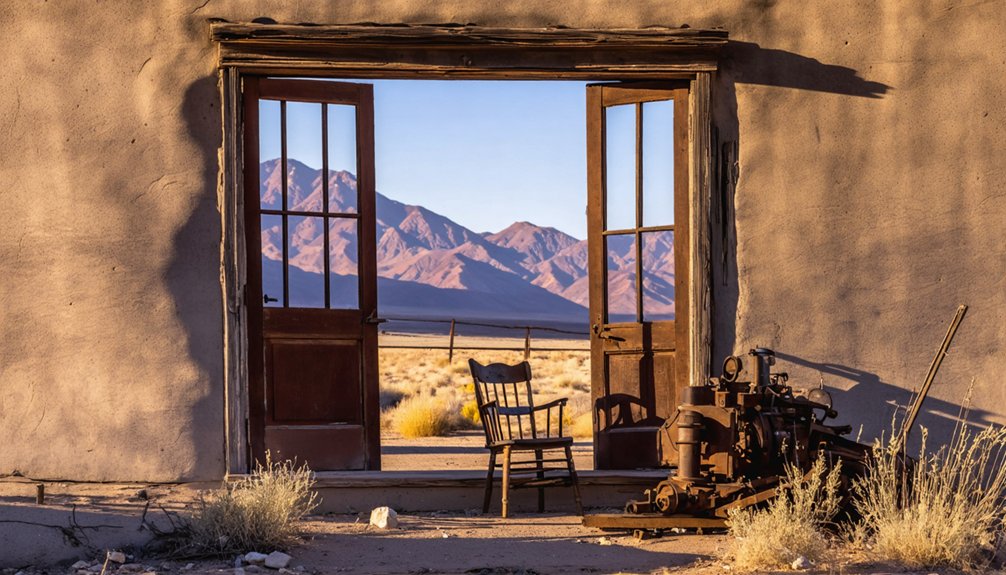
The southwestern corner of New Mexico harbors numerous ghost towns that stand as silent monuments to the region’s boom-and-bust mining era.
You’ll find abandoned structures scattered across this rugged landscape, each telling stories of mining history and economic cycles that shaped the region.
- Shakespeare’s decline followed its brick plant closure and highway rerouting
- Mogollon represents the classic mining bust cycle of the Southwest
- Kingston and Fierro remain as scattered remnants of silver mining operations
- Cooks Peak features only scattered foundations from its silver mining days
These sites reflect the harsh realities of resource-dependent communities.
When mines closed or resources depleted, entire towns often followed suit, leaving behind weathered buildings and quiet streets that once bustled with activity.
Must-Visit Ghost Towns for History Buffs
Among New Mexico’s most compelling historic sites, five ghost towns stand out as essential destinations for anyone fascinated by the American Southwest’s mining and frontier era.
You’ll find ghost town legends at Loma Parda, once known as “Sodom on the Mora,” where soldiers and desperados frequented its notorious saloons.
Chloride’s silver rush remnants tell tales of Apache raids and economic collapse, while Mogollon’s preserved structures echo stories of Butch Cassidy’s gang.
The historical hauntings of Dawson’s mining disasters are memorialized by haunting white crosses marking nearly 400 lost lives.
Lake Valley’s intact buildings showcase the raw character of the Southwest Borderlands silver boom.
Each town offers a unique window into New Mexico’s frontier past, from lawless entertainment to industrial tragedy.
The Stories Behind New Mexico’s Mining Ruins
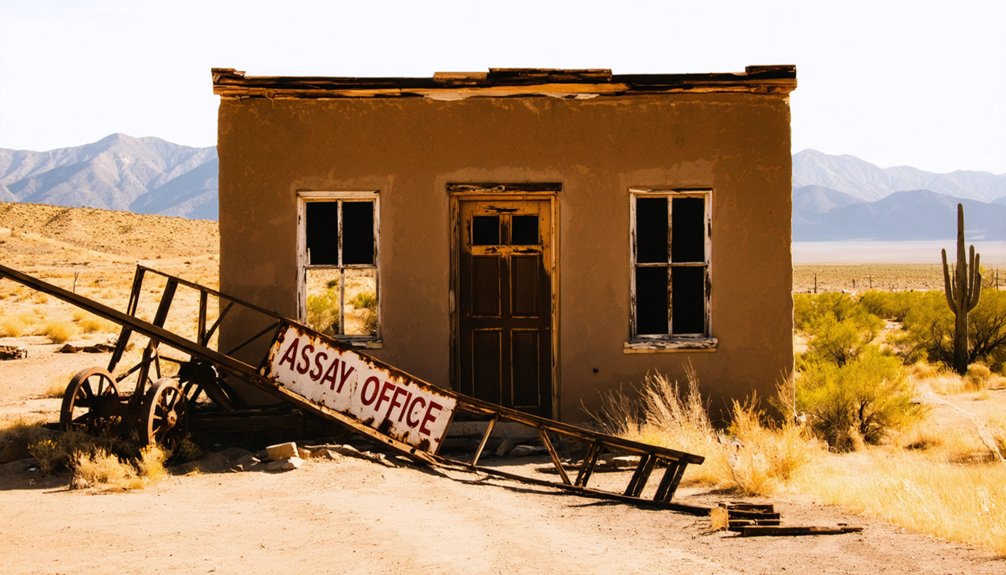
Hidden beneath New Mexico’s rugged terrain lies a rich tapestry of mining history stretching back over half a millennium.
You’ll find evidence of indigenous mining at sites like Cerrillos, where Native Americans extracted turquoise and copper centuries before European contact.
When Spanish colonizers arrived, they merged their techniques with local knowledge, creating unique mining practices that shaped the landscape you see today.
- Archaeological artifacts from 1300-1700 reveal extensive indigenous mining networks and trade routes
- Spanish colonial techniques introduced new methods but relied heavily on indigenous labor systems
- The Pueblo Revolt of 1680 disrupted many mining operations, leading to cycles of abandonment and revival
- World Wars I and II drove demand for zinc and uranium, creating new waves of mining activity that left lasting imprints on the land
Frequently Asked Questions
Are There Any Ghost Towns in New Mexico That Still Have Residents?
You’ll find residents in several New Mexico ghost towns like Mogollon, Pinos Altos, and Hillsboro, where historic preservation efforts and resident stories keep these once-bustling mining communities partially alive today.
What Safety Precautions Should Visitors Take When Exploring Ghost Towns?
Pack safety gear including boots, water, and bear spray. Stay alert for wildlife, unstable structures, and mine shafts. You’ll want a friend along and should inform others of your plans.
Can Visitors Legally Collect Artifacts From New Mexico Ghost Towns?
No, you can’t legally collect artifacts from New Mexico ghost towns. Strict artifact laws protect these sites under federal and state regulations, with heavy fines and jail time for violations of preservation ethics.
Which Ghost Towns Are Accessible During Winter Months?
You’ll find reliable winter accessibility at Glenrio and Cuervo along Route 66, Madrid on NM-14, and White Oaks near US-54. Lake Valley’s seasonal attractions remain open when mountain conditions permit.
Are Guided Tours Available for Any New Mexico Ghost Towns?
You’ll find numerous guided tour options across New Mexico’s ghost towns, with popular ghost tours available at Mogollon, Dawson, Lake Valley, Shakespeare, and Cerrillos through rangers, museums, and private operators.
These abandoned towns across New Mexico hold a rich history and countless stories waiting to be discovered. As you explore their crumbling facades and remnants of the past, the eerie atmosphere will captivate your imagination. Each location offers a unique glimpse into the lives of those who once called these places home.
References
- https://newmexicotravelguy.com/new-mexico-ghost-towns/
- https://compaslife.com/blogs/journal/abandoned-enchantment-ghost-towns-of-new-mexico-1
- https://www.atlasobscura.com/things-to-do/new-mexico/ghost-towns
- https://www.newmexicoghosttowns.net/counties
- https://www.tripadvisor.com/Attractions-g28952-Activities-c47-t14-New_Mexico.html
- https://www.newmexico.org/places-to-visit/ghost-towns/
- https://en.wikipedia.org/wiki/List_of_ghost_towns_in_New_Mexico
- https://www.newmexicomagazine.org/blog/post/abandoned-ghost-towns-new-mexico/
- https://www.newmexico.org/places-to-visit/ghost-towns/map/
- https://www.visitgallup.com/blog/carbon-citys-coal-mining-legacy/