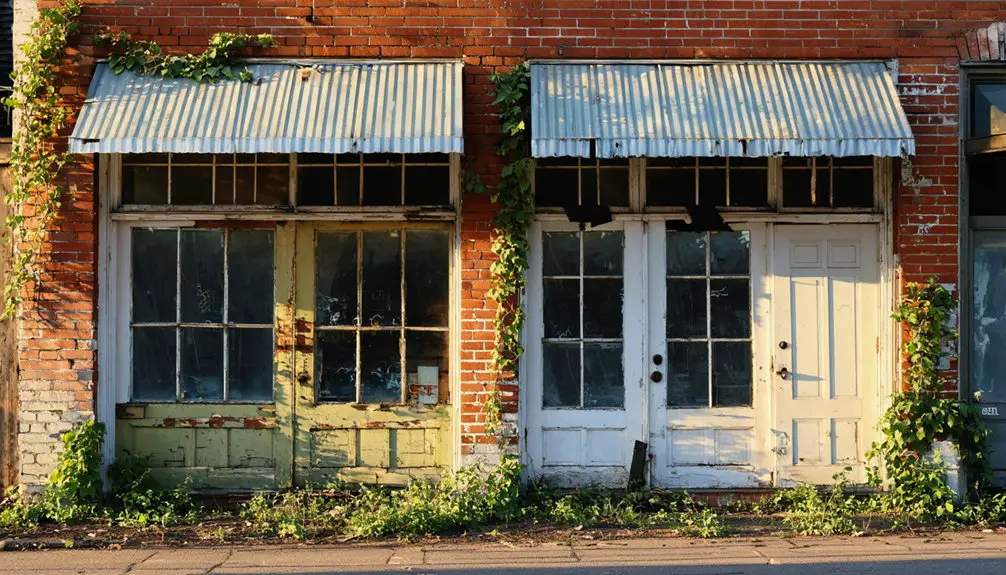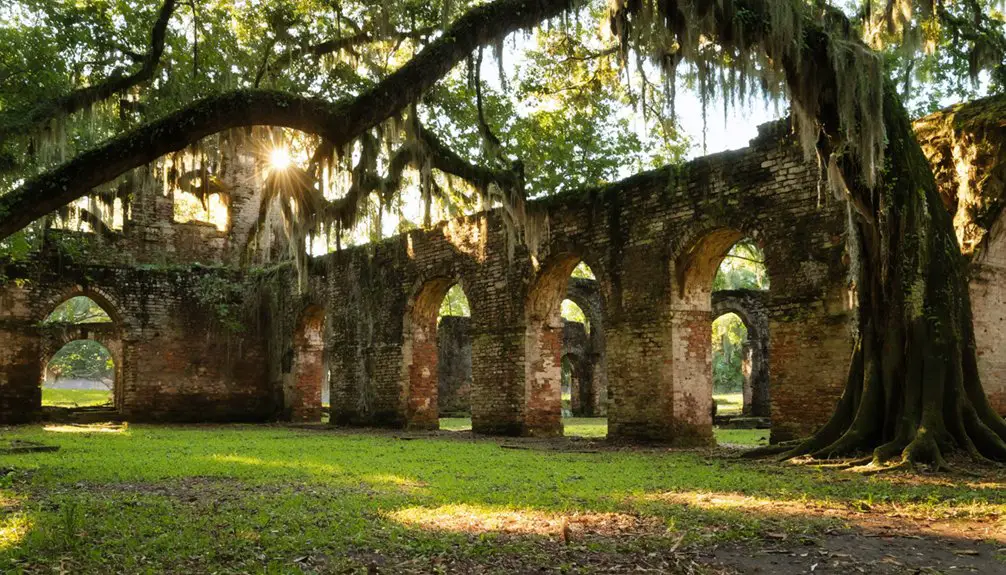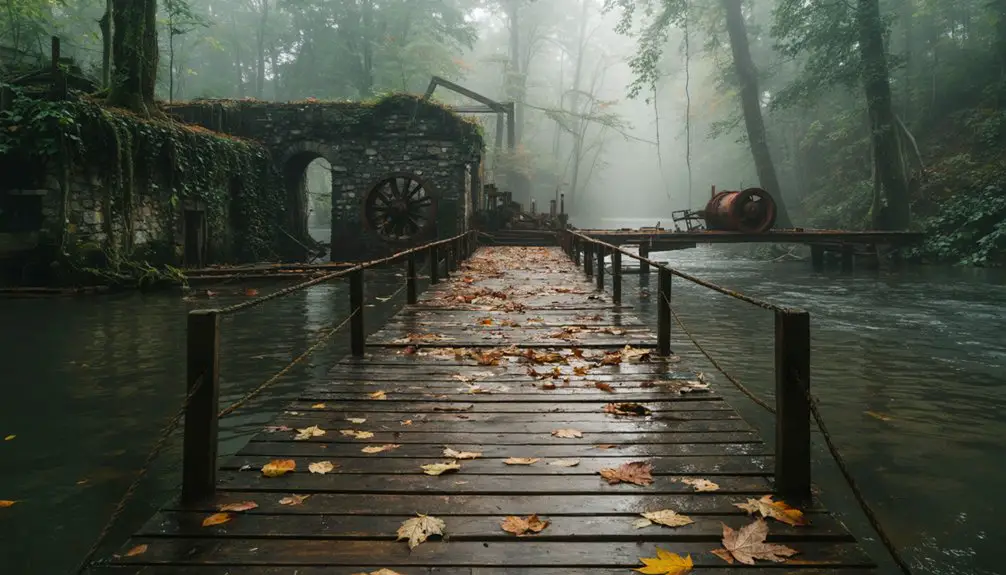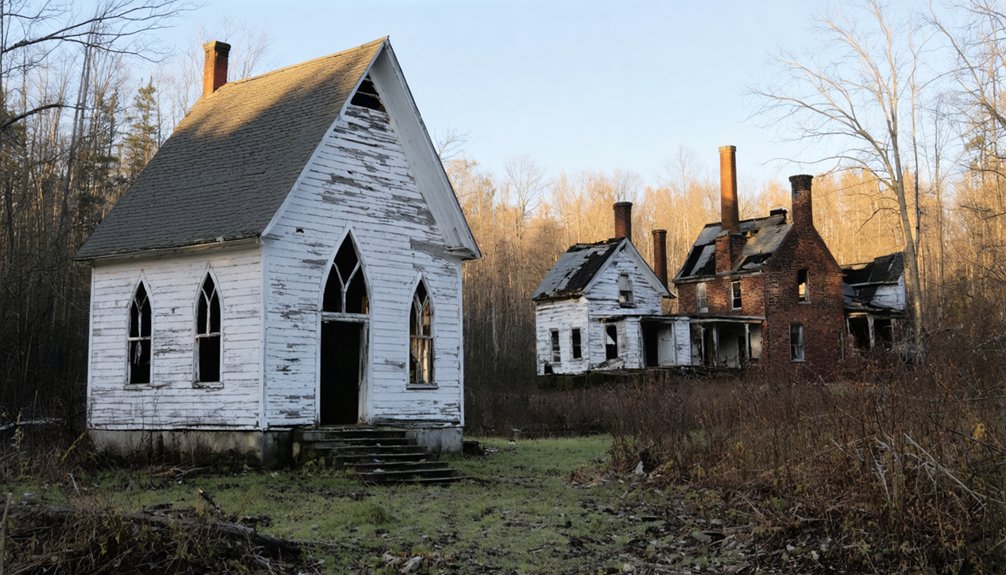
Yes, you’ll find numerous ghost towns across North Carolina, from coastal colonial settlements like Roanoke Island and Portsmouth Village to inland textile communities like Henry River Mill Village. These abandoned places showcase the state’s diverse history of maritime trade, industrial development, and natural disasters. Some, like Brunswick Town, tell stories of Revolutionary War conflicts, while others, like Buffalo City and Diamond City, reflect the rise and fall of lumber operations and coastal communities. Each site offers unique windows into North Carolina’s rich past.
Key Takeaways
- North Carolina has numerous ghost towns, including the famous Lost Colony of Roanoke Island, where 115 colonists mysteriously disappeared in 1587.
- Portsmouth Village, established in 1753, is now an abandoned maritime community accessible only by boat with preserved historic structures.
- Henry River Mill Village, a former textile community, stands abandoned since 1963 and gained fame as District 12 in “The Hunger Games.”
- Buffalo City, once a thriving logging settlement with 500 residents, became famous for moonshine production before being completely abandoned.
- Diamond City was deserted after the 1899 San Ciriaco hurricane, with residents relocating to Harkers Island, leaving their homes behind.
Lost Colonial Settlements Along the Coast
Along North Carolina’s treacherous coastline, early colonial settlements faced numerous challenges that led to their eventual abandonment or disappearance.
You’ll find the most famous example at Roanoke Island, where 115 colonists vanished in 1587, leaving only the mysterious “CROATOAN” inscription behind. Archaeological evidence suggests some settlers may have moved south to live among Indigenous peoples on Hatteras Island.
The lost colony of Roanoke remains history’s greatest American mystery, with only a single word carved in wood as evidence.
The barrier islands’ shifting nature proved particularly hostile to permanent settlement. Coastal migration, inlet changes, and devastating storms forced many 16th and 17th-century outposts to relocate inland. Sir Walter Raleigh’s initial charter of the Virginia territory marked the beginning of these ill-fated settlement attempts. Dangerous shipping conditions made immigration by sea extremely difficult and discouraged many potential settlers.
Small plantations and waterfront communities along the sounds repeatedly succumbed to hurricanes and changing shorelines. Today, you can find traces of these lost settlements through underwater archaeology and artifact scatters in marshlands, telling stories of failed colonial ambitions.
The Rise and Fall of Portsmouth Village
While many colonial settlements faded into obscurity, Portsmouth Village stands as one of North Carolina’s most well-documented ghost towns.
You’ll find its historical significance rooted in its 1753 establishment by the North Carolina Assembly as an essential maritime hub. At its peak in the mid-19th century, you’d have encountered up to 685 residents thriving on maritime trade, lightering, and fishing. The Life-Saving Service Station became a vital part of the community in 1894.
The village’s economic change began after an 1846 storm opened new inlets, diverting shipping routes. You can trace its decline through multiple factors: changing transportation patterns, Civil War disruption, and the gradual isolation of the community. Today, Portsmouth is accessible only by boat and receives roughly 700 monthly visitors during warm weather seasons.
What Remains of Ghost Town in the Sky
Perched atop Buck Mountain at 4,650 feet, Ghost Town in the Sky opened its gates on May 1, 1961, as North Carolina’s ambitious Wild West-themed attraction.
R.B. Coburn’s vision materialized through 40 replica buildings constructed with 300,000 feet of lumber and 200,000 feet of plywood, creating an authentic frontier experience. Over 200 local workers were hired to bring this mountain-top attraction to life.
With 500,000 feet of raw materials, Coburn crafted a frontier fantasy through meticulous attention to Wild West architectural details.
You’d have reached this mile-high park via a double incline railway or the state’s longest chairlift, ascending 3,370 feet to witness staged gunfights and explore themed areas.
At its peak in the early 1970s, Ghost Town drew over 400,000 visitors annually. The park faced a $2,000 fine in 2013 when performers used real firearms during staged gunfights.
However, regional competition and financial struggles led to its closure in 2003.
Today, this once-thriving Abandoned Attraction stands in disrepair, its structures weathering away amid legal disputes and failed revival attempts, serving as a stark reminder of mountain tourism’s golden age.
Henry River Mill: From Textile Hub to Movie Set
You’ll find a rich history at Henry River Mill Village, where the 1902 cotton mill operation produced fine embroidery yarn while housing 450 workers in a self-contained community with its own currency system called “doogaloo.”
The village’s distinctive features, including the company store and worker houses built from sun-baked mud bricks, stood as evidence to early 20th century textile manufacturing until the mill’s closure in 1963 and subsequent destruction by lightning in 1977. Today, visitors can explore the site through guided tours available throughout the day.
The abandoned site gained renewed attention when Hollywood transformed it into District 12’s Mellark Bakery for “The Hunger Games,” leading to its 2019 addition to the National Register of Historic Places. The Calvin Reyes family purchased the property in 2017 for just $360,000 with plans to restore the historic buildings.
Mill History and Purpose
The Henry River Manufacturing Company emerged in 1905 as a significant textile operation during North Carolina’s Cotton Mill Campaign, established on a sprawling 1,500-acre industrial site acquired by the Aderholdt and Rudisill families.
You’ll find textile innovations reflected in the mill’s power evolution, shifting from waterpower to steam and eventually electricity, enabling the company to triple its production by 1963.
The mill community featured 35 worker houses, a boarding house, and a company store where employees could exchange their tokens for goods. The property was later purchased by Wade Sheeper who maintained ownership through significant changes.
As a self-contained industrial village, it exemplified the era’s mill-village planning, though it lacked modern utilities like running water and sewage systems.
The facility produced cotton yarn for regional markets until economic pressures from overseas competition forced its closure around 1970. In 1977, a devastating event occurred when the main mill building burned after being struck by lightning.
Village Life and Culture
While Henry River Mill Village started as a modest textile operation, its tight-knit community of 450 workers eventually transformed the site into a bustling industrial hub during the early-to-mid 20th century.
You’ll find that village traditions centered around the company-controlled aspects of daily life, from the worker housing to the brick company store where residents used “doogaloo” coins for purchases.
The mill’s geographic isolation, surrounded by 1,500 acres of founding family land, fostered close community gatherings among the workforce. Workers lived either in family homes along the mill road or as boarders in the two-story boarding house.
Despite the mill’s closure in the 1960s, some resilient residents remained in their homes until the early 2000s, maintaining their connection to this historic village.
Hollywood Comes to Town
After decades of industrial decline, Henry River Mill Village experienced an unexpected renaissance when Hollywood producers transformed this abandoned textile community into District 12 for the blockbuster film “The Hunger Games.”
In 2011, film crews descended upon the site, recognizing how its weathered brick company store and stark mill houses could perfectly capture the dystopian coal-mining town from Suzanne Collins’ bestselling novel.
The Hollywood influence brought unprecedented attention to this forgotten corner of North Carolina.
You’ll recognize the brick company store as Mellark’s Bakery, while the village’s unaltered early-20th-century architecture provided an authentic backdrop for the film’s impoverished district.
This cinematic landmark status has sparked renewed interest in preservation, prompting the site’s owners to pursue historic designation and develop heritage tourism opportunities while carefully managing access to protect the fragile structures.
Brunswick Town’s Revolutionary Past
Known as America’s first city to boycott the Stamp Act, Brunswick Town emerged as a hotbed of revolutionary resistance years before the American Revolution began.
You’ll find a rich history of Colonial Resistance, where 150 armed patriots surrounded Governor Tryon’s house in 1776, and 500 militia members burned the royal fort in 1775. Under Colonel James Moore’s command, 1,847 men stood ready to defend against British fleets.
The Brunswick Battles intensified when British forces burned the town in 1776, following earlier damage from Spanish privateers in 1748.
By 1780, the town lay in complete ruins. Though General Cornwallis briefly stationed there in 1781, Brunswick Town never recovered.
The site later served as Fort Anderson during the Civil War, protecting Confederate blockade runners until falling to Union forces in 1865.
Buffalo City’s Lumber Legacy
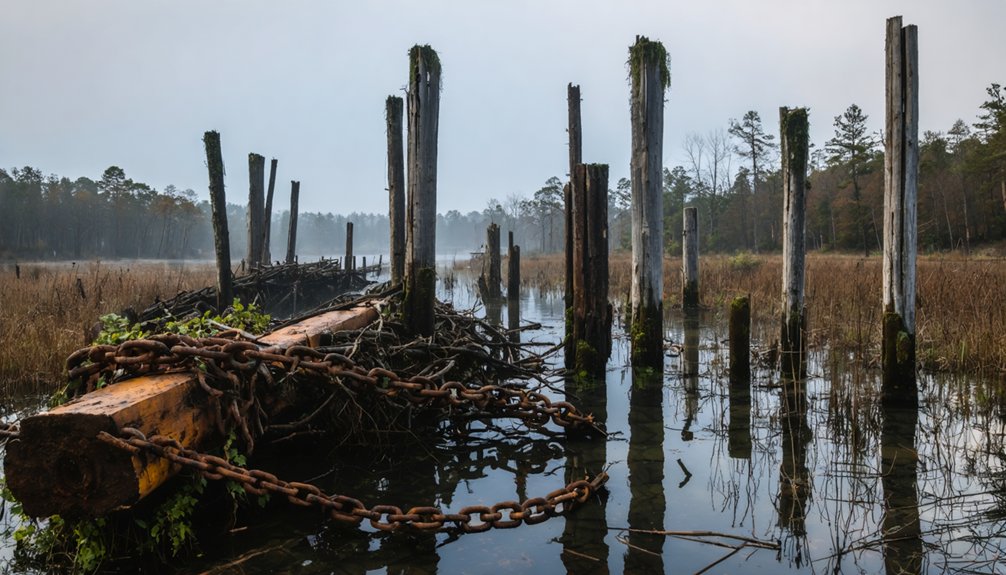
If you’re searching for a lost industrial town in northeastern North Carolina’s maritime forests, you’ll find Buffalo City‘s ghostly remnants amid the swamps where logging operations once extracted valuable juniper, cypress, and pine trees.
The town reached its peak in the early 1900s as the region’s largest logging settlement, with about 500 residents living in identical company houses and using “pluck” currency at the company store.
Though the lumber industry’s decline led to Buffalo City’s eventual abandonment, the town gained notoriety during Prohibition as a remote moonshine hub, where bootleggers utilized the same waterways that once transported timber.
Deep Swamp Logging Operations
In the swampy wilderness of Dare County, Buffalo City emerged in 1870 when the Buffalo Timber Company established a pioneering lumber operation to harvest the region’s abundant maritime forests.
They’d revolutionize logging techniques by constructing over one hundred miles of hand-laid tramways and wooden rail “log roads” across treacherous wetlands.
You’ll find that the timber trade evolved from simple creek-rafting to sophisticated rail-fed transfer systems.
Workers navigated challenging terrain to harvest cypress, juniper, pine, and sweet gum, which they’d transport via Milltail Creek to the Alligator River and Albemarle Sound.
The company brought in Russian loggers for their swamp expertise, while local laborers tackled the backbreaking work of canal construction and manual timber handling.
This intricate operation transformed raw wilderness into a bustling industrial complex.
Prohibition Era Moonshine Hub
While Buffalo City’s lumber industry began declining in the early 1920s, the town rapidly transformed into America’s “Moonshine Capital,” as nearly every family turned to distilling high-quality rye whiskey during Prohibition.
You’d find sophisticated moonshine operations utilizing the town’s strategic waterway access, with operators cleverly towing five-gallon waxed jugs on underwater lines to supply speakeasies from Boston to South Carolina. If federal revenuers approached, the lines could be cut and retrieved later.
The Prohibition impact on Buffalo City was significant – massive sugar and rye shipments arrived regularly at Milltail Creek dock, and the town’s East Lake Whiskey gained such renown that even Al Capone reportedly visited.
The largest moonshine shipment occurred in 1937, strategically timed during Roosevelt’s Lost Colony event when law enforcement was distracted.
Diamond City’s Hurricane Story
Through the violent winds and surging waves of August 17, 1899, the San Ciriaco hurricane, a devastating Category 3 storm, battered the coastal settlement of Diamond City.
The hurricane’s impact on this thriving community of 500 residents proved catastrophic, destroying homes and decimating the maritime forest that had long protected them from the elements.
Nature’s fury devastated Diamond City, leaving 500 residents without shelter as their protective maritime forest succumbed to destruction.
You’ll find a remarkable story of community resilience in the aftermath. William Henry Guthrie led an exodus that would span several years, as residents methodically dismantled their homes and transported them by sailboat to Harkers Island.
They even relocated their ancestors, moving bodies from five cemeteries across the sound. By 1901, Diamond City had transformed into a ghost town, its once-bustling streets now silent.
The population transfer dramatically altered both communities, with Harkers Island growing from 28 to nearly 200 families.
Preservation Efforts and Historical Protection
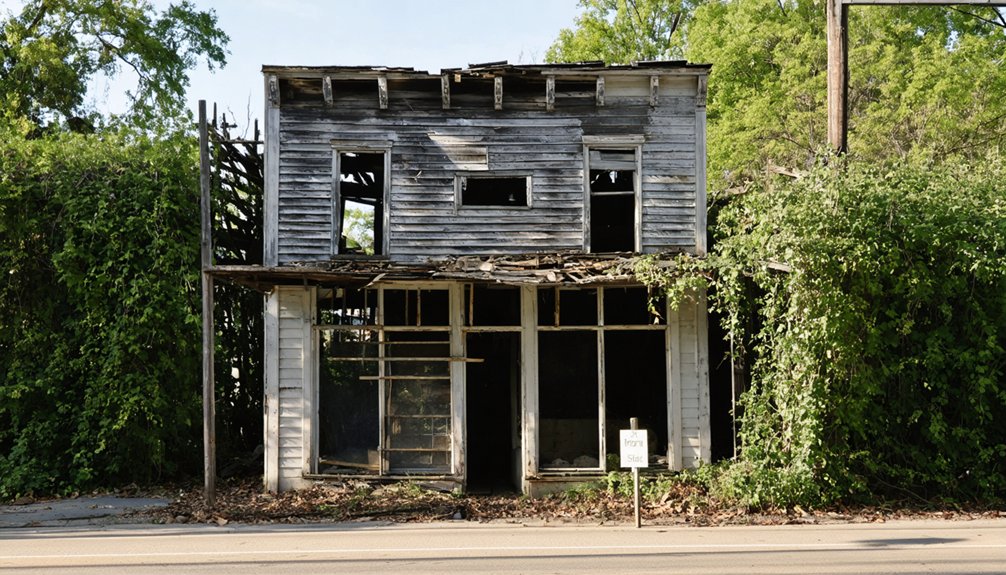
Several preservation initiatives have secured North Carolina’s ghost towns as enduring historical landmarks.
These ghost towns in North Carolina offer a glimpse into the past, showcasing the state’s rich heritage and the stories of those who once inhabited these now-desolate places. Visitors can explore the remnants of old buildings and learn about the history that led to their abandonment, making them intriguing sites for both history buffs and casual tourists alike. As interest in preserving these locations grows, efforts are being made to protect and promote them as vital pieces of North Carolina’s cultural landscape.
Among these historical sites, visitors are also drawn to the haunted accommodations in North Carolina, where eerie tales and ghostly encounters add a chilling dimension to the state’s rich history. Legends of restless spirits fill the air, inviting brave souls to spend the night and experience the thrill of the unknown. Many have reported strange occurrences, making these locations not just a glimpse into the past, but also a unique adventure for those seeking a supernatural experience.
You’ll find the Southern Appalachian Highlands Conservancy protecting Lost Cove’s historical significance through their 95-acre acquisition, while the National Park Service maintains crucial connections to Proctor Cemetery through annual Decoration Day shuttles.
The preservation challenges in Cataloochee Valley showcase successful conservation, with historic buildings standing as time capsules amid grazing elk.
Coleridge’s Historic District represents a remarkable example of textile mill village preservation, though its privately-owned structures face ongoing stability concerns.
In Mortimer, you can explore the remnants of Civilian Conservation Corps efforts, where Wilson Creek’s outdoor activities blend seamlessly with preserved historical sites, despite past fire and flood devastation.
Planning Your Visit to NC Ghost Towns
Ready to explore North Carolina’s ghost towns? Understanding travel tips and ghost town accessibility will help you plan an enriching expedition to these historic sites. Each location offers unique opportunities for discovery while requiring specific preparations.
- Brunswick Town provides year-round access via US 17, with winter visits offering fewer crowds for exploring colonial ruins.
- Lost Cove requires a challenging hike through Pisgah National Forest, best attempted during spring’s mild weather.
- Road to Nowhere near Bryson City features an accessible drive to the tunnel, followed by hiking trails.
- Cape Lookout Village and Portsmouth require boat transportation, ideal for summer exploration.
- Mountain ghost towns like Cataloochee showcase spectacular fall colors, enhancing your historic experience.
Remember to secure necessary permits, check weather conditions, and bring appropriate gear for your chosen destination.
Frequently Asked Questions
Are Any Ghost Towns in North Carolina Rumored to Be Haunted?
You’ll find haunted locations at Brunswick Town, where visitors report ghostly legends of unexplained sounds, and Henry River Mill Village, where people encounter mysterious footsteps and cold spots in abandoned buildings.
Can Metal Detectors Be Used at North Carolina Ghost Town Sites?
You can’t legally use metal detectors at NC ghost town sites due to strict metal detecting regulations protecting historical artifacts – whether on state, federal, or private lands.
Which Ghost Town in North Carolina Is the Most Complete?
You’ll find Ghost Town in the Sky in Maggie Valley stands as North Carolina’s most preserved ghost town, with its complete Old West streets, themed areas, and original structures maintaining exceptional historical significance.
Do Any North Carolina Ghost Towns Still Have Permanent Residents?
Like flickering candles in abandoned halls, you’ll find current residents in two NC ghost towns: Whitakers maintains 581 people despite its decay, while an unnamed Caldwell settlement houses 16 families along mountain streams.
What Wildlife Commonly Inhabits North Carolina’s Abandoned Ghost Towns?
You’ll find diverse wildlife species including white-tailed deer, coyotes, barn owls, eastern box turtles, and various songbirds thriving in these abandoned spaces, which serve as natural habitat preservation zones.
References
- https://www.uncorkedasheville.com/abandoned-places-in-north-carolina/
- https://www.youtube.com/watch?v=iWhjTfCyUpY
- https://kids.kiddle.co/List_of_ghost_towns_in_North_Carolina
- https://www.visitnc.com/list/ncs-mysterious-disappearances-and-abandoned-places
- https://www.atlasobscura.com/things-to-do/north-carolina/ghost-towns
- http://www.onlyinyourstate.com/experiences/north-carolina/nc-ghost-towns
- https://kenyonreview.org/kr-online-issue/2018-julyaug/selections/nell-boeschenstein-656342/
- https://www.ncpedia.org/history/colonial/coastal-plain
- https://www.firstcolonyfoundation.org/history/the-roanoke-colonies/
- https://www.britannica.com/place/Lost-Colony