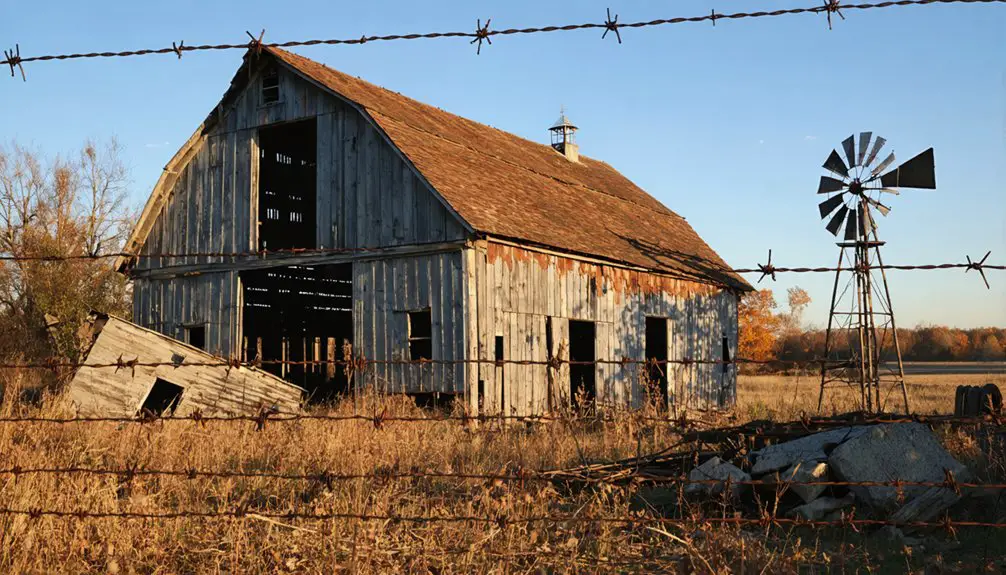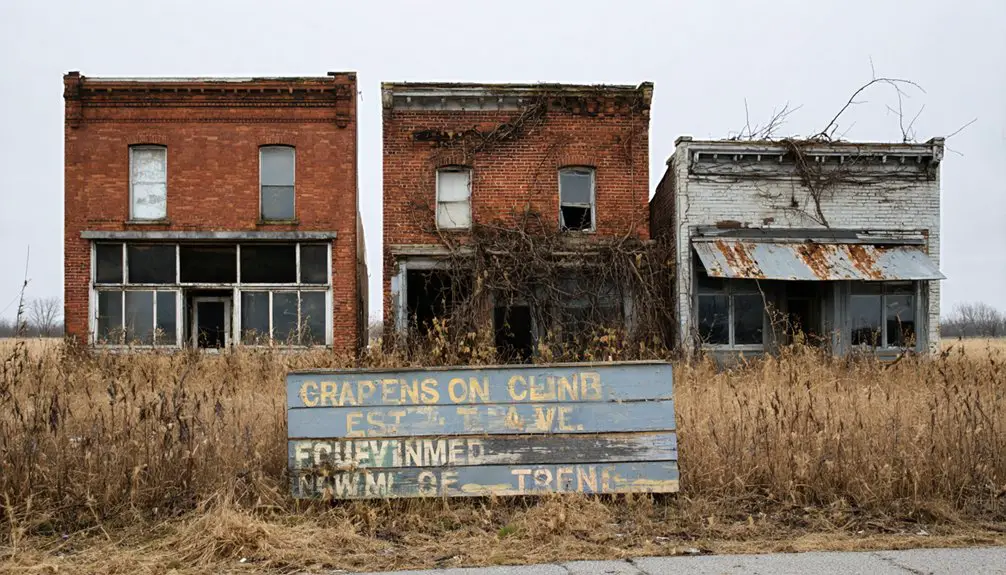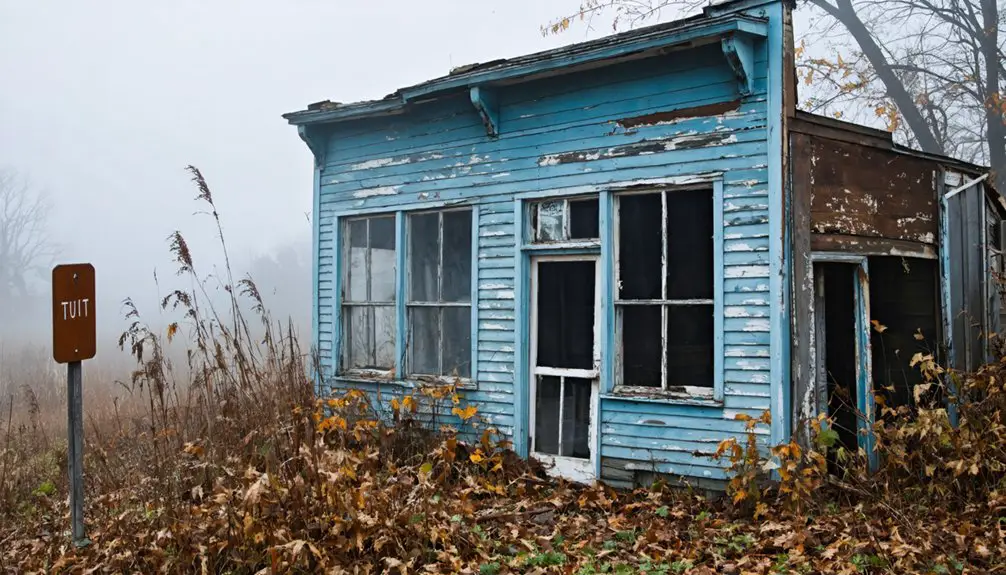
You’ll find over 130 documented ghost towns scattered across Ohio’s landscape, from abandoned mining settlements to former canal communities. These historic sites include Moonville, known for its iconic tunnel and supernatural tales, and Helltown in Cuyahoga Valley National Park. Many towns were abandoned due to economic shifts, natural disasters, and infrastructure projects. The most intriguing locations offer remnants of Ohio’s industrial heritage, with preservation efforts ensuring these forgotten communities’ stories endure for future generations.
Key Takeaways
- Ohio has numerous ghost towns, including the famous Moonville with its iconic tunnel and railroad ruins from the 1800s.
- Helltown, located in Cuyahoga Valley National Park, stands as one of Ohio’s most well-known abandoned settlements.
- Many ghost towns emerged from abandoned mining operations, including San Toy, which transformed from a bustling coal town.
- Economic shifts, natural disasters, epidemics, and infrastructure projects like dam construction led to the abandonment of Ohio towns.
- Historical sites like Atwood Lake, Frankford, and Elm Grove preserve remnants of early Ohio settlements near waterways and transportation routes.
The Rich History of Ohio’s Abandoned Settlements
While many of Ohio’s ghost towns emerged during the state’s industrial and transportation boom years, their paths to abandonment reveal complex patterns of economic shifts, natural disasters, and societal changes.
From thriving hubs to empty streets, Ohio’s ghost towns tell stories of economic upheaval, nature’s fury, and changing times.
You’ll find abandonment causes ranging from devastating epidemics that struck settlements like Newville and Hindostan Falls in the 1820s, to the decline of canal-dependent communities like Sprucevale and Hartford.
The historical significance of these lost towns includes unique stories of utopian experiments, such as the ill-fated spiritualist settlement that followed Mormon interest in Newville, and thriving industrial centers like Moonville and Haydenville that couldn’t survive when their economic foundations crumbled. Many of these ghost towns remain forgotten by GPS today, making them challenging to locate.
Infrastructure projects, including dam construction and highway development, sealed the fate of communities like New Burlington and Boston Mills. Today, some of these abandoned settlements have found new purpose through preservation efforts, with restored buildings serving as historical landmarks within protected areas like the Cuyahoga Valley National Recreation Area.
Notable Ghost Towns Across Ohio
Throughout Ohio’s diverse landscape, four distinct categories of ghost towns offer fascinating glimpses into the state’s past: the haunting remains of Moonville with its iconic tunnel, the controversial “Helltown” area within today’s Cuyahoga Valley National Park, numerous canal and river town remnants, and the sites of failed utopian experiments.
You’ll find these forgotten communities scattered across the state, each telling unique stories of economic change and social transformation. Many communities became ghost towns when major industries closed, forcing residents to seek opportunities elsewhere. Some towns like Atwood Lake were deliberately abandoned to manage flooding issues.
At Moonville, you can explore the legendary tunnel and railroad ruins, while Helltown‘s abandoned structures remind visitors of the federal land acquisitions that transformed Boston Township.
Historic landmarks like Tadmor’s canal earthworks and Carpenter’s Mill’s stone foundations showcase Ohio’s industrial heritage, while places like Utopia represent ambitious social experiments.
These sites now serve as protected cultural resources under park management, though many require careful navigation of access restrictions.
Mining and Industrial Ghost Towns
During Ohio’s industrial age, coal and iron mining operations established numerous company towns that later became abandoned settlements across the state’s southeastern region.
You’ll find remnants of this mining heritage in places like Moonville, where only a tunnel and cemetery remain from its 1800s heyday.
San Toy exemplifies the industrial decline, transforming from a bustling coal town to little more than an old jail at a rural crossroads.
Once home to thousands, San Toy’s lonely jail now stands sentinel over empty streets where industry once thrived.
The iron industry left its mark through abandoned furnaces like Hope, Steam, and Olive, which operated throughout the 1800s.
While some communities like Shawnee and Glouster maintain a mix of active and abandoned structures, others have vanished entirely. Hope Furnace once supported a thriving community of 300 peak residents.
The closure of railways and mines led to the widespread abandonment of these once-thriving communities.
Floodwood disappeared completely, though New Floodwood emerged across the Hocking River, preserving traces of Ohio’s industrial past.
Canal and Railroad Town Remnants
Ohio’s transportation evolution left behind numerous ghost towns centered around its historic canals and railroads.
You’ll find remnants of canal infrastructure throughout the state, including filled canal beds, crumbling locks, and warehouse foundations from the 1820s-1840s boom era. These canal towns declined rapidly once railroads offered faster shipping options.
Railroad features are even more prevalent, with abandoned towns marking former rail stops, branch lines, and short-line corridors. Vinton County’s mining operations employed workers who were paid in company tokens at the company store. The ghost town of Moonville once housed 100 residents during its peak in the 1800s.
You can explore old tunnels, trestles, and depot foundations, while rail-trails now provide access to previously restricted sites. Notable examples like Moonville showcase surviving railroad tunnels and cemeteries despite the disappearance of surrounding structures.
County histories, railroad maps, and historical society records help locate these vanished settlements, making them accessible for modern exploration.
Haunting Tales From Moonville and Helltown
You’ll find the most haunting tales from Ohio’s ghost towns in Moonville, where over 27 deaths along its treacherous railroad tracks have led to numerous supernatural sightings, including the ghost of Engineer Theodore Lawhead swinging his phantom lantern.
The tunnel’s narrow design offered no escape from oncoming trains, resulting in tragic accidents that spawned apparitions photographed over decades, from hovering orbs to spectral trainmen forcing emergency stops. The area’s heavy forest cover creates an especially eerie atmosphere for visitors exploring the ruins.
While most of the town has crumbled into the surrounding Hocking Hills woods, the infamous Moonville Tunnel and cemetery remain accessible, preserving these chilling stories for modern visitors. Today, the annual Midnight at Moonville Festival brings thousands of visitors to celebrate the town’s spooky heritage and Appalachian culture.
Eerie Tunnel Train Deaths
While many ghost towns have dark histories, the Moonville Tunnel stands out for its well-documented record of railway fatalities spanning over a century.
These tragic histories have made the tunnel notorious for ghostly encounters, with at least 21 deaths recorded along the Moonville-Raccoon Creek corridor.
- Head-on collisions claimed multiple crew members due to single-track operations
- Workers met gruesome ends from falling under moving trains while inspecting equipment
- Pedestrians were struck while walking between isolated communities on trestles
- Trespassers lost their lives sleeping or wandering intoxicated on the tracks
- Communication failures led to devastating crashes when trains occupied the same track
The tunnel’s deadly reputation stems from real incidents, documented in contemporary newspapers from 1859 through the late 20th century, with the final recorded death occurring between 1978 and 1986.
Local Legend Supernatural Sightings
Stories of supernatural encounters at Moonville Tunnel have persisted for over a century, with multiple distinct apparitions and phenomena reported by locals and visitors alike.
You’ll hear tales of the lantern-wielding engineer Theodore Lawhead, who’s said to appear near the site of an 1880s train collision, and the mysterious “Lavender Lady,” an elderly woman reportedly struck by a train.
The tunnel’s ghostly apparitions include a brakeman who met his fate on the tracks and numerous spectral sightings tied to the nearby cemetery.
While visiting, you might encounter unexplained lights, shadow figures, or cold spots that ghost hunters frequently document through photos and EVP recordings.
The site’s remaining physical features – the tunnel entrance, cemetery, and foundation stones – continue to draw investigators seeking evidence of these persistent supernatural claims.
Government Takeover Sparks Mystery
The government’s acquisition of Moonville and its surrounding areas marked a significant change from paranormal mysteries to bureaucratic complexities.
As government policies reshaped the landscape through land reclamation efforts, you’ll find that the state’s takeover transformed this once-thriving community into a carefully managed historic site.
- The Ohio Department of Natural Resources assumed control, designating Moonville Tunnel as Historic Site #15
- Local townships witnessed systematic property consolidations throughout the 1930s and 1940s
- Railroad rights-of-way transferred to state control after rail operations ceased
- The state’s acquisition for Zaleski State Forest brought strict land-use restrictions
- Public access became regulated under new preservation frameworks
This alteration from private to public ownership didn’t just change management – it fundamentally altered how you can interact with this historic ghost town‘s remains.
Economic Factors Behind Ohio’s Ghost Towns
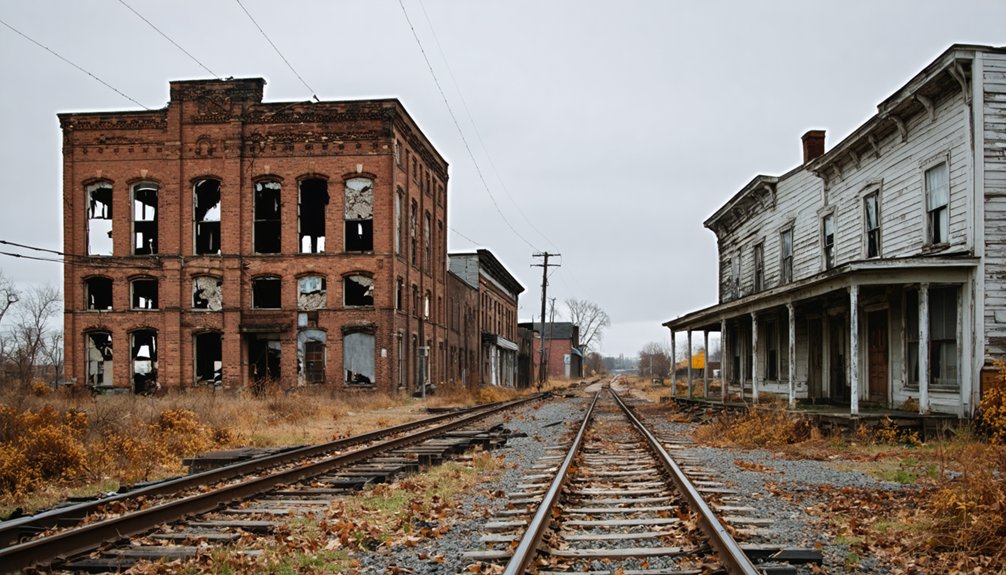
Throughout Ohio’s industrial history, distinct economic forces transformed bustling communities into ghost towns, with five primary factors driving their decline: coal industry collapse, steel mill shutdowns, canal and railroad failures, government land acquisitions, and resource exhaustion.
You’ll find that coal’s economic decline hit southeastern Ohio particularly hard, as towns like Moonville and Mineral witnessed severe population migration once their mines closed. These communities, which once housed up to 1,000 residents, couldn’t survive when coal seams were depleted.
Similarly, steel towns like Mingo Junction and Lorain suffered devastating blows from deindustrialization. The steel industry’s collapse left behind empty factories, abandoned homes, and widespread poverty.
Deindustrialization ravaged Ohio’s steel towns, turning thriving communities into shells of empty buildings and economic despair.
Canal towns faced extinction when railroads emerged as superior transportation, while resource-dependent sites like Oreton vanished after their iron furnaces, coal mines, and timber operations became obsolete.
Exploring Hancock County’s Lost Communities
You’ll find some of Hancock County’s earliest lost settlements concentrated near waterways and early transportation routes, including Waterloo along Eagle Creek and several small communities in Marion Township.
The arrival of railroads reshaped the county’s settlement patterns, leaving behind abandoned depots and former rail stops at locations like Five Points.
Physical remnants of these railroad-era ghost towns can still be traced through surviving right-of-ways and historic lot layouts documented in county land records.
Early Settlement Locations
During the early 1800s, Hancock County saw several ambitious settlement attempts that ultimately became ghost towns, including Capernaum, Frankford, Alba, Ashery, and Elm Grove.
You’ll discover fascinating settlement patterns across these lost communities that shaped the county’s early development.
- Capernaum history reveals Abraham Huff’s 1825 arrival and an 1831 platting of 16 lots that never sold.
- Frankford significance stems from its ambitious 72-lot plan, though it failed to attract settlers.
- Alba origins remain part of the county’s earliest lost settlement records.
- Ashery details showcase its rural roots as an early township development.
- Elm Grove stands as Marion Township’s record of pioneer settlement ambitions.
These vanished communities represent the determination and challenges faced by Ohio’s early settlers.
Railroad Town Remnants
As railroad companies expanded across Hancock County in the late 1800s, they established a network of stations, flag stops, and small communities that would later become ghost towns.
You’ll find railroad station remnants scattered throughout the region, from Arlington’s former depot site to Mortimer’s rebuilt station that replaced the one lost to fire in 1947.
The abandoned railroads tell stories of once-thriving locations like Huber, which maintained a post office until 1901, and El Rose, which struggled with low traffic even in its prime.
Some communities, like Ashery, never secured their hoped-for stations and faded away.
Today, you can trace these lost settlements through remaining structures, abandoned grades, and former rights-of-way visible in satellite imagery, particularly along the old Sandusky, Dayton & Cincinnati Railroad route.
Preservation Efforts and Historical Sites
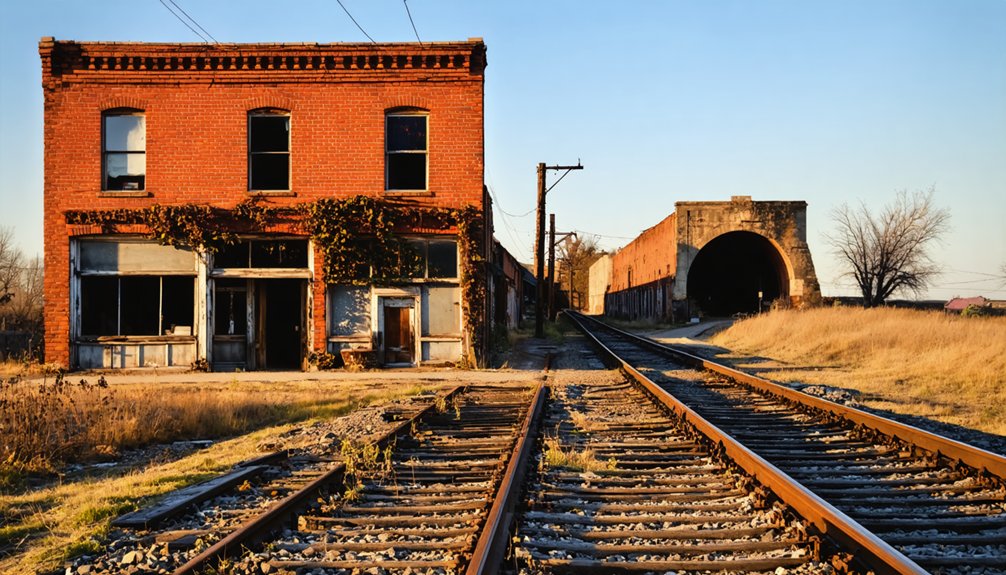
Several dedicated organizations work tirelessly to preserve Ohio’s ghost towns and their historical structures through innovative programs and community initiatives.
From the Moonville Rail Trail Association’s bridge construction to Zoar Village’s participation in the Collections Assessment for Preservation program, these preservation initiatives protect invaluable historical landmarks across the state.
- You’ll find Hale Farm & Village rescuing threatened structures through their relocation program, carefully restoring each building to its original glory.
- The Ohio Ghost Town Exploration Co. provides precise GPS coordinates while promoting respectful site exploration.
- Moonville’s preserved railroad tunnel draws annual pilgrimages.
- Zoar’s Town Hall Museum receives professional conservation assessments.
- The Shaker Trace Trail lets you explore preserved lower village buildings and a historic cemetery.
You can experience these carefully maintained sites while supporting ongoing preservation efforts through various historical organizations.
Planning Your Ghost Town Adventure
Ready to explore Ohio’s ghost towns? Start by gathering essential adventure gear including sturdy boots, flashlights, and water supplies.
As you gear up for your journey, consider taking a trip to explore deserted places near Columbus. These hidden gems offer a fascinating glimpse into the past and a chance to capture some stunning photographs. Be sure to bring a partner along for safety and to share the experience of uncovering Ohio’s forgotten history.
In addition to exploring ghost towns in Ohio history, consider researching the stories behind each location to enrich your adventure. Each site has its own unique narrative that reflects the state’s rich cultural heritage. As you walk through these silent streets, you’ll feel a connection to the lives that once thrived there, making your expedition all the more meaningful.
You’ll need detailed maps or GPS coordinates, as many sites like De La Palma aren’t on standard navigation systems. For ghost town photography opportunities, plan your visits during daylight hours and pack high-visibility clothing.
Access points vary by location – you’ll find Moonville via Hope-Moonville Road, while Boston Mills is accessible through Cuyahoga Valley National Park.
Navigate Ohio’s forgotten places through marked entrances – Moonville’s Hope-Moonville Road leads the way, while Boston Mills welcomes visitors via Cuyahoga Valley.
When visiting, respect private property boundaries and follow Leave No Trace principles. For the best experience, check weather forecasts to avoid muddy conditions, download offline maps, and travel in groups.
Consider combining your ghost town visits with nearby attractions, like pairing Moonville exploration with local mining history exhibits.
Frequently Asked Questions
Are Camping or Overnight Stays Allowed at Ohio Ghost Town Sites?
Want to camp at Ohio’s ghost towns? You’ll need explicit permission, as camping regulations and overnight policies typically prohibit stays. Most sites require landowner approval or park permits for legal access.
What Photography Permits Are Required When Visiting These Abandoned Locations?
You’ll need permits for commercial photography at abandoned sites near parks or protected areas. Check location restrictions with local authorities, as many ghost towns overlap with regulated public and private lands.
How Dangerous Are the Structural Conditions of Remaining Buildings?
You’re literally gambling with your life. These buildings have zero structural integrity due to decades of decay. Always take extreme safety precautions – most floors, walls, and roofs could collapse instantly.
Can Metal Detectors Be Used to Search Ohio Ghost Towns?
You can’t legally use metal detectors at Ohio ghost towns due to strict metal detecting regulations and historical artifact preservation laws. You’ll need permits for public lands and owner permission for private sites.
Which Ghost Towns Are on Private Property Versus Public Land?
You’ll find Boston Mills, Moonville, and Fallsville on accessible public land, while SanToy, Haydenville, and Orbiston remain under private ownership. Some sites like Moonville Tunnel have mixed land accessibility status.
References
- https://en.wikipedia.org/wiki/List_of_ghost_towns_in_Ohio
- https://ohioghosttowns.org/top-10-ghost-towns/
- https://wrkr.com/ohio-ghost-towns/
- https://www.onlyinyourstate.com/trip-ideas/ohio/road-trip-ghost-towns-oh
- https://www.atlasobscura.com/things-to-do/ohio/ghost-towns
- https://www.youtube.com/watch?v=QWTtG6njIDs
- https://ohio.org/travel-inspiration/articles/haunted-ohio-must-visit-places
- https://ohioghosttowns.org
- https://ohiohome.org/news/blog/october-2022/ghosttowns.aspx
- https://www.heraldtimesonline.com/story/lifestyle/home-garden/2020/05/01/ghost-towns-in-ohio-and-indiana/43807535/