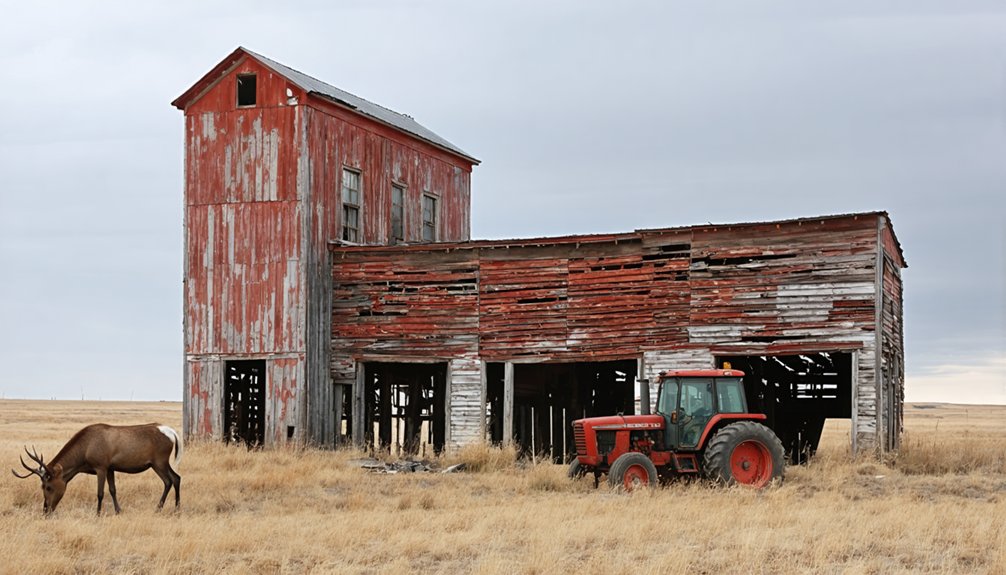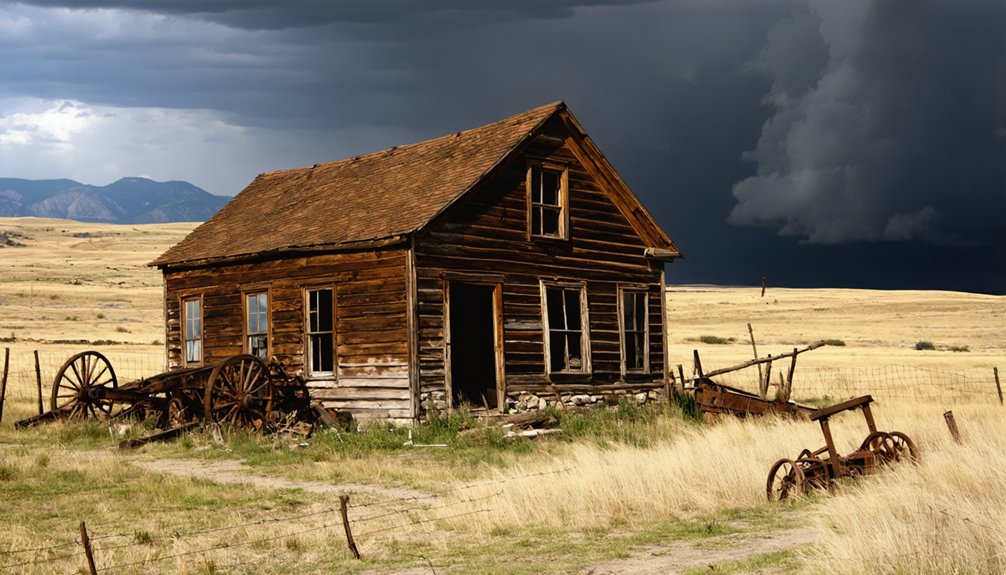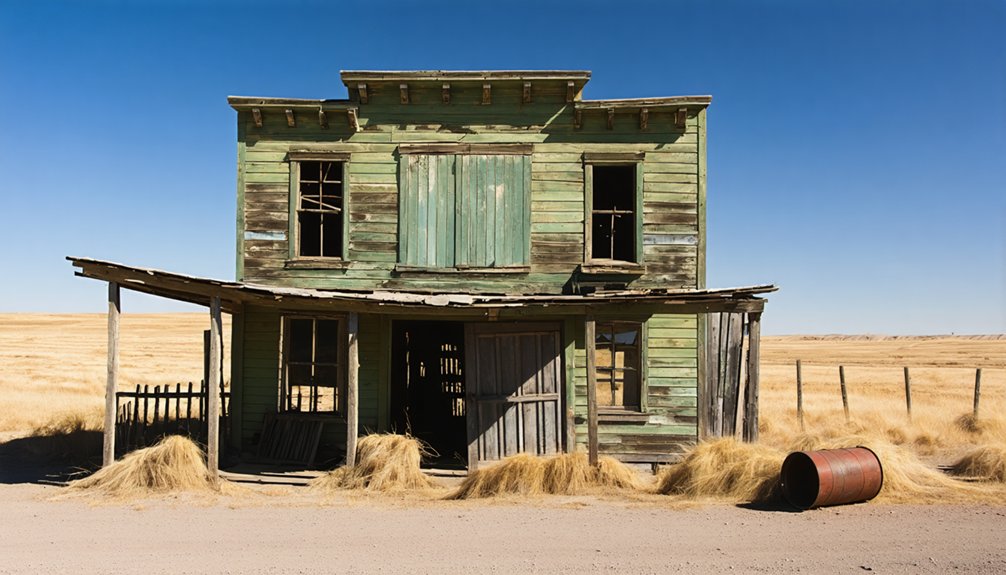
You’ll find over 845 documented ghost towns across South Dakota, with the highest concentration in the Black Hills region. These abandoned settlements include mining towns from the 1870s gold rush, featuring preserved structures like shaft houses and stamp mills, as well as prairie towns left behind when railroads changed course. While many sites are on private land, numerous accessible locations offer glimpses into South Dakota’s boom-and-bust past. The stories behind these silent remnants reveal fascinating chapters of frontier history.
Key Takeaways
- South Dakota has over 245 documented ghost towns statewide, with approximately 600 in the Black Hills region alone.
- The Black Hills Gold Rush of the 1870s created numerous mining ghost towns featuring abandoned mines, mills, and settlement ruins.
- Prairie ghost towns formed when railroads bypassed communities or ceased operations, leaving behind grain elevators and abandoned depots.
- Notable ghost towns include Galena, which has preserved schoolhouses and foundations, and Cottonwood with various abandoned structures.
- Most ghost towns qualified for this status through population decline below 25 residents and loss of their original economic purpose.
What Defines a South Dakota Ghost Town
While many communities claim ghost town status in South Dakota, establishing clear criteria for this designation has proven challenging for historians and researchers.
The most widely accepted criteria classification requires that a settlement must have first achieved town status with a nucleus of population serving formal social and economic functions.
A true ghost town must first have been a living one, complete with people and purpose at its heart.
You’ll find that population decline below twenty-five residents, combined with a sustained pattern of attrition, typically qualifies a location as a ghost town. Additionally, the settlement must have lost its original economic purpose and formal functions. The town of Argonne exemplifies this pattern, as its population fell to just eight residents by 1970.
Physical evidence, such as dilapidated buildings, foundations, or cemeteries, helps validate the designation. A comprehensive study identified 245 abandoned settlements that met these ghost town criteria in South Dakota. If a community regains its population and functions, it can be removed from ghost town status, making this a dynamic classification system.
Mining Ghost Towns of the Black Hills
The Black Hills Gold Rush of the 1870s spawned dozens of mining settlements that now stand as ghostly remnants of South Dakota’s mineral extraction era.
You’ll find these abandoned towns scattered throughout the region, with most dating from 1875 to the 1880s when gold fever was at its peak.
The mining infrastructure that remains tells the story of the era’s hard-rock operations. You can explore remnants of shaft houses, stamp mills, and cyanide processing vats at sites like Trojan and Rochford. Many towns feature crumbling buildings and rubble as telltale signs of their abandoned status.
Ghost town hunters engage in patient searches to uncover the fascinating histories of these abandoned places.
Towns like Galena, once home to 400 residents, now feature preserved schoolhouses and scattered home foundations. Some sites, like the original Pactola settlement, lie submerged beneath modern reservoirs.
While these ghost towns offer fascinating glimpses into the past, you’ll need to exercise caution – open mine shafts and unstable structures make many sites hazardous.
Prairie Ghost Towns and Railroad Remnants
Across South Dakota’s vast prairie landscape, you’ll find abandoned settlements that trace the rise and fall of railroad-era towns. When railroads bypassed or abandoned their routes, these once-thriving communities faced economic collapse and population loss. Towns like Bon Homme and Okaton illustrate how railroad abandonment sealed the fate of many prairie settlements.
Today, you can spot prairie relics that mark these forgotten places. Grain elevators stand as the most prominent survivors, while abandoned depots, concrete foundations, and overgrown trackbeds reveal where bustling communities once stood. Notable ghost towns include Cottonwood with its warped church and brick store ruins, and Owanka with its multiple abandoned buildings. Many of these sites have evolved into unpopulated standing structures that serve as historical markers of the past. The historic 1880 Town in Midland offers visitors a glimpse into authentic frontier life through its carefully preserved buildings.
The Great Depression, agricultural mechanization, and the shift to truck transport accelerated the decline of these railroad-dependent prairie towns throughout the 20th century.
Visiting Guidelines and Safety Precautions
Before exploring South Dakota’s ghost towns, visitors must follow essential safety protocols and preservation guidelines that protect both themselves and these historic sites.
Key safety tips include wearing sturdy hiking boots for traversing uneven terrain and packing adequate water and snacks, as many locations lack nearby services.
Prepare for remote ghost town exploration with proper footwear and provisions – these historic sites offer no modern amenities.
You’ll need to check weather forecasts and road conditions, particularly in the Black Hills region, where conditions can change rapidly.
Visitor etiquette requires respecting “No Trespassing” signs and obtaining necessary permissions before entering private property.
Practice Leave No Trace principles and avoid climbing or entering historic structures.
When photographing buildings, maintain a safe distance and stay aware of your surroundings.
For guided experiences, book tours in advance at locations like Deadwood or the Homestake Mine.
The best times to visit ghost towns are during spring and fall when crowds are minimal and weather conditions are favorable.
Many sites like Galena and Rochford showcase fascinating remnants of the 1870s gold rush era.
Historical Documentation and Preservation Efforts
Extensive documentation efforts have cataloged South Dakota’s vanishing ghost towns through systematic research and preservation initiatives. You’ll find detailed studies identifying over 245 ghost town sites statewide, with an additional 600 documented locations specifically in the Black Hills region.
Among these efforts, several historic sites in South Dakota have been prioritized for preservation due to their cultural significance. Many of these locations offer guided tours and educational programs, inviting visitors to explore the rich history embedded in the landscape. Additionally, ongoing conservation projects aim to protect these sites for future generations to enjoy and learn from.
Exploring ghost towns in South Dakota provides a unique glimpse into the state’s history, where remnants of bygone eras captivate the imagination. Each abandoned building and rusted artifact tells a story of resilience and transformation, echoing tales of the settlers who once thrived there. As you journey through these desolate landscapes, you’ll come to appreciate the profound legacy these ghost towns represent within the broader narrative of South Dakota’s past.
The historical significance of these sites is preserved through detailed records on index cards, mapping projects, and historical society publications. Towns like the one established in 1906 with railroad workers showcase the crucial role of transportation infrastructure in these settlements.
Documentation efforts face preservation challenges as many structures continue deteriorating beyond repair. You can explore the remnants of mining camps like Hornblend and Blue Lead through USGS maps, while sites like Maitland and Golden West showcase decaying shaft houses.
The South Dakota Historical Society has documented military camps, logging operations, and mining communities, preserving important details about settlement patterns, economic shifts, and transportation networks that shaped these abandoned towns.
Frequently Asked Questions
Can You Legally Take Artifacts or Souvenirs From South Dakota Ghost Towns?
Crumbling walls whisper tales of history, but you can’t legally remove artifacts from ghost towns. Legal regulations require permits, and artifact preservation laws protect these sites on federal, state, and private lands.
Are There Any Reportedly Haunted Ghost Towns in South Dakota?
You’ll find haunted legends concentrated in Deadwood, where paranormal sightings are frequently reported at the Bullock Hotel, Lucky Nugget Casino, and throughout town, especially near Mount Moriah Cemetery’s historic graves.
Which South Dakota Ghost Town Has the Most Intact Original Buildings?
Like a time capsule frozen in stone, Mystic boasts the most intact original buildings, with its historic preservation including a restored schoolhouse and mine manager’s house of significant architectural significance.
Do Any South Dakota Ghost Towns Still Have Active Gold Claims?
You’ll find active gold mining claims near several ghost towns, particularly in the Black Hills region, with claims overlapping historic sites near Deadman Gulch, Galena, and the French Creek mining districts.
What’s the Best Season to Photograph South Dakota Ghost Towns?
Like a photographer’s dream, you’ll capture the best ghost town shots in late spring through early fall. Clear skies and mild temperatures provide ideal lighting, while accessible roads let you freely explore these haunting ruins.
References
- https://www.atlasobscura.com/things-to-do/south-dakota/ghost-towns
- https://www.youtube.com/watch?v=_0WNYsFLSLA
- https://www.powderhouselodge.com/black-hills-attractions/fun-attractions/ghost-towns-of-western-south-dakota/
- https://b1027.com/south-dakota-has-an-abundance-of-ghost-towns/
- https://kxrb.com/the-creepiest-ghost-towns-in-all-of-south-dakota/
- https://www.blackhillshikingbikingandmore.com/old-mining-ghost-towns
- https://blackhillsatvdestinations.com/ghost-towns/
- https://www.sdpb.org/rural-life-and-history/2023-08-21/some-black-hills-ghost-towns-and-their-origins
- https://www.travelsouthdakota.com/trip-ideas/abandoned-beauty-ghost-towns-structures-south-dakota
- https://core.ac.uk/download/pdf/345016075.pdf