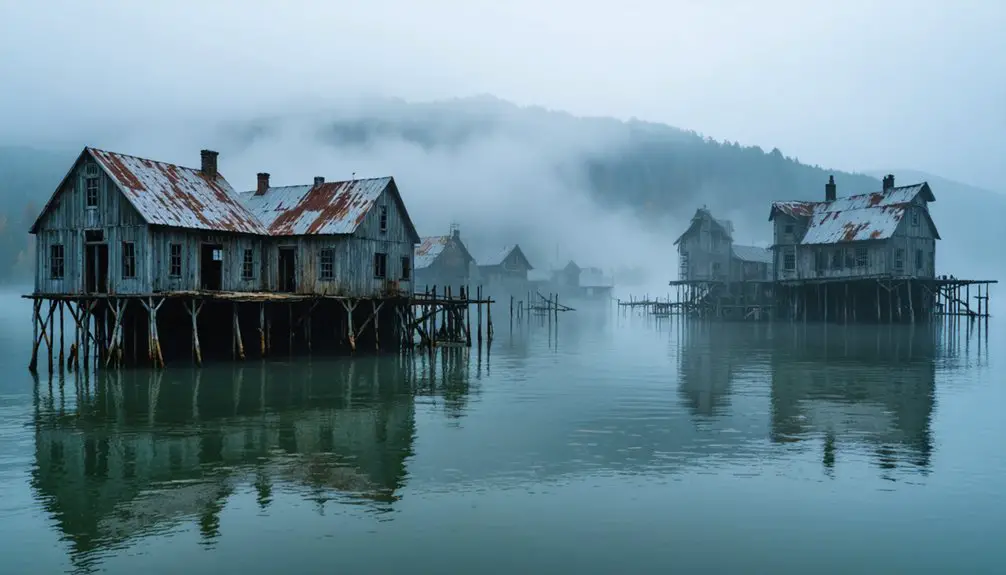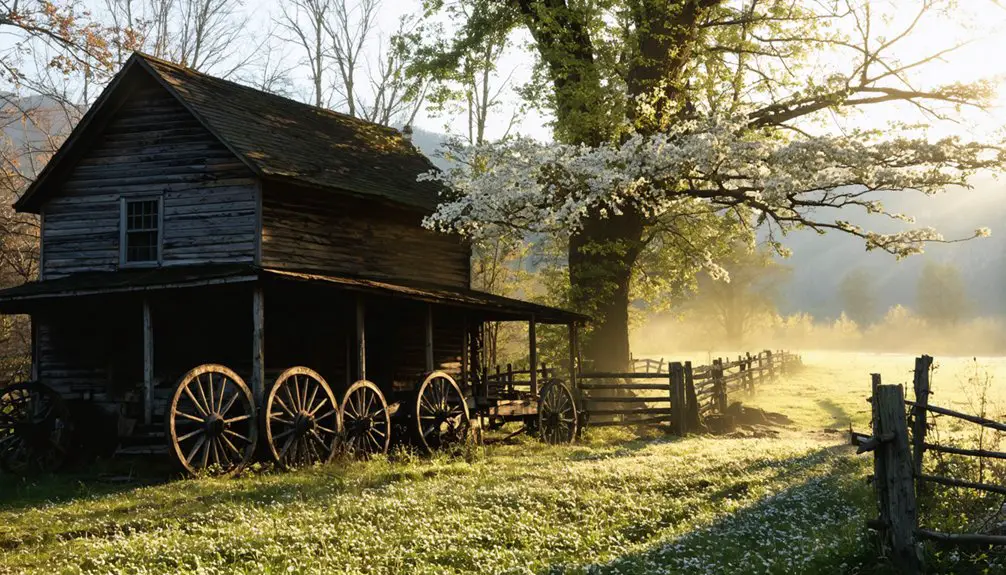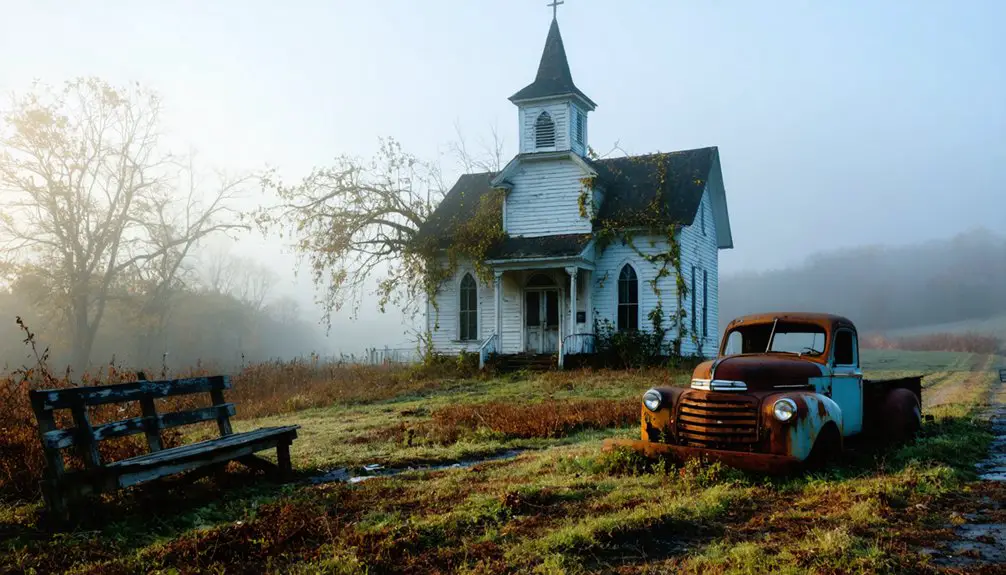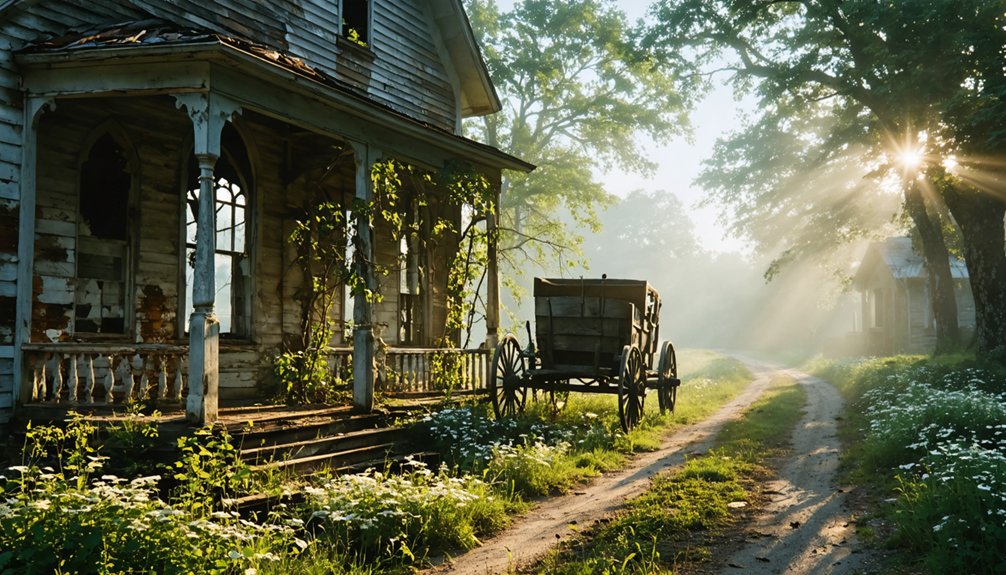
You’ll find numerous ghost towns scattered throughout Tennessee, from abandoned mining communities in Ducktown Basin to the historic resort ruins of Elkmont in the Smoky Mountains. Several towns now rest beneath TVA lakes, including Loyston and Butler, while others like Old Jefferson showcase remnants of early settlements. Many sites feature preserved structures, stone foundations, and chimney ruins that tell compelling stories of displacement, industrial decline, and environmental change. Tennessee’s ghost towns offer deeper insights into the state’s complex development.
Key Takeaways
- Tennessee has numerous ghost towns, including Elkmont in the Smoky Mountains, which was originally a logging camp turned resort destination.
- Ducktown Basin features abandoned mining communities with remnants of operations that drastically altered the local landscape.
- TVA dam projects submerged several towns, including Loyston and Butler, displacing thousands of families between 1935 and 1950.
- The preserved Daisy Town section of Elkmont showcases restored vacation cottages and represents Tennessee’s early tourism history.
- Wheat, a historic farming community, was abandoned during World War II and exemplifies Tennessee’s displaced agricultural settlements.
The Legacy of Tennessee’s Abandoned Communities
While Tennessee’s modern landscape boasts vibrant cities and thriving communities, the state’s history is punctuated by numerous ghost towns that tell compelling stories of displacement, industrial decline, and environmental change.
You’ll find abandoned structures scattered across the state, from Lost Cove’s decaying schoolhouse to No Business’s stone foundations and the Boyatt homestead chimney ruins. These sites preserve cultural memory of once-thriving settlements, like Old Jefferson, which served as Rutherford County’s seat for nearly 150 years before flooding forced its abandonment.
From company towns like Wilder to farming communities like Wheat, each ghost town reflects a distinct chapter in Tennessee’s development. The Manhattan Project relocation forever changed the Wheat community in the 1940s. Government projects, resource depletion, and environmental forces reshaped these landscapes, leaving behind powerful reminders of communities that once called these places home. In East Tennessee’s Elkmont, the restored historic cabins offer visitors a glimpse into early 20th-century life.
Notable Ghost Towns in the Smoky Mountains
Among Tennessee’s most intriguing ghost towns, Elkmont stands as a tribute to the region’s evolving relationship with the Great Smoky Mountains. The site’s Elkmont history traces back to its origins as a logging camp in the early 1900s before changing into an exclusive resort destination for wealthy Knoxville families. Colonel Townsend’s Little River Company established the town’s early development through extensive timber operations.
The town’s Native American heritage spans approximately eight thousand years of continuous human presence in the area. You’ll find the heart of this historic community in Daisy Town, where restored vacation cottages showcase the area’s shift from industrial logging to tourism.
While over 70 buildings once dotted the landscape, preservation efforts in 2018 saved 19 significant structures. Today, you can explore these carefully restored buildings, including the iconic Appalachian Clubhouse, by following trails near the Elkmont campground.
The Appalachian Clubhouse and 18 other preserved structures stand as living monuments to Elkmont’s heyday as a mountain retreat.
The remaining structures and ruins tell a compelling story of leisure, luxury, and the ultimate surrender to wilderness preservation.
Mining Communities Lost to Time
Tennessee’s mining heritage left a profound mark through communities that once bustled with industrial activity but now stand abandoned.
In the Copper Communities of Ducktown Basin, you’ll find remnants of operations that transformed the landscape into a red-orange wasteland through sulfuric acid emissions from open-pit smelting.
The Coal Mining settlements tell equally compelling stories, from the turbulent strikes at Wilder to the tragic legacy of Coal Creek, where convict laborers replaced Welsh miners and numerous lives were lost to methane gas incidents. The Freigherville disaster in 1902 claimed 216 lives, marking one of the area’s deadliest mining tragedies.
These places shaped Tennessee’s industrial evolution, from the iron furnaces of Tharpe to the worker settlements at Hales Bar Dam. Today, visitors can explore the powerhouse and tunnels that remain from this once-bustling industrial site.
While some sites, like the Ducktown Basin Museum and Coal Creek Miners Museum, preserve this history, most of these once-thriving communities have faded into time.
Resort Towns That Faded Away
Nestled in the heart of the Great Smoky Mountains, Elkmont stands as one of the most fascinating resort towns that evolved from a bustling logging camp to an exclusive vacation destination before fading into abandonment.
By 1910, you would’ve found the thriving Elkmont Resort transforming from its logging roots into a sought-after getaway, anchored by the prestigious Appalachian Clubhouse and Wonderland Hotel.
As forests depleted and logging ceased by 1926, the town shifted entirely to tourism.
When the Great Smoky Mountains National Park formed in 1934, residents faced tough choices: sell outright, accept lifetime leases, or relocate.
Colonel David Chapman and the Conservation Association led efforts to establish the national park, forever changing Elkmont’s destiny.
Much like the remote settlement of No Business, which required fording a creek to access, Elkmont’s isolation contributed to its eventual abandonment.
The last resident left in 2001, and by 2018, only 19 structures remained.
Today, you can still explore the restored historic buildings in Daisy Town, where echoes of its glamorous past linger.
Towns Submerged by Tennessee Valley Authority Projects
As you explore Tennessee’s submerged history, you’ll find that numerous communities vanished beneath TVA lakes during the authority’s massive hydroelectric projects of the 1930s and 1940s.
The flooding displaced entire towns like Loyston, which disappeared under Norris Lake in 1935, and Butler, which was completely relocated before being submerged by Watauga Lake.
While these dam projects brought electricity and flood control to the Tennessee Valley, they also created an underwater legacy of ghost towns, with some communities like Bean Station revealing their foundations during winter’s low water levels. Chickamauga Dam construction alone displaced approximately 2,000 families from their homes in the late 1930s.
The historic WH Siden Tavern, once the largest establishment between Washington D.C. and New Orleans, was dismantled during the dam’s construction.
TVA Lake Creation Impact
During the mid-20th century, the Tennessee Valley Authority‘s ambitious dam construction program permanently transformed numerous communities across the state, submerging entire towns beneath newly created lakes.
TVA projects like Norris Dam led to widespread community displacement, forcing residents to abandon their homes and relocate to higher ground.
The most significant submerged communities include:
- Loyston – documented extensively by photographer Lewis Wickes Hine before being flooded by Norris Lake
- Butler – the only incorporated Tennessee town fully inundated by TVA, requiring relocation of 12 homes, 50 businesses, and 1,300 graves
- Bean Station – substantially altered during Cherokee Dam construction, with residents moving to new locations
You can still glimpse traces of these lost communities when water levels drop, revealing old building foundations and road traces that serve as silent reminders of sacrificed towns.
Dam Project Ghost Communities
Beneath Tennessee’s tranquil reservoir waters lie the remains of several communities that fell victim to TVA’s massive dam projects between 1935 and 1950.
You’ll find Loyston, once a thriving trading center, now submerged under Norris Reservoir since 1935, though it briefly resurfaced during a 1990 lake draining.
Butler, the only incorporated town affected by dam inundation, relocated 175 buildings and 1,300 graves before Watauga Dam’s completion in 1948.
The flooding of Willow Grove by Dale Hollow Reservoir, Eva by Kentucky Lake, and Noeton by Cherokee Lake forced extensive community relocation efforts.
Each of these ghost towns represents a sacrifice made for progress, with their remnants still resting silently beneath the waters that now power and protect the region.
Historical Rural Settlements Now Forgotten
While Tennessee’s landscape today appears largely settled and developed, numerous historical communities have faded into obscurity, leaving behind only traces of their former existence.
You’ll find evidence of rural abandonment across the state, from the deteriorating cabins of Elkmont to the scattered foundations of farming settlements like Lost Cove. These forgotten places hold deep community memory through their remaining cemeteries, church ruins, and stone chimneys.
Three common patterns of historical settlement decline include:
- Mountain resorts that fell into disuse after park creation, like Elkmont’s “Millionaires’ Row”
- Agricultural communities displaced by federal projects, such as Wheat during WWII
- Remote mountain hollers abandoned due to economic isolation and declining sustainability
These sites now serve as valuable windows into Tennessee’s diverse settlement history.
Industrial Ghost Towns and Their Stories

As Tennessee’s industrial revolution gained momentum in the late 19th century, numerous company towns sprang up around coal mines, copper operations, and lumber mills across the state.
The rise of industry transformed Tennessee’s landscape, as company towns emerged wherever natural resources could be profitably extracted.
You’ll find their remains scattered throughout regions like the Ducktown Basin and Cumberland Plateau, where communities once thrived around bustling industrial operations.
The story of industrial decline played out dramatically in places like Wilder, where a violent 1932 strike accelerated the town’s abandonment, and Copper Hill, where intensive smelting left behind an eerily barren landscape.
Despite the harsh realities of environmental damage and economic hardship, traces of community resilience persist in preserved sites like the Dunlap coke ovens and Elkmont’s historic cabins.
These industrial ghost towns now serve as powerful reminders of Tennessee’s complex labor and environmental history.
Preserving Tennessee’s Ghost Town Heritage
Since the late 20th century, Tennessee’s ghost towns have benefited from a thorough preservation framework that combines federal, state, and private initiatives.
The National Park Service and State Historic Preservation Office work together to protect these cultural heritage sites through legal protections and funding mechanisms.
You’ll find three key elements driving ghost town preservation in Tennessee:
- Public-private partnerships that leverage federal grants and nonprofit endowments for restoration
- Technical conservation efforts that maintain historical accuracy through specialized materials and skilled craftsmanship
- Sustainable tourism models that balance public access with resource protection
The Elkmont restoration project exemplifies this approach, where selective preservation saved 19 significant structures through a multi-million dollar endowment, while establishing a blueprint for future ghost town conservation efforts across the state.
Frequently Asked Questions
Are Ghost Towns in Tennessee Safe to Explore at Night?
You shouldn’t attempt night exploration of Tennessee ghost towns due to serious safety hazards, legal restrictions, and physical dangers. Always follow posted hours and take proper safety precautions during daylight visits.
The allure of ghost towns in Tennessee history can be captivating, but it’s essential to prioritize safety when exploring these abandoned sites. Many of these towns hold intriguing stories and remnants of the past, inviting history enthusiasts to delve deeper into their eerie yet fascinating backgrounds. Ensure you choose safe times and conditions for your visits to fully appreciate the beauty and history without risking your well-being.
Can You Legally Collect Artifacts From Tennessee Ghost Towns?
With 90% of Tennessee ghost town artifacts protected by law, you can’t legally collect them without permits. Most sites require artifact preservation and carry serious legal implications for unauthorized removal.
Which Tennessee Ghost Towns Are Accessible by Regular Passenger Vehicles?
You’ll find Elkmont and Cades Cove easily accessible by standard car, with paved roads leading to preserved structures. Hales Bar Dam’s industrial ruins are also reachable via regular roads for exploring ghost town history.
Do Any Tennessee Ghost Towns Still Have Permanent Residents?
Precious pioneers persist in places like Elkmont, where you’ll find a few occupied abandoned homes of historical significance. Some unincorporated ghost settlements maintain private residences through preservation agreements or lifetime leases.
What Paranormal Activity Has Been Reported in Tennessee’s Ghost Towns?
You’ll find haunting legends primarily at Tharpe, where spectral sightings of former residents are reported near the doctor’s office. Other Tennessee ghost towns have minimal documented paranormal activity.
References
- https://en.wikipedia.org/wiki/List_of_ghost_towns_in_Tennessee
- https://kids.kiddle.co/List_of_ghost_towns_in_Tennessee
- https://www.wanderingsmokymountains.com/smoky-mountain-ghost-towns-in-tennessee/
- https://freepages.rootsweb.com/~gtusa/history/usa/tn.htm
- https://www.tnmagazine.org/19-ghost-towns-in-tennessee-that-are-not-underwater/
- http://www.onlyinyourstate.com/experiences/tennessee/tn-ghost-towns
- https://www.loveproperty.com/gallerylist/91679/tour-the-abandoned-tennessee-ghost-town-where-millionaires-vacationed
- https://carte-urbex.com/en/blogs/infos/top-10-abandoned-places-in-tennessee
- https://www.tnvacation.com/trip-inspiration/articles/ghost-towns-tennessee
- https://www.islands.com/2015789/no-business-tennessee-abandoned-quirky-name-blue-ridge-beauty/