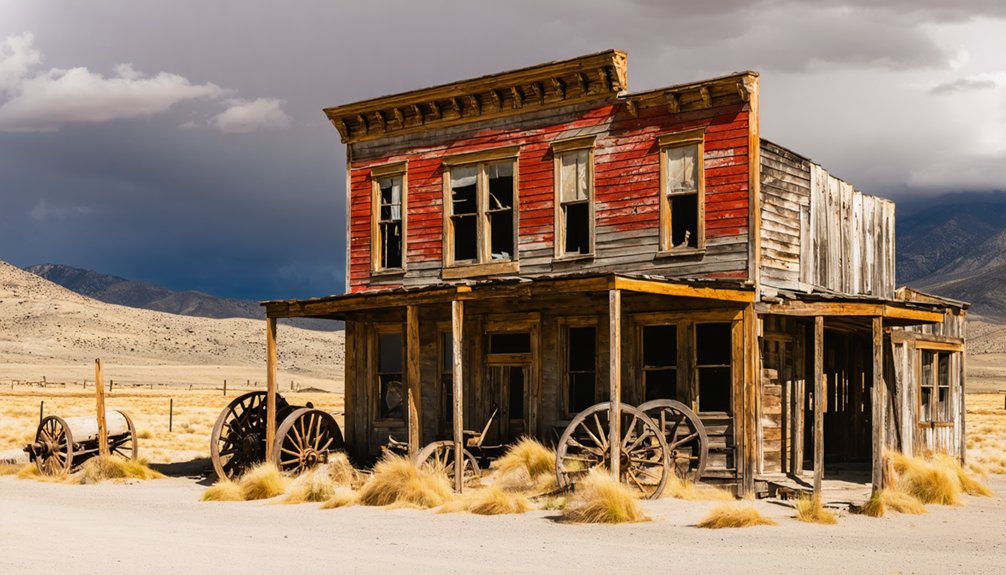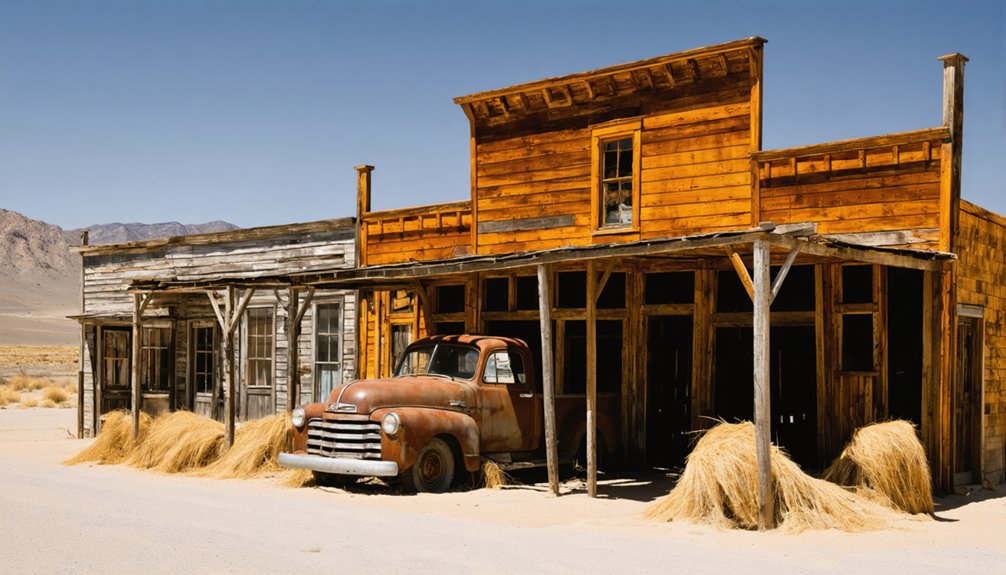
You’ll discover over 3,800 documented ghost towns across the United States, with Texas leading at approximately 550 abandoned settlements. These time capsules originated primarily from mining booms, agricultural settlements, and transportation hubs that eventually went bust. From Bodie’s “arrested decay” structures to Calico’s interactive historical park, many ghost towns now serve as heritage tourism destinations. The vast network of America’s abandoned places holds countless stories of boom, bust, and survival.
Key Takeaways
- Over 4,500 ghost towns exist across the United States, with Texas having the highest concentration at approximately 550 abandoned settlements.
- Famous ghost towns like Bodie preserve over 100 original structures in “arrested decay” for visitors to explore historical sites.
- Mining towns, agricultural communities, and submerged settlements make up the diverse types of ghost towns across America.
- Ghost towns emerged primarily from resource depletion, economic collapse, transportation shifts, and environmental disasters throughout American history.
- Many ghost towns have been transformed into heritage tourism destinations, offering interactive experiences and historical preservation.
The Rise and Fall of American Ghost Towns
While the American frontier beckoned settlers with promises of riches and opportunity, the dramatic rise and fall of ghost towns exemplifies the volatile nature of resource-driven development in the United States.
Mining booms sparked explosive growth, as seen when 80,000 forty-niners rushed to California in 1849 and when the Lucky Boy Mine drew hundreds to Idaho in 1879. You’ll find these settlements flourished rapidly, with some like Frisco swelling to over 6,000 residents during the 1870s silver rush.
Yet economic downturns proved equally swift and devastating. Resource depletion, from exhausted gold claims to depleted copper mines in Kennicott, Alaska, triggered mass exoduses. Many towns like Garnet, Montana included thirteen bustling saloons before fires and dwindling gold deposits led to their abandonment. Today, there are 3,800 ghost towns scattered across America, each telling a story of boom and bust.
Natural disasters, shifting transportation routes, and the Great Depression dealt additional blows, transforming once-bustling communities into abandoned remnants of America’s pioneering spirit.
Mapping Ghost Towns Across the States
Tracing America’s abandoned settlements has become a complex cartographic endeavor, with modern datasets revealing over 4,500 ghost towns scattered across the nation.
You’ll find the highest concentrations in Texas, which leads with approximately 550 sites, followed by California, Oklahoma, Kansas, and Florida.
Ghost town mapping efforts have categorized these sites into distinct types, from mining camps and agricultural communities to flooded towns and military installations. The database includes 46 submerged towns, many of which are located in Pennsylvania.
Interactive platforms like BatchGeo and Geotab now offer extensive mapping tools, while specialized databases on ghosttowns.com and Ghost Town Gallery provide detailed historical significance for each location. A comprehensive satellite map system allows visitors to locate and zoom in on remaining ghost town structures.
Whether you’re exploring well-preserved heritage sites or searching satellite imagery for remote ruins, you’ll discover these abandoned places are carefully documented across public lands, private property, and protected areas, creating a fascinating atlas of American settlement patterns.
What Turned Thriving Towns Into Abandoned Places
Throughout America’s settlement history, thriving communities transformed into ghost towns through four major catalysts: economic collapse of single-industry towns, shifts in transportation networks, environmental disasters, and government interventions.
You’ll find that economic decline often struck swiftly when mines depleted, timber vanished, or factories closed. Environmental changes, from devastating Dust Bowl conditions to destructive floods, forced entire populations to abandon their homes and livelihoods.
Today, many of these abandoned settlements have become popular heritage tourism destinations, drawing visitors fascinated by their historical significance. Texas alone contains over 500 documented ghost towns scattered across its vast landscape.
- Mining towns crumbled when ore deposits ran dry, leaving behind empty shaft houses and abandoned equipment.
- Railroad towns died when new routes bypassed them, cutting off essential commerce and passenger traffic.
- Oil boomtowns collapsed after wells stopped producing or prices plummeted.
- Natural disasters like floods and fires permanently displaced whole communities.
- Government projects, including dam construction, intentionally submerged towns underwater.
Most Famous Ghost Towns You Can Visit Today
Many of America’s most evocative ghost towns have found new life as preserved historical sites, offering visitors tangible connections to the nation’s pioneering past.
You’ll discover Bodie tours showcasing over 100 original structures in “arrested decay,” while Calico restoration efforts have transformed the former silver boomtown into an interactive historical park near Barstow.
South Pass City lets visitors try their hand at gold panning in Willow Creek daily.
In Montana, Bannack history comes alive through dozens of preserved frontier buildings, including the territorial courthouse and jail. The town’s annual Bannack Days festival brings history to life with dramatic recreations of the Old West.
For a unique blend of past and present, Jerome attractions feature art galleries housed in historic buildings, along with its famous sliding jail and copper mining museum.
Each site maintains distinct preservation approaches, from Bodie’s untouched authenticity to Calico’s reconstructed commerce, letting you explore the West’s mining heritage on your own terms.
Modern Cities at Risk of Becoming Ghost Towns
While America’s classic ghost towns stand as relics of the past, a sobering University of Illinois study projects that nearly 30,000 U.S. cities could face significant population decline by 2100. The greatest impact will be seen in aging populations of the Northeast and Midwest regions.
Urban decay and population shifts are already impacting major metropolitan areas, with cities like Detroit, St. Louis, and Flint experiencing dramatic transformations. These changes threaten essential infrastructure and services, creating challenges for remaining residents. The trend shows reduced birth rates contributing significantly to this urban decline.
- St. Louis faces a 6% retail vacancy rate and declining building permits
- Detroit grapples with 30% vacant homes and continued population loss
- Flint’s water crisis has accelerated its projected 30% population decline by 2040
- Northeast and Midwest cities with lower incomes face highest depopulation risks
- Paradise, CA struggles to rebuild after devastating wildfires, exemplifying how environmental disasters can trigger urban exodus
Frequently Asked Questions
Are There Any Completely Underwater Ghost Towns in the United States?
You’ll discover fascinating underwater exploration opportunities at numerous submerged towns like St. Thomas in Lake Mead and Kennett beneath Shasta Lake, where America’s rich submerged history lies perfectly preserved.
Can People Legally Live in Ghost Towns Today?
You can establish ghost town residency if you navigate the legal implications: verify property ownership, comply with zoning laws, and meet infrastructure requirements. Many abandoned towns welcome new settlers seeking independence.
Which Ghost Towns Have the Most Paranormal Activity Reports?
You’ll find the most documented paranormal investigations and haunted locations in Virginia City (Nevada), Bodie (California), and Centralia (Pennsylvania), where investigators consistently report EVPs, apparitions, and unexplained phenomena.
How Many Ghost Towns Have Been Successfully Revitalized?
While there’s no official national count, you’ll find dozens of major revitalization efforts and hundreds of smaller-scale projects that’ve successfully transformed ghost towns through private investment and heritage tourism development.
Do Native American Settlements Count in Official Ghost Town Numbers?
You won’t find Native American settlements in official ghost town counts, despite their historical significance. Traditional definitions focus exclusively on abandoned post-colonial towns with commercial or industrial purposes.
References
- https://www.loveexploring.com/gallerylist/188219/the-us-state-with-the-most-ghost-towns-revealed
- https://blog.batchgeo.com/ghost-towns/
- https://themortgagepoint.com/2024/10/25/americas-new-ghost-towns/
- https://247wallst.com/special-report/2023/07/11/americas-modern-ghost-towns/
- https://www.mentalfloss.com/geography/american-ghost-towns-can-still-walk-through
- https://www.geotab.com/ghost-towns/
- https://en.wikipedia.org/wiki/Lists_of_ghost_towns_in_the_United_States
- https://www.youtube.com/watch?v=aTbMdOZRZO4&vl=en
- https://joybird.com/blog/top-ghost-towns-in-america/
- https://www.youtube.com/watch?v=ebTh-J1XSvc