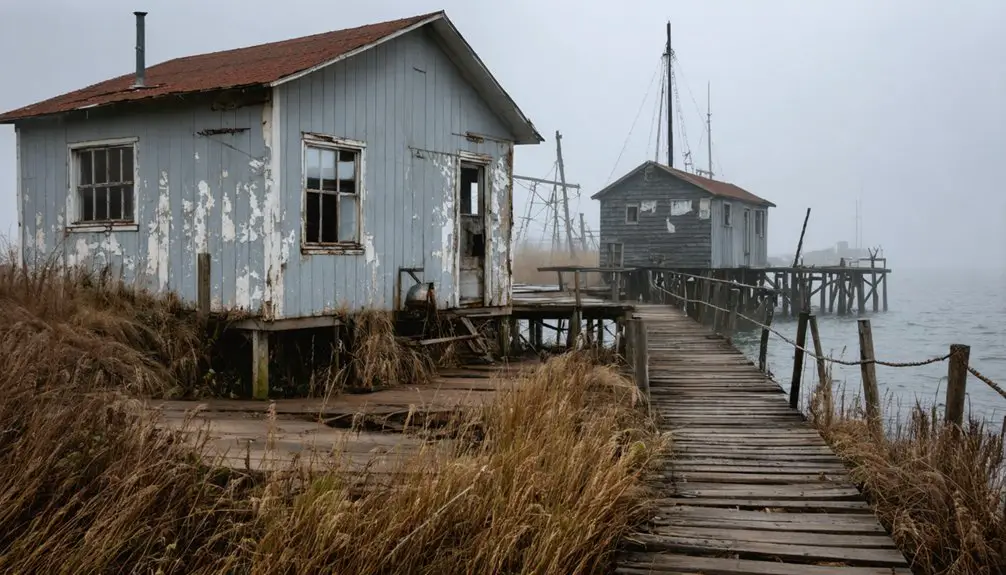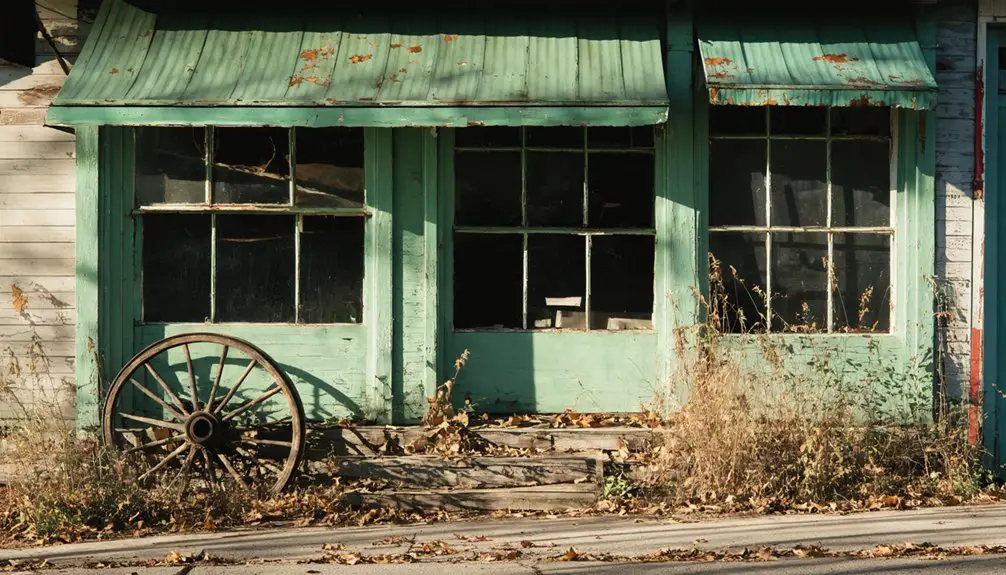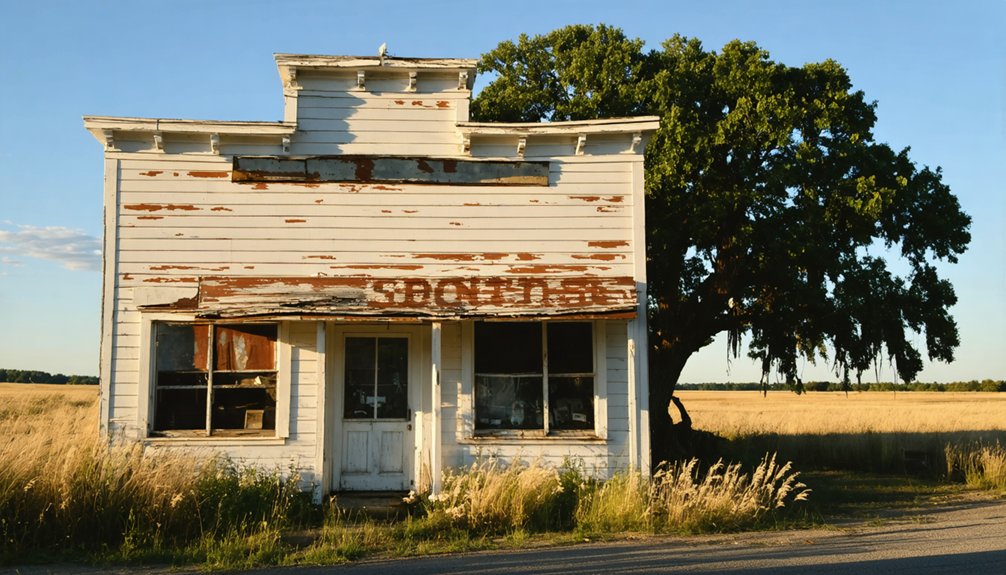
Yes, you’ll find over fifty documented ghost towns across Wisconsin, primarily remnants of 19th-century mining and logging operations. These abandoned settlements feature deteriorating structures, old cemeteries, and historical markers, with many now reclaimed by nature. While some towns like Hurley once boasted populations of 2,500 during mining booms, others served as essential logging hubs before their decline. Exploring these forgotten places reveals fascinating chapters of Wisconsin’s industrial heritage.
Key Takeaways
- Wisconsin has numerous ghost towns, primarily from abandoned mining operations and defunct logging communities during the 19th century.
- Over nineteen documented ghost towns emerged during Wisconsin’s timber industry peak, including settlements like Veazie.
- Many ghost towns feature remaining evidence like cemeteries, historical markers, concrete foundations, and deteriorating structures beneath vegetation.
- Former mining towns like Hurley experienced dramatic population changes, growing from 80 to 2,500 residents before declining due to depleted resources.
- Wisconsin’s ghost towns are now largely reclaimed by nature, with forests and vegetation covering abandoned buildings and town sites.
What Makes a Wisconsin Ghost Town
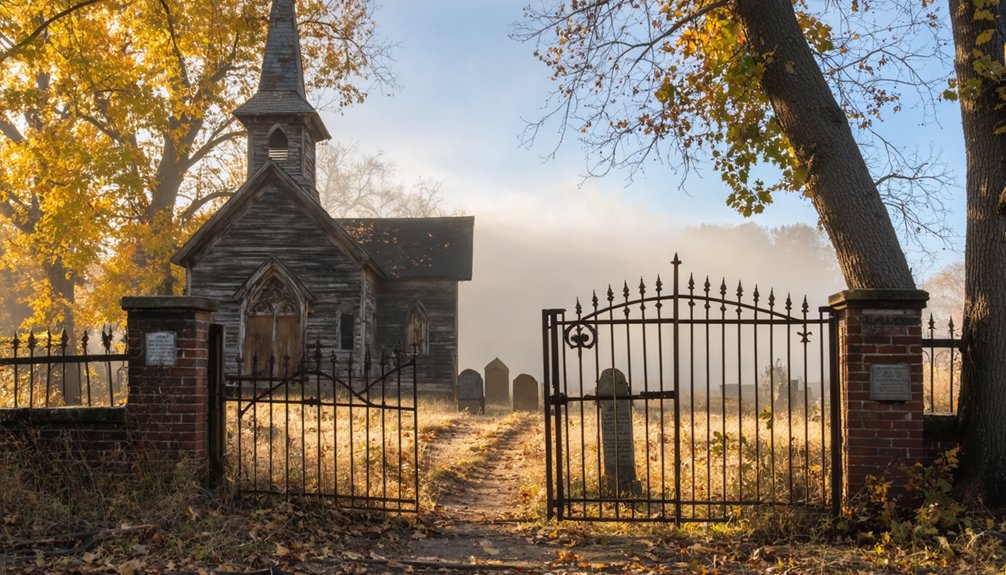
While many places claim ghost town status, Wisconsin’s abandoned communities must meet specific criteria to earn this designation. You’ll find these sites marked on maps but largely vanished from the physical landscape, with only remnants like cemeteries, historical markers, and deteriorating structures remaining.
The community characteristics that define a true ghost town include a complete absence of current residents despite evidence of previous settlement and activity. Many of these settlements declined after railroad routes changed, leaving them economically isolated.
When you explore these locations, you’ll encounter physical remains such as concrete stave silos, abandoned stone wells hidden in woods, and relocated buildings in nearby modern towns.
The abandoned town of Imalone exemplifies this pattern with its concrete block foundations still visible beneath overgrown vegetation.
Some sites retain visible “bones” of their past through open window frames and crumbling foundations, while others have faded into cartographic phantoms, leaving behind only scattered graves and historical markers as evidence of their existence.
The Rise and Fall of Wisconsin Mining Towns
When Wisconsin’s mineral wealth first attracted prospectors in the early 19th century, it sparked a dramatic transformation across the state’s landscape.
Wisconsin’s mineral discoveries in the early 1800s reshaped the state, as prospectors rushed to unlock its underground treasures.
You’ll find that lead mining dominated the southwest, where production peaked at 13 million pounds annually by 1829, drawing over 4,000 miners to counties like Grant and Iowa. Early miners lived in primitive caves they dug into hillsides, earning Wisconsin its nickname as the Badger State. The region’s success mirrored earlier mineral rushes like the Ojibwe copper trade that had flourished centuries before. As surface deposits depleted in the 1840s, many settlements saw rapid decline.
In the north, copper towns along Lake Superior experienced their own cycle of boom and bust.
Places like Ashland and Superior grew explosively when eastern investors poured in capital during the 1870s. You’d be amazed how quickly these towns could transform – Hurley’s population soared from 80 to 2,500 residents in the 1880s.
When ore deposits or investment capital dried up, these once-bustling communities often faded into obscurity.
Forgotten Logging Communities of the North
If you’re exploring Wisconsin’s forgotten logging communities, you’ll discover over nineteen documented ghost towns that emerged during the timber industry’s peak, when more than 1,000 mills operated across the northern region.
As these towns exhausted their timber resources in the early 1900s, companies withdrew, dismantled buildings, and left behind only traces of once-bustling communities like Shanagolden, Veazie, and Star Lake. The abandoned settlement of Veazie, established in the winter of 1871-72, once served as a crucial supply hub for lumberjacks and businessmen. Daily life in these communities revolved around social activities including drinking, fighting, and recreational pursuits.
Today, you can find archaeological remnants and preserved artifacts at historical sites where nature has reclaimed these abandoned settlements, offering glimpses into Wisconsin’s rich logging heritage.
Timber Industry’s Rise and Fall
As Wisconsin’s timber industry transformed the northern landscape from 1850 to 1930, a complex network of logging communities emerged and vanished with stunning rapidity.
You’ll find that timber economics evolved through distinct phases, beginning with river-drive operations that relied on seasonal camps and waterways to transport white pine. The 1837 and 1842 treaties opened vast tracts of Ojibwa lands to aggressive logging expansion.
When railroads penetrated the northern forests in the 1880s, logging techniques shifted dramatically, enabling year-round harvesting and the establishment of permanent mill towns. Many of these communities became ghost towns after their timber resources were depleted.
Nature Reclaims Empty Towns
The fate of Wisconsin’s logging communities presents a fascinating study in ecological succession.
Archaeological studies have revealed that many of these sites were once home to diverse logging camps, showcasing the rich cultural heritage of Wisconsin’s early industry.
You’ll find nature’s reclamation process transforming these once-bustling towns into wild spaces, as early-successional trees and vegetation rapidly overtake abandoned lots and buildings. The signs of urban decay accelerate as soil processes and weather patterns work to erase human presence.
What you might’ve seen as a thriving mill town decades ago has likely disappeared beneath layers of forest debris.
Root systems break apart foundations, while freeze-thaw cycles steadily degrade remaining structures. Former industrial features, like millponds and log-holding areas, have evolved into wetlands.
In the early 1900s, over 1,000 sawmills dotted the Wisconsin landscape before their eventual abandonment.
Even the most substantial town ruins now lie hidden beneath thick leaf litter and nurse logs, requiring careful archaeological survey to detect their presence.
Preserved Sites and Artifacts
Physical evidence of Wisconsin’s logging heritage survives through a rich archaeological record of tools, structures, and everyday items left behind in abandoned camps and mill towns.
You’ll find archaeological findings scattered across former settlements, including concentrations of nails, hand-forged hardware, and foundation stones that outline where bunkhouses and cookhouses once stood. These logging artifacts tell the story of daily life, from ceramic tableware fragments to tobacco pipes used by workers.
You can still spot the remnants of splash dams and cribbed spillways along rivers where spring log drives occurred, while old railroad grades persist as raised embankments.
Personal items like clothing fasteners and pocketknives provide glimpses into camp life, while surviving sawmill hardware and specialized logging equipment document the evolution of timber extraction methods.
Notable Ghost Towns Worth Exploring
[GENESIVAMENTE{ However دا
Preserving Wisconsin’s Lost Settlements
Across Wisconsin’s historically rich landscape, dedicated preservationists work tirelessly to protect the state’s abandoned settlements from falling into complete ruin.
You’ll find notable success stories like Pendarvis, where Robert Neil and Edgar Hellum’s efforts transformed a desolate mining site into a reflection of Cornish heritage, now managed by the Wisconsin Historical Society.
The Wisconsin Trust for Historic Preservation leads community engagement through workshops and documentation strategies, while places like New Diggings showcase both triumph and challenge – its St. Augustine’s Church stands restored on the National Register of Historic Places, though other structures continue to decay.
You can witness similar preservation dynamics at Heritage Hill State Park, where authentic restoration projects, like the 2022 Voyageur Sculpture renewal, keep Wisconsin’s past alive for future generations.
Ghost Town Tourism and Safety Tips
Before you explore Wisconsin’s ghost towns, you’ll need to verify land ownership, obtain necessary permissions, and carry essential safety equipment including first-aid supplies and reliable navigation tools.
You’ll find the best conditions for visiting between late spring and early fall when vegetation is manageable and daylight hours are longest.
Your exploration must prioritize both personal safety and site preservation by following Leave No Trace principles and avoiding structural hazards while documenting these historic settlements.
Visiting Safely and Legally
When exploring Wisconsin’s ghost towns, proper preparation and adherence to legal guidelines are essential for both visitor safety and site preservation.
You’ll need to secure legal permissions by verifying property ownership through county records and obtaining explicit consent from private landowners before visiting sites like Walker Junction.
For safety precautions, wear sturdy boots and protective clothing while traversing uneven terrain. Bring essential gear including flashlights, insect repellent, and plenty of water.
Watch for environmental hazards such as wildlife, flood-prone areas, and unstable structures. Travel in groups when exploring remote locations like St. Feriole Island.
Remember to follow preservation protocols by staying on marked paths, avoiding artifact removal, and documenting visits photographically.
Cross-reference locations using the Wisconsin Historical Society maps and GNIS database to confirm accurate site identification.
Best Times to Explore
The ideal timing for ghost town exploration in Wisconsin hinges on distinct seasonal advantages throughout the year.
Fall’s shoulder season (late September-October) offers prime conditions with peak foliage, extended golden hours, and cooler temperatures that enhance your photography opportunities.
You’ll find spring (May-June) equally rewarding, with atmospheric morning mist and blooming vegetation creating compelling contrasts against historic ruins.
For best photography, plan your visits during golden hour—the first hour after sunrise or last hour before sunset.
Winter delivers dramatic snow-covered scenes but requires extra preparation due to limited daylight and harsh conditions.
Consider seasonal hazards when timing your exploration: avoid peak tick and mosquito seasons in summer, and target early spring or late fall to minimize encounters with dense vegetation that can obscure ruins and pathways.
Historical Research and Documentation
Throughout Wisconsin’s history, extensive archival documentation has preserved the stories of its abandoned settlements. You’ll find valuable archival resources through the Wisconsin Historical Society‘s map index, which catalogs numbered ghost towns alongside Indian reservations, railroads, and mines.
Local organizations like the Waupaca County Historical Society have published detailed accounts of their region’s lost communities.
Historical societies across Wisconsin’s counties maintain rich archives detailing the forgotten stories of their abandoned settlements and vanished towns.
For deeper historical preservation efforts, you can access Clark County’s electronic bookshelf, featuring cemetery listings, plat maps, school histories, and veterans records.
While some documentation remains sparse, like Grant County’s limited historical records, significant sites are well-documented.
St. Augustine’s Church in New Diggings, built in 1844, stands as a restored National Historic Place, while Henry Gratiot’s house, Wisconsin’s second-oldest, continues as a bed & breakfast.
Frequently Asked Questions
Are There Any Haunted Ghost Towns in Wisconsin?
Like whispers from the past, you’ll find haunted places in Whitewater (dubbed “Second Salem”), St. Nazianz with its cursed church, and Voree, where ghost stories echo through Mormon leader Strang’s abandoned settlement.
Can You Legally Metal Detect in Wisconsin Ghost Towns?
You’ll need specific permissions based on metal detecting laws and ghost town regulations. Check land ownership, obtain written authorization, and verify if archaeological protections exist before detecting in Wisconsin ghost towns.
Which Wisconsin Ghost Town Has the Most Intact Original Buildings?
You’ll find Belmont has the most intact abandoned architecture, with several preserved 19th-century structures concentrated in its historic district, including period buildings of historical significance within Belmont Mound State Historic Site.
Do Any Wisconsin Ghost Towns Still Have Active Residents?
You won’t find active communities in Wisconsin’s true ghost towns. Once places lose their last residents, they’re classified as ghost town history – any inhabited areas are considered living communities instead.
For those interested in the past, there are numerous ghost towns to explore in Wisconsin. These remnants of bygone eras tell unique stories of hardships and hopes. Walking through their deserted streets allows for a glimpse into the lives that once thrived in these now-silent places.
What’s the Best Season to Photograph Wisconsin Ghost Towns?
You’ll find autumn’s dramatically rich seasonal colors irresistible, with crisp mornings offering perfect photography techniques. But don’t overlook winter’s stark minimalism or spring’s moody fog for hauntingly atmospheric shots.
References
- https://www.onlyinyourstate.com/experiences/wisconsin/ghost-towns-wi
- https://en.wiktionary.org/wiki/Category:en:Ghost_towns_in_Wisconsin
- http://freepages.rootsweb.com/~gtusa/history/usa/wi.htm
- https://www.ghosttowns.com/states/wi/wi.html
- https://pbswisconsin.org/news-item/southern-wisconsins-ghost-towns-leave-behind-vital-stories/
- https://www.geotab.com/ghost-towns/
- https://www.wisconsinhistory.org/Records/Image/IM116137
- https://kids.kiddle.co/List_of_ghost_towns_in_Wisconsin
- http://shunpikingtoheaven.blogspot.com/2016/05/a-wisconsin-ghost-town.html
- https://lsmagazine.wisc.edu/issues/fall-2024/phantom-finders/