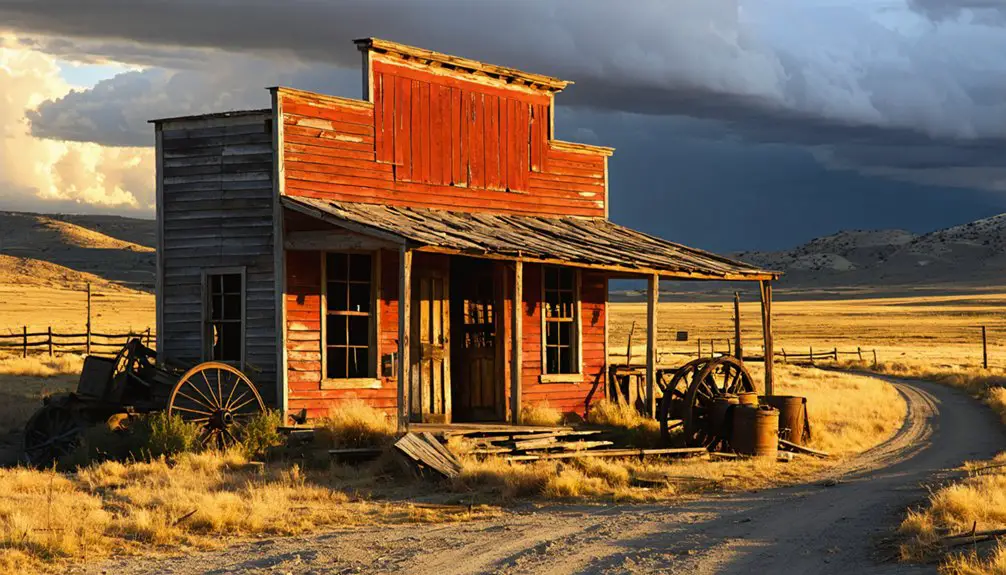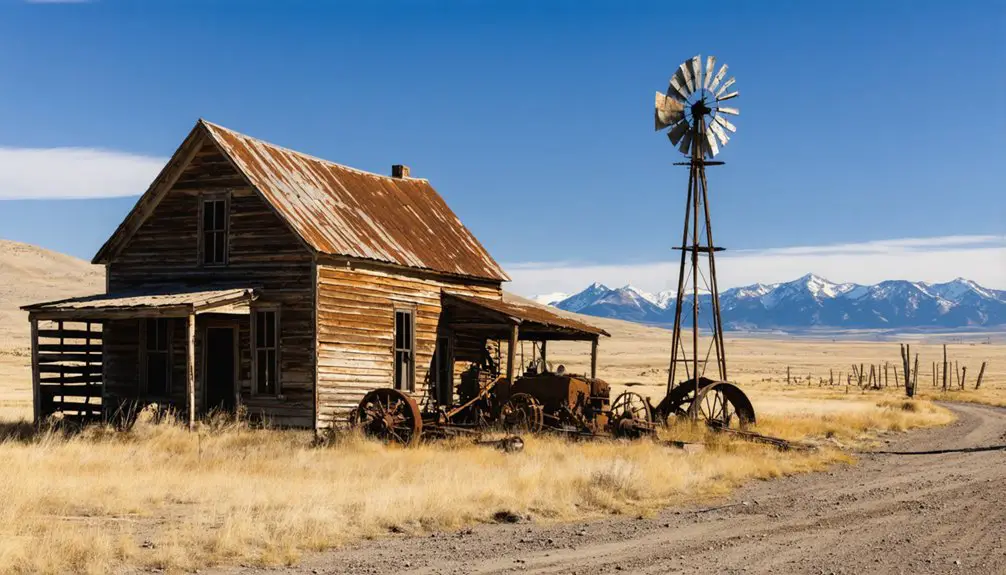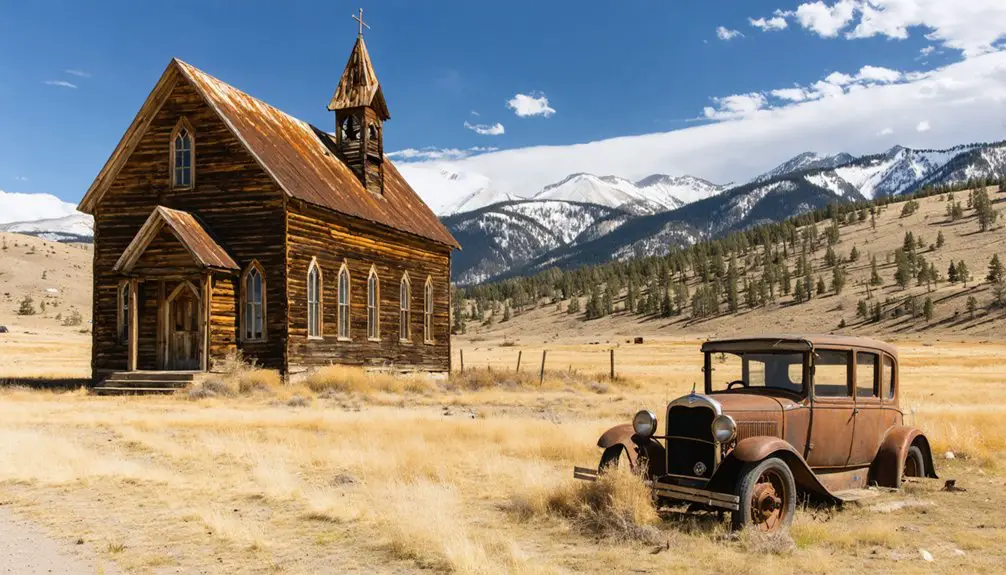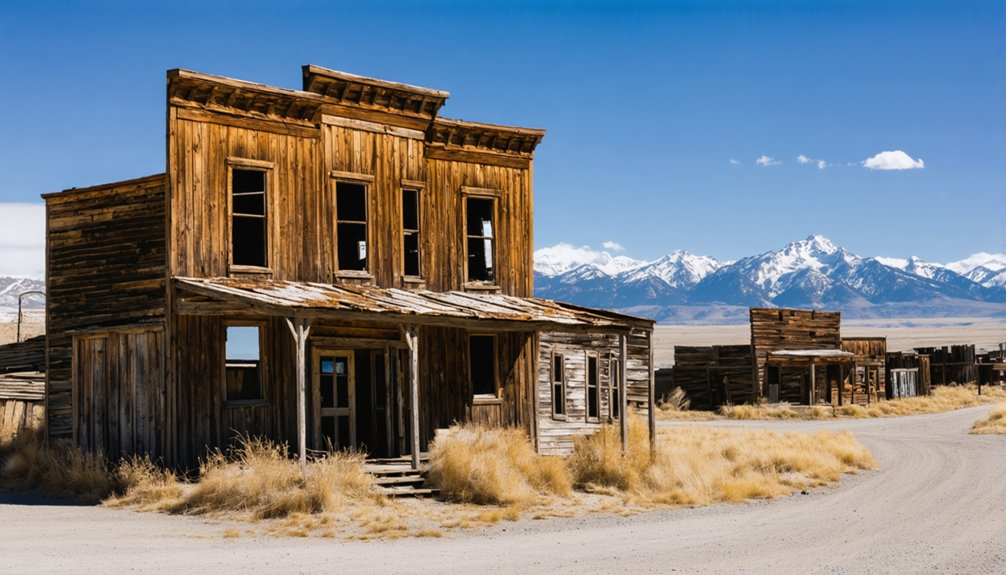
You’ll find several fascinating ghost towns scattered across Wyoming, with South Pass City, Kirwin, and Superior being among the most notable. These preserved sites showcase the state’s rich mining heritage from the late 1800s and early 1900s, when gold, copper, and coal operations drew thousands of settlers. From Benton’s brief but violent three-month existence to Hartville’s Wild West culture, each abandoned settlement offers unique glimpses into Wyoming’s frontier past. The deeper you explore, the more secrets these historic ruins reveal.
Key Takeaways
- Wyoming has numerous ghost towns, including South Pass City, Kirwin, Benton, Superior, and Hartville, each with unique historical significance.
- South Pass City, once Wyoming’s second incorporated city, peaked at 1,000 residents in 1869-1870 before declining due to mining challenges.
- Kirwin, located at 9,000 feet in the Absaroka Mountains, features preserved mining structures but was abandoned after a devastating 1907 avalanche.
- Benton existed for just three months in 1868, reaching 3,000 residents before vanishing as the railroad moved westward.
- Superior transformed from a 3,000-person coal town to America’s smallest municipality, maintaining incorporated status with just six residents in 2020.
The Rise and Fall of South Pass City
While gold was first panned near South Pass as early as 1842 by miners traversing the Emigrant Trails, South Pass City’s true beginning emerged in 1867 following a significant gold discovery by Fort Bridger troops along Willow Creek.
The discovery sparked an impressive mining boom, transforming a modest stage station into Wyoming’s second incorporated city by 1868. At its peak in 1869-1870, you’d have found a bustling community of 1,000 residents with 250 buildings stretching along a half-mile main street. By 1870, the Carissa mine’s output had already reached $15,000 in gold through hand processing methods.
Today, the historic site sits at an elevation of 7,808 feet above sea level, offering visitors a glimpse into Wyoming’s mining past.
The Carissa Mine fueled the town’s rapid growth, but prosperity wouldn’t last. Despite producing $7 million in gold, high extraction costs and diminishing returns led to the town’s decline.
Exploring the Historic Ruins of Kirwin
You’ll find a remarkable collection of early 1900s mining structures still standing at Kirwin, positioned at over 9,000 feet in Wyoming’s remote Absaroka Mountains.
The site’s preserved buildings, including the assay office and various cabins, offer a compelling window into the mining era when nearly 200 residents called this mountain town home.
The town boasted impressive amenities including a modern power plant that provided electricity to buildings throughout the settlement.
Charles and Sarah Tewksbury managed a store and hotel that served as the town’s central hub for supplies and lodging.
Under Forest Service management today, these historic ruins tell the story of ambitious mining ventures that ended abruptly after the devastating avalanche of 1907, leaving behind a wealth of artifacts and structures that document Wyoming’s mineral-seeking past.
Preserved Mining Era Buildings
Today’s visitors to Kirwin can explore a remarkable collection of preserved mining-era structures that offer a tangible connection to Wyoming’s mineral boom days.
You’ll discover the remains of what was once Wyoming’s most modern mining town, complete with rusted tools and weathered buildings that have endured over a century of mountain seasons.
The site features the preserved Tumlum mine shaft, a historic assay shop, and remnants of the town’s headquarters building.
Among the Kirwin ruins, you’ll find mining artifacts scattered throughout the 3,300-acre property, including remnants of the original post office, boarding house, and general stores.
The dank decay of aging wood mingles with mountain air as you walk among structures that once housed 200 hardy souls.
The journey to these historic ruins requires traversing a challenging path along creek beds and grades that demands four-wheel drive transportation.
A devastating 1907 avalanche fundamentally changed the town’s fate, destroying several buildings and causing three deaths that prompted many miners to abandon the area.
Rich Forest Service History
Since becoming part of the Shoshone National Forest in the 1990s through a generous donation from the Mellon Foundation and Conservation Fund, Kirwin has emerged as one of Wyoming’s best-preserved mining ghost towns.
The Forest Service’s involvement has been instrumental in protecting this historic treasure, launching extensive restoration efforts in 1999 alongside key partners like the Wyoming State Historic Preservation Office. Located 38 miles southwest of Meeteetse, this remote site remains a testament to Wyoming’s mining heritage.
You’ll find the results of their dedicated work in stabilized structures, secured mining hazards, and protected artifacts throughout the site. The historic ghost town sits at an elevation of 9,200 feet high within the stunning Kirwin volcanic complex.
The Forest Service manages Kirwin as a “window to the past,” offering interpretive resources and collaborative programs with the Meeteetse Museum.
They’ve also implemented careful forest management strategies to protect the site while ensuring safe access for visitors during the summer months.
Benton: Wyoming’s First Ghost Town Legacy
While many ghost towns dotted Wyoming’s landscape during the railroad era, Benton stands as the territory’s first and perhaps most notorious abandoned settlement.
You’ll find its brief but wild history spanning just three months in 1868, when it served as Union Pacific’s end-of-track town about 11 miles east of present-day Rawlins. Benton’s lawlessness earned it comparisons to Sodom and Gomorrah, with 25 saloons, numerous brothels, and reports of over 100 violent deaths during its short existence. Church wagon trains assisted thousands of Mormon emigrants who passed through Benton on their way to Utah.
In just three months, Benton became Wyoming’s deadliest boomtown, with 25 saloons fueling a summer of chaos and bloodshed.
The town’s railroad significance extended beyond construction, as it became a vital departure point for Mormon pioneers heading to Utah. The lack of a reliable water source ultimately doomed the town’s sustainability.
Despite its fleeting existence, Benton’s population swelled to 3,000 before vanishing completely once the railroad pushed westward, leaving behind only stories of its notorious summer of vice and violence.
Superior: From Coal Boom to Modern Living Ghost Town
You’ll find Superior’s transformation from a bustling coal town of 3,000 residents to today’s small community of under 200 particularly striking.
The town’s rich mining heritage stems from its early 1900s boom period when the Union Pacific Railroad established multiple coal mines to fuel steam engines, drawing immigrant workers from over 30 countries.
While Superior’s population has dwindled since the last mine closed in 1963, you can still explore its mining legacy through preserved structures like the South Superior Union Hall and local museum exhibits showcasing the town’s coal-mining artifacts.
Mining Heritage Lives On
During the late 1800s, the discovery of rich coal deposits in Horse Thief Canyon transformed Superior, Wyoming into one of the West’s most significant mining communities.
The mining techniques evolved from underground shaft operations to surface mining, while the cultural impact of this boom era created a diverse community representing over 30 nationalities.
Superior’s mining heritage remains evident through:
- The D.O. Clark mine’s legacy as the largest producing operation west of the Mississippi
- The historic South Superior Union Hall, once the region’s largest labor center
- The extensive network of eight mines that collectively produced 24 million tons annually
Though the last mine closed in the early 1960s following railroad dieselization and changing energy demands, Superior’s multicultural heritage and industrial significance continue to reflect Wyoming’s dynamic mining history.
Population Then and Now
As Superior’s coal mining operations flourished in the early 1900s, this Wyoming boomtown swelled to over 2,000 residents, transforming from a modest railroad camp into the county’s largest settlement.
You’ll find dramatic population trends that tell the story of Superior’s rise and fall, from its incorporation with 200 residents in 1911 to its peak during the roaring twenties.
The demographic shifts following the 1930 closure of the Rosin mine were swift and devastating.
By 1960, you’d have found just five people calling Superior home. The town earned recognition as America’s smallest incorporated municipality in 1976 with 11 residents.
Today, Superior maintains its incorporated status with six residents as of 2020, operating as a living ghost town where you can still grab a drink at the local bar.
Rambler’s Copper Mining Heritage
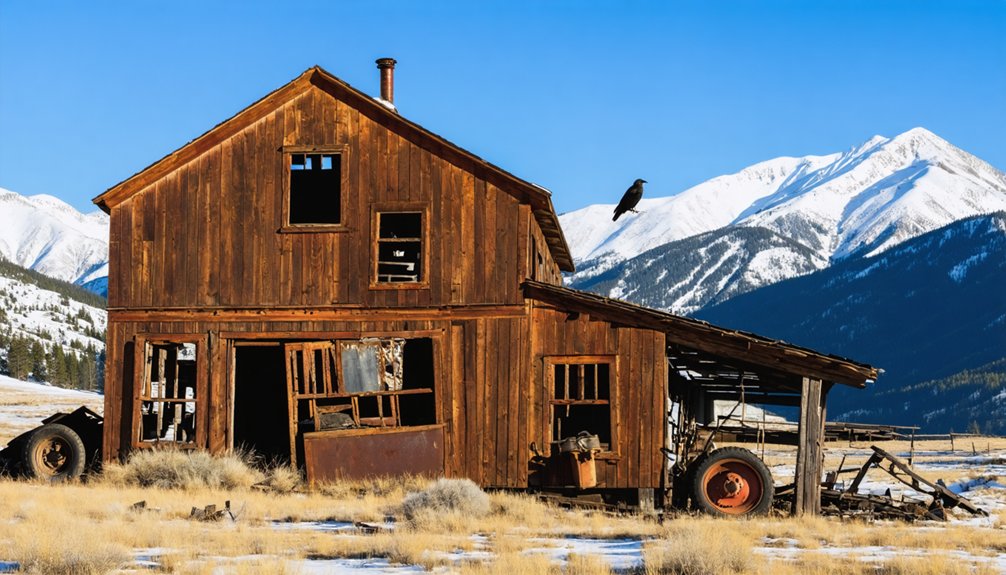
The late 1880s discovery of copper near Battle Lake by George Doane sparked one of Wyoming’s most significant mining developments, anchored by the Doane-Rambler workings that preceded the 1897 boom.
The district’s copper mining legacy flourished under the Rudefeha partnership, with the Ferris-Haggarty and New Rambler mines emerging as the region’s powerhouses.
During the copper boom’s peak, you’ll find these remarkable engineering feats:
- The world’s longest aerial tramway at 16 miles, carrying 840 buckets weighing up to 700 pounds each
- The Boston & Wyoming Smelter, processing massive quantities of ore while powering the town
- Advanced steam-powered hoisting equipment that reached depths of 2,000 feet
The Ferris-Haggarty operation alone employed 250 men and shipped 80,000 pounds of copper ore daily to Colorado smelters.
Hartville’s Wild West Connection
Founded in 1881 amid a promising copper rush, Hartville quickly evolved into Wyoming’s quintessential Wild West town when local saloonkeepers deliberately incorporated it to escape Sunrise’s strict company regulations.
The town’s Main Street came alive with up to 13 saloons, dance halls, and bordellos catering to a diverse mix of immigrant miners and fortune seekers.
Hartville’s Wild West culture manifested in frequent shootouts and street brawls, with victims finding their final rest in the local Boot Hill cemetery.
The town’s population peaked at nearly 800 residents around 1900, supported by copper, iron, and onyx mining operations.
While the mining boom eventually faded, Hartville’s historic false-front architecture and surviving structures, including the old jail, still tell tales of its rough-and-tumble frontier days.
Preserving Wyoming’s Ghost Town History
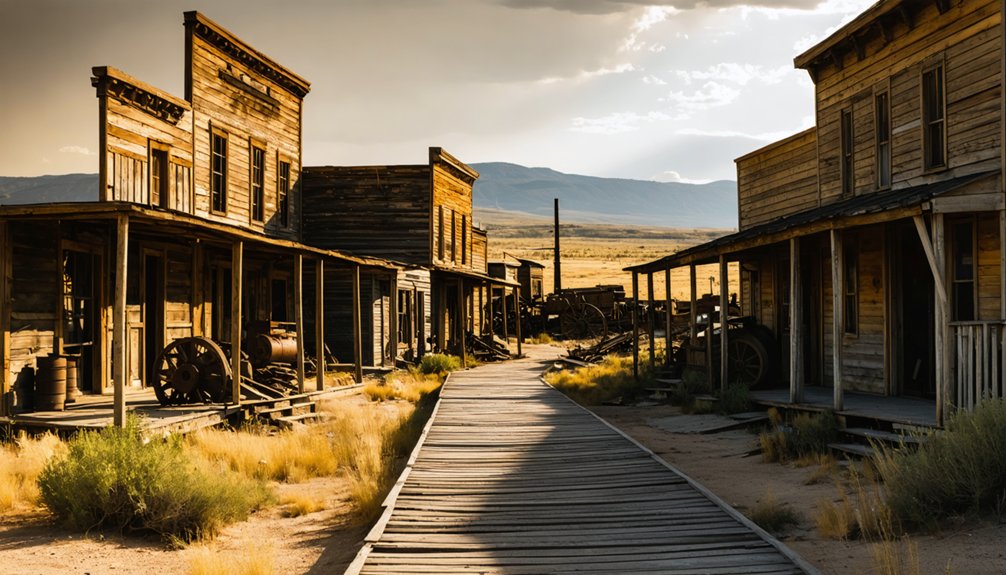
Through dedicated preservation efforts spanning decades, Wyoming’s ghost towns stand as living monuments to the state’s rich mining heritage.
Among the notable ghost towns in Wyoming, visitors can explore remnants of once-thriving communities like South Pass City and Atlantic City. Each site tells a unique story of the people who lived there and the challenges they faced. As you wander through these abandoned streets, you can almost hear the echoes of the past, bringing history to life in a way that few other experiences can.
You’ll discover meticulously preserved sites across the state, where ghost town preservation initiatives protect these invaluable historical treasures.
Wyoming’s commitment to protecting its heritage is evident through:
- South Pass City’s remarkable restoration, featuring authentic structures like the Moses Sturman Stamp Mill and Wolverine Mine Adit
- Kirwin’s protected mining remnants in Shoshone National Forest, including original log cabins and Earhart’s historic cabin
- Grand Encampment Museum’s collection of 19 preserved structures from surrounding ghost towns, showcasing both working-class and prominent residents’ homes
You’re free to explore these carefully maintained sites, where state agencies, the Forest Service, and local organizations work together to safeguard Wyoming’s pioneering spirit.
Frequently Asked Questions
Can Visitors Stay Overnight in Any of Wyoming’s Ghost Towns?
You can’t stay inside ghost town buildings, but you’ll find overnight camping options on surrounding BLM/USFS lands, nearby designated campgrounds, or ghost town accommodations in restored historic properties.
Are There Guided Tours Available at These Ghost Town Locations?
You’ll find guided explorations at sites like South Pass City and Fort Bridger, while private outfitters offer specialized tours highlighting historical significance. Both state-operated and commercial options accommodate various interests.
What Is the Best Season to Visit Wyoming’s Ghost Towns?
You’ll find late summer and early fall ideal for exploring Wyoming’s ghost towns, when spring blooms have faded but fall colors paint the landscape, offering comfortable temperatures and reliable road conditions.
Are Metal Detectors Allowed at Wyoming Ghost Town Sites?
You can’t freely use metal detectors at Wyoming ghost towns due to federal and state regulations protecting historical sites. Metal detecting requires permits and follows strict treasure hunting ethics.
How Accessible Are These Ghost Towns During Winter Months?
You’d think winter travel would be a breeze, but most ghost towns face serious accessibility challenges. You’ll need 4WD vehicles, weather monitoring, and survival gear for safe winter visits.
References
- https://travelwyoming.com/blog/stories/post/5-wyoming-ghost-towns-you-need-to-explore/
- https://www.wyomingcarboncounty.com/blog/123-5-ghost-towns-to-explore
- https://www.youtube.com/watch?v=GEoxbcwf8Ks
- https://www.explorewy.com/blog/ghost-towns-halloween-southwest-wyoming-travel
- https://www.geotab.com/ghost-towns/
- http://userpages.aug.com/bdobson/ghost4.html
- https://www.onlyinyourstate.com/experiences/wyoming/creepy-ghost-towns-in-wy
- https://en.wikipedia.org/wiki/List_of_ghost_towns_in_Wyoming
- https://www.ghosttowns.com/states/wy/wy.html
- https://westernmininghistory.com/towns/wyoming/south-pass-city/