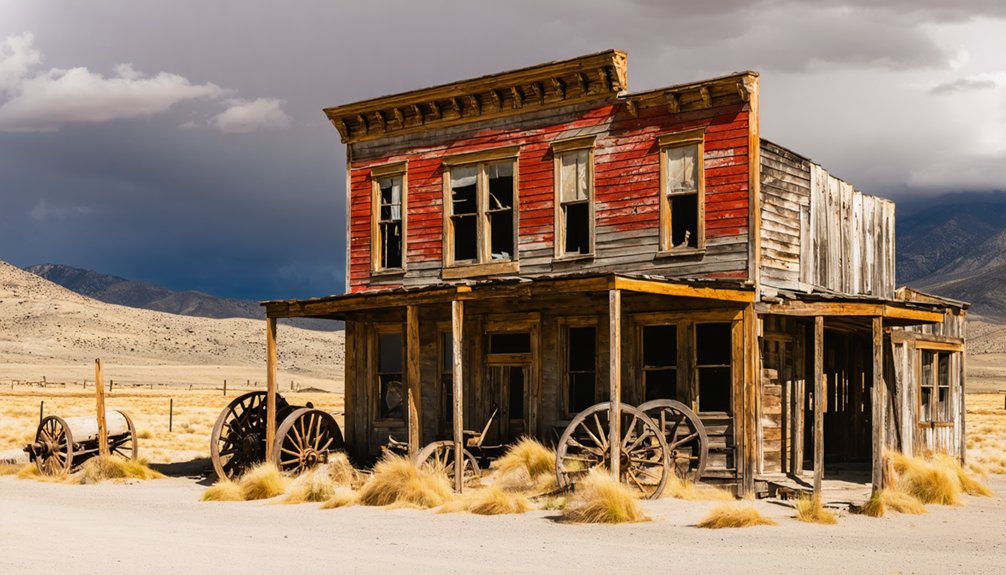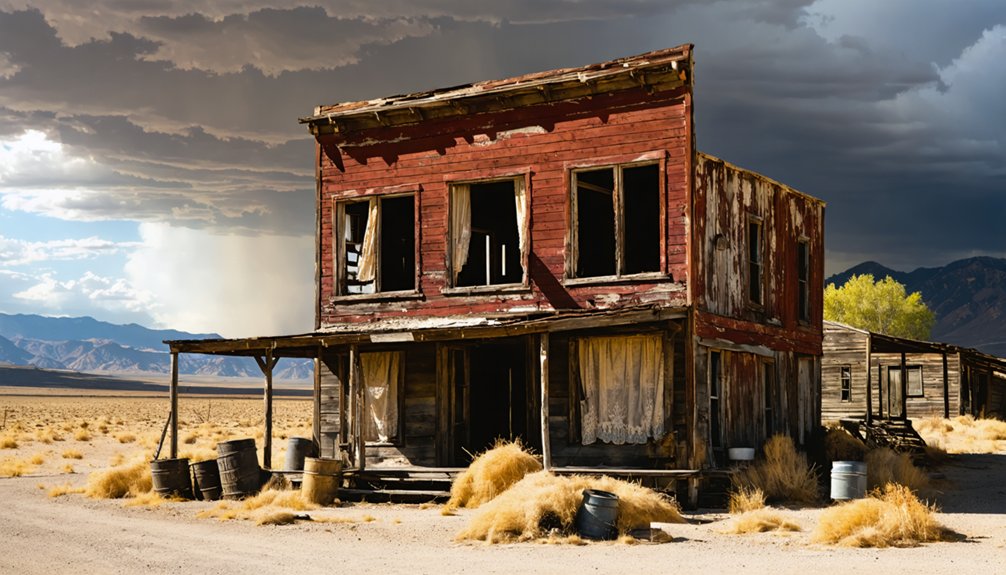
You’ll find thousands of ghost towns across the United States, from abandoned mining settlements in the West to deteriorating urban neighborhoods in the Rust Belt. These sites range from well-preserved locations like Bodie, California, with 110 Victorian-era structures, to modern examples of urban decay in cities like Detroit. While some towns face complete abandonment, others maintain minimal populations. The complex economic forces and preservation efforts behind these fascinating places reveal America’s evolving landscape.
Key Takeaways
- The United States has numerous ghost towns, including well-preserved sites like Bodie, California, which maintains 110 Victorian-era structures.
- Mining ghost towns remain prevalent across western states, with locations like Garnet, Montana, featuring 30 original buildings from the 1890s.
- Modern ghost towns continue to emerge in the Rust Belt, where cities like Detroit experience severe urban decay and abandonment.
- Texas High Plains communities and 92 small towns nationwide have lost over half their population since 2010, creating new ghost towns.
- Popular ghost towns like Calico, Tombstone, Rhyolite, and St. Elmo are preserved and open for tourism and historical exploration.
What Defines a Modern Ghost Town
While the term “ghost town” may evoke images of completely abandoned settlements in the American West, modern definitions encompass a broader spectrum of depopulated places.
Today’s definition criteria vary among experts, with some requiring complete abandonment while others include nearly empty towns where only a handful of residents remain. According to historian T. Lindsey Baker, a ghost town emerges when its reason for being disappears.
Many abandoned towns feature remaining buildings that have been left to decay naturally over time, creating an eerie atmosphere for visitors.
You’ll find that physical evidence plays an essential role in classification – most definitions require visible remains like standing buildings, ruins, or foundations.
Preservation groups often use multi-tier systems to categorize these sites, ranging from “classic” ghost towns (completely abandoned) to “semi-ghost” settlements (partially inhabited).
What ultimately defines a modern ghost town is the loss of its original purpose, whether economic, strategic, or social, even if some skeletal population persists.
Historical Mining Towns That Time Forgot
Among the most evocative ghost towns in American history, abandoned mining settlements stand as haunting monuments to the boom-and-bust cycles of mineral extraction.
You’ll find striking examples like Bodie, California, where 110 Victorian-era abandoned structures remain frozen in time, and Montana’s Garnet, with its 30 surviving buildings telling tales of 1890s gold fever. The infamous town boasted 65 bustling saloons during its wild heyday.
These mining legacies often share common causes of decline: depleted ore deposits, plummeting commodity prices, and technological shifts that made small operations obsolete. Modern ghost towns like Shenandoah, Pennsylvania show how economic decline continues to create abandoned communities.
Mining towns fell silent as resources vanished, prices crashed, and modern technology rendered traditional extraction methods obsolete.
Today, their physical remnants present both cultural treasures and environmental challenges. You’ll encounter hazardous mine shafts, contaminated soils, and deteriorating infrastructure across these sites.
The American West, particularly states like Nevada, Colorado, and Arizona, harbors the densest concentration of these time-capsule communities, preserving stark reminders of America’s mineral-rushing past.
Urban Neighborhoods Facing Abandonment
Unlike historic mining ghost towns, modern urban abandonment manifests in America’s Rust Belt cities through vast swaths of vacant homes and deteriorating neighborhoods.
You’ll find severe urban decay in cities like Detroit, Cleveland, and Youngstown, where entire blocks stand empty due to long-term population loss and industrial decline. These cities face “zombie foreclosures,” where properties remain caught in legal limbo, further accelerating neighborhood deterioration. Recent data shows that zombie foreclosures increased to 7,500 properties nationwide in the third quarter of 2025.
States like Oklahoma, Kansas, and Missouri are particularly affected, with vacancy rates exceeding 2% of all residential properties.
While some downtown areas show signs of neighborhood revitalization, surrounding residential zones continue to shrink.
Local governments attempt to address this through strategic demolition and land banking, but success varies based on municipal resources. The problem is often hyper-localized, with some zip codes showing abandonment rates above 80%, particularly in areas struggling with concentrated poverty and limited access to financing for property maintenance.
Economic Forces Behind Empty Communities
You’ll find that ghost towns emerge from interwoven economic forces, as industrial decline triggers population loss and creates a self-reinforcing cycle of abandonment.
When key industries like mining or manufacturing collapse, communities experience rapid outflows of working-age residents, leading to depressed housing values and vacant commercial spaces.
Cities facing decline often see long-term vacancies in residential properties, with some areas having over 40% of homes empty for two or more years.
The resulting erosion of tax bases often cripples municipal services and infrastructure maintenance, further accelerating the exodus of businesses and residents.
Misguided attempts at federal urban renewal programs often fail to revitalize these declining areas and may even accelerate their transformation into ghost towns.
Industrial Decline Empties Towns
Since the 1970s, industrial decline has systematically emptied communities across the United States, particularly in the Rust Belt region where manufacturing once dominated local economies.
You’ll find that single-industry towns suffered the harshest blows when major plants closed, triggering rapid unemployment and plummeting tax revenues. The effects rippled through entire communities as supplier networks collapsed and service sectors shrank. Towns like McKeesport and Johnstown saw their populations plummet as steel mills closed.
The impact on these towns wasn’t just economic – you’re seeing the physical deterioration of infrastructure as municipalities, stripped of their tax base, couldn’t maintain basic services. Similar patterns have emerged in Sunbelt cities, where massive foreclosures created widespread housing vacancies.
Contaminated brownfields, abandoned factories, and vacant properties now dot these landscapes. Global shifts in manufacturing, combined with automation and corporate restructuring, have left many of these communities struggling to reinvent themselves, testing their community resilience against seemingly insurmountable odds.
Population Loss Drives Vacancy
As major metropolitan areas and rural communities alike face unprecedented population losses, vacancy rates have surged across the American landscape.
You’ll find stark examples in cities like San Francisco, which lost 7.4% of its residents, and St. Louis, where retail vacancy rates climb 35% above average. These population dynamics reflect a broader pattern of decline affecting both urban and rural regions.
The rural exodus is particularly severe in Texas, where 75 counties experienced population losses, with High Plains communities hit hardest.
Small towns face even more dramatic shifts – 92 U.S. communities have lost half their population since 2010, while three have completely emptied.
Detroit exemplifies the connection between population loss and abandonment, with 30% of vacant homes remaining empty for two years or longer.
Market Forces Shape Abandonment
While multiple factors contribute to community abandonment, economic market forces play the decisive role in creating America’s ghost towns.
You’ll find that resource extraction dependencies create devastating boom-bust cycles, where towns flourish briefly during mining or logging peaks, then collapse when resources deplete or prices plummet. This pattern leaves behind specialized infrastructure that’s too costly to maintain.
Transportation shifts have also reshaped town viability. When railroads gave way to highways, or when major routes were redirected, previously thriving communities lost their economic lifelines.
You’ll notice that capital flight amplifies these effects – as private investment withdraws, property values plunge and tax bases erode. This triggers a downward spiral where declining municipal services and infrastructure decay accelerate abandonment, especially in single-industry towns dependent on one major employer.
Popular Ghost Towns You Can Visit Today
Although the American West’s mining boom has long since faded, numerous ghost towns remain as preserved windows into the nation’s frontier past.
You’ll find Bodie history frozen in time with 110 original buildings in arrested decay, while Calico restoration offers an accessible desert experience between Las Vegas and Los Angeles.
Tombstone legends come alive through Wild West re-enactments, drawing 400,000 visitors annually to witness its infamous OK Corral history.
For Rhyolite photography enthusiasts, the striking ruins near Death Valley provide dramatic sunrise and sunset opportunities.
St. Elmo preservation stands as the West’s best-maintained ghost town, with 40 original structures nestled in Colorado’s Chaffee County.
These five destinations let you step back into America’s mining era while experiencing the freedom of the frontier spirit.
Preserving America’s Abandoned Places
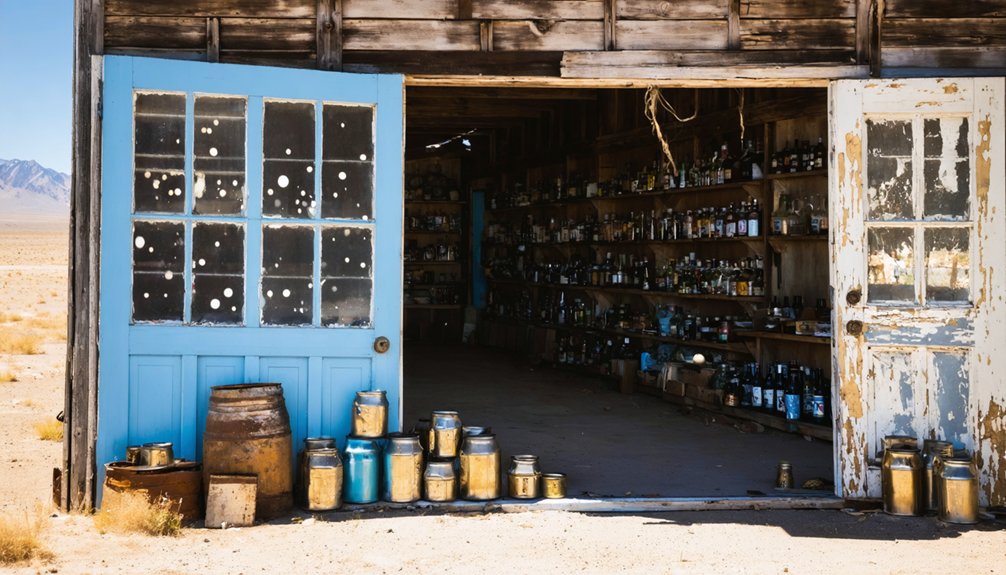
Since America’s historic abandoned places face increasing threats from weathering and development, extensive preservation efforts have emerged through multiple channels.
The race to save America’s neglected historic sites has sparked innovative solutions as time and progress threaten these cultural treasures.
You’ll find preservation strategies ranging from federal protections under the National Register of Historic Places to local historic district ordinances that restrict demolition. These frameworks enable vital funding through preservation grants, tax incentives, and private philanthropy.
Physical stabilization and digital documentation form the technical backbone of ghost town conservation.
Through adaptive reuse initiatives, you can see abandoned structures transformed into heritage tourism sites, event spaces, and interpretive centers – generating revenue for ongoing maintenance.
Local historical societies often spearhead these efforts, working alongside federal agencies and private landowners while maneuvering environmental regulations and land-use laws to guarantee these historic places endure for future generations.
Frequently Asked Questions
Can You Legally Live in an Abandoned Ghost Town Today?
You’ll need proper permits and ownership rights to legally inhabit ghost towns, as they’re governed by strict regulations. Legal implications vary between private, public, and mixed ownership, requiring thorough compliance with local codes.
How Many People Still Permanently Reside in America’s Ghost Towns?
You’d be surprised – while population dynamics vary widely, reliable estimates suggest thousands to tens of thousands of free spirits still call America’s historically significant ghost towns home, though exact counts remain debatable.
What Happens to Mail Delivery and Postal Services in Ghost Towns?
You’ll find mail delivery stops when population drops too low, but postal services often continue through nearby post offices, cluster boxes, or rural route delivery for remaining residents.
Do Ghost Towns Still Maintain Utility Connections Like Electricity and Water?
With 73% of occupied units losing power, you’ll find most ghost towns lack active utility infrastructure. Historical preservation sites occasionally maintain minimal electricity for tourism, but traditional water connections remain disconnected.
Are There Property Taxes or Municipal Fees in Officially Designated Ghost Towns?
You’ll still face ghost town taxation and municipal regulations if the property has a private owner, but government-owned historic sites are typically tax-exempt. County assessments apply unless officially waived.
References
- https://themortgagepoint.com/2024/10/25/americas-new-ghost-towns/
- https://247wallst.com/special-report/2023/07/11/americas-modern-ghost-towns/
- https://www.youtube.com/watch?v=PM4keUzOP8A
- https://www.youtube.com/watch?v=aTbMdOZRZO4&vl=en
- https://www.youtube.com/watch?v=9Q3IEfnUqyM
- https://www.youtube.com/watch?v=hS27BhfMojc
- https://www.aol.com/articles/10-ghost-towns-us-actually-200604529.html
- https://joybird.com/blog/top-ghost-towns-in-america/
- https://en.wikipedia.org/wiki/Ghost_town
- https://en.wikivoyage.org/wiki/Ghost_towns