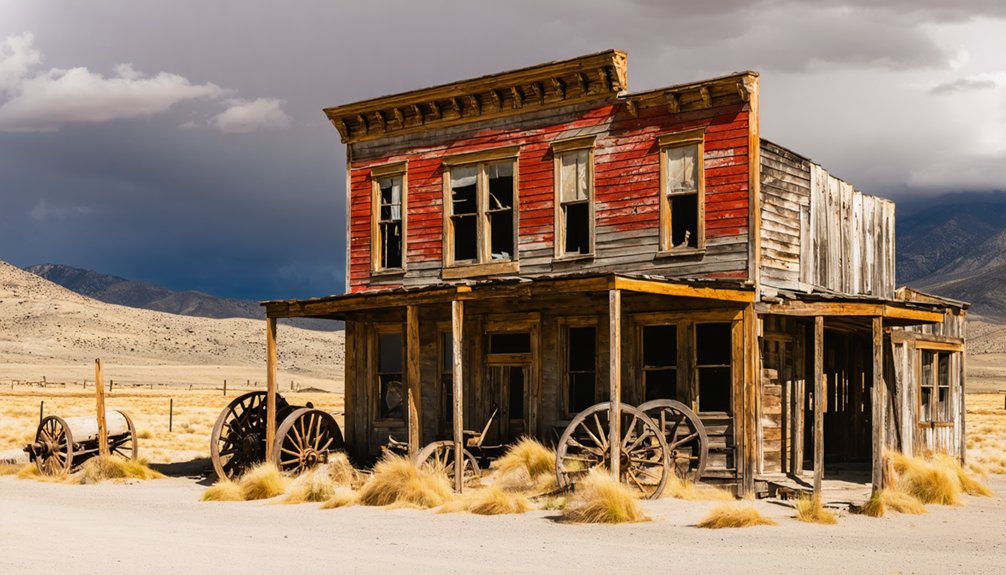
You’ll find over 3,000 ghost towns across America today, with Texas leading at 511 abandoned settlements and California following at 346. These haunting remnants emerged from economic booms like Texas’s 1901 oil discovery and California’s 1880s railroad expansion, while others resulted from natural disasters like the Dust Bowl. Modern ghost towns are now appearing in unexpected places, particularly in Rust Belt cities where vacancy rates exceed 20%. The full story of America’s abandoned places reveals surprising patterns of rise, decline, and transformation.
Key Takeaways
- Over 3,000 ghost towns exist across America, with the highest concentrations in Texas (511 towns) and California (346 towns).
- Modern ghost towns are emerging in Rust Belt cities like Detroit and St. Louis, where vacancy rates exceed 20%.
- Natural disasters, economic decline, and industry collapse continue to create new ghost towns, with Augusta, Georgia identified as likely next.
- Mining regions in Western states contain numerous abandoned settlements from past boom-and-bust cycles.
- Cities like Detroit show active ghost town formation, with some neighborhoods losing over half their housing to demolition.
The Rise and Fall of Historical Ghost Towns
While ghost towns now dot the American landscape from coast to coast, their distribution reveals fascinating patterns in the nation’s development.
You’ll find the highest concentration in Texas, with 511 abandoned settlements, followed by California’s 346 ghost towns. The historical significance of these sites traces back to specific economic booms – Texas’s ghost town architecture emerged largely after the 1901 Spindletop oil discovery, while California’s abandoned towns multiplied during the 1880s railroad expansion. These abandoned towns serve as vivid reminders of America’s turbulent history.
The American West’s abandoned towns tell tales of fleeting prosperity, from Texas oil fields to California’s railroad dreams.
Natural disasters and economic shifts triggered many towns’ demise. The 1930s Dust Bowl devastated Great Plains farming communities, while severe weather events, like the hurricane that struck Fort Jefferson in 1906, forced other settlements into abandonment. Kern County, California holds the record for the most ghost towns in a single county with 113 abandoned settlements.
Today, over 3,000 ghost towns stand as silent witnesses to America’s dynamic past.
Modern Ghost Towns: A New Urban Reality
You’ll find today’s ghost towns emerging in unexpected places, particularly across America’s Rust Belt where vacancy rates in some neighborhoods exceed 20%.
Augusta, Georgia stands out as the most likely future ghost town in the United States.
In cities like Detroit and St. Louis, entire blocks of empty homes and shuttered storefronts tell the story of rapid population decline and economic distress. With 2.3 million units missing from the current housing supply, these vacant properties represent a stark contrast to America’s broader housing shortage.
What you’re witnessing is a modern urban phenomenon where once-thriving neighborhoods transform into near-empty streets, marked by plummeting property values and abandoned commercial spaces.
Vacancy Rates Rising Fast
Three stark trends have emerged in America’s housing landscape since 2020: widespread population shifts, unprecedented vacancy rates, and the rise of modern ghost towns.
You’ll find about 1.3 million vacant homes across the nation, representing 1.27% of all properties. But that’s just the average – dig deeper, and you’ll discover dozens of ZIP codes where vacancy rates soar past 15-20%.
These vacancy trends aren’t hitting everywhere equally. You’re seeing the worst impacts in older industrial areas and rural communities, where population decline has taken its toll. The Midwest and Rust Belt regions show the highest concentration of vacant properties. Cities like Las Vegas and Detroit lead the nation in vacancy rates, showcasing the stark reality of urban abandonment.
When people leave, housing values plummet, creating a cycle that’s tough to break. The numbers tell a sobering story: over 26 ZIP codes lost more than 20% of their residents between 2010 and 2020, leaving behind increasingly empty neighborhoods that signal America’s shifting demographics.
Rust Belt’s Empty Streets
The Rust Belt‘s modern ghost towns represent a dramatic transformation of America’s industrial heartland.
You’ll find entire neighborhoods where more than half the homes are gone – places like Detroit’s McDougall-Hunt, where urban decay has hollowed out once-thriving communities.
Since their mid-20th century peaks, major cities like Detroit, Cleveland, Pittsburgh, and Buffalo have lost between 30-60% of their populations, with some smaller industrial towns hit even harder.
High property tax burdens drive many homeowners to abandon their properties, perpetuating the cycle of neighborhood decline.
This pattern mirrors what has happened in Sunbelt cities, where massive foreclosures have created similar vacancy challenges.
In Youngstown and Gary, you’ll see block after block of empty streets where industry once hummed.
While some areas are pursuing neighborhood revitalization, the reality is stark: across 49 Rust Belt cities, 269 census tracts have lost over half their housing stock since 1970.
Even suburban areas aren’t immune, as vacancy rates climb into double digits throughout the region.
Understanding Vacancy Rates and Population Decline
Residential vacancy rates across America paint a stark picture of population shifts and economic challenges in numerous cities.
You’ll find the national vacancy rate holding at 1.32% in late 2025, but this figure masks dramatic local variations. Cities like Dayton, Ohio and Jackson, Mississippi are experiencing alarming vacancy trends, with rates soaring above 40%. Oklahoma and Kansas demonstrate this ongoing challenge with notably high rates of 2.4% and 2.3% respectively.
Population shifts have hit certain regions particularly hard. St. Louis saw its population plummet by 6.6% between 2020-2023, while New Orleans shrunk by over 5%. In states like Colorado and Washington, zombie foreclosures have more than doubled year-over-year.
These declines correlate directly with high vacancy rates, creating a cycle of abandonment. In areas like Augusta, Georgia, more than a quarter of vacant homes have been empty for over two years, signaling deep-rooted economic struggles that continue to reshape America’s urban landscape.
Geographic Distribution of America’s Ghost Towns
When you examine America’s ghost towns, you’ll find the highest concentrations in Western mining regions, with Texas and California leading at 511 and 346 documented sites respectively.
Mining booms of the late 19th and early 20th centuries created thousands of temporary settlements across states like Colorado, Nevada, and Montana, many of which now stand abandoned near historic mine sites.
While the West’s ghost towns often resulted from depleted mineral resources, the Rust Belt’s vacant cities tell a different story of industrial decline, with cities like Detroit and Gary showing significant abandonment patterns in their urban cores.
Western Mining Regions Dominate
Mining activityді American’s sort of frontier tb
Rust Belt’s Empty Cities
The Rust Belt’s abandoned cities tell a stark story of American deindustrialization, with 269 census tracts across 49 cities losing over half their housing units between 1970-2010.
You’ll find some of the most dramatic urban decay across cities like Detroit, Cleveland, and Buffalo, where population losses have exceeded 45% since 1970.
- Detroit’s troubles run deep, with neighborhoods like McDougall-Hunt losing over half their housing to demolition and ZIP codes showing vacancy rates above 24%.
- St. Louis’s north end exemplifies the racial divide, with ZIP 63120 experiencing 17.4% vacancy rates and continuing population decline.
- Buffalo’s east side and Cleveland’s core showcase the economic impact, with median household incomes dropping 20-30% and persistent abandonment.
Economic and Social Forces Behind Abandonment
Since the late 20th century, economic restructuring has driven the systematic abandonment of countless American communities.
You’ll find this devastation most apparent in places that once thrived on single industries like manufacturing, mining, or timber. When these economic pillars collapsed, they triggered waves of job losses, sparking mass exodus and economic disinvestment.
The demographic shifts have been equally dramatic. As working-age residents flee to growing metro areas, they leave behind aging populations and shrinking tax bases.
Rural towns empty as young workers migrate to cities, leaving elderly neighbors and dwindling public resources behind.
This creates a downward spiral: fewer residents mean less revenue for basic services, while maintenance costs for aging infrastructure keep rising.
You’ll see the evidence in deteriorating roads, shuttered businesses, and blocks of vacant homes. Many communities can’t escape this cycle, as declining property values and persistent vacancies discourage new investment.
Preserving and Revitalizing Declining Communities
While many communities face severe economic decline, preservation efforts have emerged as powerful tools for revival. Through strategic preservation strategies and community revitalization initiatives, you’ll find numerous ways to breathe new life into struggling towns.
- Historic district designations and National Register listings reveal valuable tax credits and grants, making restoration projects more financially viable for investors and property owners.
- Main Street programs and community land trusts empower local residents to take control of their commercial corridors and housing stock.
- Adaptive reuse policies and targeted infrastructure investments create opportunities to transform vacant buildings into vibrant spaces while maintaining historical character.
Frequently Asked Questions
Is It Legal to Take Artifacts or Souvenirs From Ghost Towns?
You’d face serious legal ramifications if caught pocketing that rusty nail from Bodie – it’s illegal. Artifact preservation laws protect ghost towns through federal, state, and private property regulations, with hefty fines and jail time.
How Can I Find Undiscovered Ghost Towns Not Listed on Tourist Maps?
Research historical mining claims, study old railroad maps, and scout remote backroads. You’ll find hidden locations through urban exploration forums, but always verify property access rights before visiting.
Are There Ghost Towns That Still Have Active Residents Today?
You’ll find many ghost town communities still have current residents today – from caretakers maintaining tourist sites to locals who never left after economic decline, and artists or retirees seeking remote living opportunities.
What Safety Precautions Should Visitors Take When Exploring Ghost Towns?
Like a desert scout treading carefully, you’ll need proper safety gear, sturdy boots, first-aid supplies, and wildlife awareness. Stay alert for hazardous structures, bring navigation tools, and always explore with companions.
Can Someone Purchase and Restore an Abandoned Ghost Town Property?
Yes, you can acquire ghost town ownership through various legal pathways like real estate listings, auctions, or tax sales. Property restoration requires managing zoning permits, historic preservation rules, and significant financial investment.
References
- https://themortgagepoint.com/2024/10/25/americas-new-ghost-towns/
- https://247wallst.com/special-report/2023/07/11/americas-modern-ghost-towns/
- https://www.youtube.com/watch?v=aTbMdOZRZO4&vl=en
- https://www.youtube.com/watch?v=9NbQToO9gOE
- https://www.frrandp.com/p/ghost-towns-map.html
- https://www.youtube.com/watch?v=9Q3IEfnUqyM
- https://www.youtube.com/watch?v=hS27BhfMojc
- https://www.aol.com/articles/10-ghost-towns-us-actually-200604529.html
- https://joybird.com/blog/top-ghost-towns-in-america/
- https://www.geotab.com/press-release/american-ghost-towns/