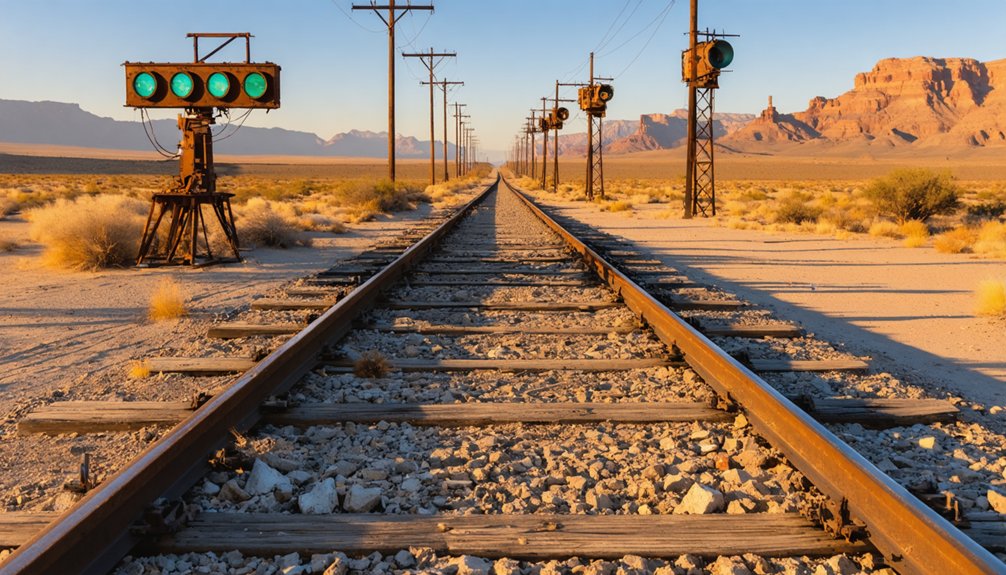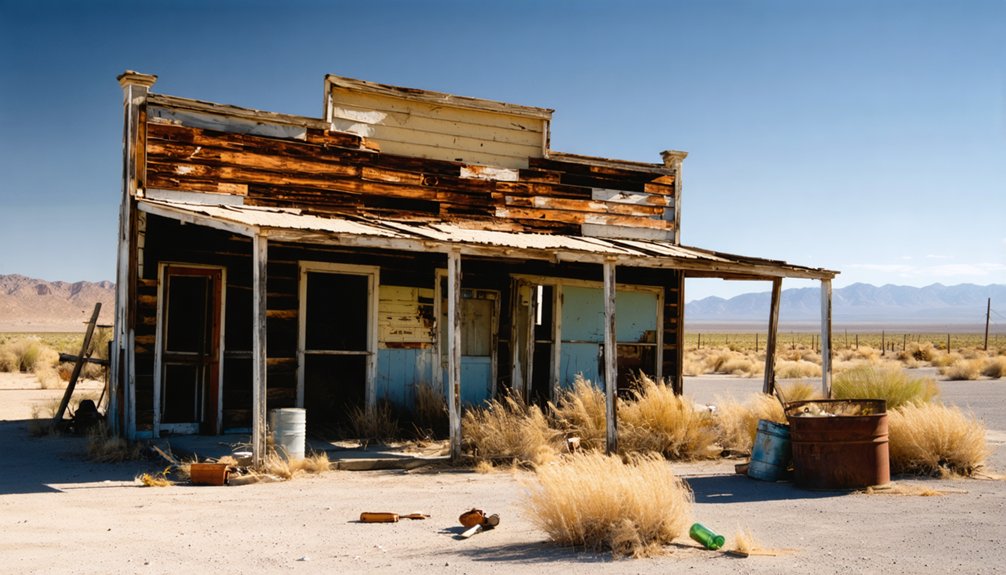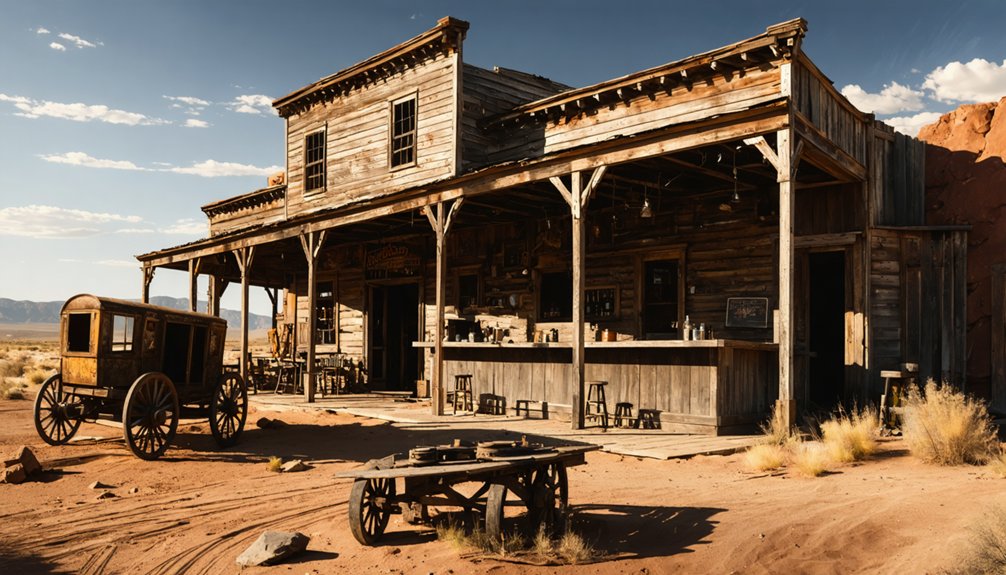
You’ll discover Arizona’s ghost towns and mining camps as remnants of the late 1800s mining booms, when gold, silver, and copper drove rapid development across the territory. These settlements, like Congress, Cleator, and Ruby, grew from simple camps into thriving communities with populations reaching thousands. While many towns declined after World War I due to falling mineral prices and depleted ore grades, their preserved structures and artifacts offer compelling windows into Arizona’s pioneering spirit.
Key Takeaways
- Mining towns like Congress became Arizona Territory’s leading gold producers, yielding $16 million by 1906 before eventual abandonment.
- Cleator’s social life centered around its general store and saloon, with the Cleator Bar remaining a historic gathering spot today.
- Ruby stands as Arizona’s best-preserved ghost town, featuring 20 original buildings and maintaining an on-site caretaker.
- Transportation evolved from primitive roads to narrow-gauge railroads, dramatically reducing ore transport costs in mining settlements.
- The Great Depression and falling mineral prices caused widespread abandonment of mining camps, creating today’s ghost towns.
The Gold Rush Legacy of Turkey Creek
While Turkey Creek‘s gold-bearing potential wasn’t discovered until the late 19th century, this central Arizona waterway became a notable destination for placer mining between 1908 and 1941.
You’ll find its historical prospecting roots intertwined with the broader Bradshaw Mountains and Hassayampa gold rushes that drew thousands to the territory in the mid-1800s.
The creek’s placer deposits originated from multiple historic lode districts, including Senator, Poland Junction, and Hassayampa. Gold appeared both as coarse nuggets and fine particles, concentrated in deep gravel bars and bedrock exposures.
Like many mining areas where Cornish miners were imported to handle difficult terrain, Turkey Creek’s deposits required extensive expertise to extract effectively.
Though the area’s production remained modest compared to richer strikes like Rich Hill, Turkey Creek’s legacy continues through modern recreational prospecting. Today, the area offers seasonal water availability for various mining methods.
Several underground mines, including the Hidden Treasure and Golden Turkey, added to the district’s allure during the early 20th century.
Daily Life in Historic Cleator
You’ll find that Cleator’s bustling social life centered around the general store and saloon, which served as the town’s main gathering spots for miners, ranchers, and travelers.
Today, the historic town maintains its friendly atmosphere at the Cleator Bar and Yacht Club, where locals and visitors continue to gather.
The Bradshaw Mountain Railroad’s Turkey Siding depot established essential trade connections, while stage routes and freight services operated by Lev Nellis connected Cleator to Crown King and other regional mining communities.
The town’s position as a crucial transportation hub supported both the mining industry and local ranching operations, including the Mognett Family’s substantial cattle enterprise of 7,000 head. James P. Cleator took full ownership in 1915 of the store after buying out his business partner Lev Nellis.
Social Hub Activities
At the heart of historic Cleator’s social life stood the Cleator Bar and Yacht Club, which served as the town’s primary gathering spot for an eclectic mix of visitors.
You’d find cowboys sharing stories with hippies and bikers on the front porch, while regulars like Bill MacMaster enjoyed their beers inside among cowboy memorabilia and nautical decor.
The venue hosted vibrant community gatherings and social dances that brought together ranchers, miners, and railroad workers.
The Cordes girls would ride into town for these lively events, creating memorable evenings with local ranch hands.
Even today, the bar maintains its tradition as a welcoming space where diverse groups converge.
Despite the town’s dwindling population of around 11 residents, you’ll still experience the same spirit of inclusivity that’s defined this social hub for generations.
The town’s decline began when mines closed in the late 1920s, though the social spirit of the bar endured.
Transportation and Trade Routes
During Cleator’s mining heyday, the Bradshaw Mountain Railroad served as the town’s vital transportation artery, leaving an indelible mark on the region’s infrastructure.
You’ll find evidence of expert railroad engineering in the dirt road that follows the old railbed, featuring calculated curves and deep rock cuts designed for trains.
If you’re heading to Cleator today, you’ll take U.S. Route 93 northwest from Wickenburg for 6 miles to State Route 89, then north to Congress.
Similar to the Commonwealth Mine in Pearce that produced vast amounts of precious metals, the De Soto Mine‘s 0.75-mile tramway facilitated ore transportation to the main railway line at the Middleton site, 2.5 miles southwest of Cleator.
This integrated network of rails and tramways revolutionized mining operations, replacing slower wagon transport and connecting Cleator to Arizona’s broader trading system.
Like many boom and bust cycles in Arizona’s mining history, Cleator’s transportation infrastructure eventually fell into disuse as mining activities declined.
Congress: A Railroad Mining Success Story
The discovery of gold in 1884 by Dennis May launched Congress into Arizona’s most successful railroad mining ventures.
“Diamond” Jim Reynolds’ purchase of the mine in 1887 set the stage for dramatic railroad expansion, linking Congress Junction to the Santa Fe, Prescott and Phoenix railroad by 1893.
You’ll find that mining innovations flourished under William F. Staunton’s leadership, including the introduction of the cyanide process and expansion to a 40-stamp mill.
Congress thrived as Arizona Territory’s leading gold producer, yielding $16 million in precious metals by 1906.
With 425 workers at its peak, the town split between Mill Town and Lower Town, each serving distinct purposes.
The mine’s rich deposits yielded gold in white quartz veins with iron pyrite inclusions.
Post office operations moved to Congress Junction in 1938, marking another step in the town’s decline.
Despite the mine’s success, high freight rates of $14.60 per ton ultimately forced its closure in 1910, though later operations recovered gold from the tailings.
Gleeson’s Copper Mining Heritage
You’ll find Gleeson’s copper mining origins in John Gleeson’s strategic Copper Belle claim, which yielded impressive ore grades of 4-7% during his early ownership period.
The town’s physical location shifted downhill from its original Turquoise camp site to access vital water resources when the new mining settlement was established in 1900. A devastating fire in 1912 destroyed 28 buildings in the town, though residents quickly rebuilt the structures.
With the completion of a railroad spur in 1909, Gleeson’s mining operations expanded through various methods including shafting, tunnel mining, and cyanide processing of tailings until declining activity in the 1930s.
Early Copper Belle Claims
Founded initially as the Leonard claim by Kit Charleston in 1887, Copper Belle emerged as one of Arizona’s most significant copper mining operations after John Gleeson purchased and developed the property in 1896.
Under Gleeson’s direction, the mine expanded rapidly until 1901, when Shannon Copper Company acquired the operation for $100,000. The Copper Belle became part of the larger Charleston Group, which included several contiguous claims that defined the Turquoise mining district.
You’ll find the mine’s success centered on its rich deposits of copper, lead, zinc, and precious metals, accessed through a 300-foot shaft system with multiple underground levels.
The mine’s development catalyzed Gleeson’s growth, transforming it from a small camp into a bustling town of 500 residents with crucial rail connections by 1909.
Water Drives Town Relocation
While Native Americans had long extracted turquoise from the surrounding hills, white prospectors’ discovery of copper, lead, and silver deposits in the 1870s sparked new mining interest in what became known as Turquoise Camp.
You’ll find that water scarcity posed significant challenges for early mining operations, limiting copper production and hampering development. The original camp’s location in the hills proved unsustainable due to mining logistics and insufficient water resources.
In 1900, the settlement relocated three miles south to flatland, establishing the new town of Gleeson. This strategic move positioned operations closer to water sources and coincided with John Gleeson’s copper claims.
The relocation proved successful – the town grew to 500 residents, supported multiple mines including the Copper Belle, and maintained operations through the World War I mining boom.
Mining Operations and Decline
The discovery of rich copper deposits in 1887 launched Gleeson’s mining legacy when Kit Charleston established the Leonard mine, later renamed the Copper Belle under John Gleeson’s ownership in 1896.
You’ll find that copper production flourished during World War I, with the town’s population reaching 500 as mining operations expanded to include the Silver Belle, Brother Jonathan, and Defiance mines.
The railroad spur‘s completion in 1909 revolutionized ore transport.
The mining decline began after World War I when copper prices plummeted. Despite earlier success, the ore quality deteriorated, with copper grades dropping to 1.5%.
The Great Depression accelerated the town’s downturn, leading to the railroad spur’s abandonment in 1932 and the post office’s closure in 1939, transforming Gleeson into a ghost town.
The Rise and Fall of Harshaw’s Silver Empire
During the late 1870s, David Tecumseh Harshaw’s fortuitous discovery of silver while grazing cattle sparked one of Arizona Territory’s most dramatic mining booms.
The Harshaw mining district rapidly expanded, attracting eastern capital and establishing a bustling town with a mile-long main street filled with businesses and over 200 buildings.
At its peak, Harshaw’s silver empire boasted:
- Population of 2,000 residents
- Production of $1.1 million in silver (1880)
- Over 40 active mining operations
You’ll find that harsh labor conditions defined life for workers, particularly Mexican American miners who earned half the wages of their Anglo counterparts.
The town’s prosperity proved short-lived—declining ore grades by 1881 and the federal demonetization of silver in 1893 transformed this once-thriving settlement into yet another Arizona ghost town.
Today, visitors can explore the remnants of these ghost towns of Arizona history, where the echoes of the past whisper stories of boom and bust. Each decaying structure tells a tale of ambition and despair, inviting adventurers to uncover the secrets lost to time. As nature reclaims these once-bustling communities, they stand as poignant reminders of the region’s rich and tumultuous history.
Ruby: Arizona’s Best-Preserved Mining Town
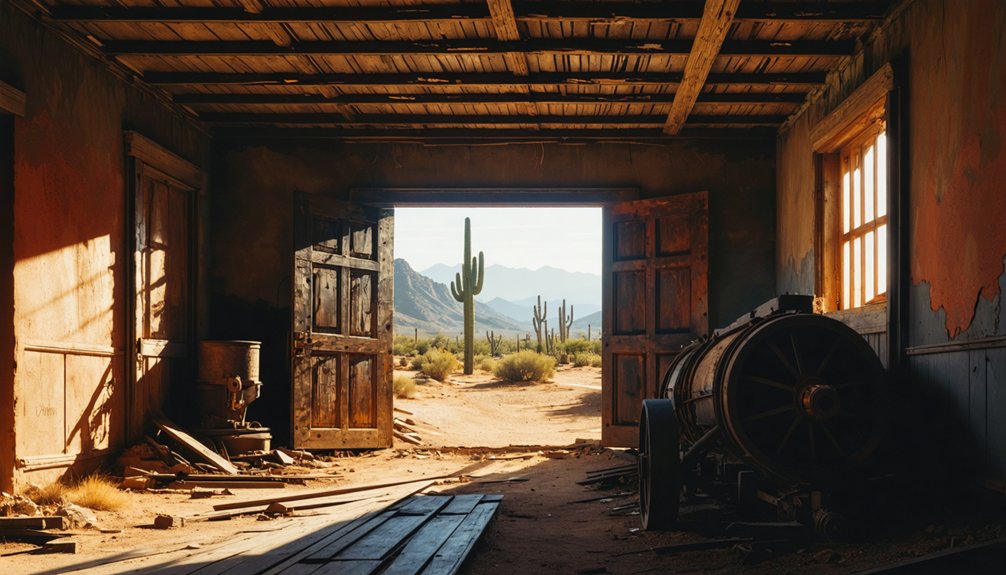
Located at the base of Montana Peak, Ruby emerged from humble beginnings as Montana Camp in the 1870s to become one of Arizona’s most significant mining settlements. The discovery of rich silver ore in 1891 and the Ruby Mercantile’s establishment shaped early mining community dynamics, though growth remained constrained by harsh conditions.
You’ll find Ruby’s true heyday began in 1926 when Eagle-Picher Lead Company transformed it into a thriving operation with 2,000 residents. The company built essential infrastructure, including water systems and electricity, while providing modern amenities like schools and medical care.
Despite its prosperity, Ruby wasn’t immune to lawlessness, with the mercantile witnessing notorious double murders in the 1920s. Today, though closed to the public, Ruby stands as Arizona’s best-preserved ghost town, with 20 buildings remaining and a single caretaker maintaining its historic legacy.
Explorers often seek out historic sites in Washington Camp, where remnants of mining culture and early settlements can still be appreciated. The area’s rugged beauty complements its rich history, drawing visitors interested in both adventure and education. Guided tours offer insights into the lives of those who once thrived in this remote part of Arizona, making it a unique destination for history enthusiasts.
The Role of Transportation in Mining Settlement Growth
Mining settlements like Ruby relied heavily on evolving transportation networks to sustain their growth and operations throughout Arizona Territory.
Early wagon road development followed Native American trails, with routes like Black Canyon becoming crucial arteries between settlements.
You’ll find the most significant transportation developments came in three distinct phases:
- Primitive wagon roads and stagecoach routes that faced steep climbs, dangerous river crossings, and constant bandit threats
- Narrow gauge railroads that revolutionized ore transport, especially in challenging terrain like the Bradshaw Mountains
- Standard gauge railways that dramatically reduced freight costs from $1,000 to manageable levels per ton
These transportation innovations transformed Arizona’s mining operations, though stagecoach challenges persisted with lengthy 30-hour rides costing up to $30 ($575 today) across the territory.
Frequently Asked Questions
What Safety Precautions Should Visitors Take When Exploring Arizona Ghost Towns?
You’ll need proper safety gear, stay alert for wildlife, avoid unstable structures, obtain property permissions, travel with others, and keep emergency supplies handy when exploring these remote historical locations.
Are There Any Paranormal Activities Reported in These Abandoned Mining Camps?
Where there’s smoke, there’s fire. You’ll find numerous ghost sightings in Jerome, with its haunted history drawing paranormal tourists. Vulture City, Goldfield, and southern mining camps report mysterious apparitions and unexplained phenomena.
What Artifacts Can Legally Be Collected From These Historic Mining Sites?
You can’t legally collect historic artifacts from these sites, as both federal and state legal regulations protect them. Only modern refuse may be removed, and artifact preservation must be prioritized.
Which Arizona Ghost Towns Still Have Active Property Owners or Residents?
Like flickering lanterns in the desert night, you’ll find active communities in Chloride, Oatman, and Bisbee, while private property ownership continues in Vulture City, Ruby, and Goldfield’s restored tourist sites.
When Is the Best Season to Visit Arizona’s Ghost Towns?
You’ll find the best weather and ideal temperatures from late October through March, avoiding summer’s intense heat and monsoon risks while enjoying comfortable exploration conditions and fewer crowds.
References
- https://www.arizonahighways.com/article/arizona-ghost-towns
- https://www.visittucson.org/blog/post/8-ghost-towns-of-southern-arizona/
- https://www.youtube.com/watch?v=l_ogVgvyw7Y
- https://www.legendsofamerica.com/az-ghosttowns/
- https://www.worldatlas.com/cities/6-arizona-towns-where-time-stands-still.html
- https://azoffroad.net/ghost-towns
- https://vocal.media/earth/arizona-s-rich-mining-history-a-tale-of-terror-and-triumph
- https://minedata.us/property/turkey-creek-placer-claims-prescott-arizona/
- https://pubs.usgs.gov/bul/1355/report.pdf
- https://azoffroad.net/golden-turkeygolden-belt-mines