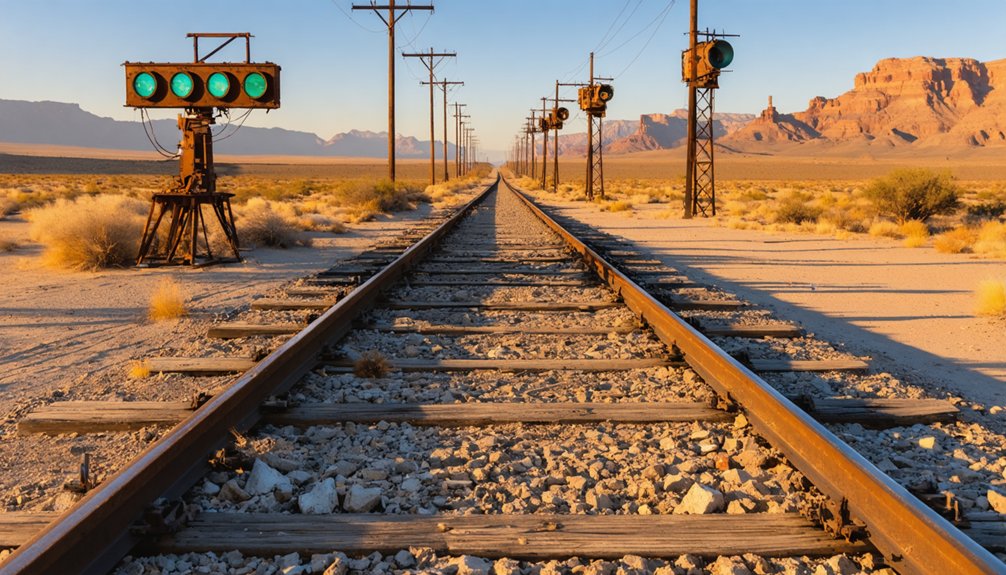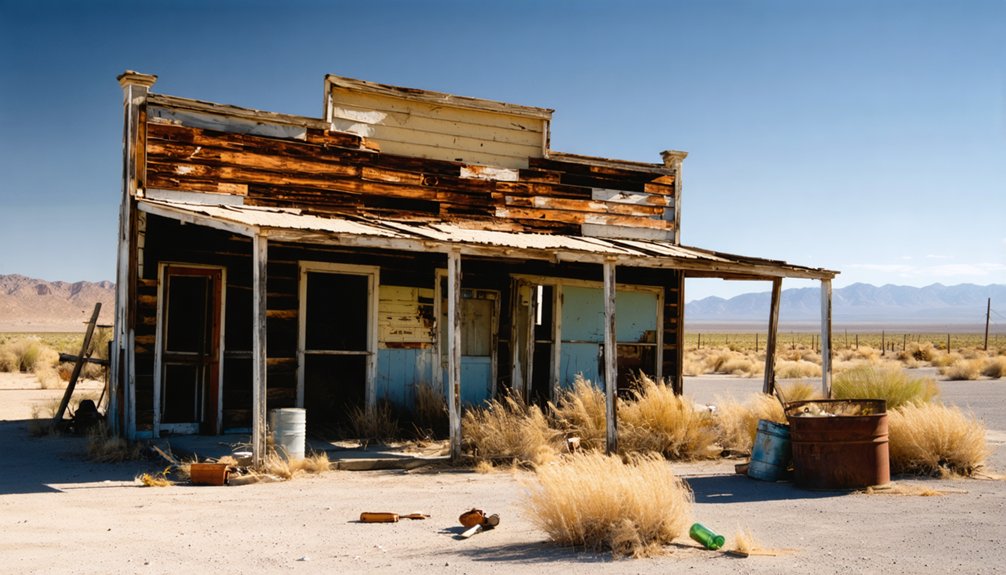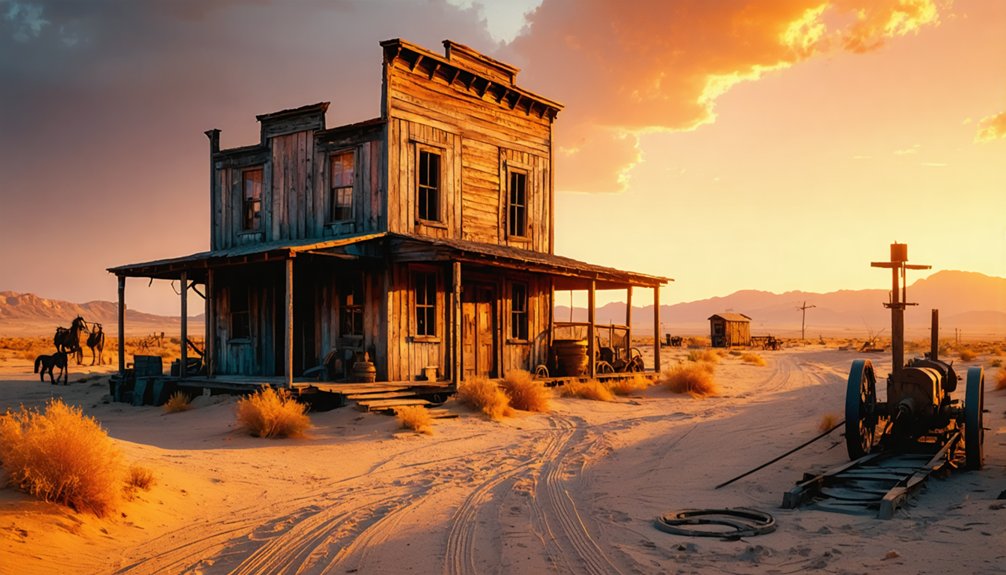
You’ll find Arizona’s most atmospheric ghost towns in places like Ruby, where 2,000 residents once mined silver, and Kentucky Camp, where visitors report shadowy figures and mysterious footsteps. These abandoned settlements showcase weathered adobe walls, stark jail cells, and mining remnants that create eerie silhouettes against the desert night. While some towns like Jerome and Tombstone have found new life, others remain frozen in time, their stories waiting in the desert silence.
Key Takeaways
- Kentucky Camp features haunted adobe buildings where visitors report encounters with shadowy figures, cold spots, and mysterious footsteps.
- Ruby’s abandoned mining town showcases eerie remnants of its 2,000-person peak, including weathered structures and a historic 15-mile pipeline.
- Nighttime visitors to ghost towns experience unsettling phenomena among cemetery plots, vintage storefronts, and wind-worn masonry.
- Jerome evolved from a ghost town into an artist community while maintaining its haunted reputation and historic mining-era architecture.
- Tombstone preserves its haunted history through O.K. Corral reenactments and attracts half a million visitors seeking supernatural experiences annually.
The Lost Mining Legacy of Ruby and Swansea
While many ghost towns dot Arizona’s landscape, few match the fascinating histories of Ruby and Swansea, two former mining boomtowns that emerged from the state’s mineral-rich terrain.
The Ruby legacy began in the 1870s as Montana Camp, later striking it rich with high-grade silver that drew 2,000 residents and kept 350 miners working around the clock. To sustain operations, you’d have found an impressive 15-mile pipeline lifting water 1,500 feet to support the town’s needs. The Montana Mine operations generated over $10 million in revenue from the Oro Blanco district between 1909 and 1949.
Meanwhile, Swansea smelting operations transformed a patch of desert into a copper powerhouse by 1908. Named after its Welsh counterpart to attract skilled metallurgists, the town boasted a 700-ton smelter and essential railroad access. The town’s population reached its zenith with over 5,000 residents by the 1920s before declining during the Great Depression.
Both settlements conquered harsh desert conditions through extensive infrastructure, though their prosperity proved as fleeting as desert rain.
Haunted Tales From Kentucky Camp’s Gold Rush Days
When you visit Kentucky Camp‘s weathered adobe buildings today, you’ll find more than just relics of Arizona’s 1870s gold rush – many guests report encounters with shadowy figures they believe are spirits of miners who perished during the camp’s dangerous hydraulic mining operations.
Forest Service structures now occupy the former Santa Rita Water & Mining Company headquarters, where staff and visitors alike describe inexplicable cold spots, disembodied voices, and mysterious footsteps echoing through the restored buildings. The tragic death of James Stetson’s fall in 1905 marked the beginning of the end for the once-prosperous mining operation.
The camp’s remote location in the Santa Rita Mountains, surrounded by abandoned ditches and collapsed mine workings, creates an eerie atmosphere that’s enhanced by documented accidents, conflicts, and hardships that claimed numerous lives during Kentucky Camp’s bustling heyday.
Mining Camp’s Eerie Past
Deep in the Santa Rita Mountains, Kentucky Camp‘s abandoned adobe buildings still echo with tales from Arizona’s gold rush era.
As you explore the historic site, you’ll walk the same paths where spectral gold once lured hundreds of fortune seekers in 1874. The camp’s heyday saw ghostly miners hauling precious dirt to streams and paying dearly for water – three cents per gallon from burro packers.
In 1902, engineer James Stetson dreamed bigger, constructing an ambitious 8.5-mile hydraulic mining system with powerful monitors that shot water 100 feet high. His mysterious death from falling three stories in 1905 marked the beginning of the end for the mining operation.
But by 1910, the operation had failed, and Kentucky Camp fell silent.
Today, the preserved buildings stand as silent sentinels, holding secrets of boom-and-bust dreams where over a quarter-million dollars in gold was extracted from these rugged slopes.
Ghostly Miner Encounters
Modern visitors to Kentucky Camp report more than just crumbling adobe walls and rusty mining equipment.
You’ll encounter stories of ghostly miners still haunting the grounds where they once sought their fortunes during the area’s 1870s gold rush. The spectral sightings, documented through visitor accounts and local folklore, paint a vivid picture of Kentucky Camp’s supernatural residents.
- Uniformed apparitions materialize near the historic hydraulic monitor sites, their soot-stained forms a reminder of dangerous working conditions.
- Mysterious footsteps echo through adobe structures, accompanied by sudden temperature drops.
- Unexplained lights drift along gulch trails where miners once worked their claims.
- Visitors report intense feelings of being watched while exploring the camp’s loop trails, especially after sunset.
These encounters mirror the harsh realities of life and death in this remote mining outpost.
Haunted Forest Service Buildings
Since the Forest Service acquired Kentucky Camp in 1989, visitors have reported unsettling encounters within its restored adobe buildings.
You’ll find five haunted structures remaining from the early 1900s mining operation, including the headquarters, assay office, and Stetson’s Cabin – named for James B. Stetson who mysteriously fell to his death from a hotel window in 1904.
While the Forest Service has carefully preserved these buildings using period-appropriate materials, spectral sightings persist. Like many early Forest Service sites, these structures were built with limited resources and minimal standardization.
The assay office, where gold samples were once processed, draws particular attention from ghost hunters.
Today, you can explore these adobe ruins, some intentionally left partially deteriorated to showcase their original condition. The site transitioned to cattle ranching operations after its days as a mining headquarters ended.
Two buildings even offer overnight stays through the “Rooms with a View” program – if you’re brave enough to spend the night.
Pearce and Gleeson: Preserved Pieces of the Past
When James Pearce discovered gold at Commonwealth Mine in 1894, he set in motion the birth of two remarkable mining communities that would dot Arizona’s landscape.
Pearce history reveals a town that quickly grew to 1,500 residents, complete with essential structures that still stand today. The Sulphur Springs Valley landscape provides a stunning backdrop to the historic town.
From humble beginnings, Pearce blossomed into a bustling frontier town of 1,500 souls, leaving lasting architectural footprints.
Meanwhile, Gleeson heritage began when John Gleeson staked his copper claims in 1900, establishing another crucial mining settlement in the region. The town later became known for its rich turquoise deposits that initially gave it its first name.
- The historic Pearce Jail, built in 1915, stands as a monument to frontier law enforcement
- You’ll find the Old Store, unchanged since the 1890s, listed on the National Register
- Our Lady of Victory Catholic Church preserves the spiritual legacy of early settlers
- The Pearce Cemetery, deeded by President Wilson himself, spans 40 acres of history
Both towns now rest quietly along Ghost Town Trail, their preserved structures telling tales of Arizona’s mining era.
Ghostly Encounters Along Ghost Town Trail
Countless visitors along Ghost Town Trail report unexplained phenomena that bring Arizona’s mining history to spectral life.
You’ll encounter tales of ghostly apparitions near old mine shafts, where orbs of light dance in the darkness and disembodied footsteps echo through abandoned saloons.
The historic Pearce jail and Gleeson’s weathered buildings harbor their own spectral legends, with visitors reporting shadow figures and sudden temperature drops. The 34-mile dirt road winds through three former mining communities, each with its own haunted history.
Starting at the town of Pierce, this haunted journey takes you through some of the most well-preserved foundations of Arizona’s mining era.
These haunting experiences often trace back to the region’s turbulent past – deadly mining accidents, disease outbreaks, and violent conflicts that claimed countless lives.
From Boot Hill cemeteries to the ruins of Courtland, you’ll find stories of unexplained encounters woven deeply into local lore, where the spirits of miners, townspeople, and displaced Indigenous communities are said to linger.
Abandoned Buildings and Their Silent Stories
As you walk through Arizona’s abandoned mining towns after sunset, you’ll find the weathered adobe walls of Charleston and the stark concrete jail of Courtland cast long shadows in the moonlight.
The empty halls of Finley’s brick residence in Harshaw and the desert-worn ruins of Swansea hold echoes of the thousands who once called these places home.
These silent structures, from Pearce’s still-standing Our Lady of Victory Catholic Church to the crumbling miners’ quarters, tell stories of boom-and-bust cycles that transformed bustling communities into hollow shells within a generation.
Lingering Shadows After Dark
Standing silently against the desert sky, Arizona’s abandoned buildings hold stories that become more pronounced after sunset. As you explore these weathered structures, spectral whispers seem to echo through crumbling adobe walls and deteriorating wooden beams. The desert’s thermal cycling creates settling noises that might explain tales of shadowy figures in these remote locations.
- Mining remnants like headframes and smelter foundations cast eerie silhouettes against starlit skies.
- Cemetery plots with weathered markers tell tales of boom-town tragedies and forgotten souls.
- Collapsing storefronts preserve moments frozen in time, from vintage signage to personal artifacts.
- Wind-worn masonry and exposed timbers creak and settle in the cooling night air.
These historic ruins, whether managed by BLM or privately owned, continue their slow dance with decay, preserving memories of Arizona’s mining era.
Whispers Through Empty Halls
Behind weathered doors and broken windowpanes, Arizona’s ghost town buildings hold material records of the state’s mining heyday.
You’ll find haunting architecture in the form of crumbling adobe walls, sagging timber frames, and rusted corrugated metal – silent witnesses to boom-and-bust cycles that shaped these spectral landscapes.
Whether you’re exploring Ruby’s dozens of intact structures or discovering lone foundations in barren sites, each building tells a story of social hierarchy and economic fate.
Mill towns split into distinct zones – processing areas and worker housing near mine portals, while commercial districts clustered around bustling streets.
Today, these abandoned halls whisper tales through their remains: collapsed general stores marking community death, segregated housing revealing class divisions, and persistent cemeteries documenting the human cost of frontier dreams.
Wild West Justice: Historic Jails and Lawlessness
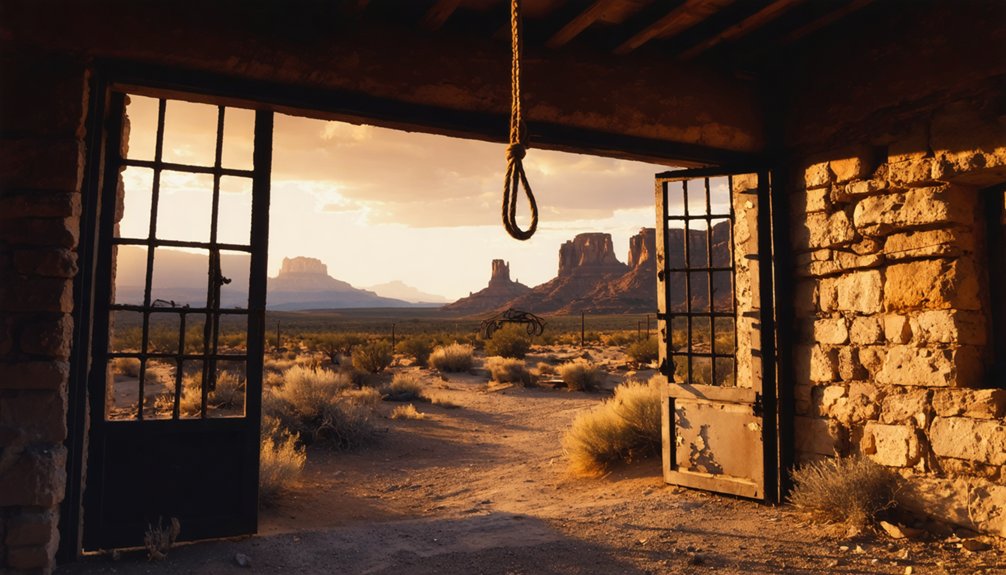
When the Arizona Territory emerged in 1863, justice arrived in raw, uncompromising forms.
You’d find frontier justice dealt swiftly through makeshift courtrooms and cramped jail cells, where the line between lawman and outlaw often blurred. The infamous O.K. Corral shootout epitomized this era’s violent struggle between order and chaos, leading to controversial vigilante trials that would echo through history.
- Tombstone’s gun control laws required visitors to surrender weapons, though enforcement sparked deadly confrontations.
- U.S. Marshal Crawley P. Dake battled constant jurisdictional challenges across vast desert territories.
- Prison conditions served as intimidation tools, with inmates facing extreme heat and minimal rations.
- Sheriff corruption ran rampant, with some claiming “escape attempts” to justify suspect deaths without trial.
You’ll find these ghost town jails still standing as stark reminders of an unforgiving time when survival often trumped civility.
Natural Springs and Sacred Grounds
vis
Life After Death: Towns That Refuse to Die
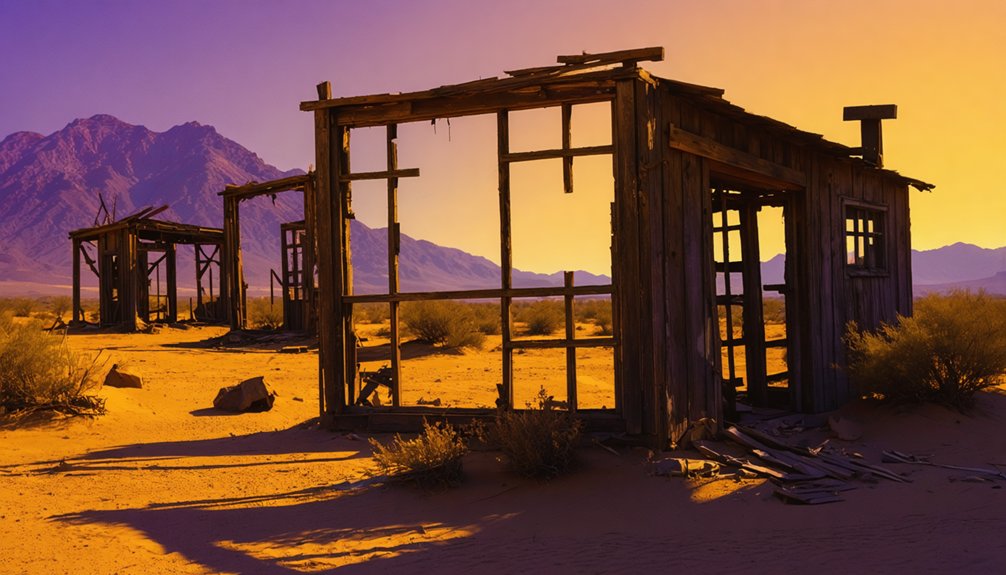
Despite their near-death experiences in the early 1900s, several Arizona ghost towns have found new life through tourism and preservation efforts.
Visitors are drawn to abandoned sites in Arizona, eager to explore the rich history and unique stories encapsulated within these decaying structures. Many of these locations, once bustling with life, now serve as poignant reminders of the challenges faced by early settlers. As interest grows, preservation projects aim to maintain the integrity of these fascinating remnants while providing insight into the region’s past.
You’ll discover remarkable ghost town resilience in places like Jerome, which transformed from a dying mining community into a thriving artist haven, and Tombstone, where O.K. Corral re-enactments draw 500,000 visitors annually.
- Chloride stands as Arizona’s oldest continuously inhabited ghost town, maintaining 400 residents since its 1862 silver mining origins.
- Oatman’s tourism revival features wild burros and restored storefronts, attracting over 500,000 yearly visitors.
- Bisbee captures 20% of its 300,000 annual visitors through preserved historic attractions.
- Cleator keeps its spirit alive with inhabited cabins and an operating saloon that serves visitors daily.
These communities prove that with determination and reinvention, yesterday’s abandoned towns can become today’s cultural treasures.
Desert Mysteries and Vanished Communities
While some ghost towns found new life through tourism, countless others vanished into Arizona’s harsh desert landscape, leaving only scattered ruins and mysterious traces of their existence.
Desert isolation proved a formidable enemy, as rugged terrain and extreme temperatures drove up costs for mining operations and daily living. When wells ran dry or flash floods destroyed infrastructure, many communities simply couldn’t survive.
You’ll find that resource depletion dealt the final blow to most of these settlements. Once-bustling mining towns collapsed when ore veins played out or metal prices crashed.
Today, their stories persist in crumbling adobe walls, weathered headstones, and abandoned rail grades. Concrete foundations and scattered artifacts whisper tales of boom-time dreams that succumbed to the desert’s unforgiving nature.
Frequently Asked Questions
Are Overnight Stays Allowed in Any of Arizona’s Ghost Towns?
You’ll find limited ghost town accommodations – Kentucky Camp’s cabin sleeps five, Jerome Grand Hotel welcomes guests, and Oatman Hotel offers rooms. Most sites don’t allow direct overnight camping.
What Safety Precautions Should Visitors Take When Exploring These Abandoned Sites?
Bring safety gear including flashlights, first-aid kit, and plenty of water. Stay wildlife-aware, watching for rattlesnakes and scorpions. Don’t enter unstable structures, and always explore with a buddy.
Do Any Ghost Towns Still Have Active Mining Claims?
You’ll discover countless active mining claims near ghost towns, especially around Vulture Mine’s massive operation. Jerome and Chloride blend tourism with modern extraction, while 11.55% of Arizona claims remain active today.
Which Ghost Towns Are Wheelchair Accessible or Suitable for Elderly Visitors?
You’ll find wheelchair ramps and elderly amenities in Tombstone’s historic district and parts of Goldfield Ghost Town, while Hackberry’s Route 66 stops offer level walkways and close parking access.
When Is the Best Season to Visit Arizona’s Ghost Towns?
Visit in winter (December-February) or fall (October-November) when you’ll enjoy the best weather for exploring. You’ll find comfortable hiking temperatures, clear photography conditions, and seasonal guided tours without extreme heat.
References
- https://en.wikipedia.org/wiki/List_of_ghost_towns_in_Arizona
- https://www.visitarizona.com/like-a-local/4-arizona-ghost-towns-you-may-have-never-heard-of
- https://www.visittucson.org/blog/post/8-ghost-towns-of-southern-arizona/
- https://www.youtube.com/watch?v=spJF1kNAXhg
- https://www.atlasobscura.com/things-to-do/arizona/ghost-towns
- https://www.arizonahighways.com/article/arizona-ghost-towns
- https://www.manaraproperties.com/blog/exploring-arizonas-spookiest-and-most-haunted-locations
- https://www.legendsofamerica.com/az-ruby/
- https://www.wandertheroad.co/places/ghost-towns-and-abandoned-mines/swansea-arizona/
- https://www.youtube.com/watch?v=_OusTvk8NxQ