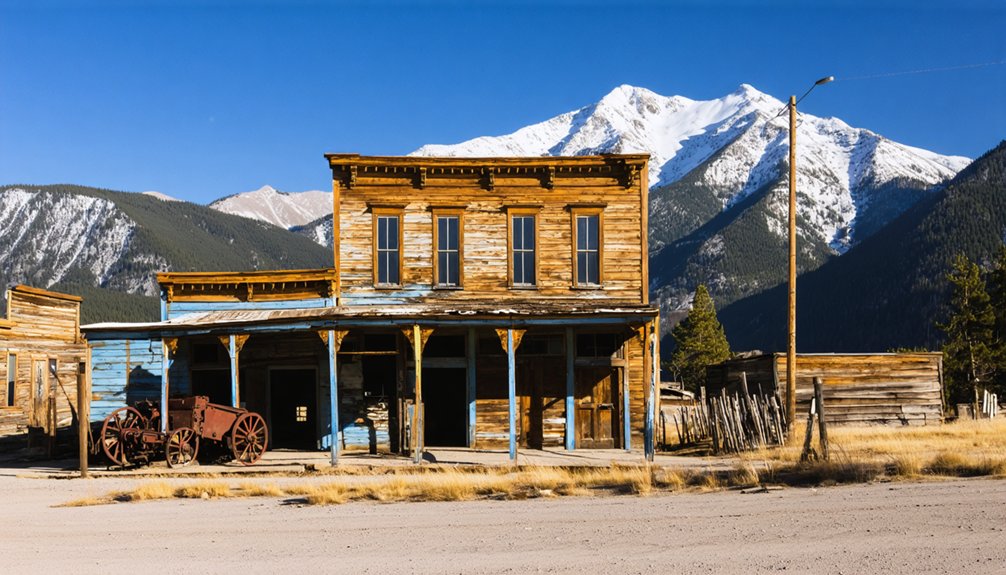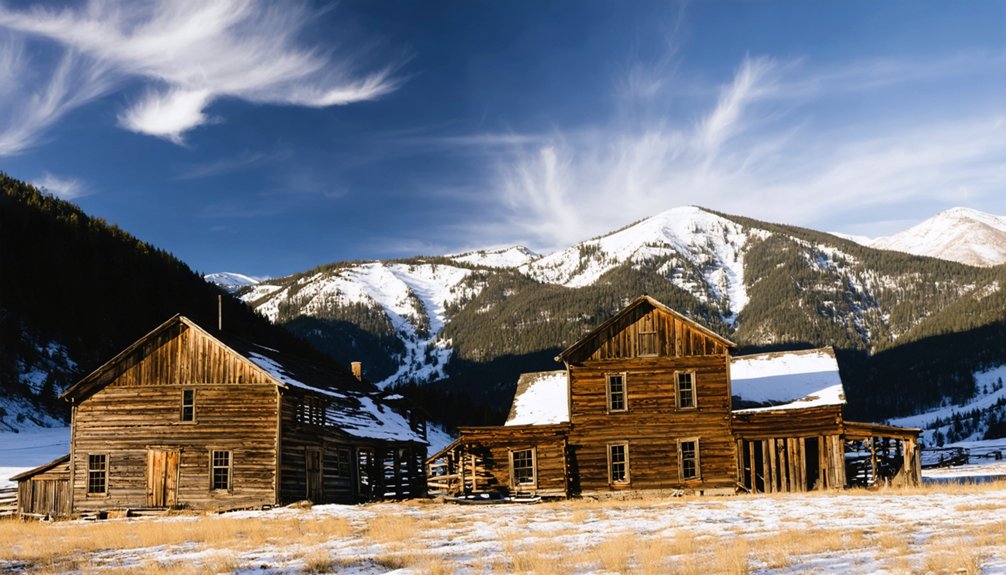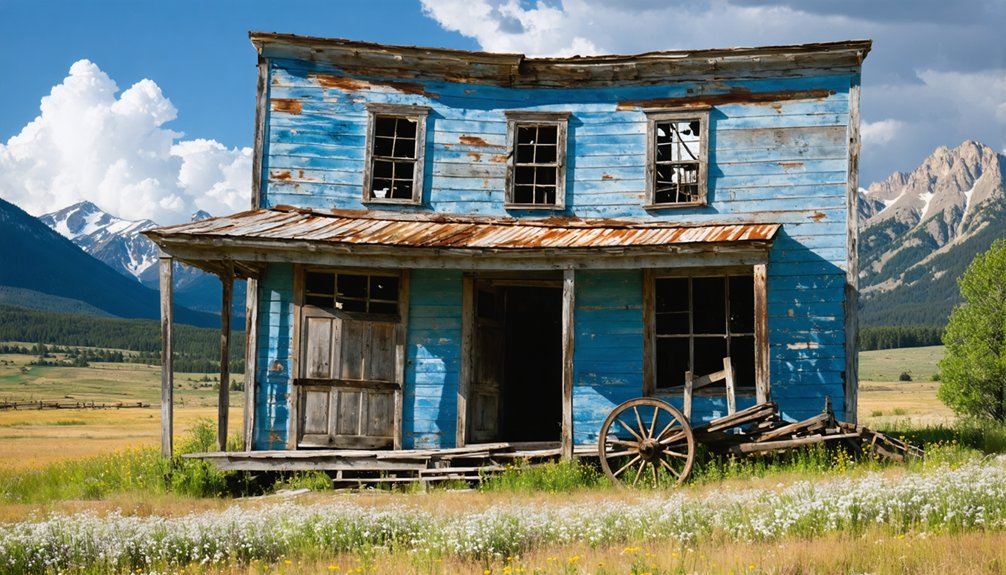
You’ll find over 640 authentic ghost towns scattered across Colorado’s mountains, remnants of the state’s 1858 gold rush that spawned more than 1,500 mining settlements. Well-preserved sites like St. Elmo showcase original 1880s architecture, while high-altitude towns like Animas Forks (11,200 feet) and Independence (11,000 feet) offer glimpses into extreme frontier living. Beyond mining ruins, unique settlements like Dearfield tell compelling stories of agricultural pioneering and cultural resilience.
Key Takeaways
- St. Elmo features 43 preserved 1880s structures along Main Street, including the American House Hotel and remnants of mining operations.
- Animas Forks, at 11,200 feet elevation, offers about a dozen abandoned structures for exploration, including the historic Duncan/Walsh House.
- Independence Ghost Town showcases original structures like a general store and Farwell Stamp Mill, best visited between mid-June and Labor Day.
- Ashcroft maintains nine restored buildings from its silver mining era, recognized as a National Historic Site since 1974.
- Dearfield represents a unique Black agricultural settlement with remaining structures that tell the story of early 20th-century farming communities.
Historic Mining Legacy: What Makes a Ghost Town
When prospectors discovered gold in Colorado’s streams in 1858, they sparked a mining boom that would establish over 1,500 settlements across the territory, with 640 of these sites still showing visible remains today.
As mining techniques evolved from simple placer mining to more complex operations, towns like Creede and Goldfield sprang up virtually overnight, with populations swelling into the thousands. The arrival of the Denver, South Park Railroad in 1880 fueled the rapid growth of mining towns across Colorado.
You’ll find that a true ghost town emerges when the mining goes bust – whether from depleted resources or plummeting mineral prices. Visitors are encouraged to practice safe exploration when investigating these historic sites due to deteriorating structures.
The ghost town culture of Colorado is perfectly captured in places like Teller City, which went from hosting 30 saloons and hundreds of log cabins to complete abandonment by 1902.
Visitors can explore the ghost towns of Colorado history to uncover stories of mining booms and busts that shaped the region. Each deserted street and crumbling structure tells a tale of dreams that once flourished and the harsh realities that led to their decline. These remnants serve as a reminder of both the resilience and the fragility of communities in the ever-changing landscape of the West.
These boom-and-bust cycles created the authentic ghost towns you can still explore today.
St. Elmo: Best-Preserved Main Street in the Rockies
Among Colorado’s most remarkable ghost towns, St. Elmo stands as a tribute to the state’s mining heritage with its exceptionally preserved 1880s architecture.
Originally named Forest City, this historic settlement reached its peak in 1881 with nearly 2,000 residents before declining in the 1920s as silver prices fell and gold ore quality diminished. Situated at an elevation of nearly 10,000 feet, the town is surrounded by the dramatic Sawatch Mountain Range.
Today, you’ll find 43 original structures along Main Street, including the iconic American House Hotel, blacksmith shop, and undertaker’s parlor. The Mary Murphy Mine was the largest operation in the area, producing up to 75 tons of ore daily during peak operations.
St. Elmo’s architecture showcases authentic wood-frame buildings from the boom years, protected by the Whittenberger Stonewall and listed on the National Register of Historic Places.
Popular ghost town activities include exploring on foot or ATV, fishing in Chalk Creek, touring old mining roads, and feeding the abundant chipmunks that now outnumber human visitors.
High-Alpine Adventures: Exploring Animas Forks
Perched at a breathtaking 11,200 feet in San Juan County, Animas Forks ranks as one of Colorado’s highest ghost towns. You’ll discover its dramatic setting at the confluence of three branches of the Animas River, surrounded by towering 14,000-foot peaks.
After gold and silver discoveries in 1873, this remote outpost flourished into a bustling community of 450 residents by 1883. The town supported multiple local businesses, including a hotel, several saloons, a drug store, post office, and jail.
Today, you can explore about a dozen abandoned structures, including the iconic Duncan/Walsh House from 1879. Winter snow challenges once forced residents to dig 25-foot tunnels between buildings. The site is now maintained by the Bureau of Land Management, ensuring public access for visitors.
While the 1891 fire and 1893 silver crash hastened its decline, Animas Forks lives on as a symbol of mining-era determination.
Access the site via the Alpine Loop Backcountry Byway, where preserved buildings await your discovery among the high-country wilderness.
Independence Ghost Town: Life at 11,000 Feet
Situated along Colorado’s historic Highway 82, Independence Ghost Town stands as one of the state’s most accessible high-altitude mining settlements at nearly 11,000 feet.
This short-lived boomtown flourished in 1882 with 1,500 residents before harsh elevation challenges and declining gold production led to its abandonment by 1912. The town originated when miners established the Beldon tent camp in 1879 before renaming it Independence.
Due to the extreme elevation, visitors should prepare for potential altitude sickness and stay well-hydrated while exploring the site.
- Explore original structures including the general store, stable, and Farwell Stamp Mill via an easy one-mile interpretive trail
- Visit between mid-June and Labor Day when the historic site is staffed and Highway 82 is clear of snow
- Experience authentic ghost town history through preserved artifacts and buildings with original owner signage
You’ll find Independence just 16 miles southeast of Aspen, where the Aspen Historical Society maintains this archaeological preserve as one of Colorado’s 640 protected mining-era ghost towns.
Ashcroft and Alta: Tales of Silver Boom and Bust
When prospectors Charles B. Culver and W.F. Coxhead discovered silver in Castle Creek Valley in 1880, they couldn’t have imagined the boom town that would follow.
Their initial settlement, Castle Forks City, quickly evolved into Ashcroft after rich strikes at the Montezuma and Tam O’Shanter mines. By 1883, you’d have found a thriving community of 2,000 residents, complete with 20 saloons, two newspapers, and a bustling commercial district surpassing nearby Aspen in size.
Yet Ashcroft’s silver mining glory proved short-lived. The shallow ore veins depleted rapidly, and by 1885 the population dwindled to just 100 as miners rushed to Aspen’s deeper strikes. By 1900, the town had become a bachelor’s paradise with aging single men as the primary inhabitants.
Today, you can explore nine restored buildings maintained by the Aspen Historical Society, walking the same streets where silver dreams once flourished and faded in the Colorado high country. The site achieved recognition as a Nationally Registered Historic Site in 1974.
Hidden Gems: Vicksburg and Winfield’s Tree-Lined Past
Deep in Clear Creek Canyon, the tale of Vicksburg began with a fortuitous mishap in 1867 as prospectors’ wandering burros led to the discovery of placer gold in the creek bed.
You’ll find this remarkable ghost town, where miners planted Balm of Gilead trees along the main street, creating a unique legacy that still stands today.
- Original buildings preserved since the 1870s, with seven structures defying time
- Vicksburg trees irrigated by creek-fed ditches that once cooled food and fought fires
- National Historic District featuring restored mining equipment and museum displays
This hidden gem, located just 15 miles from Buena Vista, shares its canyon with nearby Winfield, founded in 1861.
Together, they represent Colorado’s rich mining heritage, where determined settlers carved out communities in the wilderness, leaving behind a testament to frontier ingenuity.
Beyond Mining: Dearfield’s Unique Agricultural Story

Here encourage a Railway negroev
Early Black Farming Community
Unlike Colorado’s numerous mining ghost towns, Dearfield emerged as a pioneering Black agricultural settlement founded by Oliver Toussaint Jackson in 1910.
Inspired by Booker T. Washington’s vision of economic independence, Jackson established this ambitious 320-acre townsite with surrounding farmland in Weld County’s challenging terrain.
The community’s resilience and agricultural innovation helped it flourish despite limited irrigation:
- You’ll discover how 60-70 families transformed 15,000 acres into productive farmland through dryland techniques.
- You’ll find evidence of their $1,075,000 success through diverse crops and livestock operations.
- You’ll learn how they created a self-sufficient economy with two churches, stores, and shared farming equipment.
Drought’s Devastating Effects
While Dearfield initially thrived through innovative dry-farming techniques, the devastating Dust Bowl of the 1930s struck a fatal blow to this ambitious Black agricultural settlement.
You’ll find that drought impacts cascaded through every aspect of community life. Without water rights to the nearby South Platte River, farmers watched helplessly as seasonal creeks dried up and wells ran empty.
The agricultural decline was swift and merciless. Once-profitable crops like corn, melons, and sugar beets failed year after year.
Despite attempts to diversify crops and establish processing facilities, the persistent drought proved insurmountable. By 1940, Dearfield’s population had plummeted from hundreds to mere dozens.
The community’s estimated $1,075,000 net worth vanished as businesses closed, planned developments stalled, and families were forced to abandon their dreams of generational land ownership.
Planning Your Ghost Town Visit: Seasonal Access Tips
Planning a successful ghost town visit in Colorado requires careful attention to seasonal accessibility patterns. Most ghost towns are best explored from June through October when access routes are open and weather conditions are favorable. However, high-elevation sites and mountain passes often close from November to May, requiring careful planning and awareness of weather considerations.
Colorado ghost towns are most accessible from June to October, with many high-elevation sites closed during winter months due to weather conditions.
- High-altitude locations demand respect for rapidly changing conditions, including afternoon thunderstorms and potential snowfall even in summer.
- Remote sites frequently require travel on unpaved roads – you’ll need a high-clearance vehicle and knowledge of current road conditions.
- Many locations sit above 9,000 feet, so acclimatize properly and carry essential safety gear.
When planning your adventure, monitor CDOT alerts, county road reports, and BLM/USFS notices for real-time updates on closures and conditions that might affect your exploration of these historic sites.
Preservation Efforts and Historical Significance Today
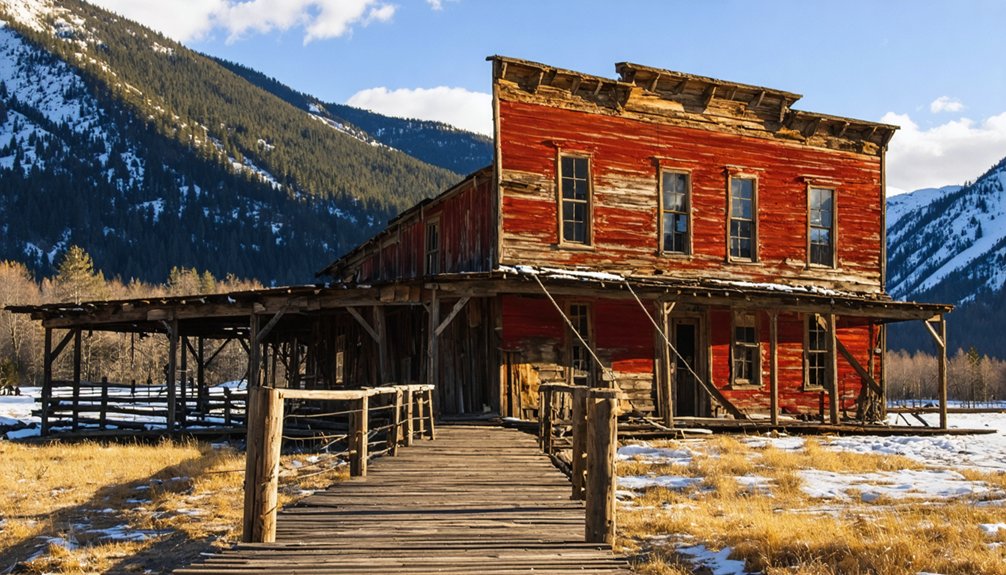
Preservation efforts stand at the forefront of Colorado’s ghost town legacy, with multiple organizations working to protect these irreplaceable historic sites.
You’ll find various entities tackling preservation challenges through coordinated approaches, from federal protections to local initiatives. The National Register of Historic Places provides essential recognition, while History Colorado and the State Historical Fund offer critical grant support.
Major funding strategies include competitive grants, local fundraising, and nonprofit partnerships. For instance, Animas Forks secured $330,000 for stabilization projects, while other sites benefit from tax incentives and preservation easements.
When you visit these sites, you’ll see the results of careful conservation work, including restored roofs, stabilized foundations, and interpretive features that help protect these treasures while sharing their stories with future generations.
Frequently Asked Questions
Are There Any Reported Ghost Sightings or Paranormal Activity in These Towns?
Popular places produce plenty of ghost stories, but you’ll find most paranormal investigations yield unverified results. While visitors report shadows, sounds, and cold spots, there’s no scientific proof of supernatural activity.
Can Visitors Take Home Artifacts Found at Ghost Town Sites?
You can’t legally remove artifacts from ghost towns without proper permits. Artifact preservation is essential, and you’ll face serious legal ramifications including fines or jail time for taking items home.
What Wildlife Encounters Are Common When Exploring Colorado Ghost Towns?
You’ll spot chipmunks begging for handouts at St. Elmo, while marmots whistle warnings at Animas Forks. Watch for deer, elk, and bears around buildings, and stay alert for mountain lions in remote areas.
Do Any Ghost Towns Still Have Year-Round Permanent Residents?
You’ll find year-round residents in several ghost towns, including St. Elmo’s 10 inhabitants and Fulford’s few families, who help preserve historic structures while keeping local legends alive through their presence.
Are Metal Detectors Allowed at Colorado Ghost Town Sites?
You’ll need specific permits due to metal detector regulations and historical preservation laws. Most ghost town sites are protected federal/state land where detecting is prohibited without proper authorization.
References
- https://coloradoinfo.com/blog_post/explore-ghost-towns-in-colorado/
- https://www.longmontleader.com/colorado/explore/20-must-visit-ghost-towns-in-colorado-for-an-eerie-adventure-10192944
- https://www.colorado.com/articles/colorado-ghost-towns
- https://en.wikipedia.org/wiki/List_of_ghost_towns_in_Colorado
- https://alissapeterson.com/blog/discover-the-spookiest-colorado-ghost-towns
- https://www.uncovercolorado.com/ghost-towns/
- https://www.americansky.co.uk/colorado-holidays/exploring-colorados-ghost-towns
- https://303magazine.com/2024/05/where-history-sleeps-colorado-ghost-towns/
- https://www.tripadvisor.com/Attractions-g28927-Activities-c47-t14-Colorado.html
- https://www.uchealth.org/today/ghost-towns-abound-in-colorado/