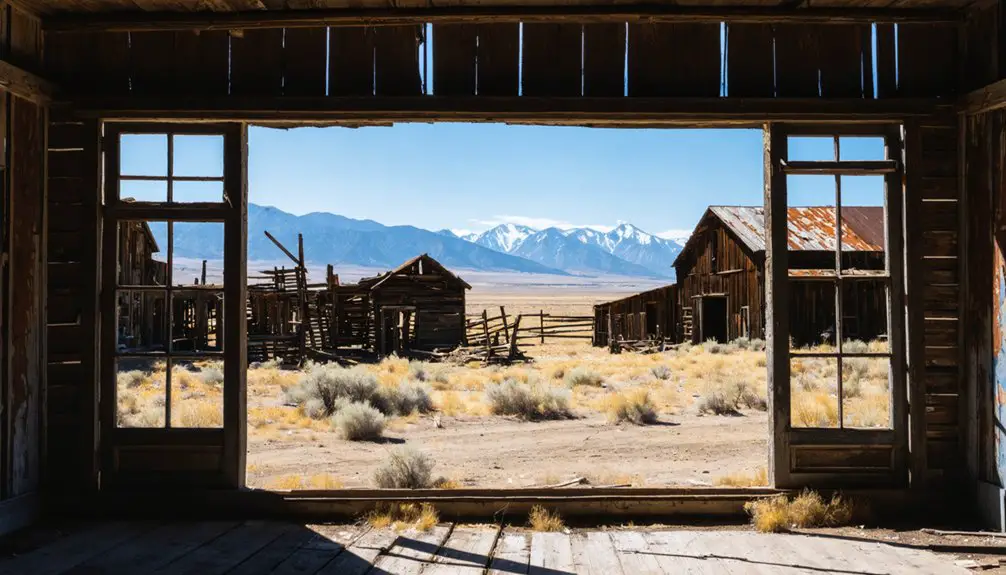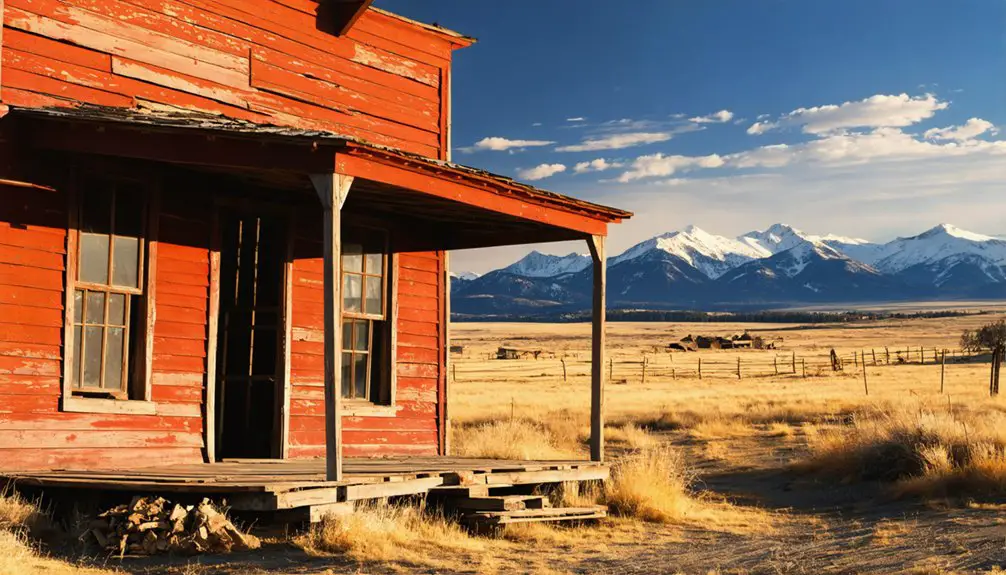
You’ll find Montana’s first territorial capital preserved as a ghost town, where the 1862 gold discovery sparked a rush that drew thousands to Bannack’s Main Street. The town’s authentic wooden buildings, constructed during three distinct growth waves, housed everything from saloons to government offices. While the railroad’s bypass in the 1880s sealed its fate, about 60 original structures still stand today, each holding stories of frontier justice and fortune-seeking pioneers.
Key Takeaways
- Bannack became Montana’s first territorial capital after its 1862 gold rush, featuring gold deposits of exceptional 99-99.5% purity.
- Located in southwest Montana, Bannack State Park preserves 60 original structures from the historic mining town’s boom era.
- The town’s decline began when the railroad bypassed it in the 1880s, transforming the once-thriving hub into a ghost town.
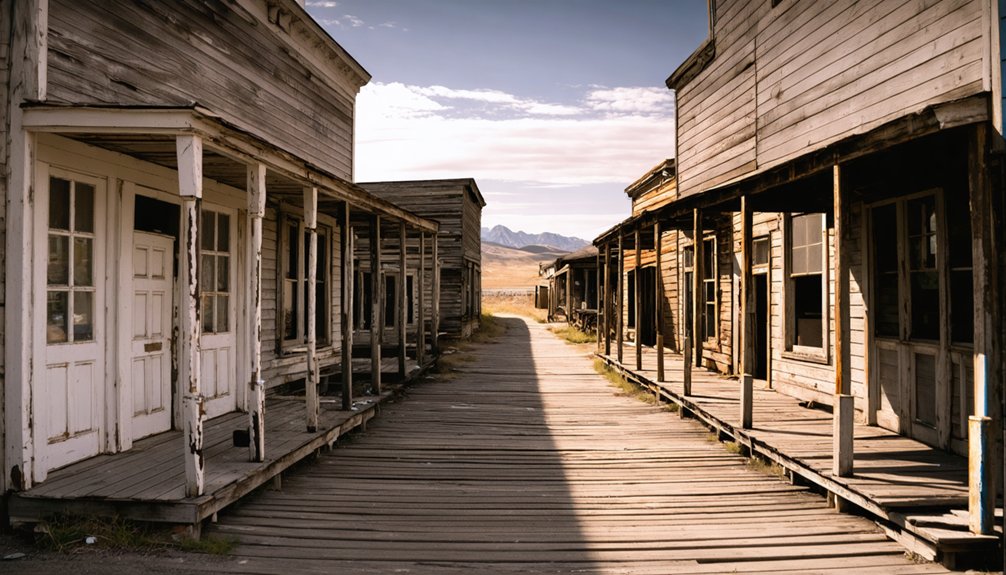
- Visitors can explore well-preserved buildings along Main Street, including hotels, saloons, and other frontier-era structures.
- The site gained notoriety during the 1863 reign of the Innocents Gang, led by Sheriff Henry Plummer, ending with vigilante justice.
The Gold Rush That Started It All
Within months, you’d have found yourself among a bustling camp of hundreds of prospectors engaged in placer mining, sifting through the coarse gold deposits in stream gravels.
By spring 1863, you’d have been shoulder-to-shoulder with up to 3,000 others who’d abandoned played-out claims in California and Colorado, all hoping to strike it rich in what was then Idaho Territory.
The surface gold proved so bountiful that it launched Montana’s era of mining prosperity.
The gold’s exceptional 99-99.5% purity made Bannack’s deposits particularly attractive to early miners.
The discovery led to the construction of a six-stamp mill during the winter of 1862-1863.
From Boomtown to Wild West Hub
Three distinct waves of growth transformed Bannack from a crude mining camp into a sophisticated frontier hub between 1862-1874.
You’d have witnessed the first surge when 3,000 fortune seekers flooded in, sparking rapid construction of over 50 wooden buildings along Main Street.
The frontier economy then diversified beyond mining, as merchants established saloons, hotels, and essential services like blacksmithing and assaying.
The political dynamics shifted dramatically when Bannack became Montana’s first territorial capital, with Governor Edgerton establishing governmental institutions and a courthouse.
While the railroad’s bypass in the 1880s eventually dimmed Bannack’s prominence, you can still explore one of the West’s most authentic ghost towns, where original structures stand as evidence of its pivotal role in Montana’s development.
Today, visitors can experience authentic gold panning during summer weekend lessons while discovering the town’s rich mining heritage.
Visitors can explore the site where Montana’s first major gold discovery sparked the birth of this historic settlement.
The Dark Days of the Innocents Gang
During the height of Montana’s gold rush in 1863, the notorious Innocents Gang emerged as a ruthless criminal enterprise that would terrorize the frontier corridor between Bannack and Virginia City.
Under the alleged gang leadership of Sheriff Henry Plummer, a charismatic 27-year-old lawman, the outlaws preyed on gold shipments, stagecoaches, and travelers using a secret password: “I am innocent.”
As Bannack’s population swelled from 1,800 to 8,000, crimes escalated dramatically. The gang was responsible for nearly 100 killings during their reign of terror.
The town served as Montana’s capital in 1864, during the peak of the gang’s activities.
Vigilante justice soon followed when concerned citizens formed a 500-strong committee.
You can still visit the gallows where they executed 23 suspected gang members, including Plummer and his deputies, before 5,000 spectators.
Though modern scholars question the scale of the gang’s activities, the legend of their buried gold continues to draw treasure hunters to this day.
Legacy of a Mining Era
While Bannack’s initial gold rush attracted thousands seeking quick riches through placer mining, the town’s economic legacy evolved through distinct technological phases that shaped its destiny. The discovery by John White’s group in 1862 sparked the dramatic transformation of the area.
The newly established town quickly became a territorial capital in 1864. You’ll find evidence of this progression in the shift from simple panning to industrial-scale dredging operations, which began with Graves’ innovative dredge in 1895. The economic impact rippled through every aspect of life, as the town transformed from a rough placer camp into an established community with schools and businesses.
The social evolution became apparent as families replaced single miners, creating a more stable society. Yet, when the railroad bypassed Bannack for Dillon in the 1880s, the town’s fate was sealed.
Today, 25,000 annual visitors explore the preserved buildings and mining remnants, evidence of a bygone era.
Preserving Montana’s Historic Treasure
Historic preservation at Bannack emphasizes authenticity, with dedicated state park staff and community involvement keeping the site’s abandoned nature intact.
You can explore the town’s genuine character through guided tours, while volunteers assist in maintaining the historic log and frame buildings along Main Street.
For $8 (free for Montanans), you’ll experience a raw slice of frontier history, complete with interpretive exhibits and seasonal activities like gold panning and ghost tours – all while supporting the ongoing preservation of this National Historic Landmark. The site became a state park in 1954 when local organizations worked to protect this important piece of Montana heritage. Today, visitors can explore approximately 60 structures that have survived from the original gold rush town.
Frequently Asked Questions
What Was the Average Daily Temperature in Bannack During Its Peak Years?
Feel the wild swings of Mother Nature! You’d have experienced average temperatures ranging from 10-25°F in winter to 50-60°F in summer, with dramatic climate variations between day and night.
How Many Children Attended the Bannack School During the 1870S?
You won’t find exact Bannack education records from the 1870s, but with the town’s declining demographics, student numbers likely ranged from several dozen to around fifty as the decade progressed.
Did Any Famous Actors or Politicians Visit Bannack During Its Heyday?
Like a tumbleweed rolling through town, celebrity visits were nonexistent in Bannack’s glory days. Despite its political connections as Montana’s first capital, no famous actors or politicians made documented appearances.
What Happened to Henry Plummer’s Personal Belongings After His Execution?
After Plummer’s execution, vigilantes ransacked his house searching for gold. Only his double-barreled shotgun survived, while his office items and other belongings vanished. Their fate remains a frontier mystery.
Are There Any Documented Paranormal Activities in Bannack’s Historic Buildings?
As chilling as winter’s breath, you’ll find extensive ghost sightings documented throughout Hotel Meade, where apparitions watch from windows, while historical hauntings at Chrismans’ Store include shadow figures and Henry Plummer’s restless spirit.
References
- https://www.legendsofamerica.com/mt-bannack/
- https://southwestmt.com/blog/bannack-haunting-montana/
- https://www.roadunraveled.com/blog/bannack-ghost-town-montana/
- https://www.youtube.com/watch?v=2wd4DVyZmkY
- https://southwestmt.com/specialfeatures/history/bannack/
- https://fwp.mt.gov/stateparks/bannack-state-park
- https://www.distinctlymontana.com/bannack-montanas-best-preserved-ghost-town
- https://westernmininghistory.com/towns/montana/bannack/
- https://www.youtube.com/watch?v=MHoTmOC4reE
- https://southwestmt.com/communities/bannack/