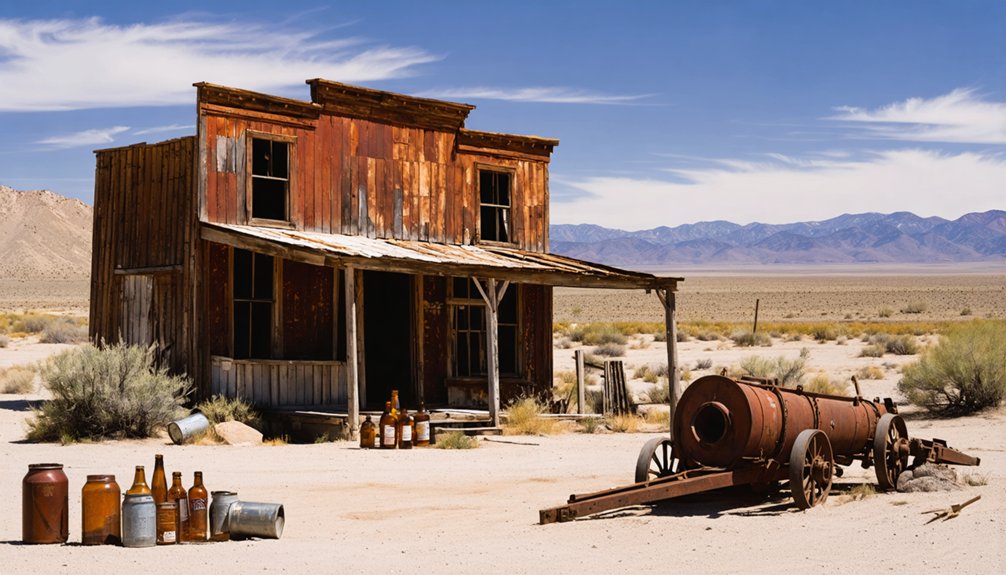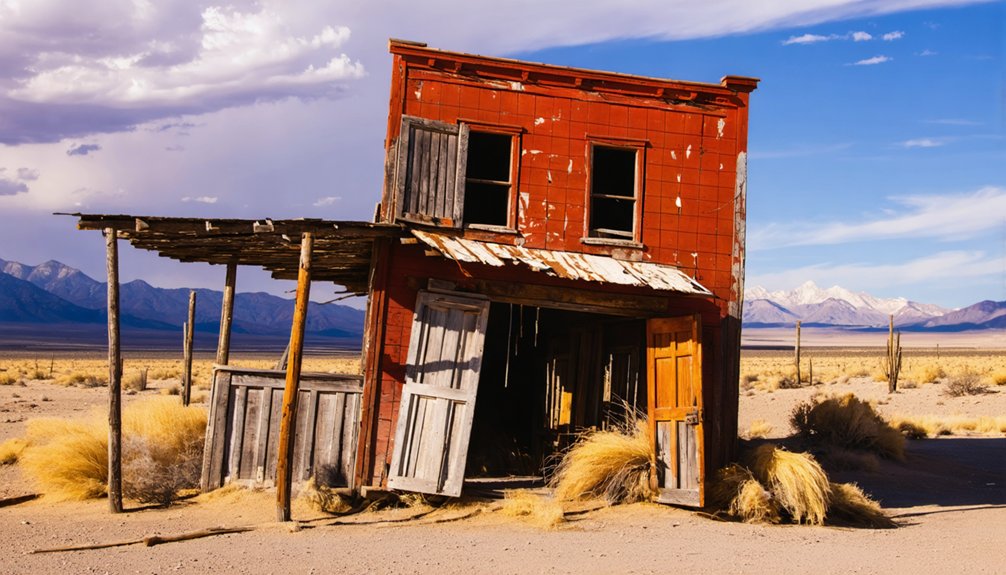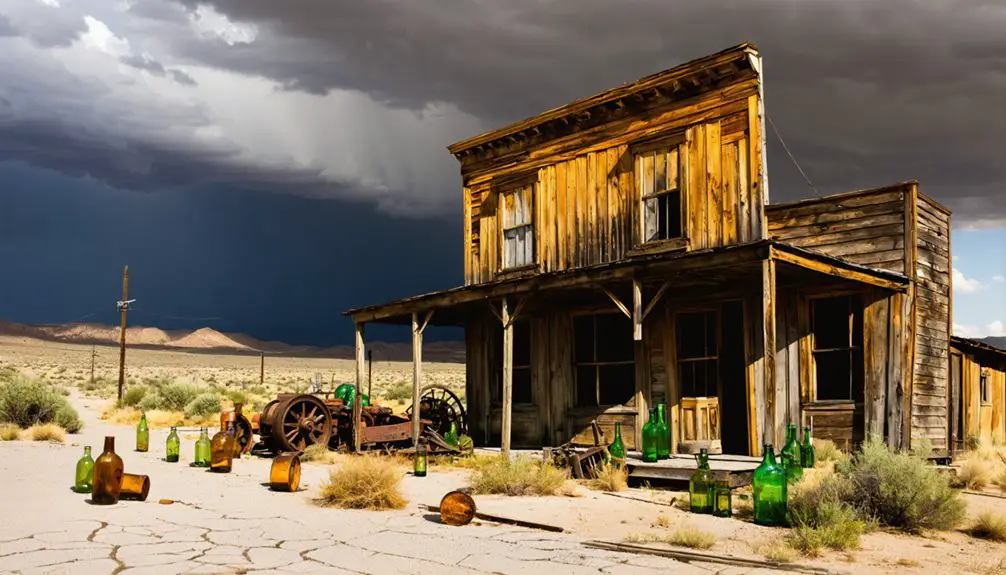
You’ll find Battle Creek’s copper mining ruins nestled in Nevada’s Galena range, where George Tannehill’s 1866 discovery sparked a bustling operation. The town flourished with the arrival of the Central Pacific Railroad in 1870, boasting boarding houses, machine shops, and a 50-ton mill. After several boom-bust cycles, mining ceased in 1956, leaving behind mill foundations, an abandoned cemetery, and rail depot remains. These silent artifacts tell a remarkable story of Nevada’s mining heritage.
Key Takeaways
- Battle Creek Mining Camp was established in 1866 after George Tannehill’s copper discovery and grew into a significant mining settlement.
- The town thrived through the late 1860s and 1870s, supported by the Central Pacific Railroad and Nevada Central Railroad connections.
- Over 300 residents abandoned Battle Creek in the 1880s when copper ore veins were depleted, transforming it into a ghost town.
- Mining operations underwent several revival attempts until 1956, including upstream relocations and new dredging techniques.
- Today, Battle Creek’s ruins require a high-clearance vehicle to access and include mill foundations, an abandoned cemetery, and mining remnants.
The Birth of Battle Creek Mining Camp
While historical records offer conflicting accounts of Battle Creek’s name origin, the mining camp’s birth can be traced definitively to 1866 when prospector George Tannehill discovered significant copper deposits in the area.
The name itself comes from prospector legends of Native American skirmishes, though these tales remain unverified in contemporary documents.
You’ll find that Tannehill’s discovery sparked intense mining activity, leading to the formal establishment of the Battle Mountain Mining District in 1867.
The district’s rich geology revealed multiple valuable commodities beyond copper, including gold, silver, and turquoise.
As mining folklore spread about the area’s mineral wealth, the district quickly became a hub for prospectors seeking their fortune, with porphyritic intrusions dating back 38 million years yielding promising deposits that would sustain mining operations for decades to come.
The settlement grew rapidly as a supply center to support the bustling mining operations in the surrounding area.
The area experienced a significant economic transformation when the Central Pacific Railroad arrived in 1869, establishing crucial transportation links for the mining industry.
Early Mining Operations and Infrastructure
You’ll find Battle Creek’s earliest mining operations centered around the rich lode deposits first worked in 1866, with copper becoming a major focus after George Tannehill’s discovery near the Humboldt River.
The district’s infrastructure expanded considerably when the Central Pacific Railroad moved its station to Battle Mountain in 1870, establishing it as an essential shipping hub for the mining operations.
A network of stage and freight roads soon developed, complete with mud wagons and massive freight wagons to transport ore and supplies, while the 1880 completion of the Nevada Central Railroad connected Battle Mountain to Austin, further strengthening the region’s mining capabilities.
The mining district grew steadily after Measure for Measure, the area’s first newspaper, began publishing in 1873.
Early mining faced several challenges including the lack of water and difficulties accessing deep pay gravels, which initially limited the development of placer operations until 1909.
Initial Mine Site Development
After the discovery of copper ore in 1866 north of Lander County, the Battle Mountain mining district quickly organized its operations around the rich lode deposits in the Galena range.
During initial exploration, prospector George Tannehill showcased copper samples from a site four miles south of the Humboldt River, sparking interest in the area’s mineral potential.
The ore discovery prompted the Central Pacific Railroad to establish the Argenta station in 1866, followed by the Reese River siding in 1868.
By 1870, the railroad relocated the Argenta station to Battle Mountain, creating a significant transportation hub.
You’ll find that stage and freight roads soon connected the district north to south, establishing essential infrastructure for mining operations.
The district’s development focused primarily on copper-gold-silver ores within sulfide mineral zones.
The area would eventually become one of Nevada’s major gold producers, yielding over 1,000,000 ounces throughout its history.
Proper disambiguation links were crucial for early miners and prospectors to navigate between the various Battle Mountain mining claims and settlements.
Early Support Buildings Emerge
As mining operations intensified in Battle Creek, essential support buildings sprang up to serve the growing workforce and industrial needs.
You’ll find remnants of boarding houses and bunkhouses that sheltered the unmarried laborers, while company-built cottages housed skilled workers like millwrights and engineers.
The mining infrastructure expanded to include machine shops and blacksmith facilities where crews repaired steam engines and ore-crushing equipment.
Near the rail access points, general stores and assay offices emerged to support daily operations. The bustling activity mirrored the energy of the Comstock Lode boom that had transformed Nevada’s mining landscape decades earlier.
Water towers and fuel bunkers were strategically placed near boiler houses, while timber storage yards supplied materials for mine scaffolding.
Cookhouses became central gathering points, doubling as basic medical stations.
Throughout the site, temporary structures like tent camps gradually gave way to more permanent wooden buildings.
Mill Construction and Growth
The mill construction era at Battle Creek marked distinct periods of mining investment and development.
Located 8.6 miles south of Battle Mountain via SR-305, the site offered a strategic location for ore processing operations.
You’ll find evidence of multiple attempts to establish ore processing capabilities, starting with a 50-ton mill erected in 1917 following the site’s initial abandonment in 1910. This mill efficiency upgrade represented renewed faith in the area’s mineral potential.
The processing facilities underwent significant changes in the 1950s when operations shifted one mile up the canyon. A boarding house and cafeteria supported the workers during early operations.
From 1953 to 1956, you can trace how the relocated infrastructure supported continued ore processing at the new workings.
Despite these development phases, Battle Creek’s growth remained limited by brief operational windows.
The mill remnants you’ll discover today tell the story of an operation that adapted to changing conditions but ultimately succumbed to resource depletion.
First Wave of Abandonment
Once mining activity began dwindling in Battle Creek during the 1880s, over 300 residents abandoned the bustling settlement. This first abandonment came after the copper ore veins, originally discovered in 1866, could no longer sustain profitable operations in the Galena range.
The mining decline led to a mass exodus as workers and their families relocated to more active districts like Battle Mountain proper.
You’ll find evidence of this departure in the ruins that remain – scattered mill foundations, an untended city park, and a neglected cemetery deep in the forested canyon.
The first major copper boom of 1897 would later revitalize mining operations in the Galena range, though Battle Creek remained largely abandoned.
The once-vital infrastructure fell into disrepair as supply routes saw diminished traffic. By the late 1880s, with claims staked since 1863 now exhausted, Battle Creek transformed into a ghost town.
1917 Revival and Mill Construction
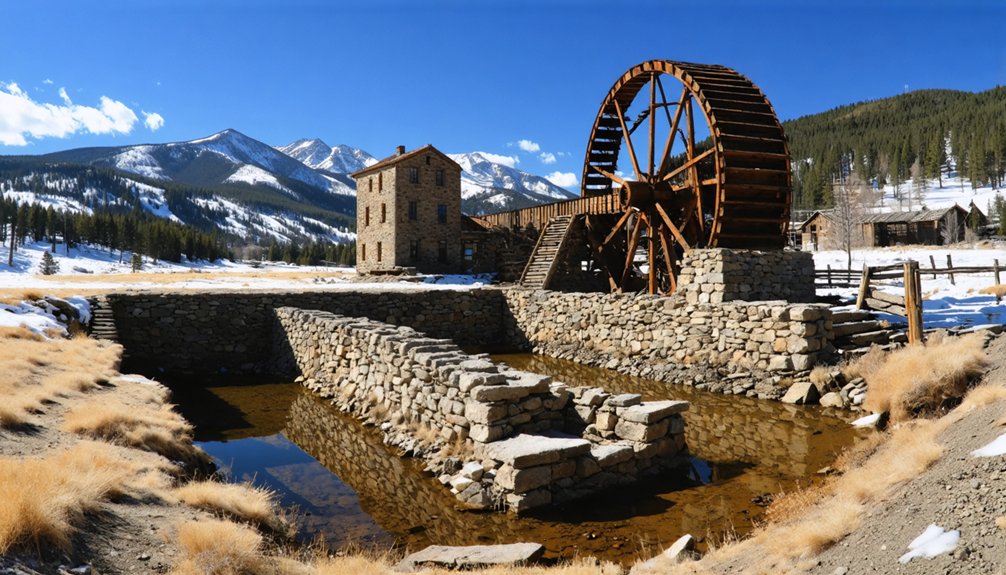
During 1917’s brief mining revival, workers reworked Battle Creek’s abandoned claims and erected a 50-ton mill to process newly extracted ore. The revival techniques focused on existing mineral deposits, marking a determined effort to resurrect the site’s mining potential after its 1910 decline.
You’ll find that mill innovations weren’t limited to ore processing – the period saw strategic infrastructure development too. A boardinghouse and cafeteria supported the workforce, though construction remained modest compared to earlier boom years.
The revival’s timing coincided with broader district-wide resurgence, spurred by improved mining methods and favorable metal prices. While Battle Mountain’s renewed activity, particularly around the Galena area, showed promise, it couldn’t sustain long-term operations.
Like many pre-WWI mining revivals, Battle Creek’s resurgence proved short-lived despite its technological advances.
Relocation and Final Mining Era
As mining operations shifted closer to the Central Pacific rail line in 1868, you’ll find evidence of Battle Creek’s relocation through remnants of the original rail siding and depot foundations.
You can trace the town’s gradual change as businesses and services moved to capitalize on the improved freight access and expanding rail infrastructure.
The final mining activities lasted until 1956, marked by Natomas Company’s large-scale dredging operations that transformed the surrounding placer deposits and alluvial fans.
Moving Operations Upstream
The depletion of near-mouth gravels in Battle Creek forced mining operations to shift upstream, targeting higher-elevation pay gravels in the late mining era.
This upstream relocation required adaptations in both equipment and methods. You’ll find evidence of bulldozers and draglines that were used to strip overburden and expose buried paleochannels, while sluice-box systems were modified for the higher-gradient terrain where conventional dredges couldn’t operate.
The operational challenges intensified as miners extended water delivery systems and deployed smaller dredges to work the narrower channels.
They focused on paleochannel gravels in canyon mouths and alluvial-fan apexes, where lode-derived gold created rich pockets.
Though this move increased stripping costs and shortened operational lifespans, it allowed access to previously untapped high-grade pay zones left by earlier miners.
Last Working Years 1953-56
While early mining operations centered near Battle Creek’s mouth, the site’s final active period from 1953 to 1956 saw a significant relocation roughly a mile upstream.
The last production efforts focused on reworking existing veins and processing old tailings, with miners using small-scale underground stoping and surface mining techniques rather than industrial-scale operations.
You’ll find that during this period, operators reused or relocated existing buildings and facilities rather than constructing new ones.
They relied on diesel generators for power and local water sources to support their modest operation.
Final mining techniques remained basic, with newly staked claims targeting remnants of earlier workings.
After operations ceased in 1956, the site was abandoned, leaving structures that would later contribute to its ghost town status.
Ghost Town Legacy
Here drawerató Battlesequor glej covers grupos
Forest Service Wilderness Designation
Under landmark Nevada wilderness legislation enacted in 1989, significant portions of Humboldt National Forest received federal protection, expanding the Jarbidge Wilderness from 64,667 to 113,167 acres and creating 13 new wilderness areas totaling 733,400 acres.
You’ll find these protected lands scattered throughout Nevada’s rugged terrain, including the Currant Mountain Wilderness (36,000 acres) and Mount Moriah Wilderness (82,000 acres).
The wilderness preservation efforts continued with the 2006 White Pine County Conservation Act, which established additional areas like Bristlecone and Goshute Canyon Wildernesses.
The ecological impact of these designations can’t be understated – they’re the most restrictive land-use categories, prohibiting permanent development while preserving these spaces as untrammeled areas where humans remain merely visitors, not permanent residents.
Exploring the Ruins Today
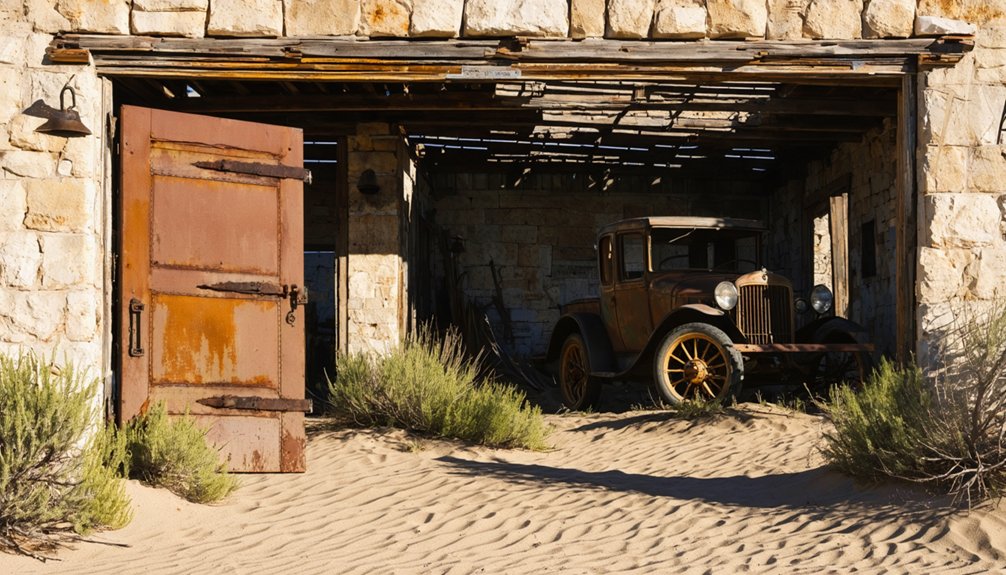
Accessing Battle Creek’s ghost town ruins today requires careful planning and a high-clearance vehicle to navigate the unpaved canyon roads leading to this remote site.
You’ll find the remains scattered across National Forest land, including an old flatbed truck, pickup, and Ingersoll-Rand Type 40 compressor near the entrance.
For site safety, wear sturdy boots, gloves, and eye protection while exploring the deteriorating foundations and metal fragments.
Stay clear of dangerous mine openings and unstable structures. Don’t handle old equipment that may contain asbestos or hazardous materials.
When photographing the ruins, shoot during early morning or late afternoon for ideal lighting. Use GPS-tagged images and scale references to document machinery and foundations.
Remember to check weather conditions, as seasonal flooding and snow can limit access to late spring through early fall.
Battle Creek’s Place in Nevada Mining History
Battle Creek emerged as a significant mining district in 1866 when prospectors discovered rich deposits of copper, gold, and silver in the Battle Mountain region.
You’ll find that early copper exploration shaped the area’s development, with the Central Pacific Railroad establishing an essential supply hub between 1868-1870 that transformed the district’s mining capabilities.
The district’s mining heritage spans several productive phases, including major operations from 1913-1922, 1932-1939, and 1947-1955.
You can trace the evolution from early manual placer mining to sophisticated mechanized operations, including Natomas Company’s dredging project that yielded approximately 100,000 ounces of gold.
The 1960s brought renewed vigor when Duval Company invested millions in copper development, while the 1980s saw diversification into barite production for oilfield services.
Frequently Asked Questions
What Native American Tribes Originally Inhabited the Battle Creek Area?
You’ll find three Native tribes historically impacted this region: the Western Shoshone (particularly the Battle Mountain Band), Northern Paiute, and Bannock peoples converged around Battle Mountain and Battle Creek.
How Many Total Deaths Were Recorded During Battle Creek’s Mining Operations?
You won’t find a definitive total count of mining accidents from available historical records. Research shows gaps in documentation of deaths at small mining camps like this one during the 19th century.
What Was the Peak Population of Battle Creek During Its Boom?
You can’t find a definitive peak population for Battle Creek’s mining boom, as census records didn’t track it separately. Economic impact studies and mining techniques brought shifting populations, likely ranging from dozens to a few hundred.
Were Any Famous Outlaws or Notable Personalities Associated With Battle Creek?
You won’t find any famous outlaws or notable personalities linked to this site – historical records don’t document any well-known criminals or significant local figures during its brief mining period.
What Were the Average Wages Paid to Battle Creek Miners?
Like gold dust slipping through fingers, Battle Creek’s wage history remains largely unrecorded. You’ll find modern miners nearby earn $26.92 hourly, but their 1800s predecessors’ miner lifestyle was far less lucrative.
References
- https://www.ghosttowns.com/states/nv/battlecreek.htm
- https://www.roadtripryan.com/go/t/nevada/northern-nevada/galena-ghost-town
- https://en.wikipedia.org/wiki/Battle_Mountain
- https://nvtami.com/2024/01/23/northern-washoe-county-ghost-towns-2/
- https://www.nevadaghosttownsandmininghistory.com/copy-of-esmeralda-county
- https://www.nvexpeditions.com/lander/battlemountain.php
- https://www.cowboycountry.org/GhostTowns.shtml
- https://landercountytourism.com/battle-mountain-history
- https://travelnevada.com/ghost-town/
- http://www.onv-dev.duffion.com/articles/battle-mountain