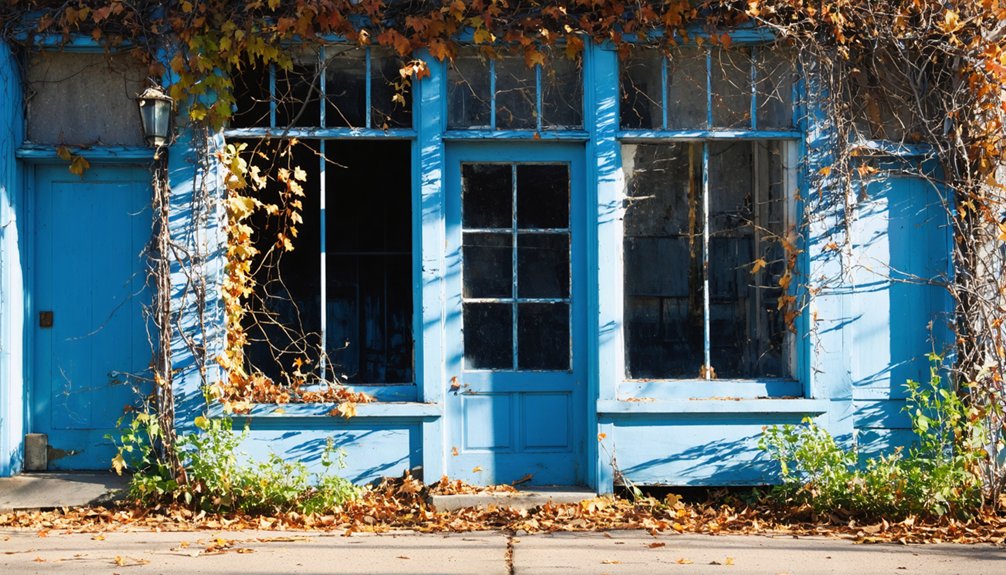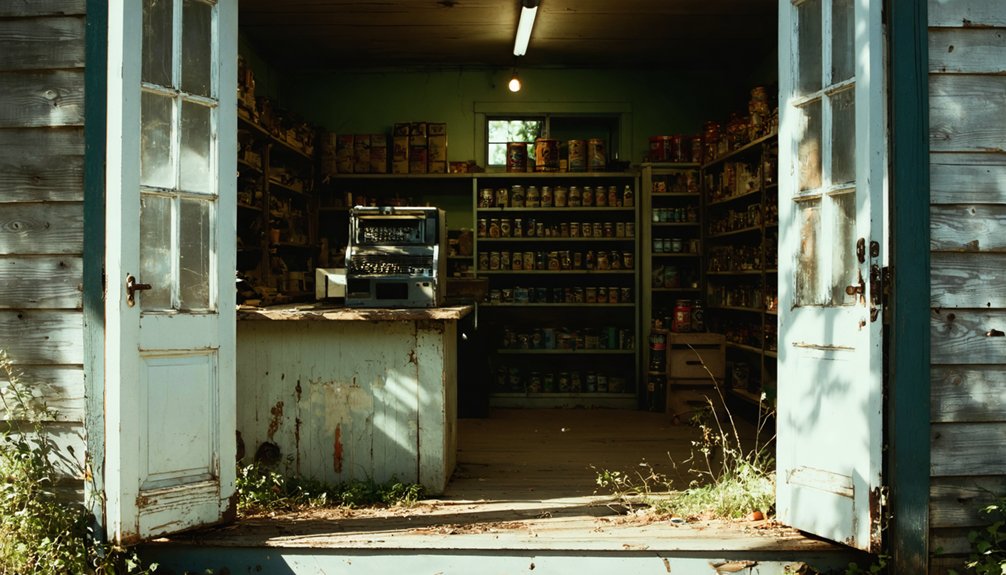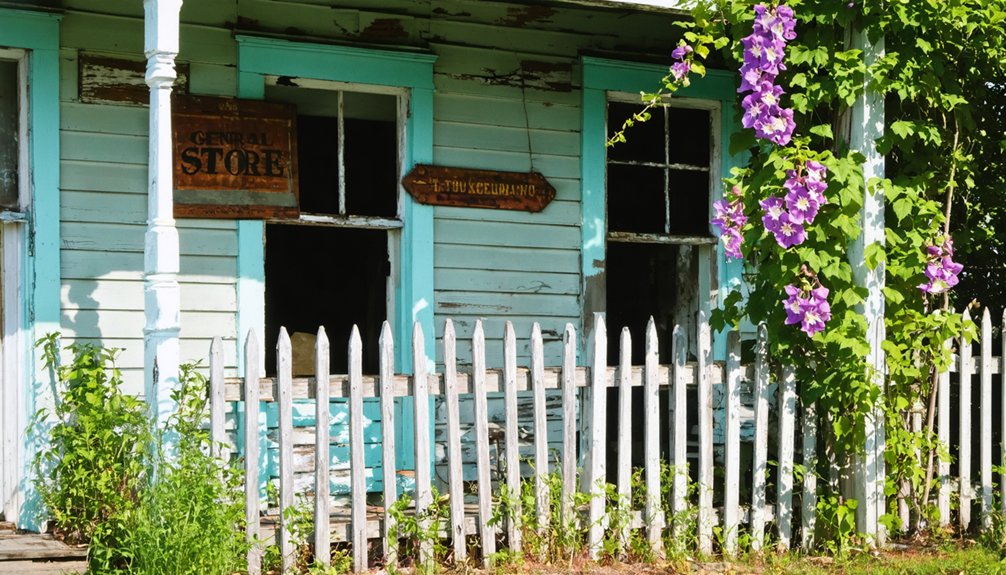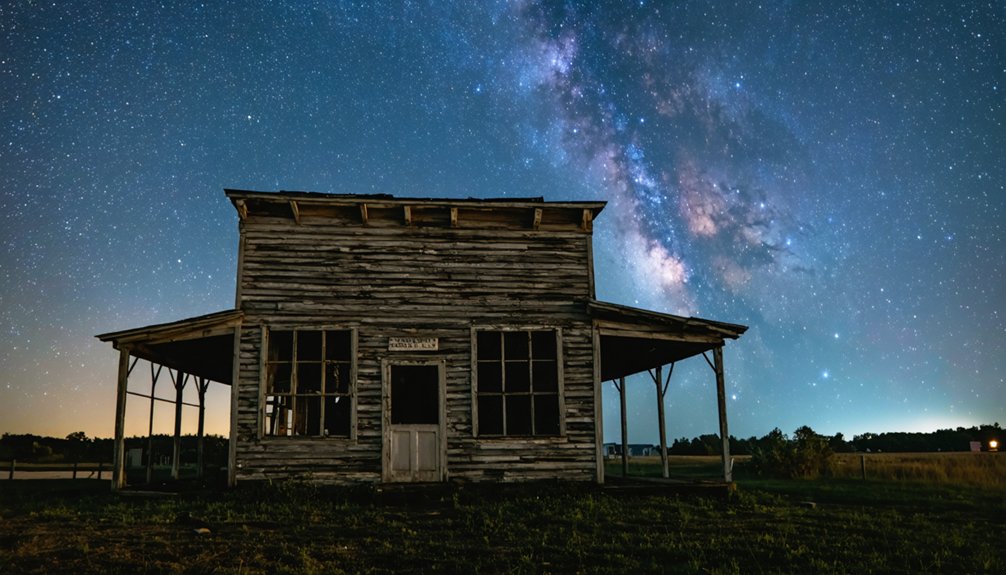
You’ll find exceptional astrophotography conditions at Glenville, an abandoned settlement 8 miles southwest of Wilmington along Route 4. Its minimal light pollution and fenced-off park area provide clear access to dark skies with Bortle 3-4 conditions. New Market’s historical cemetery and Sussex County’s farm ruins offer compelling foreground elements for Milky Way compositions. Fort Delaware and the Reedy Island Range Light add coastal and historical dimensions to your night sky portfolio. These locations harbor deeper astronomical treasures waiting to be revealed.
Key Takeaways
- Glenville, abandoned since 2004, offers minimal light pollution and excellent dark sky conditions just 8 miles from Wilmington.
- Bancroft Mills’ historic industrial ruins provide dramatic silhouettes against the night sky, accessible through Alapocas Run State Park.
- Sussex County Farm Ruins near Milford features 18th-century structures and unobstructed Milky Way views with minimal light pollution.
- Fort Delaware on Pea Patch Island combines historic architecture with dark sky conditions, particularly within its interior courtyard.
- New Market’s ghost town cemetery provides compelling foreground elements with NELM readings of 5.5-5.6 for deep sky photography.
Glenville: A Hidden Haven for Night Sky Photography
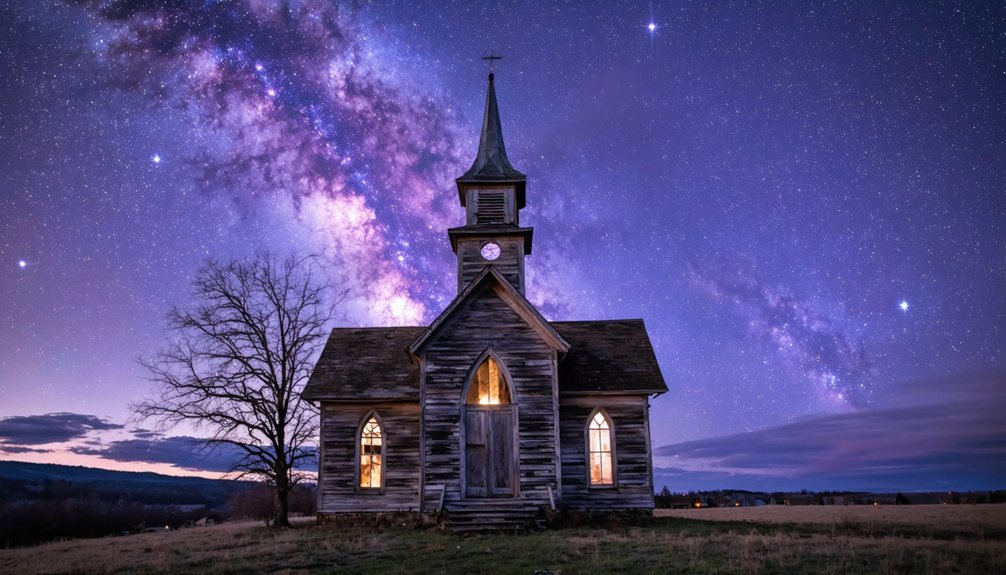
While Glenville’s tragic history of flooding led to its abandonment in 2004, this ghost town‘s location 8 miles southwest of Wilmington now offers photographers an ideal dark sky destination.
You’ll find the ghostly remnants positioned along Route 4 near Red Clay Creek, where demolished structures and foundations create unobstructed views of the night sky.
For night sky photography enthusiasts, Glenville’s rural setting and minimal light pollution provide excellent shooting conditions.
The fenced-off area, now prepared as a park, gives you clear access to dark skies away from Wilmington’s urban glow.
Though the site’s abandoned streets and foundations may be filled in, the open space created by demolition works to your advantage.
The area, once a thriving suburban neighborhood, stands as a testament to nature’s power over human settlements.
Hurricane Floyd and Isabel triggered the area’s evacuation, leaving behind an eerily perfect setting for astrophotography.
Visit during cold winter nights when atmospheric clarity peaks for best astrophotography results.
New Market’s Rural Celestial Charm
You’ll find ideal dark sky conditions at New Market’s crossroads during new moon phases, with minimal light pollution from the Route 16 corridor affecting your astrophotography.
Similar to the abandoned town of Sussex-Banning, which was lost to storms in 2003, this area offers a haunting glimpse into Delaware’s past.
The historic cemetery off Reynolds Pond Road offers compelling foreground elements for Milky Way compositions, particularly when you position ancient headstones against the starfield. Like the Cape Henlopen Lighthouse that once stood 69 feet tall, these monuments serve as striking vertical elements against the night sky.
For the most dramatic night sky shots, set up your tripod near the cemetery’s western edge, where agricultural fields create an unobstructed horizon and farm structures provide silhouetted architectural elements.
Dark Sky Viewing Spots
Located in rural Delaware, New Market offers celestial observers remarkably dark skies with NELM readings of 5.5 to 5.6, making it ideal for deep sky astrophotography.
You’ll find yourself less than a half-hour drive from Mount Cuba, with easy access to premier dark sky sites like Fair Hill, MD.
The area’s rural setting minimizes light pollution, rivaling the darkness at Blue Mountain Vista Observatory Field, where NELM readings reach 6.0-6.1.
You’ll need permission to access New Market, but it’s worth the effort – the conditions triple your visible Messier objects compared to urban locations.
For best viewing, plan your visits during new moon periods when the Milky Way emerges in stunning detail.
The western horizons remain relatively untouched by sky glow, creating perfect conditions for your astrophotography endeavors.
Remember to bring a fellow observer for safety while exploring these dark skies at night.
Park rangers must be contacted for access after 10 PM since Delaware state parks have strict closing times.
Historic Ruins After Dark
As darkness settles over New Market’s remnants, a small graveyard along Reynolds Pond Road serves as your primary landmark for nighttime astrophotography sessions.
You’ll find minimal light pollution here, one mile east of Ellendale, where ghostly echoes of the 18th-century settlement create an atmospheric foreground for your shots.
Position your tripod near the cemetery’s weathered stones, where the celestial remnants of New Market’s past merge with the star-filled sky above.
Much like the Lady in Blue apparition at Amstel House, mysterious shadows often dance across long exposures here.
The rural crossroads at Holly Tree Road offers unobstructed views of the night sky, unmarred by modern structures.
While the village’s blacksmith shop and store have vanished, their absence leaves you with pristine dark sky conditions.
The mobile home community nearby stays quiet after sunset, making this forgotten crossroads an ideal spot for long-exposure photography. The willow tree engravings on many headstones add a haunting silhouette to nighttime compositions.
Cemetery Silhouette Compositions
Weathered headstones and ancient oaks create dramatic silhouettes against New Market’s star-filled skies, offering photographers rich compositional opportunities at the Reynolds Pond Road cemetery.
You’ll find ideal silhouette techniques during astronomical twilight, when the sun dips 18° below the horizon. Position your camera to capture upright markers against the Milky Way’s core, visible from April through October. Located in Sussex County, this historic cemetery provides exceptional dark sky conditions away from major light pollution.
For cemetery lighting, avoid full moon periods – instead, shoot within three days of new moon for maximum contrast. Frame your shots using the natural leading lines of churchyard paths, and consider focus stacking to maintain sharpness across multiple planes.
Start with f/2.8, ISO 3200, and calculate exposure times using the 500/NPF rule.
Park carefully along Reynolds Pond Road’s shoulder, respecting private property boundaries while accessing this historic site.
Bancroft Mills: Urban Industrial Nightscapes
While you’ll need to contend with significant light pollution from nearby urban areas, Bancroft Mills offers unique opportunities to capture the contrast between restored and derelict industrial architecture under the night sky.
You can mitigate ambient light interference by using narrowband filters and selecting darker vantage points along the Brandywine River’s edge, where the water’s surface adds reflective elements to your compositions.
The site’s massive brick facades and iron remnants provide compelling foreground elements for light painting techniques, allowing you to highlight the ghostly textures of this former textile giant against the urban night sky. The recent development of 346 luxury apartments has transformed portions of the historic complex, creating an intriguing juxtaposition of old and new structures for nighttime photography.
Light Pollution Solutions
Despite its urban-industrial setting, Bancroft Mills offers unique opportunities for nightscape photography when paired with strategic light pollution management techniques.
You’ll need to adjust your exposure times considerably – what takes 1 hour in pristine dark skies requires nearly 10 hours here due to the elevated light levels.
To maximize your success, leverage the site’s Dark Skies compliant lighting fixtures, which cut off light above 90 degrees.
You can monitor real-time conditions using ClearDarkSky’s zenith brightness data and the Light Pollution Map app’s Bortle scale readings.
For deep-sky objects, consider traveling to nearby Trap Pond or Cape Henlopen State Parks, both rated at Bortle 4 – considerably darker than Bancroft’s urban glow.
These locations will dramatically reduce your required exposure times while improving your night sky visibility.
Historic Facades After Dark
Because Bancroft Mills retains its original 19th-century architectural character, the site’s historic facades offer compelling opportunities for nighttime industrial photography.
You’ll find rich nighttime textures in the brick and stone masonry, especially when illuminated by low-angle artificial light during long exposures. The complex’s industrial silhouettes – from towering smokestacks to arched loading bays – create dramatic compositions against the dark sky.
For the best shots, position yourself along the public trails of Alapocas Run State Park.
Use a wide-angle lens (16-35mm) to capture the expansive riverfront facades, and employ focus stacking to maintain sharpness from foreground masonry to distant skyline.
Consider light painting with warm-geled LED panels to selectively highlight architectural details while preserving the moody atmosphere of this historic industrial giant.
Fort Delaware: Stargazing From a Historic Island Fortress

Perched on Pea Patch Island in the Delaware River, Fort Delaware offers astrophotographers a unique blend of historical architecture and dark-sky potential.
For stargazers seeking history under the stars, Fort Delaware stands as a majestic backdrop against the night sky.
You’ll need to plan your fort photography around the Delafort ferry’s seasonal schedule from Delaware City, as island access is limited to boat service.
The fort’s strategic layout provides multiple shooting locations: the interior courtyard creates perfect framing for Milky Way arches, while the upper gun tiers offer excellent vantage points for star trails.
You’ll find the best dark-sky conditions within the ramparts, where the fort’s walls block ambient light from nearby cities.
When shooting near the moat, you can capture stunning reflections in still waters, doubling your celestial compositions.
Consider timing your visit during non-event periods to avoid light interference from reenactments.
Reedy Island Range Light: Coastal Dark Sky Paradise
While traversing Delaware’s coastal dark-sky terrain, you’ll discover Reedy Island Range Light standing sentinel along the Delaware River near Taylors Bridge.
For ideal coastal photography, time your visit during low tide when exposed shorelines provide stable foreground compositions of the rear tower and keeper’s house.
The site offers prime dark-sky viewing toward the south and west, where the marshlands shield you from urban light pollution.
You’ll find SQM readings of 19-20 mag/arcsec² during new moon phases, particularly in winter’s crisp air.
Position yourself to capture the Milky Way core rising behind the tower during spring and summer months.
Remember to respect private property boundaries and maintain safe distances from active navigation equipment.
The tidal pools and river surface create stunning mirror reflections of starlit skies.
Sussex County Farm Ruins Under the Stars
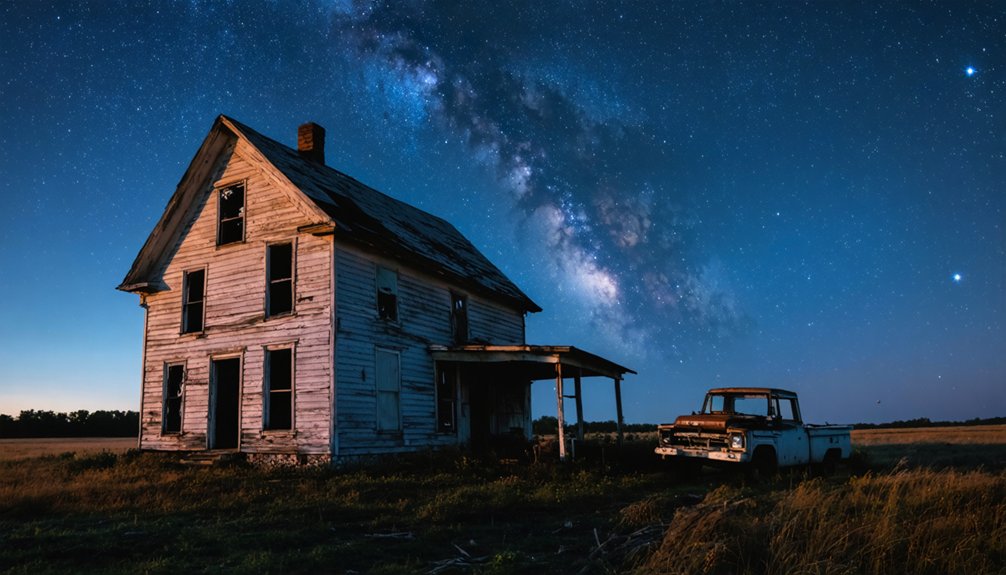
Moving inland from Delaware’s coast reveals another stellar dark sky destination at the Cedar Creek Road ruins in northern Sussex County. The remnants of this 18th-century settlement offer exceptional astrophotography techniques against minimal light pollution, just six miles from Milford.
To capture stunning night sky images at Cedar Creek:
- Position your camera near the bloomery furnace pit for compelling foreground elements.
- Frame your shots using the post-in-ground structural remains to add historical depth.
- Take advantage of the open farmland vistas for unobstructed Milky Way views.
The site’s abandoned industrial features and brick remnants create striking silhouettes under starlight.
You’ll find plenty of composition options among the scattered ruins, with the added benefit of being far enough from coastal light domes to capture clean, long exposures.
Frequently Asked Questions
What Specialized Camera Equipment Is Needed for Ghost Town Astrophotography?
You’ll need a full-frame camera, fast wide-angle lens (f/2.8 or wider), sturdy tripod for stability, intervalometer, and dew heaters. Don’t forget tracking mounts for longer deep-sky exposures.
Are There Guided Night Photography Tours Available at These Locations?
You’ll find guided tours with local photographers at Fort Delaware and Lewes Historical Society, but you’ll need to arrange private night photography access through the historical societies separately.
If you’re looking for the best drone locations in Delaware, consider exploring Cape Henlopen State Park or the scenic beaches of Rehoboth. These spots offer breathtaking vistas and unique perspectives that are perfect for aerial photography. Just remember to check local regulations regarding drone usage to ensure a hassle-free experience.
When Is the Best Season to Photograph the Milky Way Here?
With 6+ hours of dark skies nightly, you’ll find your best Milky Way shots from April through August, when clear weather conditions and core visibility align perfectly before late-summer humidity intensifies.
How Do You Handle Wildlife Encounters During Night Photography Sessions?
Stay alert and make noise while shooting. You’ll want to carry bear spray, maintain a 50-meter distance, and use red headlamps to minimize wildlife disturbance. Back away slowly if animals approach.
What Permits or Permissions Are Needed for Overnight Equipment Setup?
Like clockwork, you’ll need ranger permission and park-specific permits for overnight camping. Contact park offices directly and join astronomy clubs for smoother access to photography regulations and extended stargazing sessions.
References
- http://freepages.rootsweb.com/~gtusa/history/usa/de.htm
- https://kids.kiddle.co/List_of_ghost_towns_in_Delaware
- https://www.phillybite.com/index.php/travel/7398-ghost-towns-in-delaware-that-you-can-visit
- https://www.youtube.com/watch?v=ex8Hld_imPU
- https://www.onlyinyourstate.com/experiences/delaware/abandoned-places-delaware
- https://www.youtube.com/watch?v=0UAkxBOSLhs
- https://www.visitkeweenaw.com/listing/delaware-the-ghost-town/515/
- https://www.ghosttowns.com/states/de/glenville.html
- https://kids.kiddle.co/Glenville
- https://mapcarta.com/20631016