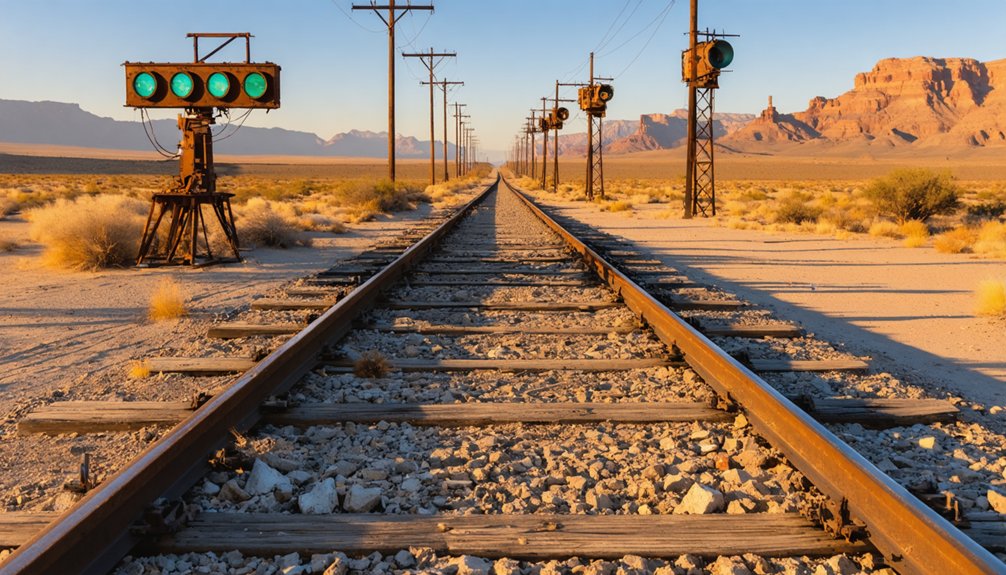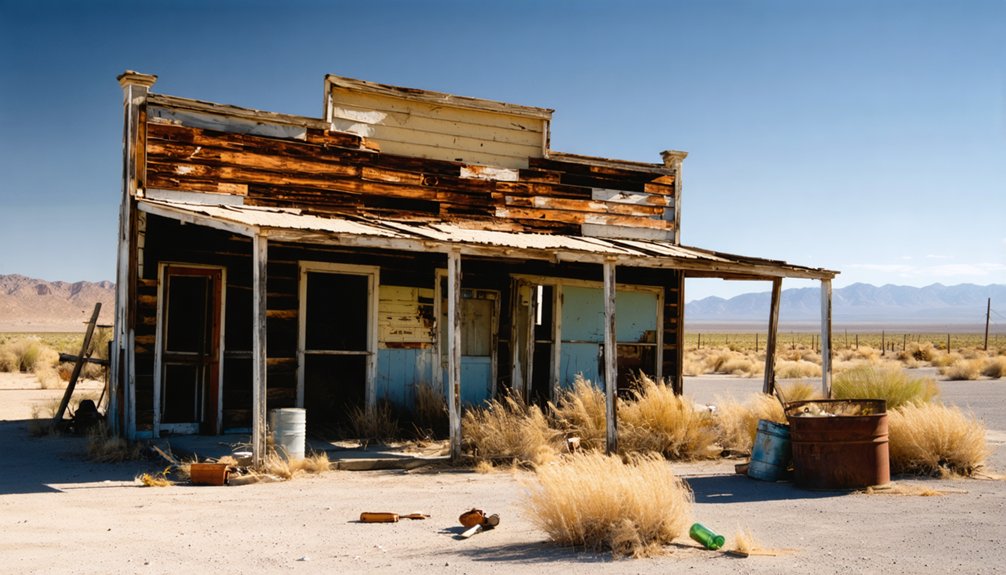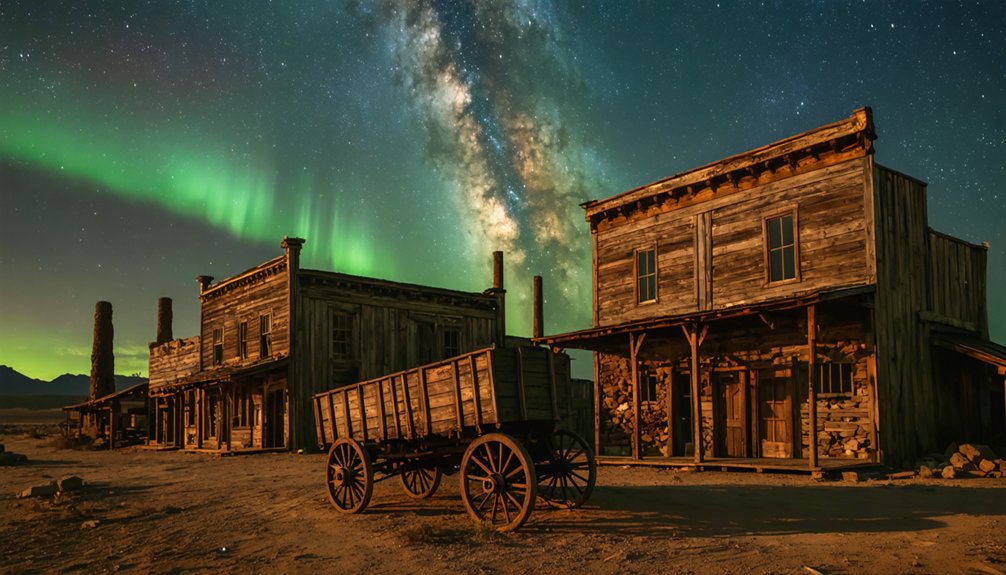
You’ll find Arizona’s top ghost towns for astrophotography in Bisbee, Ruby, Vulture City, Jerome, and Goldfield, where pristine dark skies meet historic mining structures. These locations benefit from high desert elevations, minimal light pollution, and surrounding mountain ranges that shield from urban skyglow. For ideal results, visit during winter months when atmospheric conditions are most stable, or spring for wildflower foregrounds. The combination of International Dark Sky Community designations and preserved architectural elements opens up endless compositional possibilities.
Key Takeaways
- Bisbee stands out as an International Dark Sky Community with preserved mining structures, offering exceptional nighttime photography conditions.
- Vulture City provides well-preserved stamp mill silhouettes against dark horizons, perfect for dramatic night sky compositions.
- Jerome’s multi-level ruins create unique vertical compositions for Milky Way photography, especially during summer months.
- Ruby offers pristine dark skies with private access, allowing controlled environments for astrophotography without light pollution.
- Goldfield provides controlled access to historical structures with convenient amenities while maintaining sufficiently dark skies for astrophotography.
Why Arizona Ghost Towns Are Perfect for Night Sky Photography
While many locations offer opportunities for astrophotography, Arizona’s ghost towns provide an unparalleled combination of dark skies and historic settings.
You’ll find ideal night photography conditions thanks to the state’s extensive dark sky certifications, with six of sixteen U.S. Dark Sky Communities located in Arizona.
The remote desert locations of these ghost towns naturally minimize light pollution, while surrounding mountain ranges like McDowell and Santa Catalina shield sites from urban skyglow.
High desert elevations reduce atmospheric interference, and year-round clear skies in southern Arizona guarantee consistent shooting conditions. Clear night skies in Arizona make it one of the best states for stargazing photography.
Arizona’s elevated desert landscape delivers crystal-clear night skies and reliable year-round conditions perfect for capturing the cosmos.
You’re perfectly positioned near multiple Dark Sky Parks, including Kartchner Caverns and Tumacácori National Historic Park, while BLM-managed public lands preserve natural darkness around sites like Swansea.
The corridor stretching from Pipe Spring Monument in the north to Tumacacori National Historical Park in the south ensures access to certified dark sky locations throughout your ghost town photography journey.
Essential Equipment and Planning for Ghost Town Astrophotography
To capture stunning astrophotos in Arizona’s ghost towns, you’ll need specialized equipment that balances portability with technical capability.
Your gear selection should start with either a full-frame DSLR or mirrorless camera for wide landscape shots, or an APS-C body for more affordable planetary work. Prime lenses deliver superior image quality and are strongly recommended for night sky photography.
Essential mount choices include portable star trackers like the Sky-Watcher Star Adventurer for beginners, while advanced shooters might opt for the ZWO AM5N harmonic drive mount. The William Optics RedCat 51 telescope offers an ideal entry point for ghost town astrophotography due to its compact size and versatility.
Planning strategies must account for fast wide-angle lenses around 14mm for ghost town contexts, plus vital accessories like intervalometers and dew heaters for desert nights.
Create detailed checklists covering power supplies, cables, and alignment tools.
When upgrading your kit, verify equipment compatibility and match your choices to specific imaging goals before investing.
Top Dark Sky Locations Among Arizona’s Abandoned Mining Towns
Armed with the right equipment, you’ll find Arizona’s ghost towns offer prime locations for astrophotography, combining historic mining structures with some of North America’s darkest skies.
These areas hold a haunting beauty that captivates not just stargazers but also photographers seeking unique landscapes. In addition to their celestial charm, Arizona’s ghost towns for drone photography reveal breathtaking aerial views of crumbling buildings amidst vast desert expanses. Each captured image tells a story of abandonment and the passage of time, making them a treasure trove for visual storytellers.
Arizona’s abandoned ghost towns stand as silent sentinels beneath pristine dark skies, perfect for capturing the cosmos alongside historic mining relics.
The state’s abandoned architecture creates striking silhouettes against star-filled nights, with several locations offering exceptional dark sky conditions.
For ideal ghost town history and starfield captures, target these prime locations:
- Bisbee – An International Dark Sky Community with preserved copper mining structures
- Ruby – Private access site featuring pristine dark skies and intact mining facilities
- Vulture City – Well-preserved stamp mill silhouettes against dark western horizons
- Jerome – Multi-level ruins and headframes providing dramatic vertical compositions
These sites balance accessibility with minimal light pollution, though you’ll need to secure necessary permits for private locations and plan around seasonal access restrictions at managed properties.
Founded by Henry Wickenburg in 1863, Vulture City’s rich mining heritage provides photographers with authentic period structures perfect for night sky compositions.
Many former mining towns like Goldfield were revived as tourist attractions, offering photographers controlled access to historical structures during evening hours.
Best Seasons and Weather Conditions for Desert Night Photography
You’ll find ideal conditions for ghost town astrophotography during Arizona’s winter months, when low precipitable water vapor and stable atmospheric conditions combine to deliver exceptional sky transparency.
Spring presents opportunities to incorporate desert wildflowers into your foreground compositions while maintaining moderate humidity levels and manageable nighttime temperatures. Midday light rays penetrating through canyon walls can create interesting shadows and illumination patterns during daytime scouting sessions.
Summer’s monsoon season (mid-June through September) requires careful planning around thunderstorms and lightning risks, though these weather phenomena can create dramatic elements for specialized storm photography. The shift from dry western to moist southern air currents creates these powerful monsoon conditions.
Winter’s Clear Desert Nights
While Arizona’s deserts offer year-round stargazing opportunities, winter stands out as the premier season for astrophotography due to its excellent atmospheric conditions.
You’ll find minimal humidity and exceptional air clarity, creating perfect conditions for capturing desert nightscapes and winter constellations in sharp detail. The combination of desert terrain and dark night skies makes the Southwest region particularly ideal for capturing the Milky Way. Remember to pack essential safety gear including warm layers, water, and emergency supplies.
For ideal winter shooting, consider these critical factors:
- Set up during dusk or dawn twilight (45 minutes after sunset/before sunrise)
- Utilize shutter speeds under 25 seconds to prevent star trailing
- Adjust ISO between 800-6400 based on available light
- Focus manually on bright stars or distant lights for precise results
Late December presents unique advantages with potential snow-covered foregrounds against dark skies.
The cold desert nights stabilize the atmosphere, reducing distortion and enabling crisp long-exposure shots without monsoon interference.
Summer Monsoon Storm Timing
Despite offering unique photographic opportunities, Arizona’s summer monsoon season demands precise timing and careful planning for successful night photography.
You’ll need to navigate the June 15-September 30 window strategically, as storm patterns can be highly unpredictable.
For ideal monsoon photography tips, focus on the peak activity hours between 16:00-21:00, when convective storms typically develop.
Lightning activity often intensifies near sunset and continues into early nightfall.
Your storm timing strategies should account for rapidly changing conditions – storms can form quickly and clear just as fast, creating brief windows for stellar photography.
Watch for post-storm opportunities when clearing skies coincide with reflective surfaces from rainfall.
Remember that elevated humidity and dust can greatly impact visibility and image quality, so maintain flexibility in your shooting schedule.
Spring Desert Wildflower Backdrops
For ideal wildflower astrophotography in Arizona’s desert landscapes, understanding the precise timing of spring blooms becomes essential to capture stellar compositions.
You’ll find peak displays from late February through mid-April, with most locations reaching maximum intensity in early March.
To maximize your night photography success during spring bloom season:
- Target low elevation sites (<4,500 ft) in February-March for earliest blooms
- Schedule shoots during the two-week peak window at each location
- Align your visits with new moon phases for best Milky Way visibility
- Plan multiple nights to account for weather variables and scouting needs
Your best results will come from clear, low-humidity nights when autumn germination and winter rains have properly aligned to produce dense wildflower carpets in your chosen ghost town location.
Safety Tips and Access Information for Remote Ghost Town Shoots
Before venturing into Arizona’s remote ghost towns for astrophotography, you’ll need to navigate complex access requirements and safety protocols that vary by location.
Start by confirming legal access status and securing necessary permits, as many sites restrict entry or require advance reservations. Don’t assume all ghost towns are freely accessible – ownership varies between federal, state, tribal, and private entities.
Always verify site ownership and obtain proper permits before exploring Arizona ghost towns – access restrictions and requirements vary widely.
Your emergency preparedness strategy should include satellite communication devices, abundant water supplies, and a detailed trip plan filed with a reliable contact.
Pack appropriate PPE for structural hazards, and bring a partner for remote shoots. Always verify road conditions and vehicle requirements beforehand, as many locations demand high-clearance 4x4s and extensive dirt road navigation.
Carry paper maps and GPS coordinates since cell service is often nonexistent in these isolated areas.
Capturing the Milky Way Above Historic Mining Structures
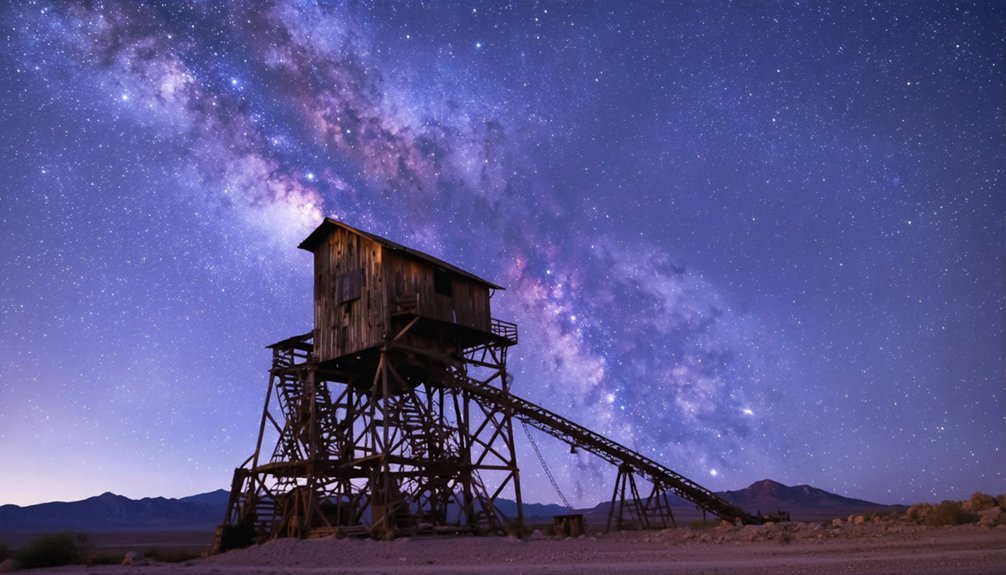
When photographing the Milky Way above Arizona’s ghost towns, you’ll need to strategically align mining structures with galactic features to create compelling compositions. The state’s rich mining heritage provides perfect foreground elements that complement night sky photography.
For ideal alignment with the Milky Way core, consider these technical approaches:
- Position vertical headframes parallel to the galactic plane during spring and summer months.
- Use wooden bunkhouses and saloons as silhouetted frames to create depth.
- Illuminate mill equipment and tailings with minimal LED lighting to maintain sky contrast.
- Incorporate reflective metal debris as midground elements to separate foreground from sky.
Higher elevation sites like Jerome and Ruby offer reduced atmospheric interference, while remote locations minimize light pollution.
Consider seasonal variations, as southern Arizona ghost towns provide better winter shooting conditions, while northern locations excel during summer months.
Recommended Camera Settings for Ghost Town Starlight Photos
Capturing ghost town astrophotography demands precise camera settings to balance the intricate details of abandoned structures with the delicate light of stars.
Start with your lens’s widest available aperture (f/1.4-f/2.8) to maximize light gathering, but consider stopping down one stop if you notice soft corners.
Fast apertures gather maximum starlight, but stepping down slightly can sharpen those pesky corner details for better overall results.
For exposure techniques, limit your shutter speed to 15-25 seconds for wide-angle shots to prevent star trails, using the 400 or 500 rule as your baseline.
Set your ISO between 1600-3200 on full-frame cameras, pushing higher only when necessary for fainter stars.
When photographing detailed structures, bracket your exposures: capture short frames for sharp stars and longer exposures for the foreground.
You’ll achieve cleaner results by stacking multiple frames rather than relying on a single high-ISO shot.
Frequently Asked Questions
Are There Paranormal Investigation Opportunities at These Ghost Towns?
You’ll find paranormal tours and ghostly legends at all three sites—Jerome’s Grand Hotel welcomes investigators, Goldfield offers guided night tours, and Vulture Mine requires special permission for ghost hunting.
Which Ghost Towns Allow Camping or Overnight Vehicle Parking?
You’ll find legal overnight options at Fairbank with BLM permits ($2/night), Two Guns for dispersed camping, and Goldfield’s formal campground. Always check current camping regulations and vehicle restrictions before setting up.
Do Any Sites Require Special Permits for Commercial Photography?
You’ll need to navigate bureaucratic hurdles, as most sites require commercial permits. Federal lands demand 30-60 day advance applications, while state parks and tribal territories enforce strict photography regulations and insurance requirements.
What Wildlife Hazards Should Photographers Watch for at Night?
You’ll need to watch for rattlesnakes, mountain lions, coyotes, and scorpions during night photography. Use bright lights, scan your surroundings, and don’t leave gear unattended to minimize wildlife encounters.
Can Drones Be Used for Aerial Night Photography at These Locations?
Shadowy sites strictly supervise drone usage. You’ll need permits at Goldfield and Vulture City for aerial night photography, while Two Guns remains unregulated. Tombstone’s historic district likely prohibits unauthorized drone flights.
References
- https://pamphotography.blog/2023/05/22/photographing-four-ghost-towns-in-arizona/
- https://mwg.aaa.com/via/places-visit/arizona-ghost-towns
- https://www.flagstaff.com/5-best-stargazing-spots
- https://www.tripadvisor.com/Attraction_Review-g29033-d116634-Reviews-Goldfield_Ghost_Town-Apache_Junction_Arizona.html
- https://www.visitarizona.com/places/dark-skies-sunrises
- https://darksky.org/news/diamond-mountain-retreat-center-earns-darksky-approved-lodging-certification/
- https://goldfieldghosttown.com
- https://stantonaz.com/blog/stanton-arizona-best-stargazing-gold-prospecting-camp
- https://www.golakehavasu.com/things-to-do/outdoor-adventures/stargazing/
- https://nightskytourist.com/arizona-dark-sky-corridor/