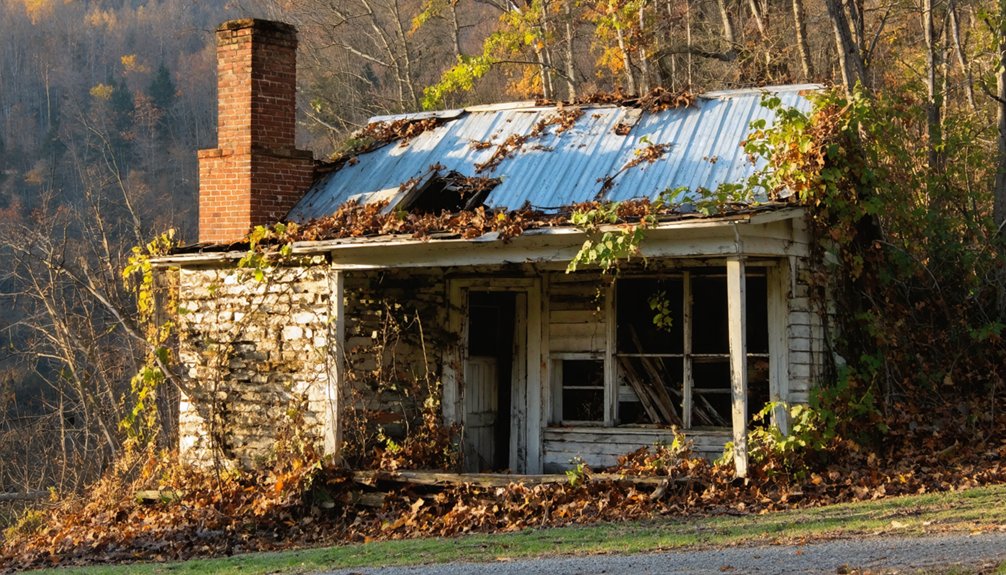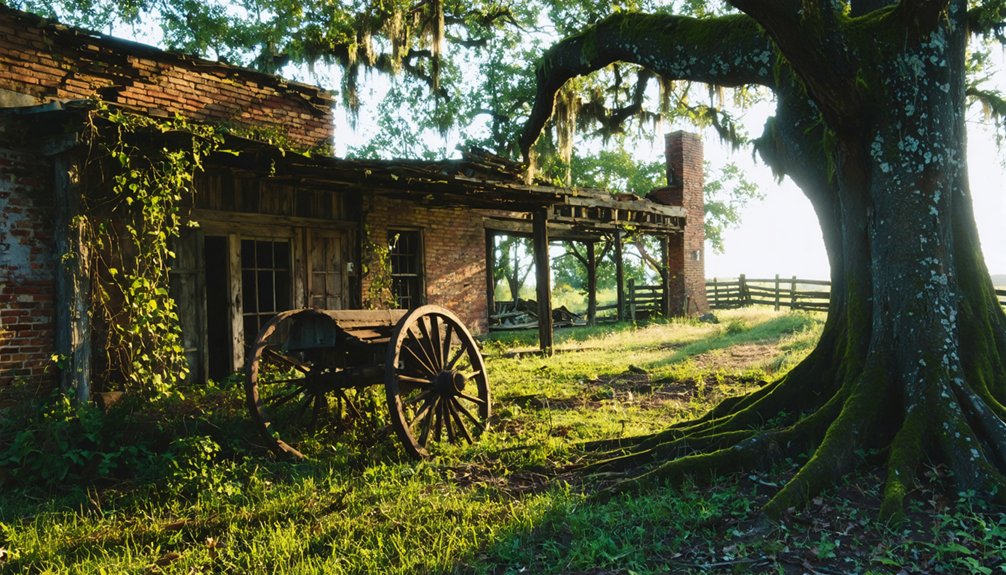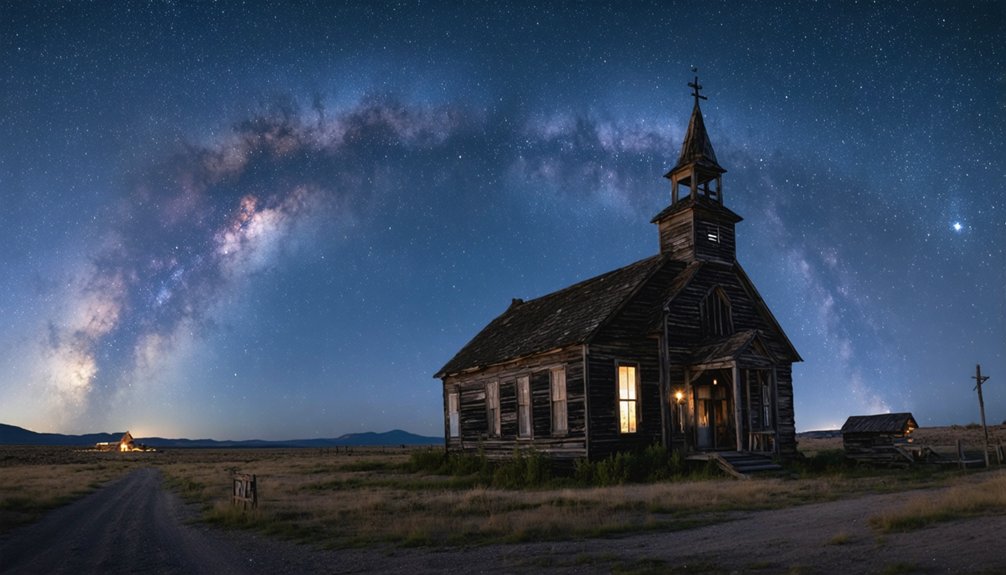
Arkansas’s ghost towns provide exceptional astrophotography opportunities, with Rush Ghost Town leading as part of the state’s first International Dark Sky Park. You’ll find pristine Bortle 2-3 conditions at remote locations like Zinc and Monte Ne, where historic ruins create compelling foreground elements against the Milky Way. For best results, target June through September during new moon phases with clear skies and low humidity. The fascinating convergence of forgotten architecture and celestial wonders awaits your exploration.
Key Takeaways
- Rush Ghost Town offers exceptional dark sky conditions within Buffalo National River, featuring historic zinc mining ruins as compelling foreground elements.
- Monte Ne’s underwater ruins emerge during low water periods, providing unique compositions against pristine dark skies for Milky Way photography.
- The Zinc Mining District combines unrestricted access with minimal light pollution, offering abandoned structures and equipment for authentic nighttime compositions.
- Old Davidsonville’s 163-acre archaeological site provides unobstructed celestial views with pristine dark-sky conditions at coordinates 36.15639°N, 91.05639°W.
- Calico Rock’s historic district features the 1941 trestle bridge and railroad tracks against dark rural skies with minimal light pollution.
Why Arkansas Ghost Towns Offer Prime Night Sky Photography
While many regions boast dark skies, Arkansas’s ghost towns present an unparalleled confluence of pristine atmospheric conditions and compelling historical artifacts for astrophotography.
You’ll discover these abandoned settlements offer superior celestial photography conditions, with Rush Ghost Town’s designation as part of Arkansas’s first International Dark Sky Park ensuring minimal light pollution interference. The Buffalo National River protects this pristine night sky viewing location.
The remote locations of sites like Zinc and Eros provide exceptional Bortle scale ratings, maximizing your ability to capture the Milky Way and meteor showers against haunting historical backdrops.
Beyond ghost town legends, these protected environments maintain their atmospheric integrity through federal oversight and dark sky preservation initiatives. The area’s natural light patterns contribute significantly to the local ecosystem’s health.
The strategic positioning between natural barriers like Clabber Creek and Buffalo River creates prime conditions for long-exposure shots, while crumbling structures provide compelling foreground elements for your compositions.
Essential Gear and Safety Equipment for Ghost Town Shoots
Although capturing the night sky amid abandoned structures demands creative vision, success hinges on assembling a detailed imaging system optimized for low-light conditions.
You’ll need a full-frame camera with manual controls paired with fast wide-angle glass (f/2.8 or wider) for nightscape compositions, plus a robust tracking mount for pinpoint stars.
Important gear maintenance includes protecting optics with dew heaters and implementing proper cable management to prevent accidents in the dark. For optimal results, consider using narrowband filters to combat any residual light pollution from nearby towns.
Essential safety precautions demand redundant illumination sources – your primary red headlamp and backup lights for preserving night vision while maneuvering through deteriorating structures.
Consider bringing multiple warm layers since temperatures can drop significantly during extended nighttime photo sessions.
Pack a thorough first-aid kit, and make sure your GPS device has offline maps pre-loaded.
Power management is vital: carry multiple batteries and a high-capacity power bank to prevent session-ending failures when you’re deep in remote locations.
Planning Your Visit: Best Seasons and Moon Phases
You’ll need to carefully align your ghost town shoots with Arkansas’s prime Milky Way visibility window of June through September, while targeting new moon periods (±2 days) for maximum dark sky conditions.
Your weather monitoring should focus on low humidity nights with minimal wind and clear atmospheric transparency, using high-resolution cloud cover models and satellite-derived aerosol maps to confirm ideal shooting conditions. The upper Buffalo River offers exceptional vantage points for capturing both ghost town ruins and stellar nightscapes in one frame. Crisp September evenings provide optimal atmospheric conditions for capturing detailed star trails and constellations.
For the sharpest star points and deepest sky detail, schedule your sessions during autumn months when lower humidity combines with good Milky Way core positioning, particularly during moonless periods near astronomical twilight.
Dark Sky Calendar Basics
Planning successful astrophotography sessions at ghost towns requires meticulous attention to the dark sky calendar, particularly regarding Moon phases and seasonal target visibility.
You’ll need to master dark sky essentials by timing your shoots within ±1-3 days of the New Moon for peak deep-sky contrast. For lunar planning, calculate Moon rise/set times to avoid periods when lunar illumination could wash out your target fields. Deep sky objects are best captured when there is absolutely no moonlight interference.
Schedule your Arkansas ghost town visits strategically: spring for the galaxy window in Leo, summer for Milky Way panoramas, autumn for Andromeda shots, and winter for Orion’s rich nebulosity. December offers excellent opportunities to photograph the Christmas Tree Cluster and its surrounding nebulae about 2,500 light-years away.
Exploring the best drone spots in Arkansas can enhance your photographic experience, especially when capturing the state’s breathtaking landscapes from above. Consider flying your drone over the stunning Ozark Mountains during golden hour for truly magical shots. Additionally, the lush greenery of the Buffalo National River presents an ideal backdrop for aerial footage, showcasing the river’s winding paths and natural beauty.
You’ll achieve prime results by waiting until astronomical twilight (Sun 18° below horizon) for the darkest skies. Cross-reference Clear Sky Charts to verify seeing conditions and factor in your site’s specific latitude for precise twilight timing calculations.
Weather and Visibility Windows
When selecting ideal visibility windows for ghost town astrophotography in Arkansas, successful outcomes hinge on mastering the region’s distinct seasonal patterns.
You’ll find prime weather patterns during fall and winter months, with the northwest Ozarks offering exceptional 25-35% cloud cover statistics. The region’s visibility forecasts peak during La Niña winters, reaching up to 80% clear sky probability. Local astronomy clubs’ expertise can help identify peak seasonal viewing conditions. The Hornet Spooklight phenomenon adds a unique photographic opportunity during clear nights.
- Schedule shoots during fall’s clear skies (September-November) for maximized Milky Way visibility.
- Leverage winter’s low humidity (December-February) for superior atmospheric transparency.
- Target new moon phases for 3-5 night shooting windows in ghost town locations.
- Plan around the Arkansas Dark Sky Festival for prime Perseid meteor shower conditions.
Utilize NOAA satellite imagery for 48-hour accuracy in predicting visibility windows, and maintain dark adaptation with red-light equipment for extended shooting sessions.
Essential Timing Considerations
Successful ghost town astrophotography hinges on precise timing windows that align with ideal seasonal and lunar conditions.
Your best timing strategies should target autumn’s low humidity nights (September-October) for multi-hour deep-sky exposures, while mid-April through mid-September offers prime Milky Way core visibility against ghost town silhouettes.
Structure your shoots around new moon phases (±3 nights) to maximize darkness, or leverage waxing/waning crescents for subtle foreground illumination.
Consider seasonal variations in your planning – winter delivers extended darkness perfect for high-declination targets, while late summer presents opportunities for meteor shower captures.
For clearest atmospheric conditions, schedule your sessions 1-2 nights after cold fronts pass through.
When shooting near valley ghost towns, choose elevated locations to avoid localized fog that can compromise image quality.
Rush: The Crown Jewel of Arkansas Ghost Towns
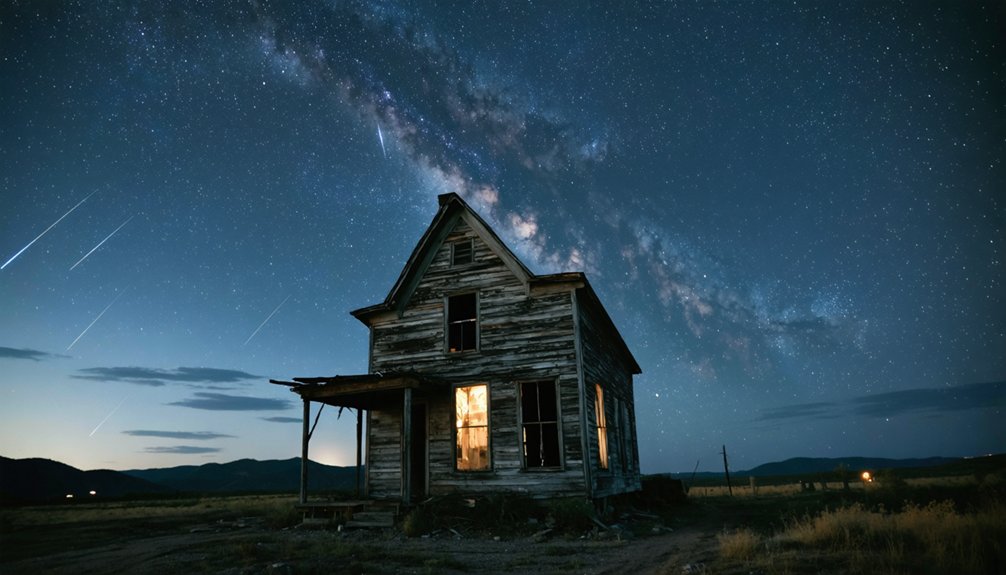
You’ll find Rush’s remote location within Buffalo National River provides exceptional dark sky conditions for capturing the Milky Way above its historic zinc mining ruins.
The site’s preserved structures, including the Morning Star Mine complex and scattered stone foundations, offer compelling foreground elements that align naturally with celestial compositions.
The ghost town’s position away from major light pollution sources, combined with its protected status within NPS lands, creates ideal conditions for long-exposure astrophotography throughout the year.
Dark Sky Paradise
Nestled at the confluence of the Buffalo and White Rivers in North Central Arkansas, Rush stands as a premier dark sky destination for astrophotographers seeking pristine nocturnal conditions.
The remote location, minimal light pollution, and elevation create ideal conditions for capturing the Milky Way above historic mining structures.
- Position your tripod near the 1886 smelter for dramatic foreground compositions against the star-filled sky.
- Utilize the Monte Cristo Trail’s elevated vantage points for unobstructed celestial views.
- Frame abandoned mine entrances with star trails during long exposures.
- Access primitive campsites for extended dark sky photography sessions.
For serious ghost town exploration and astrophotography, you’ll find Rush’s isolated setting and well-preserved ruins offer unlimited creative possibilities throughout the 1,300-acre historic district, especially during new moon phases.
Mining History Meets Stars
While photographing the celestial majesty above Rush’s ruins, you’re standing atop a century-old zinc mining empire that once dominated Arkansas’s mineral industry. The ghostly silhouettes of abandoned structures, including the iconic Morning Star Mine complex, create compelling foreground elements against the star-filled sky.
These mining relics, preserved within the 1,300-acre historic district, offer unique compositional opportunities for your astrophotography pursuits. You’ll find prime shooting locations near the remaining ore mills and elevated tramway remnants, where room-and-pillar mining methods created distinctive waste rock formations.
The site’s elevation and remote location within Buffalo National River guarantee minimal light pollution, while the historic buildings, dating from the 1880s through the 1931 closure, provide authentic architectural elements that enhance your nighttime exposures.
Monte Ne’s Mysterious Underwater Ruins
Here’s Monte Ne – Arkansas’ submerged ghost town offering unparalleled astrophotography opportunities amid mysterious ruins. When Beaver Lake’s waters recede, you’ll discover concrete foundations of the once-grand Oklahoma Row hotel emerging like an ancient civilization.
The site’s remote location provides exceptional dark sky conditions, perfect for capturing the Milky Way above partially submerged structures.
- Position your wide-angle lens toward the exposed amphitheater foundations during low water periods for dramatic foreground compositions.
- Utilize long exposures to capture star trails above the historic Harvey family tomb.
- Frame the Oklahoma Row’s basement ruins against deep space objects during new moon phases.
- Scout underwater photography possibilities near the boat ramp where additional foundations rest beneath the surface.
The site’s isolation and minimal light pollution create ideal conditions for combining nocturnal architectural and celestial photography techniques.
Historic Zinc Mining District After Dark
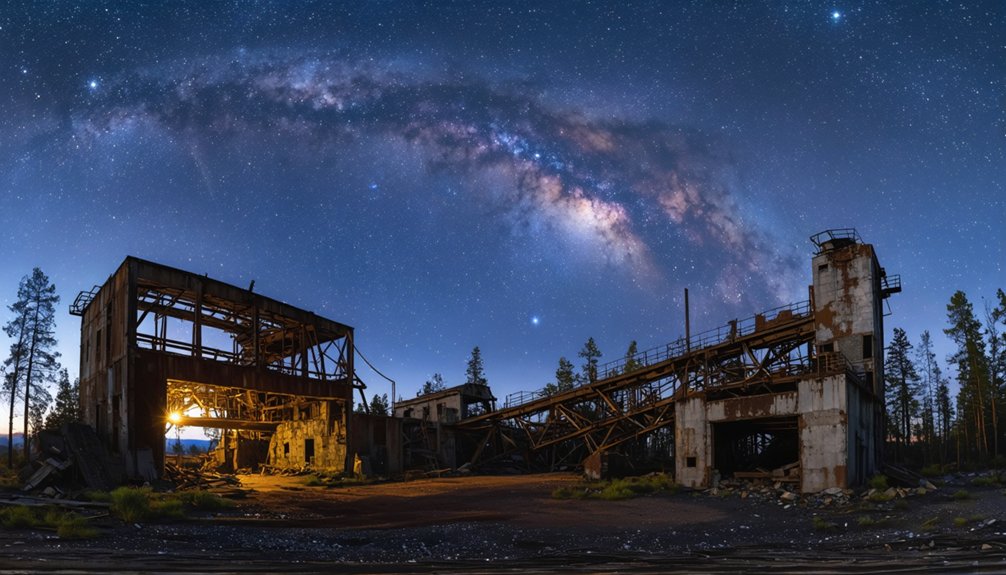
The abandoned mining town of Zinc offers astrophotographers an extraordinary nocturnal canvas, where remnants of Arkansas’ industrial past merge with pristine dark skies.
You’ll discover ideal shooting conditions in this remote ghost town, where minimal light pollution and dense Ozark terrain create exceptional visibility for celestial photography.
Navigate the historical grounds to compose compelling foreground elements using crumbling stone foundations, rusted mining equipment, and sealed mine shaft entrances.
The site’s rich zinc mining heritage, dating to its 1904 incorporation, provides authentic architectural elements to anchor your Milky Way compositions.
Position your tripod near the deteriorating community center or along the network of old mining trails.
You’ll appreciate the site’s unrestricted access and lack of crowds, allowing uninterrupted long exposures throughout the night.
Located at the convergence of the Ozarks and Arkansas Delta, Old Davidsonville Historic State Park presents astrophotographers with pristine dark-sky conditions across its 163-acre archaeological site.
The historical significance of this pioneer settlement merges perfectly with night sky photography opportunities, offering unobstructed celestial views from its strategically positioned ridge overlooking the Black River valley.
Nature and history unite in perfect harmony as stargazers discover pristine views from this strategic ridge above Black River.
- Set up your equipment on the open grassy townsite, utilizing ghost structure frameworks for compelling foreground compositions.
- Scout cardinal directions from the visitor center to identify ideal dark sky quadrants away from Highway 62/63 skyglow.
- Leverage the site’s rural setting at coordinates 36.15639°N, 91.05639°W for minimal light pollution interference.
- Time your shoots around seasonal community events to avoid artificial lighting impacts on long exposures.
Capturing the Stars Above Calico Rock
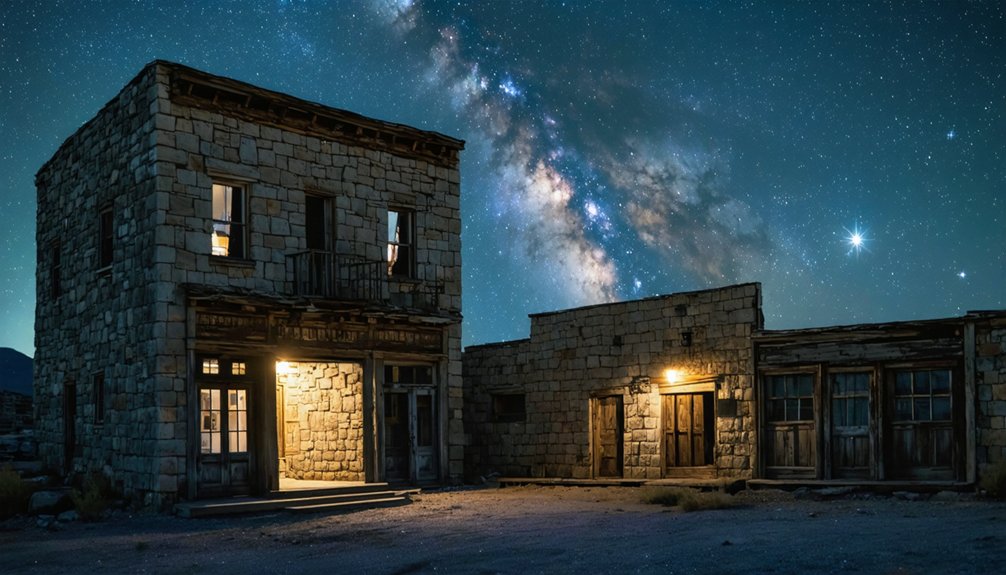
Nestled along the pristine White River, Calico Rock’s abandoned district presents astrophotographers with an extraordinary confluence of historic architecture and dark sky conditions.
You’ll find prime shooting locations throughout this authentic ghost town’s six-block grid, where 23 original structures create compelling foreground elements against the star-filled Arkansas sky.
Position your tripod along the historic 1941 trestle bridge or near the Missouri Pacific Railroad tracks for dramatic leading lines into the cosmos.
The weathered Ozark Theatre and vine-covered shells of former establishments offer unique framing opportunities for Milky Way compositions.
With minimal light pollution in rural Izard County, you’ll capture pristine star trails above deteriorating facades.
Access is straightforward – park near Main and Walnut Streets, but remember these structures remain privately owned, so shoot from designated public areas.
Hidden Gems: Lesser-Known Ruins for Night Photography
Beyond well-documented ghost towns lies a network of lesser-known ruins that offer astrophotographers pristine dark sky conditions without the crowds.
These hidden histories reveal themselves through nocturnal explorations, providing unique compositional elements for your astroscape portfolio.
- Peppersauce Ghost Town’s preserved structures, including its historic barber shop and theater, create compelling foreground elements against the Milky Way.
- Monte Ne’s partially submerged ruins emerge during low water levels, offering surreal reflections for star trail photography.
- Booger Hollow’s iconic two-story outhouse provides an unconventional architectural element for meteor shower captures.
- East Calico Historic District’s street-viewable ruins present unobstructed celestial vistas perfect for deep-sky imaging.
These locations deliver both historical authenticity and ideal dark-sky conditions for capturing the cosmos above Arkansas’s forgotten places.
Frequently Asked Questions
Are There Any Paranormal Photography Opportunities at These Ghost Town Locations?
You’ll find limited empirical evidence of ghost sightings, though you’re free to deploy paranormal equipment at Rush’s mining ruins, Monte Ne’s lake ruins, and various cemetery sites during night photography sessions.
What Wildlife Encounters Should Photographers Be Prepared for at Night?
You’ll need to watch for raccoons raiding gear, rattlesnakes near ruins, coyotes prowling perimeters, and black bears in forested areas. Keep food secured and maintain vigilant nighttime safety protocols.
How Do You Handle Trespassing Locals Who May Visit After Dark?
Prioritize local etiquette by introducing yourself to property owners beforehand. Install trail cameras, maintain documented permission, and don’t confront trespassers directly – instead, coordinate with law enforcement for safety measures after dark.
Which Locations Allow Camping Directly Among the Ruins for Sunrise Shots?
You’ll need to camp at Buffalo National River’s designated sites near Rush, not within ruins themselves. Strict camping regulations prohibit overnighting among structures, but you can access ruins pre-sunrise for photography.
Can Drones Be Used for Night Photography at These Historic Sites?
Like threading a needle in the dark, you’ll need FAA permits and park authorizations. Avoid light pollution with dimmable LEDs, maintain line-of-sight compliance, and respect preservation guidelines for drone-based astrophotography missions.
References
- https://arkansasfrontier.com/ghost-towns-in-arkansas/303766/
- https://everafterinthewoods.com/forgotten-ghost-towns-in-arkansas-that-are-eerially-scenic/
- https://onlyinark.com/places-and-travel/buffalo-river-arkansass-first-dark-sky-park/
- https://www.go-astronomy.com/dark-sky-parks-stargazing-state.php?State=AR
- https://onlyinark.com/places-and-travel/rush-arkansas-ghost-town/
- https://www.youtube.com/watch?v=l4g8nwzMZ4s
- https://www.uaex.uada.edu/environment-nature/musings-on-nature-blog/posts/ghost-towns.aspx
- https://darkskyarkansas.org/stella-observation-sites/
- https://www.arkansas.com/things-to-do/outdoors/skygazing
- https://astrotelescopium.com/pages/checklist-for-a-perfect-stargazing-night