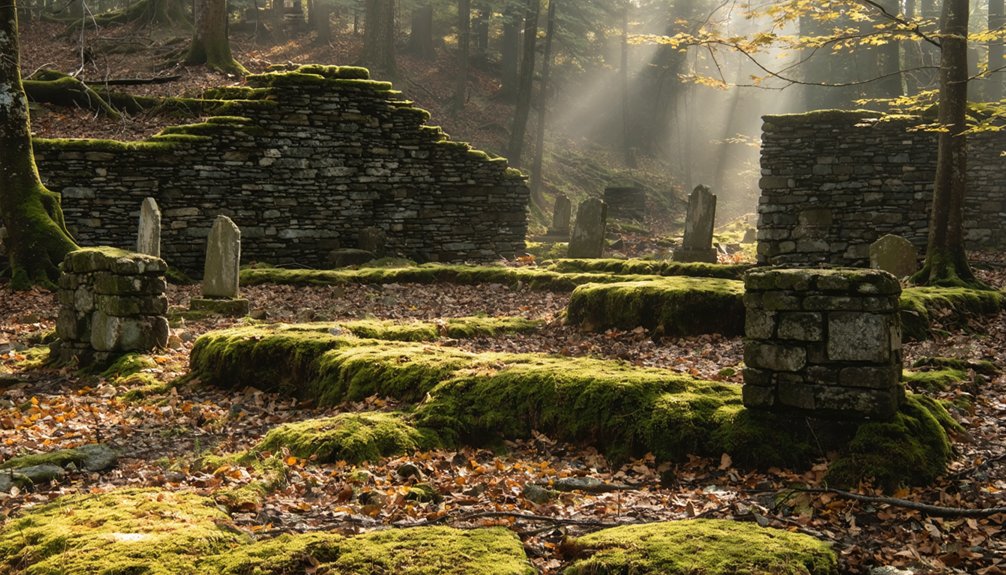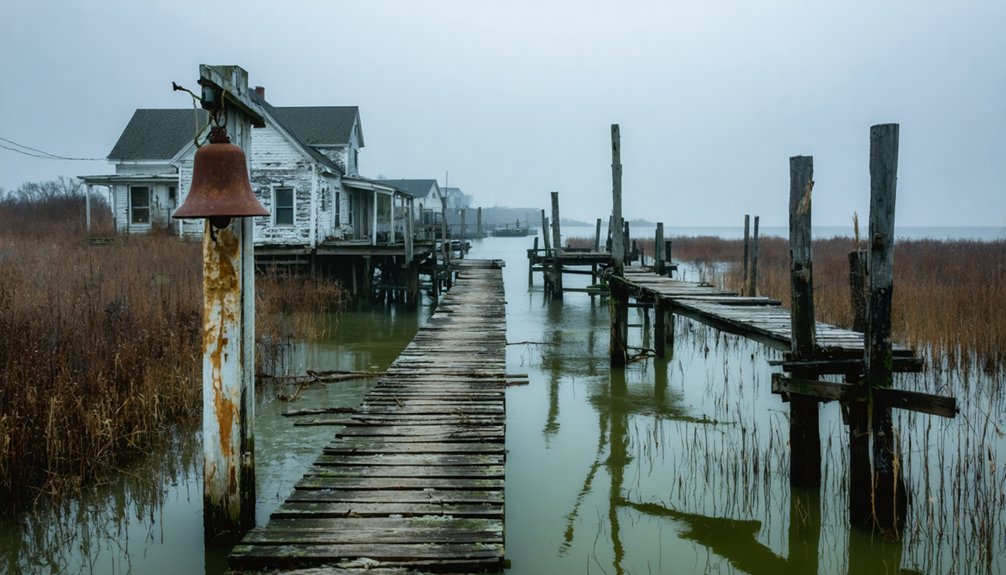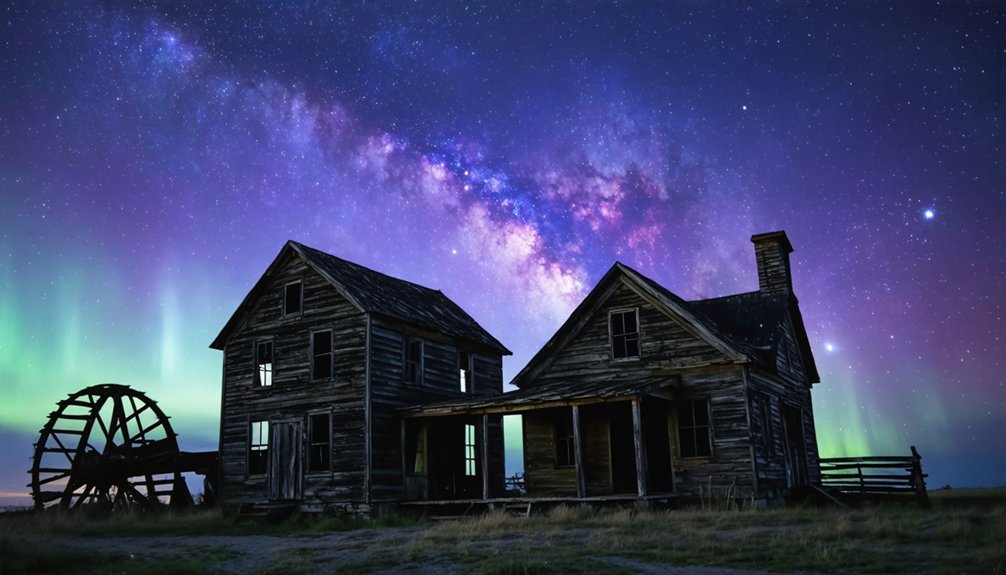
You’ll find Connecticut’s prime ghost town astrophotography in Litchfield and Windham Counties, where Bortle 4 dark skies illuminate abandoned mill ruins. Top locations include Beckley Furnace, North Grosvenordale Mill, and Talcottville Mill, offering unobstructed Milky Way views from June through September. For best shots, visit between 2-3 AM EDT during new moons with a full-frame camera and f/2.8 wide-angle lens. Legal access requires proper permits and permissions, but these haunting historical backdrops reveal spectacular night sky possibilities.
Key Takeaways
- Beckley Furnace offers exceptional dark sky conditions and historic industrial ruins perfect for nighttime photography in Litchfield County.
- North Grosvenordale Mill provides unobstructed night sky views with well-preserved architectural elements for compelling foreground composition.
- Talcottville Mill combines Bortle 4 darkness ratings with accessible ghost town structures, ideal for Milky Way photography.
- Adams Mill Dams create dramatic water reflections for star trail photography while featuring preserved historical mill structures.
- Old Town Mill delivers both historical architecture and dark sky conditions, though requires proper permits for nighttime access.
Connecticut’s Dark Sky Heritage Sites
Connecticut’s darkest skies cluster in Litchfield and Windham Counties, where you’ll find the state’s only Bortle 4 locations suitable for deep-sky astrophotography.
These heritage sites, protected by state regulations and dark sky conservation efforts, offer you rare opportunities to capture the Milky Way against historic backdrops.
Discover Connecticut’s protected heritage sites, where dark skies and historic landscapes merge to create stunning Milky Way photography opportunities.
You’ll discover prime shooting locations at Beckley Furnace, Kent Falls, Haystack Mountain, Housatonic Meadows, and Macedonia Brook State Parks.
Each site benefits from Connecticut’s progressive light pollution laws, including mandatory shielding and night-time dimming requirements.
While practicing proper stargazing etiquette, you can photograph circumpolar constellations like Cassiopeia and the Big Dipper year-round.
Though Connecticut lacks official International Dark Sky Places, these rural parks preserve essential dark sky corridors for both astrophotography and migrating wildlife.
The Lights Out! Movement has significantly improved viewing conditions at these locations by encouraging local businesses and residents to reduce unnecessary lighting.
Many locations offer overnight camping options for extended photography sessions under the stars.
Exploring Abandoned Mill Villages After Sunset
While the state’s dark sky sites offer pristine celestial views, its abandoned mill villages present compelling foreground elements for nighttime compositions.
You’ll find prime locations at the North Grosvenordale Mill’s towering silhouette and Talcottville Mill’s deteriorating structures, both offering unobstructed views of the night sky.
The Adams Mill Dams’ three-tiered ruins along the Hockanum River create dramatic reflections for star trail photography.
For historical significance paired with ghostly encounters, explore the Old Town Mill’s 1650 foundations after dusk. The site’s enduring legacy is highlighted by its early industrial heritage as one of Connecticut’s oldest manufacturing locations. Photographers seeking unique spiritual elements can capture the illuminated giant cross that towers above Holy Land U.S.A., visible from I-84.
While Johnsonville Village remains off-limits, its Victorian-era buildings occasionally appear in neighboring dark sky zones.
Remember to scout these locations during daylight hours, as mill ruins require careful navigation for ideal camera placement during astronomical twilight.
Equipment Setup for Ghost Town Night Photography
Successful ghost town astrophotography demands specialized equipment configured for challenging low-light conditions.
You’ll need a full-frame mirrorless or DSLR body paired with fast wide-angle glass (f/2.8 or wider) for capturing the Milky Way above abandoned structures. Many photographers achieve excellent results with a Nikon D700 setup.
Your night photography setup must include a robust tripod with a quality ballhead rated for your gear’s weight – consider adding a sandbag for stability in Connecticut’s breezy valleys.
For precise focus, pack a remote trigger and use manual focus techniques: autofocus on a torch-lit subject or magnify live-view on a bright star. Using longer 10-second exposures allows you to experiment with different lighting techniques while maintaining image quality.
Don’t forget weather-sealed equipment to handle New England’s notorious dew and temperature drops.
Your ghost town equipment should include backup batteries and memory cards, as long exposures drain power quickly in cold conditions.
Seasonal Considerations and Weather Planning
To maximize your astrophotography potential at Connecticut ghost towns, careful seasonal planning must align with specific dark sky periods and weather patterns.
You’ll find ideal conditions from late September through early November, particularly in Dudleytown, though access restrictions apply during peak foliage.
Winter’s extended dark hours at Beckley Furnace and Kent Falls enhance Milky Way visibility, while spring mornings offer clearer views.
Track seasonal effects through NOAA light pollution maps, focusing on Windham County’s stable Bortle 4 zones.
The Tory Den tunnels provide unique framing opportunities for night sky photography during summer months when temperatures are mild.
Weather patterns favor Litchfield County’s clear post-eclipse skies, and drought conditions in Fairfield County often reveal hidden ghost town features.
For equipment protection, consider winter’s stable air in Barkhamsted for long exposures, but pack dew heaters during humid summer sessions at Mashamoquet Brook.
Public astronomy events with telescope observation sessions can provide valuable guidance on optimal viewing times and locations throughout Connecticut’s seasonal changes.
Legal Access and Permission Requirements
You’ll need to carefully distinguish between public and private ghost town sites in Connecticut, as each carries distinct access requirements and restrictions for night photography.
If you’re looking for the best photo spots in Connecticut, consider exploring some of the lesser-known areas that provide unique backdrops. Many of these locations are ideal for capturing the haunting beauty of deserted landscapes under the moonlight. Remember to do your research to find the most picturesque spots while ensuring you respect all local regulations.
When shooting on public lands, you must obtain permits from the relevant municipal authorities and verify specific rules about nighttime access, lighting equipment, and group size limits. Entering these locations without proper authorization could result in serious trespassing charges.
For privately owned locations, you’ll need explicit written permission from the current legal owner(s), with documentation specifying allowed hours, parking areas, and equipment usage. This includes historic sites like Johnsonville Village, which requires special access arrangements due to its National Register status.
Public Vs Private Sites
Before venturing out for astrophotography in Connecticut’s ghost towns, understanding the critical distinction between public and private site access is essential for legal compliance.
Public land locations, like state parks and forests, typically allow daytime access and designated camping but may restrict after-dark activities. You’ll need to verify specific rules for each site.
Private property requires explicit written permission from landowners, often through email or signed documentation. This includes town-owned reservoirs, water-company lands, and conservation parcels that might appear accessible but carry strict restrictions.
You’ll encounter varying regulations for submerged village sites and abandoned settlements, even within public preserves. Cemetery parcels and historic sites frequently maintain separate access protocols.
When choosing your shooting location, prioritize sites where you’ve secured proper authorization to avoid legal complications.
Permit Requirements By Location
Three distinct permit categories govern astrophotography access in Connecticut’s ghost towns: state land permits, municipal authorizations, and private property permissions.
You’ll need a state park overnight camping permit for after-dark stays, plus special-use permits if you’re using tripods or conducting workshops. Local regulations vary by town – check with the clerk’s office for ordinances on nighttime access to municipal parks and abandoned sites.
For reservoir ghost towns, you’ll need explicit permission from water utility companies, especially for Class I watershed areas.
They’ll often require liability waivers and may restrict access when water levels expose historic foundations.
Don’t assume seasonal exposure of submerged structures grants public access rights – always verify your legal status and obtain necessary permits before setting up your astrophotography equipment.
Safety Tips for Night Shoots in Remote Locations
While capturing stunning astrophotography in Connecticut’s ghost towns can be rewarding, the remote nature of these locations demands careful attention to safety protocols.
You’ll need to scout locations during daylight hours, mapping out hazards and establishing clear entry points. Maintain wildlife awareness by researching local species and wearing appropriate protective gear. Always pack redundant equipment, including two reliable light sources with spare batteries and backup camera gear.
Your situational preparedness should include parking strategically for quick exits, notifying a trusted contact of your plans, and maintaining constant awareness of your surroundings.
Avoid using headphones and scan periodically for unexpected visitors or wildlife. When possible, shoot with a partner and establish clear exit triggers. Keep your gear organized in a grab-and-go kit for swift evacuation if needed.
Best Times for Milky Way Visibility
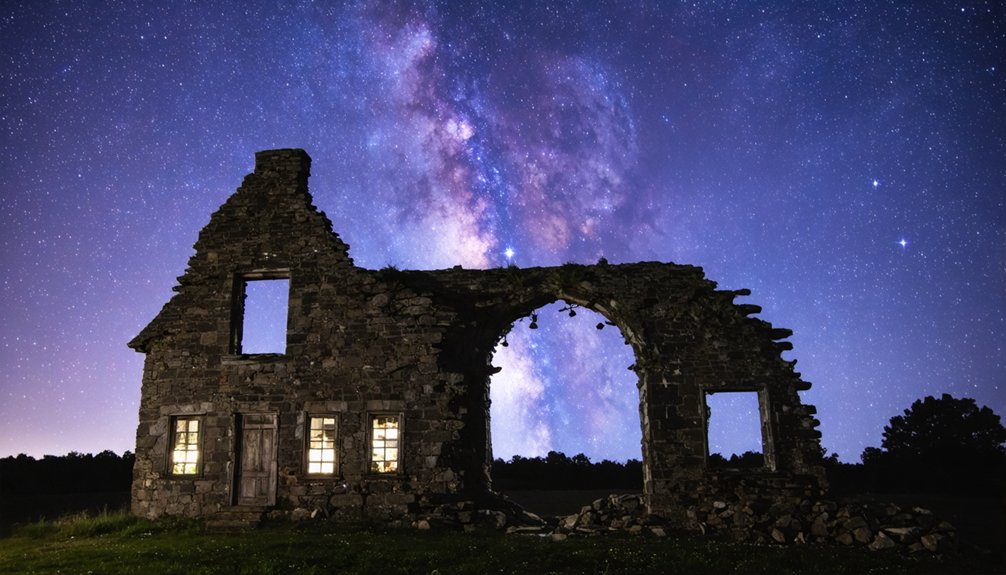
Capturing Connecticut’s Milky Way core requires precise timing during the summer months of June through September, when the galactic plane rises prominently in the eastern sky.
You’ll find ideal viewing between midnight and 4 AM, particularly in Litchfield County’s Bortle class 4 zones, where light pollution remains minimal.
Track lunar phases carefully – new moons provide your clearest shots of the core, while full moons can wash out up to 80% of detail.
Plan your shoots during astronomical twilight, typically after 10 PM in summer. You’ll get peak visibility in July and August when the core reaches its highest point around 2-3 AM EDT.
For maximum contrast, head to dark-sky locations like Haystack Mountain or Beckley Furnace State Park where the core’s ethereal glow truly shines.
Long Exposure Techniques at Historical Ruins
Once you’ve identified your ideal Milky Way viewing window, mastering long exposure techniques becomes your next challenge at Connecticut’s abandoned historical sites.
You’ll get cleaner results at ghost towns by stacking multiple 30-second exposures rather than attempting single long shots. Set up your tripod, use a wide-angle lens at f/2.8 or lower, and employ an intervalometer to capture sequences automatically.
For the best results at historical ruins, shoot your foreground and star trails separately. Capture the architectural details during blue hour, then focus on the sky using ISO 100-200 to minimize noise.
Stack up to 1,000 brief exposures using StarStax software – this approach prevents sensor heat buildup while allowing you to create dramatic star trails even in Connecticut’s light-polluted areas.
Light Pollution Maps and Site Selection
Digital light pollution maps serve as essential tools for finding Connecticut’s darkest ghost towns suitable for astrophotography.
Light pollution mapping helps photographers discover Connecticut’s abandoned settlements hidden in the darkest corners of the state.
You’ll want to analyze VIIRS satellite radiance data combined with World Atlas sky brightness layers to identify sites with readings above 21.2 mag/arcsec². For ideal site evaluation, cross-reference these maps with the Light Pollution Atlas to detect any concerning brightness trends within 5-10 km of your target location.
Focus your search on ghost towns situated at least 20-30 km from major urban light domes like Hartford and New Haven.
Use Dark Site Finder and LightPollutionMap to confirm Bortle class ratings – aim for class 3 or darker zones. Always verify your chosen location’s SQM readings from ground measurements and check satellite imagery for any nearby artificial lighting that could interfere with your long exposures.
Preserving History Through Night Sky Images
Through the synthesis of astrophotography and historical documentation, you’ll discover how night sky imaging breathes new life into Connecticut’s abandoned places.
Your long exposures at sites like Pilfershire’s stone foundations reveal 18th-century town layouts while star trails dance overhead, creating powerful nighttime storytelling opportunities.
When photographing Valley Forge’s remnants near Saugatuck Reservoir during low water, you’ll capture submerged streets and walls against celestial backdrops, preserving Welsh immigrant history.
For historical preservation, focus on documenting locations like the Indian Council Caves, where Tunxis gathering sites emerge under ethereal starlight.
At Dudleytown’s cellar holes, your star trail images will frame local legends while avoiding trespassing issues – just remember that the Dark Entry Forest Association strictly limits access to this infamous site.
Frequently Asked Questions
Are There Guided Ghost Town Astrophotography Tours Available in Connecticut?
You won’t find guided tours or astrophotography workshops at Connecticut’s ghost towns. These sites are either privately restricted or lack organized night photography programs, though they offer potential dark sky locations.
Which Ghost Towns Have Cellular Service for Emergency Communication?
You’ll find reliable cellular coverage for your emergency preparedness near ghost towns closer to town centers – just text your bestie from Kent or Litchfield rather than remote Cornwall or New Preston.
How Do Wildlife Encounters Differ Between These Abandoned Locations?
You’ll encounter more elusive wildlife at heavily restricted Dudleytown and Bara-Hack, while Gay City’s maintained trails offer frequent deer sightings. Johnsonville’s riverside location uniquely attracts diverse waterfowl and amphibian species.
What Paranormal Equipment Might Interfere With Astrophotography Gear?
While EMF meters won’t damage your gear, you’ll want to keep RF detectors, thermal imagers and unshielded recording equipment away from your telescope’s sensitive electronics to prevent interference with astro-imaging sensors.
Do Any Sites Require Special Permits for Commercial Photography?
You’ll need commercial permits for all state parks, Weir Farm, and many municipalities. Connecticut’s photography regulations require insurance coverage and special use licenses through DEEP for any commercial shooting.
References
- https://patch.com/connecticut/brookfield/abandoned-not-forgotten-4-connecticut-ghost-towns
- https://www.atlasobscura.com/things-to-do/connecticut/ghost-towns
- https://www.williampitt.com/johnsonville-connecticuts-hauntingly-beautiful-ghost-town/
- https://www.youtube.com/watch?v=RODeJvoS7NE
- https://i95rock.com/mystery-of-dudleytown-ct/
- https://ctvisit.com/articles/ghost-hunting-in-connecticut
- http://www.onlyinyourstate.com/experiences/connecticut/dudleytown-ct
- https://www.ctinsider.com/projects/2025/lost-ct-towns/
- https://en.wikipedia.org/wiki/Dudleytown
- https://i95rock.com/litchfield-and-windham-counties-have-the-darkest-skies-in-connecticut/