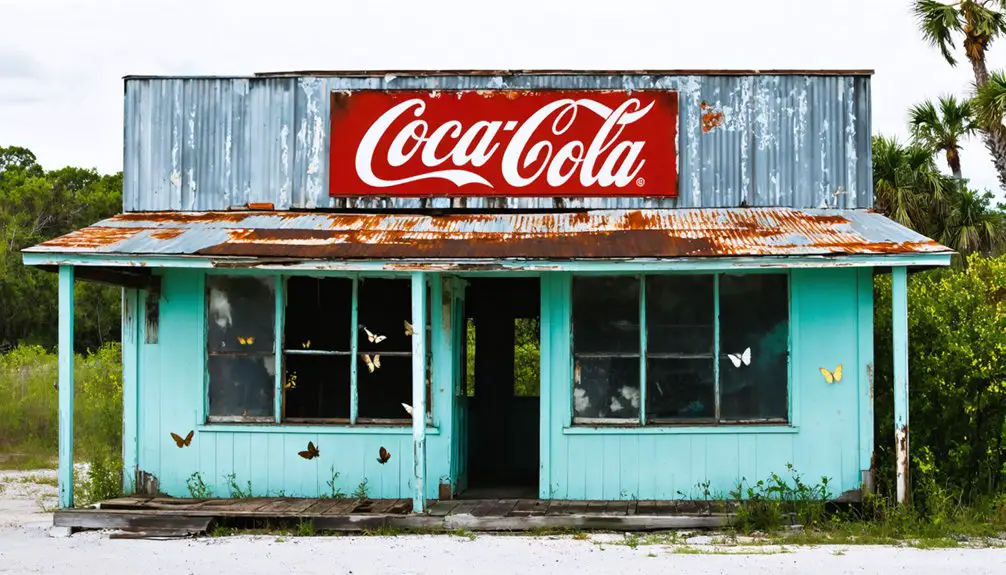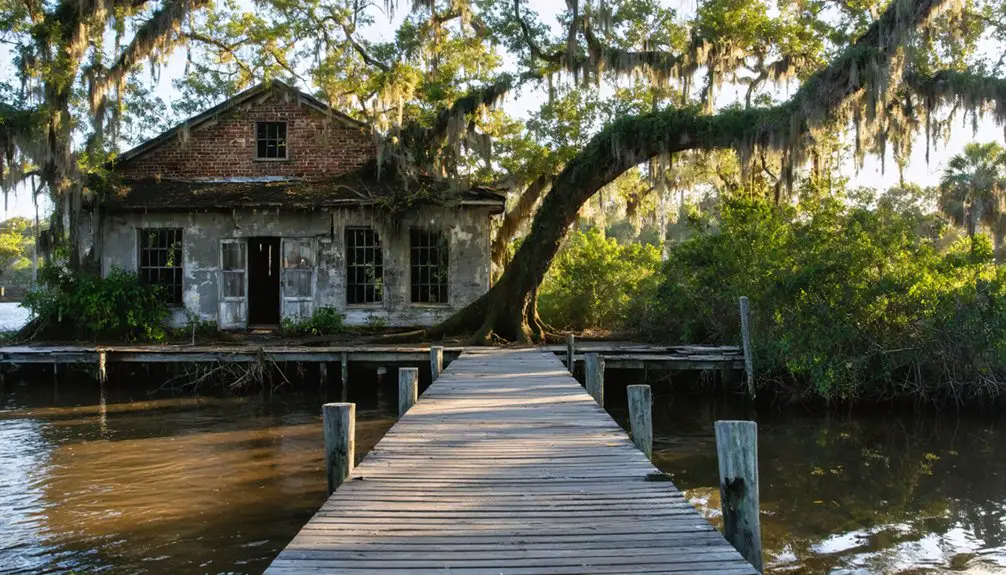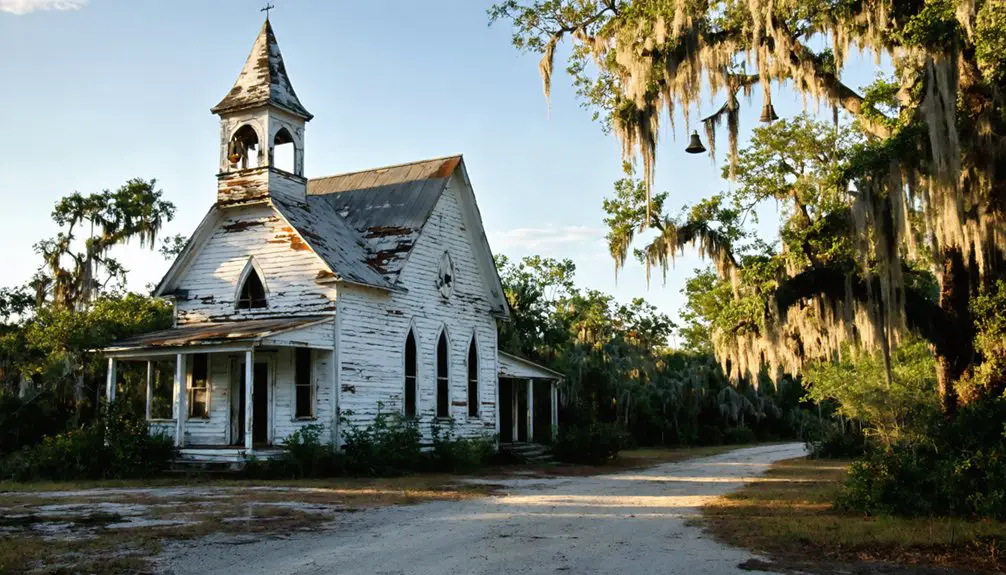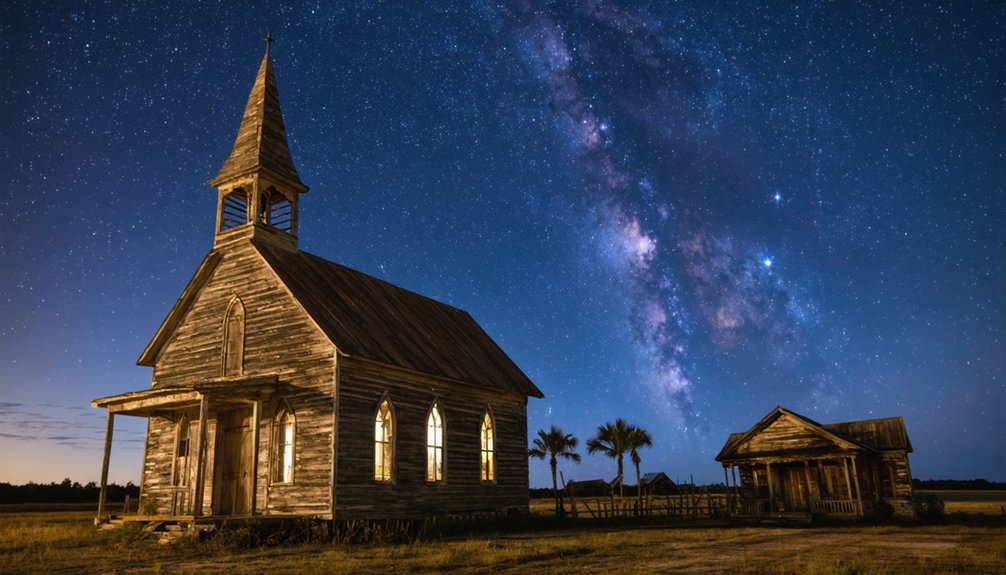
You’ll find exceptional astrophotography opportunities at several Florida ghost towns, with Kerr City’s historic cemetery and Fort Dade’s coastal military ruins offering dramatic foreground elements against dark skies. Pack your full-frame camera, f/2.8 wide-angle lens, and sturdy tripod for long exposures at ISO 1600-3200. White Sulphur Springs and Hampton Springs Hotel provide architectural frames for Milky Way shots. These locations demand proper scouting and safety prep to reveal their full potential.
Key Takeaways
- Kerr City provides decaying structures and a historic cemetery as compelling foreground elements against dark Florida skies.
- Fort Dade’s coastal military ruins on Egmont Key create dramatic silhouettes for Milky Way photography.
- White Sulphur Springs offers ornate architectural remnants with minimal light pollution for exceptional night sky compositions.
- Aladdin City features photogenic 1920s Moorish-themed ruins ideal for architectural framing of celestial objects.
- Hampton Springs Hotel’s 1908 foundation serves as a historical backdrop for night photography with clear sky visibility.
The Dark Sky Heritage of Florida
While Florida may not immediately spring to mind as a dark sky destination, the state has made remarkable strides in preserving its nighttime heritage through three designated Dark Sky sites.
You’ll find the state’s pioneering dark sky initiatives at Kissimmee Prairie Preserve, Florida’s first Dark Sky Park, where you’re strategically positioned away from urban light pollution.
Big Cypress National Preserve followed as the first National Park Service unit east of Colorado to achieve this designation, implementing extensive lighting retrofits. Rangers conduct free astronomy programs throughout winter months, offering public telescope viewing and constellation tours.
Most recently, Groveland’s certification as Florida’s first International Dark Sky Community has set new standards for light pollution control. The city’s comprehensive ordinance requires all exterior lighting to meet dark-sky standards by 2027.
These locations offer you unparalleled opportunities to capture the cosmos, with dedicated astronomy pads, specific lighting requirements, and strategic access points designed for ideal astrophotography conditions.
Ghost Towns and Abandoned Sites Worth Exploring
Florida’s ghost towns and abandoned sites present unique opportunities for creative astrophotography compositions.
You’ll find rich urban decay at Kerr City, where ruined structures and a historic cemetery provide compelling foreground elements against dark rural skies.
Fort Dade’s coastal military ruins on Egmont Key offer dramatic silhouettes for Milky Way shots, though you’ll need to arrange special access.
White Sulphur Springs showcases ornate architectural remnants perfect for night sky framing, with minimal light pollution interference.
While photographing these sites, respect property boundaries and obtain necessary permissions.
Consider using light painting techniques to illuminate historical structures while preserving sky detail in your long exposures.
Pack wide-angle lenses for capturing both architectural elements and celestial features in single frames.
The land boom collapse of the 1920s left behind photogenic ruins at Aladdin City, where Moorish-themed architecture creates distinctive night sky compositions.
The Hampton Springs Hotel ruins in Taylor County offer a fascinating backdrop for night photography, with its historic 1908 foundation still visible among the grounds.
Essential Gear for Night Sky Photography
You’ll need a full-frame mirrorless or DSLR camera with strong high-ISO performance and manual exposure controls to capture Florida’s night skies effectively.
Fast wide-angle lenses (f/2.8 or faster) with minimal coma distortion will maximize your ability to photograph the Milky Way and star fields at ghost town locations. An equatorial tracking mount is critical for capturing detailed long-exposure images of deep sky objects.
Your gear must be protected against Florida’s humid conditions with weather-sealed bodies, dew heaters for optics, and waterproof storage cases for all electronic equipment. A sturdy tripod base is essential for stability during the long exposure times required for night sky photography.
Camera Equipment Basics
To capture the ethereal beauty of ghost town astrophotography, you’ll need a specialized set of equipment that excels in low-light conditions. Your primary weapon will be a full-frame DSLR or mirrorless camera – models like the Canon 6D, Nikon D750, or Sony Alpha 7S shine in darkness with their superior sensor performance. A sturdy tripod is absolutely essential for achieving sharp images during extended night exposures. The Rokinon 14mm and Sigma 14mm f/1.8 are excellent wide-angle prime options for capturing expansive night skies.
You’ll want to pair your camera with fast glass – opt for wide-angle lenses with apertures of f/2.8 or lower to maximize light collection. The Tamron 17-28mm f/2.8 gives you compositional freedom, while Canon’s 24-105mm serves as a versatile all-rounder.
For camera settings, shoot in RAW format to preserve detail, and keep your ISO between 400-1600 to balance noise with brightness. Master manual focus and bulb mode for tack-sharp stars in your long exposures.
Weather Protection Must-Haves
When shooting astrophotography in ghost towns, protecting your gear from Florida’s challenging weather conditions becomes just as vital as the technical aspects of capture. Long exposure settings are critical for capturing celestial objects, so stable protection is essential.
You’ll need a robust dew management system, including thermostatically controlled heater straps for your optics and chemical desiccants for your camera housing. Invest in weatherproof gear covers rated for outdoor use, particularly the TeleGizmos 365 series, to shield your setup from unexpected rain and heavy dew. A Celestron dew controller helps maintain optimal lens temperature to prevent condensation buildup during long exposure sessions.
For equipment maintenance in Florida’s humidity, pack waterproof dust covers and outdoor-rated power strips with GFCI protection.
Keep your gear safe with redundant power sources and weatherproof cable connections.
Don’t forget a pop-up shelter with at least 2000mm water resistance rating – it’ll serve as your command center while providing essential protection during sudden tropical showers.
Top Locations Where History Meets Dark Skies
Florida’s abandoned structures and historical sites offer unique opportunities to capture the Milky Way against architectural elements while utilizing dark sky conditions.
You’ll find prime shooting locations at Fort Jefferson in the Dry Tortugas, where the 19th-century fortress walls provide dramatic foreground elements under some of the state’s darkest skies.
Your technical setup for these heritage locations should account for both structure illumination and sky exposure, requiring careful bracketing techniques and specialized gear for architectural astro-landscape compositions.
Remote Historical Viewing Sites
Seeking pristine dark skies paired with compelling historical structures, astrophotographers will find Florida’s remote ghost towns offer unique opportunities for nightscape compositions.
You’ll discover prime shooting conditions near Yeehaw Junction’s abandoned railway depots, where Bortle-class dark skies create perfect conditions for wide-field Milky Way captures. Position your tripod near weathered wooden structures for compelling foreground elements.
The Big Cypress region delivers exceptional dark sky conditions alongside historical swamp-era cabins, though you’ll need careful planning to navigate wetland hazards.
For lighter logistical demands, explore the forgotten citrus towns of Polk and Hardee counties, where derelict packinghouses silhouette dramatically against star-filled skies.
Scout these remote historical landmarks during daylight to identify safe shooting positions and compose your nighttime frames.
Dark Sky Heritage Spots
To capture the Milky Way’s ethereal glow against historical backdrops, you’ll find exceptional dark sky conditions at five premier heritage locations across Florida.
Kissimmee Prairie Preserve, Florida’s first Dark Sky Park, offers dedicated astronomy pads with strict dark sky conservation protocols.
At Big Cypress National Preserve, you’ll discover retrofitted lighting systems perfect for long exposures of celestial objects.
Ocala National Forest’s Fakahatchee Strand provides pristine conditions for star trails, while the remote Everglades delivers unmatched nightscape compositions.
For the ultimate dark sky experience, venture to Dry Tortugas National Park via boat or seaplane.
Practice proper stargazing etiquette at these locations: use red lights only, avoid flash photography, and respect quiet hours.
Each site requires specific permits or passes for after-dark access.
Abandoned Places After Sunset
While modern astrophotography often favors pristine wilderness, Florida’s abandoned structures offer unique opportunities to blend history with night sky imagery.
Fort Jefferson’s massive walls provide dramatic foreground elements for Milky Way shots, with virtually zero light pollution to contend with. You’ll need to plan carefully for overnight stays and marine transit.
Kerr City’s historic district lets you frame the cosmos through nineteenth-century doorways and porches, though you’ll want to verify access and watch for nocturnal wildlife.
For urban nightscapes, Ybor City’s industrial ruins offer compelling compositions despite Tampa’s skyglow – its brick facades and vintage signage create striking contrasts with artificial lighting.
Remember to secure proper permissions, as many abandoned structures sit on private property or restricted areas.
Seasonal Weather Patterns and Viewing Windows
Florida’s seasonal viewing windows offer distinct opportunities for astrophotographers throughout the year, with each season presenting unique celestial targets and atmospheric conditions.
You’ll find ideal viewing conditions at Big Cypress National Preserve during Fall and Winter, when peak meteor showers like the Geminids deliver dozens of streaks per hour.
Your seasonal stargazing strategies should account for Summer’s high humidity in Central Florida, where mosquito protection becomes essential for long exposures.
Spring offers stable conditions in the Gainesville/Jacksonville region, with enlarged dark sky areas perfect for planetary shots.
Year-round, you can leverage Kissimmee Prairie’s Bortle 1-2 skies for Milky Way captures, while Dry Tortugas delivers pristine dark conditions for deep-sky imaging if you’re willing to make the remote trek.
Safety Tips for Night Explorations
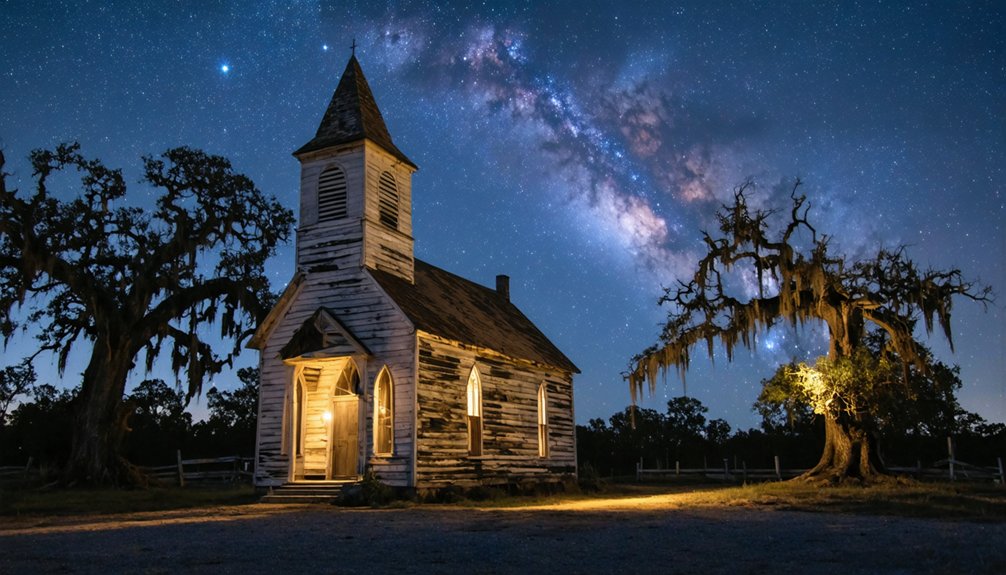
Capturing stellar images in ghost towns after dark demands meticulous preparation and tactical awareness.
You’ll need to scout locations during daylight hours, mapping entry points and hazards before your night shoot. Always pack redundant lighting systems – a headlamp with red-light capability for preserving night vision and backup flashlights with fresh batteries.
Move with a partner using the buddy system and maintain constant situational awareness of your surroundings. Carry a charged phone, share your coordinates with a trusted contact, and keep emergency numbers handy.
You’ll want steel-toed boots and heavy-duty gloves for traversing debris, plus an N95 mask for dusty interiors. Set up clear communication protocols with your shooting partner and establish rally points in case you need to exit quickly.
Capturing the Perfect Milky Way Shot
To achieve stunning Milky Way photographs in Florida’s ghost towns, you’ll need specialized gear and precise technical settings.
Mount your camera on a sturdy tripod and attach a wide-angle lens with an aperture of f/2.8 or faster. Set your camera to manual mode and dial in a shutter speed based on the 500 rule.
Your capturing techniques should focus on ideal timing and precise focus. Use PhotoPills to track the Milky Way’s position, and schedule your shoot during minimal moon illumination.
Lock your focus by manually zooming in on a bright star at 10x magnification. For ghost town foregrounds, consider shooting during blue hour or using subtle LED lighting.
Start with ISO 1600 and a white balance around 3800K, then adjust based on test shots until you’ve nailed the perfect exposure.
Local Communities and Photography Groups
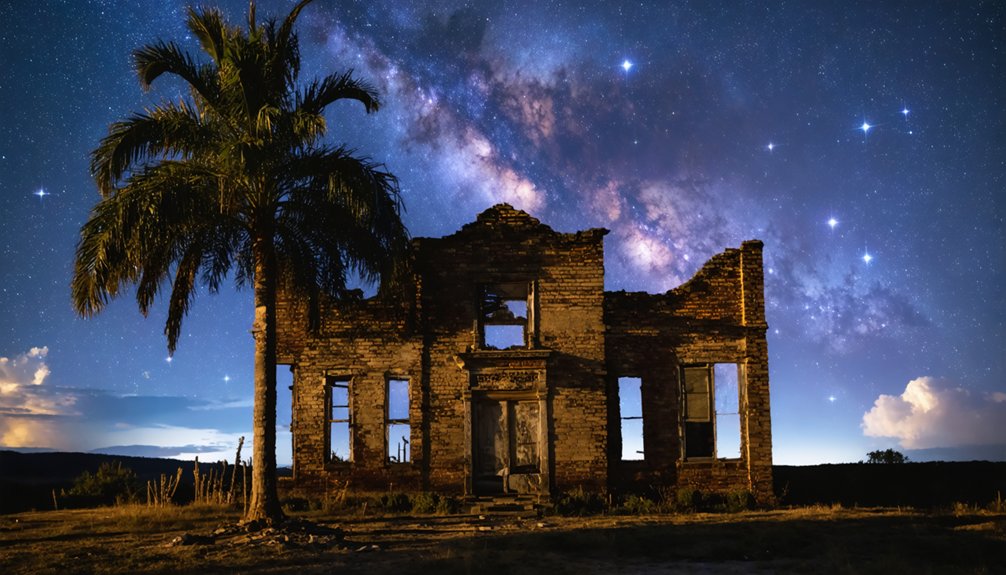
When venturing into ghost towns for astrophotography, you’ll benefit from connecting with Florida’s extensive network of photography groups and camera clubs.
The Port Charlotte Camera Club organizes regular night shoots with safety protocols, while Elite Photography Group Florida specializes in abandoned-places composition. These photography clubs provide essential local knowledge and coordinate group access to remote locations.
You’ll find support through the Florida Camera Club Council‘s workshops and the numerous regional clubs offering specialized night-sky technique sessions.
Local Meetup and Facebook groups regularly organize sunset-to-night shoots, sharing real-time site conditions and coordinating carpools.
These community events help you navigate permissions, safety protocols, and location access while connecting you with experienced astrophotographers who know the best ghost town locations for compelling Milky Way compositions.
Frequently Asked Questions
Are Permits Required for Overnight Parking at These Ghost Town Locations?
You’ll need permits for overnight parking since most ghost town locations fall under strict overnight regulations and parking restrictions. Check with property owners or governing authorities before setting up gear.
Can Drones Be Used for Aerial Night Photography of Ghost Towns?
You’ll need an FAA night waiver and anti-collision lighting for drone regulations compliance. Capture aerial perspectives using long exposures, but respect local ordinances and maintain visual line-of-sight requirements.
How Reliable Is Cell Phone Service at These Remote Locations?
You’ll face wildly unreliable cell coverage in these remote areas. Pack a satellite phone or GPS device – you can’t count on your smartphone working when you’re deep in these abandoned territories.
Are There Guided Astrophotography Tours Combining Ghost Towns and Dark Skies?
You won’t find dedicated guided tours combining ghost towns and night photography in Florida. You’ll need to plan your own shoot, bringing proper gear for both historic and astro settings.
Which Locations Allow Light Painting of Abandoned Structures During Night Shoots?
You’ll need specific permits for light painting at Kissimmee Prairie’s designated areas. Always verify structure safety and get proper permissions before illuminating any abandoned buildings – most locations restrict artificial lighting techniques.
References
- https://floridaastronomy.weebly.com/dark-sky-sites.html
- https://www.visitflorida.com/travel-ideas/articles/florida-dark-sky-parks-stargazing/
- https://livewildly.com/the-5-best-places-to-stargaze-in-florida/
- https://www.go-astronomy.com/dark-sky-parks-stargazing-state.php?State=FL
- https://everafterinthewoods.com/one-of-americas-best-stargazing-spots-hides-in-this-florida-state-park/
- https://www.youtube.com/watch?v=bNjqcQ5SMwg
- https://www.cloudynights.com/forums/topic/954770-good-stargazing-sites-in-south-florida/
- https://www.floridastateparks.org/learn/dark-sky-designation
- https://floridanationalparksassociation.org/international-dark-sky-place
- https://darksky.org/news/city-of-groveland-named-first-international-dark-sky-community-in-florida/