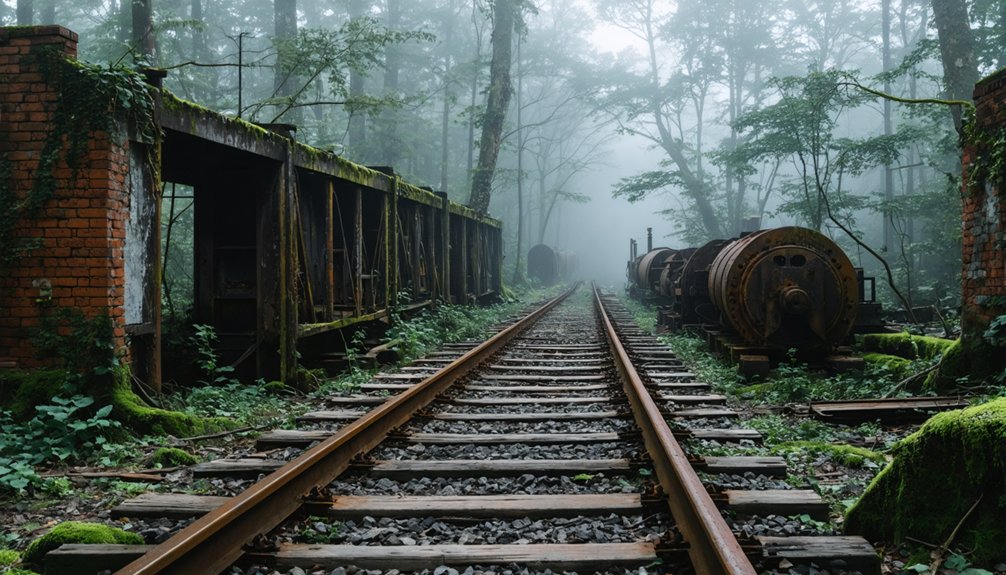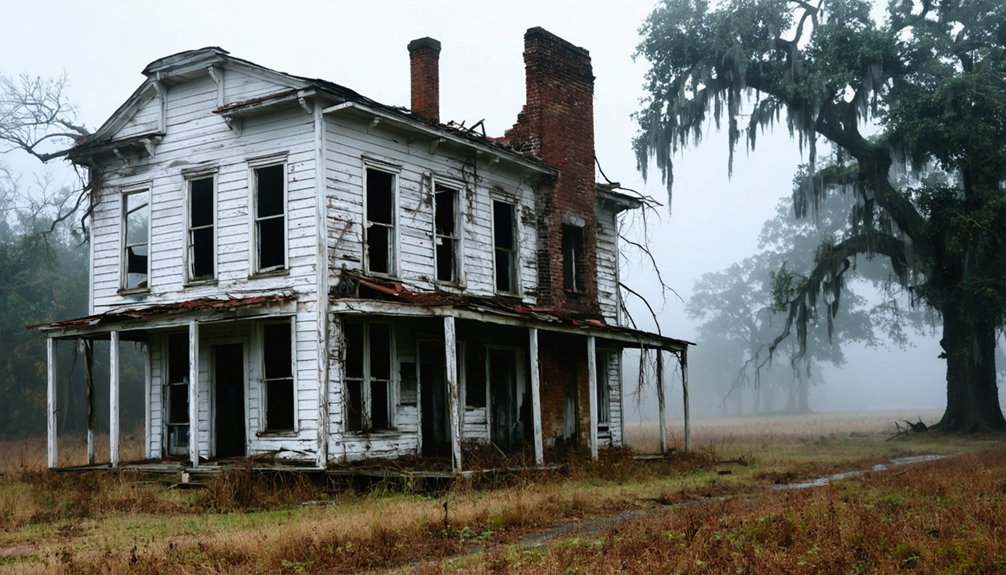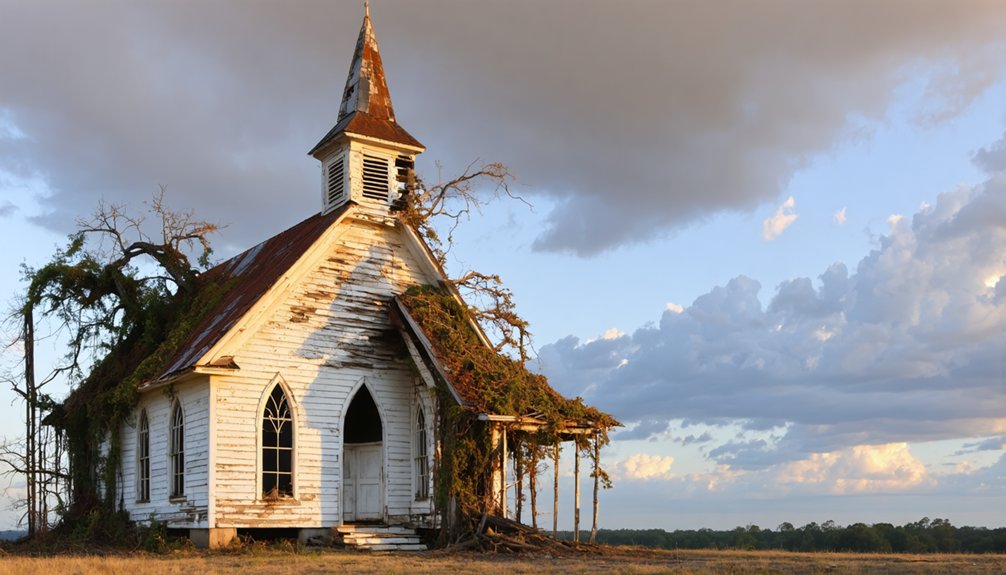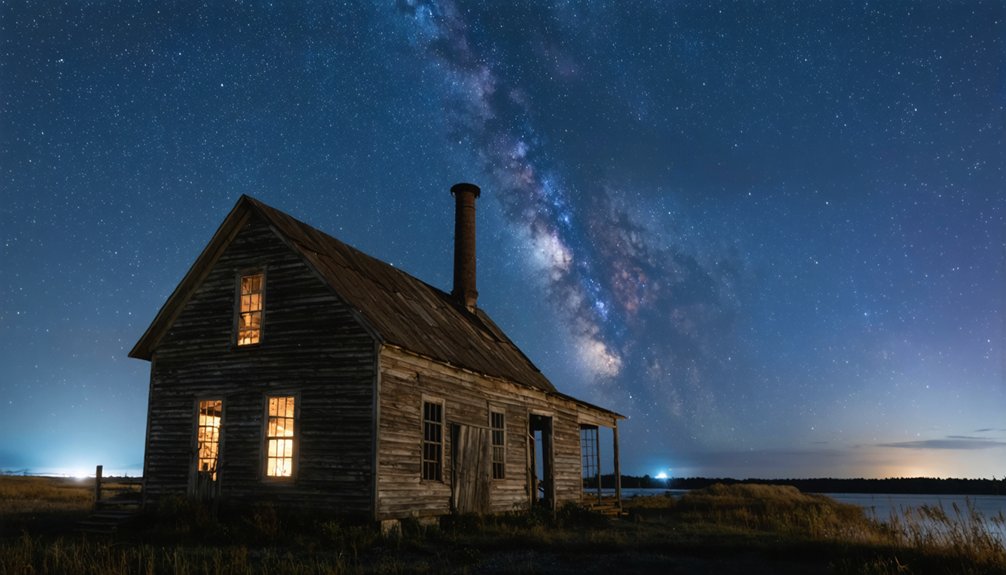
You’ll find exceptional astrophotography conditions at Georgia’s abandoned mining settlements in Lumpkin and Cherokee counties, where Bortle 3-4 skies create ideal shooting environments. The historic Auraria site offers compelling building silhouettes for foreground elements, while Sharon Mill Village provides some of the Southeast’s darkest skies. For coastal options, Sunbury’s colonial ruins deliver clear horizons and stable marine air. These ghost towns reveal unique perspectives when you’re equipped with the right permits and gear.
Key Takeaways
- Auraria’s original buildings in Lumpkin County provide dramatic silhouettes against dark skies with minimal light pollution.
- Sharon Mill Village offers some of the Southeast’s darkest skies, with historic mill remains creating compelling foreground elements.
- Sunbury’s colonial port ruins feature preserved structures and low tree lines ideal for Milky Way compositions.
- Deerlick Astronomy Village combines pristine dark skies with concrete pads for stable long-exposure astrophotography setups.
- New Manchester’s brick ruins present excellent night photography opportunities with regulated heritage site access.
Ghost Mining Settlements of North Georgia’s Dark Sky Territory
While Georgia’s gold rush predated California’s famous bonanza by two decades, its abandoned mining settlements now serve a different purpose as premier astrophotography locations.
You’ll find these Dark Sky territories scattered across Lumpkin and Cherokee counties, where $20 million in gold once lured prospectors. The ghostly allure of Auraria’s remaining structures and Sixes Mine’s weathered shafts provides compelling foreground elements for your night shots.
At the Franklin-Creighton site, the historic Shingle House stands sentinel against star-filled skies. The area saw significant abandonment after the California Gold Rush began drawing miners westward. These remote locations, largely free from light pollution, offer unobstructed views of celestial wonders. Several original buildings from the mining era still stand in Auraria, creating dramatic silhouettes for nighttime photography.
Set up your tripod near Auraria’s old Woody’s Store or along Six’s Road, where strange lights occasionally flicker through the darkness, adding mystique to your long exposures.
Forgotten Rail Towns Along the Starlit Corridors
As Georgia’s once-bustling railroad network faded into history, its abandoned rail towns now offer pristine dark-sky locations for astrophotography enthusiasts.
You’ll find striking compositions where industrial heritage meets starlit skies, with minimal light pollution to interfere with your long exposures.
The Great Depression led to the permanent decline of these locations, creating the perfect isolated conditions for night sky photography.
Many of these towns were overtaken when rail lines closed in the 1950s, leaving behind pristine landscapes ideal for celestial photography.
- Elko silhouettes deliver dramatic main-street storefronts against active rail corridors – perfect for capturing light trails from passing trains beneath the stars.
- Bridgeboro ruins provide limestone foundations and track alignments that frame the Milky Way’s arc.
- Troupville embankments create stark geometric shapes for low-horizon shots, with preserved right-of-ways offering clear sightlines.
- Meansville stations and Rocky Branch heritage sites give you controlled access to vertical structures like water towers and depots – ideal for foreground anchors in deep-sky imaging.
Abandoned Mill Villages Under the Milky Way
Georgia’s abandoned mill villages present a unique convergence of industrial heritage and pristine dark skies for astrophotographers.
You’ll find exceptional shooting conditions in Taliaferro County’s Sharon Mill Village, where the darkest skies in the Southeast create perfect conditions for capturing the Milky Way’s intricate details. The skeletal remains of historic mills provide compelling foreground elements for your night sky compositions. The quaint one horse town atmosphere enhances the eerie ambiance of nighttime shoots.
For technical versatility, try infrared imaging at the grist mill sites, where you can leverage covered bridges and mill ruins as striking silhouettes against star-filled backgrounds. Setting your camera to ISO 8000 will help capture the faintest starlight details against the historic structures.
The remote locations of these abandoned textile communities, particularly in Tifton, offer zero light pollution interference. You’ll want to time your shoots for August when the Milky Way arch peaks above these haunting industrial remnants.
Remote Mountain Homesteads for Night Sky Photography
You’ll discover that Georgia’s remote mountain homesteads offer spectacular opportunities to capture weathered structures beneath pristine dark skies, with many sites achieving Bortle 3-5 ratings ideal for Milky Way photography.
Late fall and winter months provide optimal clear skies for capturing these haunting scenes against the backdrop of brilliant stars and constellations.
The crumbling stone foundations, isolated chimneys, and rusting farm equipment provide compelling foreground elements that you can illuminate selectively with red or amber LEDs while shooting wide-angle nightscapes. These locations require 45 minutes adaptation for your eyes to fully adjust to the darkness.
When composing your shots, leverage linear features like old fence lines and wagon ruts to create leading lines toward the galactic center, which aligns perfectly with south-facing hollows during spring and summer months.
Ancient Structures Under Stars
Within the remote mountain reaches of Georgia, ancient homestead ruins provide compelling foreground elements for astrophotography compositions. You’ll find these architectural remnants perfectly positioned against dark skies, especially in locations like Fort Mountain State Park and Rising Fawn’s pristine wilderness. Traveling through expansive pine forests creates an immersive journey to these remote photography locations.
The ancient architecture creates striking silhouettes when paired with star trails and Milky Way exposures. The Peach State Stargaze in October offers ideal conditions for capturing these ghostly structures against crystal-clear autumn skies.
- Set up your gear on concrete pads at Deerlick Astronomy Village for stable long exposures of starry landscapes
- Frame shots through crumbling doorways and windows during moonless nights for dramatic depth
- Position your wide-angle lens to capture both structure and stars during August-November’s clear conditions
- Scout locations during daylight to identify compelling angles that align with Polaris or the galactic core
Weather-Beaten Buildings Frame Milky
Three prime locations along Georgia’s Blue Ridge Mountains offer exceptional opportunities to frame the Milky Way through weather-beaten homesteads.
You’ll find the darkest skies near Cohutta Wilderness, where abandoned log cabins and stone foundations create compelling foreground elements against Bortle 3-4 conditions. For best results, shoot between April and October when the Milky Way core rises highest after astronomical twilight.
Before setting up your gear, verify land ownership since many weathered structures sit on private property adjacent to National Forest lands.
You’ll want to scout vehicle access points during daylight – several sites require 4WD or hiking after sunset. Position your camera to face west or north, away from Atlanta’s light dome, and target nights with SQM readings above 20.5 mag/arcsec² for maximum galactic detail.
Historic Coastal Settlements With Clear Horizons
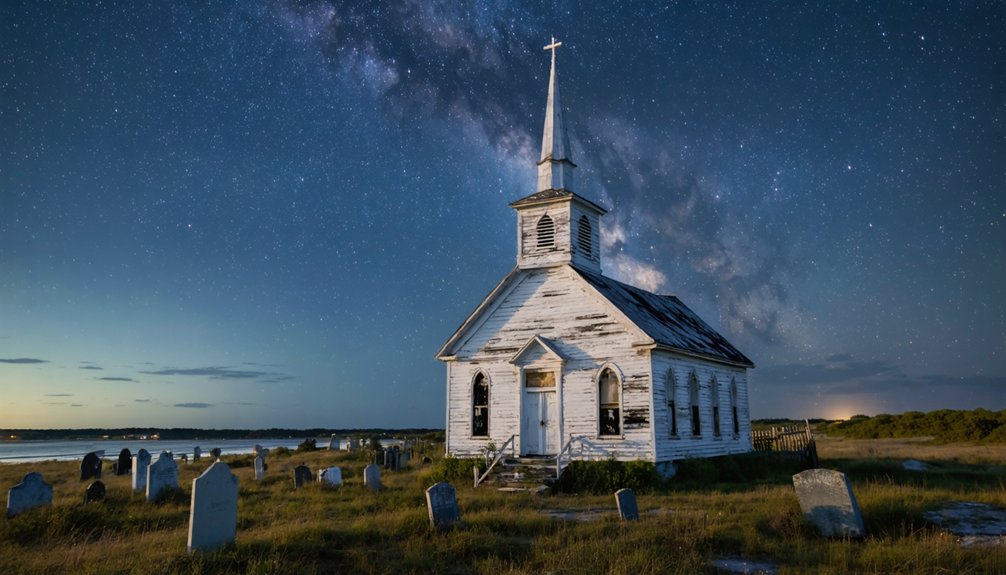
You’ll find exceptional astrophotography conditions at Georgia’s coastal ghost towns, where tabby fortification ruins provide stable mounting points for long-exposure shots of the southern sky.
The abandoned settlements of Frederica and Sunbury offer unobstructed maritime horizons and minimal light pollution, ideal for capturing the Milky Way core as it rises over the Atlantic.
These remote colonial-era sites combine historical architecture with dark sky conditions, allowing you to frame star trails and deep sky objects above centuries-old structural remains.
Tabby’s Island Ruins Outlook
Along Georgia’s historic coastline, Tabby’s Island Ruins provide an exceptional backdrop for astrophotography, thanks to their unique construction from tabby – a durable colonial-era concrete made from oyster shells, lime, and sand.
You’ll find these architectural remnants scattered across St. Simons, Jekyll, and Cumberland islands, offering pristine dark-sky vantage points where coastal photography meets celestial observation.
- Low-lying horizons with minimal vertical obstruction create ideal conditions for Milky Way compositions
- Offshore winds deliver the clearest atmospheric conditions, reducing coastal humidity interference
- Maritime forests frame your shots while preserved clearings offer unobstructed skyline views
- Strategic positioning toward the open ocean minimizes light pollution from nearby communities
Remember to secure necessary permits for night access and tripod setup, as many sites fall under protected historic status.
Maritime Ghost Town Panoramas
Georgia’s historic maritime ghost towns offer exceptional opportunities for coastal astrophotography, with their well-preserved ruins set against expansive oceanic horizons.
You’ll find prime shooting locations at Sunbury’s colonial port ruins and Dungeness’s tabby mansion remains, where low tree lines create ideal silhouettes for Milky Way compositions.
For best results, time your shoots during new moon phases and after cold fronts when marine air stability peaks.
You’ll need to navigate various access requirements – NPS permits for Cumberland Island and Fort Frederica, plus landowner permissions for Sunbury parcels.
Watch those tides carefully when setting up on intertidal flats.
To maximize image quality, position your camera above 20° elevation to minimize coastal humidity interference, and scout locations where Savannah’s light dome won’t impact your dark sky shots.
Lost Communities Near Dark Sky Parks
Five abandoned settlements near Georgia’s dark sky locations offer prime opportunities for nightscape photography and Milky Way compositions.
You’ll find ghostly landscapes perfectly positioned away from city light pollution, with abandoned storefronts and industrial ruins serving as compelling foreground elements.
- Deerlick Astronomy Village provides the Eastern Seaboard’s darkest skies, with strict light control measures ideal for deep-sky imaging.
- High Falls’ historic dam remnants and bridge create striking silhouettes against star-filled skies.
- Auraria’s lone chimney and weathered general store offer stark vertical elements for star trail compositions.
- Scull Shoals’ skeletal brick walls emerge from forest shadows, perfect for light painting techniques.
Your best results will come during new moon phases, using fast wide-angle lenses and tracking mounts for maximum detail capture.
Preserved Ghost Towns With Photography Permits
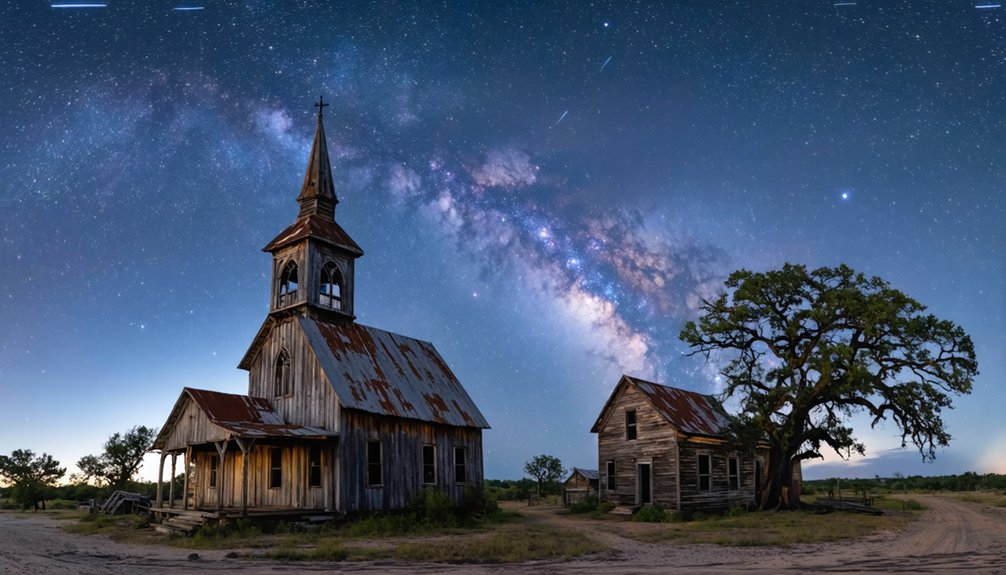
While shooting in Georgia’s abandoned settlements offers unique astrophotography opportunities, you’ll need to secure proper permits before setting up your gear at these preserved locations.
The most accessible sites include Scull Shoals, with its stone foundations requiring Oconee County permits for tripod setups, and New Manchester‘s brick ruins, where heritage groups regulate night shoots.
Banning Mills offers dramatic stone raceways but requires written approval for lighting equipment.
Along the coast, Sunbury’s cemetery and structural remains demand special consideration – you’ll need heritage manager permits for tripod use near fragile saltmarsh zones.
For ideal dark sky conditions, target High Falls‘ factory ruins, where state park permits enable after-dark access.
Remember that photography regulations vary by location, with most sites requiring advance notice for equipment-intensive shoots.
Rural Church Ruins in Low Light Pollution Zones
Ancient church ruins scattered across Georgia’s rural landscape provide exceptional foregrounds for wide-field Milky Way photography.
Georgia’s forgotten churches stand silent against starlit skies, perfect sentinels for capturing the Milky Way’s celestial dance.
You’ll find these historical structures in areas with minimal light pollution, perfect for capturing the cosmos while preserving community storytelling through your lens.
- Powelton Methodist Church’s dual front doors and original sanctuary create striking architectural elements for composing vertical Milky Way shots with ultra-wide lenses.
- New Ebenezer’s reflective creek adds mirror effects to astro compositions, doubling your celestial subjects.
- Antioch Baptist’s weathered facade serves as a powerful foreground element, especially during blue hour when combining twilight and stars.
- Scull Shoals’ deep forest setting offers unobstructed southern sky views ideal for tracking the galactic core, while its historical preservation status guarantees continued access.
Deserted Farming Communities Away From City Lights
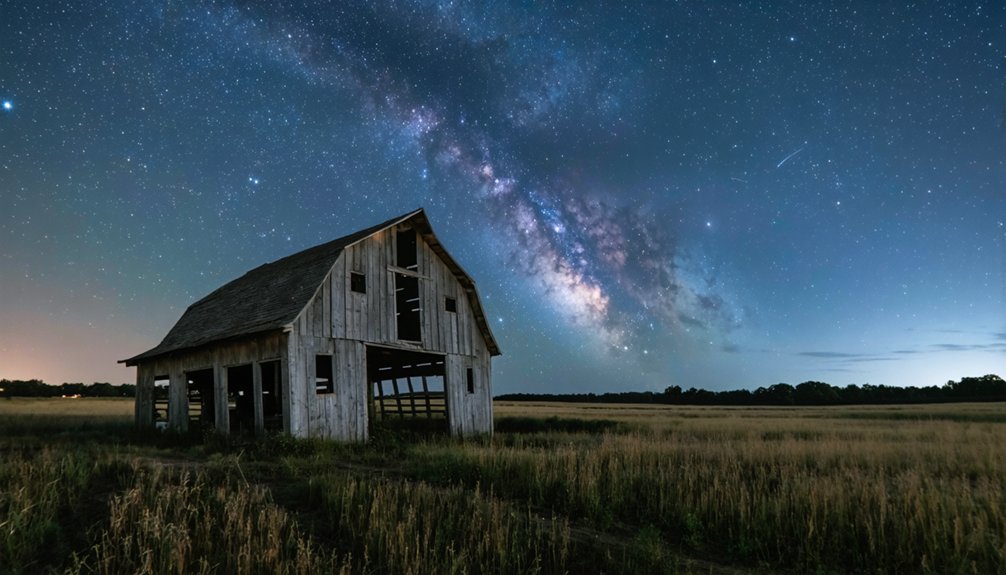
You’ll find exceptional astrophotography conditions at abandoned farming sites like Grooverville and Starkville, where vast open fields provide unobstructed views of the night sky away from urban light pollution.
Your wide-angle lenses in the 14-35mm range will capture sweeping Milky Way panoramas above weathered structures and cemetery stones that add compelling foreground elements.
Position your tripod on stable ground and use exposure stacking techniques to bring out star details while maintaining clarity in the architectural remnants that dot these forgotten agricultural landscapes.
Remote Rural Ruins
Five abandoned farming communities scattered across Georgia’s rural landscape offer prime conditions for capturing the night sky, thanks to their isolation from major light sources and preserved historical structures.
You’ll find these remote sites require careful navigation via unpaved roads and detailed local maps, often beyond cellular coverage.
- Mill foundations at Scull Shoals and brick ruins near Auraria create compelling silhouettes against star-filled backgrounds.
- Weathered tenant houses and tobacco barns across south Georgia provide textural elements for Milky Way compositions.
- Historic bridges and railroad remnants near Scarboro offer leading lines for long exposures.
- Period-specific structures like chimneys and store facades enable authentic historical context in nightscape photography.
Pack your high-clearance vehicle with essential gear and prepare for off-grid shooting – these abandoned structures in rural landscapes deliver unparalleled dark sky opportunities.
Forgotten Farmland Photography Tips
While Georgia’s forgotten farmlands offer rich opportunities for astrophotography, capturing these rural ruins requires specialized gear and careful timing.
You’ll need a sturdy tripod to stabilize long exposures of abandoned homesteads against starlit skies, particularly in remote locations like Emanuel County’s isolated fields.
For ideal twilight photography, scout locations during daylight hours, noting potential compositions featuring vernacular farm architecture.
Pack LED panels for light painting decaying structures, and consider using a wide-angle lens to capture both the Milky Way and architectural elements.
Target sites away from Atlanta’s light pollution, such as Mitchell County’s forgotten stores or north Georgia’s crumbling grist mills.
Remember to document GPS coordinates of promising locations, as many of these sites aren’t mapped and access points can be overgrown.
Hidden Forest Settlements for Deep Sky Imaging
Deep within Georgia’s forgotten settlements, a network of prime astrophotography sites beckons imaging enthusiasts seeking pristine dark skies.
You’ll discover hidden clearings in Deerlick Astronomy Village and abandoned outposts near Cohutta Wilderness that offer exceptional conditions for deep-sky imaging. These remote locations deliver unmatched dark-sky quality with minimal light pollution interference.
- Deerlick’s strict lighting controls and clear-cut horizons maximize your imaging potential for both narrowband and broadband targets
- Cohutta’s elevated wilderness roads provide thermal stability and wide western vistas perfect for Milky Way core shots
- Stephen C. Foster’s gold-tier dark sky designation guarantees pristine conditions for capturing faint deep-sky objects
- Forest service roads near abandoned logging camps offer vehicle-accessible setup points with minimal horizon obstruction
Frequently Asked Questions
What Safety Gear Is Essential When Photographing Ghost Towns at Night?
You’ll need multiple portable lighting sources with night vision settings, protective boots, gloves, eye gear, first aid supplies, and communication devices. Always pack a fire extinguisher and backup batteries.
Are There Guided Astrophotography Tours Available to Georgia’s Abandoned Settlements?
Quick as a flash – you won’t find guided ghost town astrophotography tours in Georgia. You’ll need to create your own adventure by combining local astrophotography workshops with self-guided ghost town history exploration.
For those looking to capture stunning landscapes from above, exploring the best drone photography spots in Georgia will offer a unique perspective on its rich history and natural beauty. From the rugged mountains to the serene coastlines, each location provides an opportunity to document the enchanting scenery. Make sure to check local regulations regarding drone usage to ensure a smooth photography experience.
How Do Seasonal Changes Affect Ghost Town Access for Night Photography?
You’ll face limited seasonal accessibility during spring floods and summer storms. Winter brings clearer skies but challenging road conditions, while fall’s moderate weather conditions offer your best shooting window.
Which Ghost Towns Have Cell Phone Coverage for Emergency Situations?
Pristine phone coverage awaits you at Auraria and Ebenezer near major roads, while you’ll find patchy ghost town connectivity at Fort Mountain. Pack satellite communicators for emergency communication in remote locations.
Can Drones Be Used for Night Photography in These Abandoned Locations?
You’ll need FAA Part 107 waivers and local permits for night drone operations. Monitor visibility conditions, maintain visual line-of-sight, and check airspace restrictions. Consider signal interference and reduced sensor performance.
References
- https://wandernorthgeorgia.com/stargazing-in-north-georgia/
- https://matadornetwork.com/read/deerlick-astronomy-village/
- https://bittersoutherner.com/the-dark-end-of-the-south-taliferro-county-georgia-deerlick-astonomy
- https://www.youtube.com/watch?v=hTJJKKAbAe4
- https://deerlickgroup.com/dark_sky/
- https://www.go-astronomy.com/dark-sky-parks-stargazing-state.php?State=GA
- https://exploregeorgia.org/things-to-do/list/15-best-stargazing-spots-in-georgia
- https://app.advcollective.com/travel-guides/Blue-Ridge/starry-skies-campfires-georgia-best-dark-sky-camping-spots
- https://darksky.org/places/stephen-c-foster-state-park-dark-sky-park/
- https://www.youtube.com/watch?v=OcZ1tICx5qk