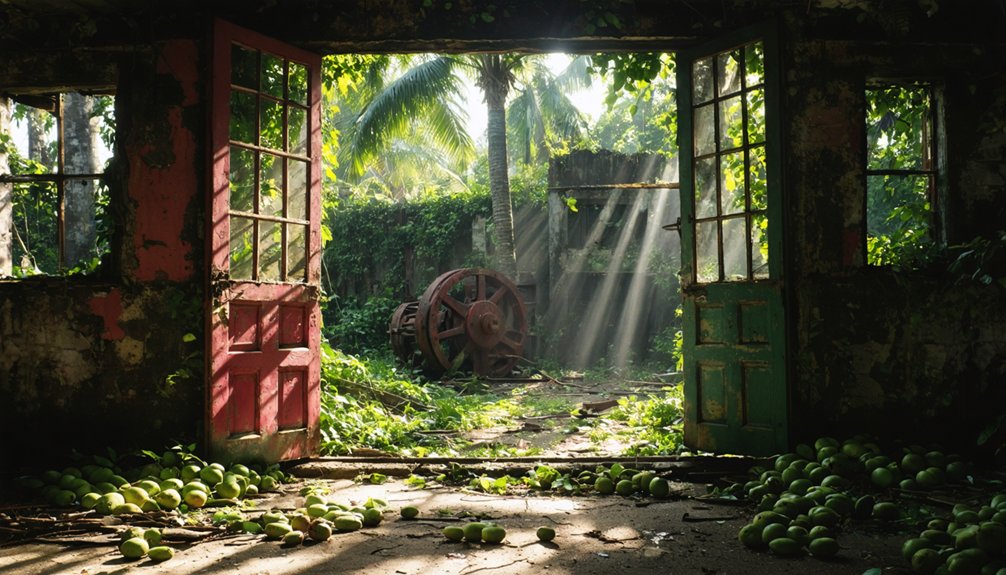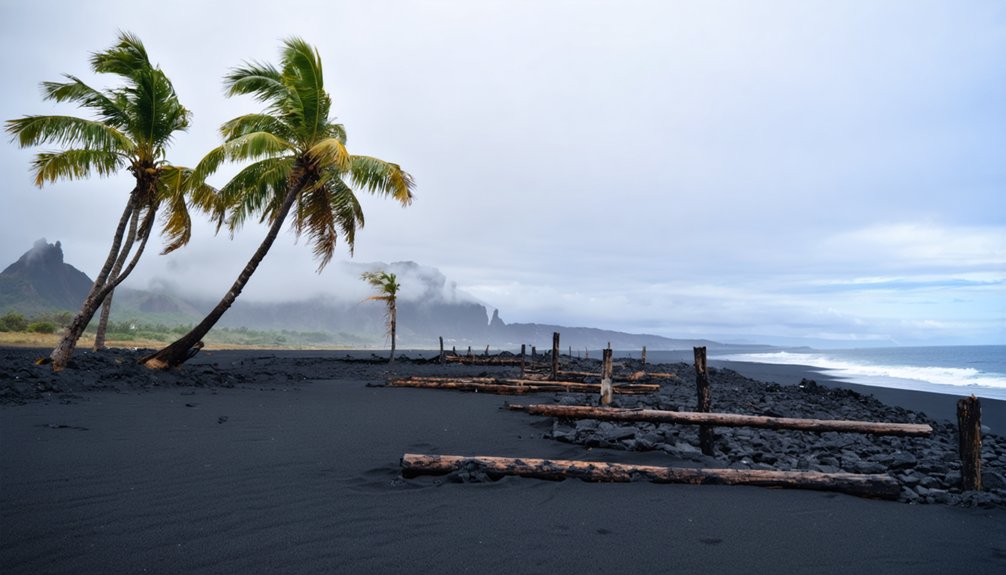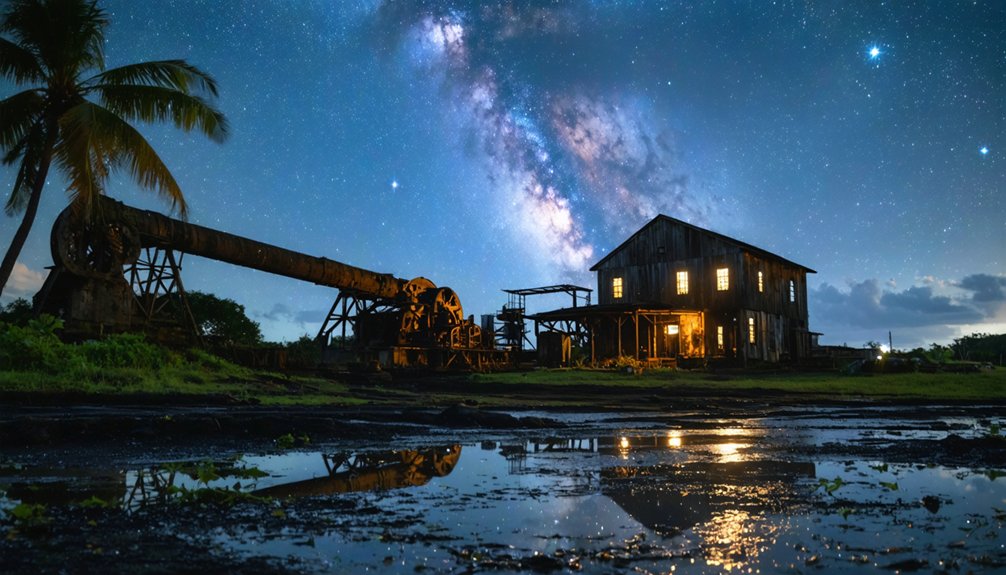
You’ll find exceptional astrophotography conditions at Hawaii’s historic ghost towns, with the abandoned Paʻauhau Sugar Mill and Old Waipiʻo Valley settlements offering dramatic foreground elements against pristine dark skies. The Puna District’s deserted plantations and Kōkeʻe’s forgotten military installations provide minimal light pollution and compelling structural ruins. For the most striking shots, target the remote locations along Saddle Road and Molokaʻi’s North Shore, where ancient structures merge with stellar vistas. The deeper you venture into these forgotten places, the more secrets they’ll reveal.
Key Takeaways
- Waipiʻo Valley’s abandoned settlements offer pristine dark skies and ancient ruins as compelling foreground elements for astrophotography.
- Abandoned sugar mills in Paʻauhau provide industrial structures against starlit skies with minimal light pollution.
- Kaupoa Village on Molokaʻi features well-preserved shrines and structures under exceptionally dark skies with challenging but rewarding access.
- Former Olaa Sugar Company facilities near Puna offer multiple vantage points with minimal light interference from surrounding agricultural lands.
- Kōkeʻe State Park’s abandoned military installations provide unique foreground elements with excellent dark sky conditions for Milky Way photography.
Old Waipiʻo Valley Settlements
Three distinct eras of settlement mark Waipiʻo Valley‘s shift from ancient Hawaiian metropolis to photogenic ghost town. At its peak, Waipiʻo history reveals a thriving population of 10,000 residents, with extensive loʻi kalo systems and sacred heiau dotting the landscape. When Western missionaries first arrived in 1823, they counted 1,325 inhabitants based on dwelling numbers.
From thriving Hawaiian metropolis of 10,000 to ghost town, Waipiʻo Valley’s sacred landscape tells a story of dramatic transformation.
The 19th century brought dramatic changes as the population dropped to roughly 1,200, while Chinese immigrants established rice-farming communities with small commercial structures. Known as the Valley of the Kings, this sacred area once served as the residence for Hawaiian royalty including King Līloa.
Today, you’ll find remnants of this layered cultural significance: ancient taro terraces, temple ruins, and scattered foundations from the plantation era.
The 1946 tsunami dealt the final blow to valley occupancy. When shooting here, you’ll need to navigate restricted road access and obtain proper permits, while respecting sacred sites and burial grounds that persist among the archaeological features.
Abandoned Sugar Mills of Paʻauhau
Along Hawaiʻi Island’s Hamakua Coast stands the historic Paʻauhau Sugar Mill, established in 1878 by prominent investors Samuel Parker, R.A. Lyman, W.G. Irwin, and Claus Spreckels.
You’ll find this abandoned industrial complex between Honokaʻa and Paʻauilo, where stone foundations and old railbeds create compelling foreground elements for plantation photography against Hawaii’s dark skies.
As one of the first fully irrigated plantations on the Hamakua coast, Paʻauhau’s extensive network of ditches and water tunnels shaped the landscape you see today.
While the mill closed in 1972, you can still explore the remnants of this multicultural company town, including worker camp sites and irrigation infrastructure. The plantation was later sold to Honokaa Sugar Co. that same year.
The area once contributed to Hawaii’s 1 million tonnes of annual raw sugar production during the industry’s peak in the 1980s.
Just note that some areas may require permission to access, as they’re on private property.
Ghost Towns Along Saddle Road
You’ll find abandoned military outposts and defunct sugar plantation remnants dotting the otherworldly landscape along Saddle Road’s 52.7-mile stretch between Mauna Kea and Mauna Loa.
The road’s elevation of over 6,600 feet, combined with minimal light pollution, creates ideal conditions for photographing these ghostly structures against the star-filled Hawaiian night sky.
At sites like the old Paʻauhau Mill ruins, you can capture long exposures of the Milky Way arching over weathered buildings while experiencing the road’s notorious supernatural ambiance.
Due to frequent vision-obscuring fog and eerie weather conditions, photographers should exercise extra caution when setting up night shots.
The haunting atmosphere intensifies after dark, when mysterious yellowish-red ghost lights have been documented by local officials and visitors since the 1950s.
Military Ruins After Dark
Originally constructed as a military thoroughfare in 1942, Saddle Road’s dark history has left behind a network of abandoned military ruins that provide unique opportunities for astrophotography.
You’ll find remnants of the U.S. Army’s wartime presence scattered across the Humu’ula Plateau, where armored warfare training once dominated the landscape. Local residents long believed that construction would offend goddess Pele, leading to supernatural occurrences in the area.
After dark, these ruins take on an eerily photogenic quality against the star-filled sky. Military sightings and ghostly encounters, particularly documented in 1955, add an intriguing element to your nighttime shoots. Many visitors explore historic sites like the Kaloko-Honokohau ruins while capturing the night sky.
The desolate 50-mile stretch offers pristine dark sky conditions at 7,000 feet elevation. When photographing near Pohakuloa Training Area, you’ll need to watch for unexploded ordinance while setting up your equipment.
The area’s isolation and minimal light pollution create ideal conditions for capturing both ruins and celestial objects.
Abandoned Plantation Remnants
Traversing Saddle Road’s desolate interior reveals a rich tapestry of abandoned plantation remnants, particularly in the historic Waipi’o Valley where pre-1778 populations once thrived between 4,000-10,000 residents.
You’ll discover abandoned structures scattered throughout the six-mile valley, including remnants of stores, churches, and schools that operated until the devastating 1946 tsunami. Near these ruins stands a solemn memorial to David Douglas’s death, marked by surrounding Douglas Fir trees.
The area’s historical significance extends beyond Waipi’o to Kaloko-Honokohau National Historic Park, where you’ll find 1160 acres of prehistoric village ruins. The road winds between two ancient volcanoes, creating an otherworldly landscape perfect for night photography.
These sites feature raised lava rock platforms, ancient fishponds connected by 600-year-old ditches, and natural lava tube shelters.
For astrophotographers, these abandoned remnants provide compelling foreground elements against the dark Hawaiian sky, offering unique compositions that capture both human history and celestial wonder.
Historic Puna District Plantations
You’ll find excellent astrophotography conditions around Puna’s abandoned sugar plantations, where the old mill buildings and worker camps create striking foreground elements against the night sky.
The former Olaa Sugar Company facilities near Kea’au offer multiple vantage points with minimal light pollution, as the surrounding agricultural lands provide natural dark sky buffers.
When planning your night shoots, you’ll need to research property access permissions and safe parking spots, since many plantation structures remain on private land despite their abandoned status.
Light Pollution Control Areas
Located within Hawaii’s historic Puna District, several abandoned sugar plantations now serve as prime astrophotography sites due to their strict adherence to the state’s lighting ordinances.
You’ll find these areas particularly ideal for night photography as they’re protected by thorough light pollution control measures, including mandatory fully shielded fixtures and low-pressure sodium lighting.
The district’s commitment to dark sky preservation shows in its extensive use of filtered LEDs that emit less than 2% blue light and 590nm red LEDs that minimize ecological impact.
You can take advantage of the naturally dark conditions, enhanced by downward-directed lighting and strategic placement of shields that prevent light spillage.
These locations offer unobstructed views of the night sky, far from the urban glow that affects observatories like Mauna Kea and Haleakala.
Former Mill Buildings
The massive Puna Sugar Company mill complex, which operated from 1899 to 1984, offers photographers unique industrial backdrops for night sky compositions.
You’ll find surviving elements of plantation architecture throughout Pahoa and Keaʻau, including brick foundations, repurposed warehouses, and remnants of narrow-gauge railroad infrastructure.
When shooting these industrial heritage sites, you’ll need to navigate carefully around subsurface features like pipes and buried rail lines.
The mill’s 60,000-ton capacity buildings included processing houses, boiler rooms, and bagasse handling areas – many now transformed into dramatic ruins.
While tropical weathering has accelerated decay on metal and wooden structures, this deterioration adds character to your nighttime images.
Look for terraced landscapes and historic access roads to create compelling foreground elements against Hawaii’s star-filled skies.
Night Access Planning
Accessing historic Puna plantation sites after dark requires careful advance planning and proper permits.
You’ll need to secure permissions from multiple authorities, including DLNR, Hawaii County, and private landowners, depending on your chosen location.
For safe night photography tips and essential safety precautions, follow these key guidelines:
- File a detailed shoot plan with a local contact and bring satellite communications due to spotty cell coverage
- Wear protective footwear rated for volcanic terrain and carry multiple bright headlamps
- Monitor coastal conditions and maintain safe distance from surf zones when shooting shoreline ruins
- Check drone regulations and obtain necessary FAA night waivers before attempting aerial shots
Position yourself away from resort lighting and residential areas to minimize light pollution in your shots.
The darkest skies are typically found along Highway 137 near Kalapana and Kapoho.
Forgotten Military Sites of Kōkeʻe
Nestled within Kōkeʻe State Park, a complex of forgotten military installations chronicles Hawaii’s wartime history from 1935 through the Cold War.
You’ll discover an 11-building CCC camp that later served as headquarters for the 443rd Aviation & Construction Battalion, offering unique opportunities to capture Kōkeʻe history through your lens.
The site’s abandoned radar installations, including the historic SCR-271 station with its bombproof tunnels, provide compelling foreground elements for nighttime photography.
These remnants once formed part of Hawaii’s critical defense network, detecting approaching aircraft and protecting strategic harbors.
While Hurricane Iwa destroyed the Recreational Hall in 1982, you’ll find the remaining structures particularly atmospheric for astrophotography, with the park’s dark skies and minimal light pollution creating ideal conditions for capturing the Milky Way above these silent sentinels.
Lost Villages of Molokaʻi’s North Shore
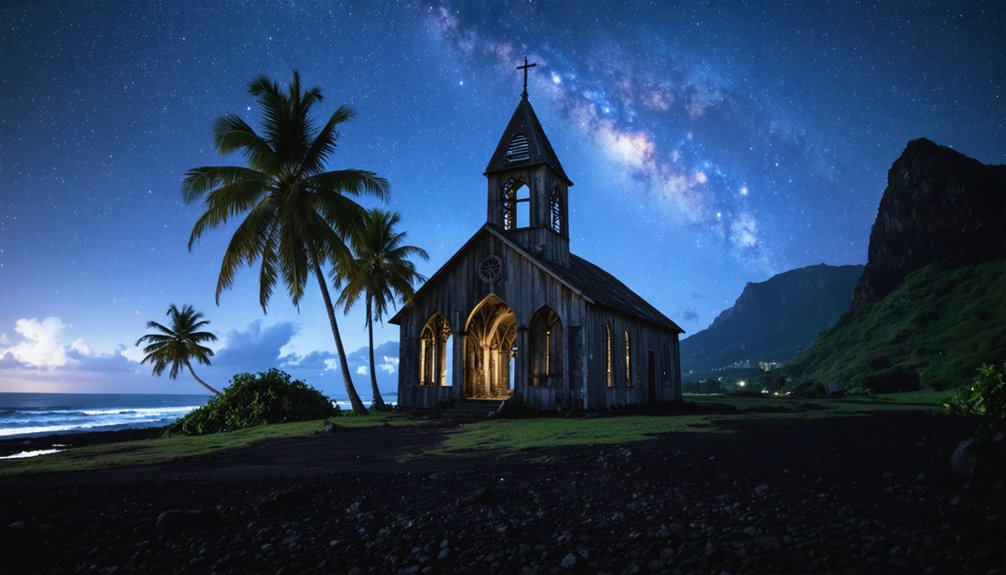
Perched along Molokaʻi’s rugged northern coastline, ancient Hawaiian settlements like Kaupoa Village offer photographers an unparalleled blend of cultural history and pristine dark skies.
Once home to 100 permanent residents and hundreds of seasonal visitors, this remote location now stands abandoned, its spiritual significance enhanced by tales of Night Marchers and ancient spirits.
- Access requires challenging boat navigation or hiking, ensuring minimal light pollution
- Well-preserved shrines, stone lo`i walls, and 1,000-year-old imu provide compelling foreground elements
- 1,700-foot North Shore Pali cliffs create dramatic framing for star trail compositions
- Ancestral burial grounds and Lanikaula sorcerer sites add mystical depth to nighttime captures
Pack robust gear for the remote terrain, and respect cultural protocols while shooting these sacred grounds where ancient Hawaiian civilization meets the cosmos.
Deserted Camps of Lānaʻi’s Pineapple Era
While Lānaʻi’s pineapple industry dominated the island’s economy for most of the 20th century, its abandoned infrastructure now provides exceptional dark-sky photography locations.
You’ll find three prime shooting locations that tell different chapters of Lānaʻi history:
- Keōmoku’s sugar-era ruins along the northeast shore, where you can frame the Milky Way rising over the ocean;
- Lāna’i City’s preserved Dole-era grid with its iconic Norfolk pines and historic storefronts;
- and the Ko’ele uplands, featuring ranch ruins at higher elevations perfect for clearer night shots.
Each site requires specific access planning – Keōmoku needs vehicle coordination, Lāna’i City’s buildings may require shooting permits, and Ko’ele’s elevation offers darker skies but demands careful composition around hotel lighting zones.
Remote Sugar Ruins of Hāmākua Coast
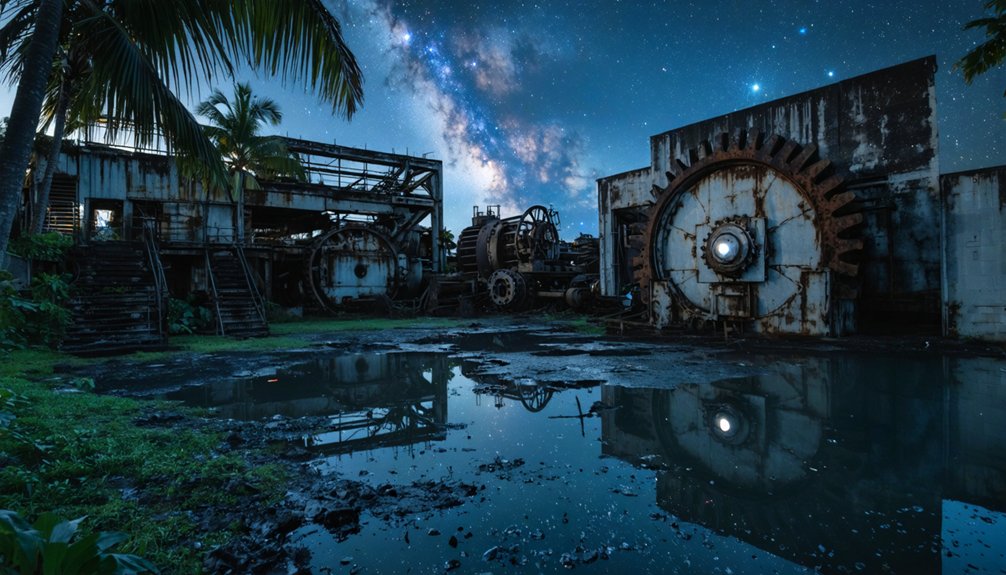
The Hāmākua Coast’s abandoned sugar infrastructure offers stark contrasts to Lānaʻi’s pineapple-era sites, with its atmospheric ruins dating back to the 1870s sugar boom.
You’ll find these remote sugar ruins scattered across 30 miles of dramatic coastline, where nature’s reclamation creates compelling compositions for night photography.
- Hakalau Beach Park’s overgrown mill ruins provide foreground elements against the Milky Way
- Historic landing sites with concrete platforms and rusted derricks dot the coastline’s cliff bases
- Abandoned railway tunnels and infrastructure from the pre-1946 tsunami era offer unique framing
- Former plantation towns like Honoka’a feature preserved industrial structures from Hāmākua’s sugar history
Access these locations via hiking trails from cliff tops, but time your shoots with moon phases for ideal starlight conditions.
Frequently Asked Questions
Can I Bring Camera Drones for Night Aerial Shots of Ghost Towns?
You’ll need FAA Part 107 certification and night operation waivers for drone aerial photography after dark. Most ghost town locations require additional permits and face strict regulations regarding culturally sensitive areas.
Exploring the best locations for drone shots in Hawaii offers breathtaking views of lush landscapes and pristine beaches that are perfect for photographers. Make sure to research any specific requirements or restrictions for each site to ensure compliance with local laws. With the right preparation, you can capture stunning aerial images that highlight the natural beauty of the islands.
As you plan your trip, consider the best months to explore Hawaiian ghost towns, which often feature unique architectures and rich histories waiting to be discovered. Timing your visit can enhance your experience, as certain months offer better weather and fewer tourists. These factors can significantly impact your ability to photograph these hidden gems and capture the essence of Hawaii’s haunting past.
What Wildlife Hazards Should Photographers Watch for When Shooting at Night?
Watch for nocturnal predators like feral cats, dogs, and pigs near lit areas. You’ll need to guard against disoriented seabirds, venomous invertebrates, and disease-carrying mammals during wildlife encounters.
Are There Guided Astrophotography Tours to These Abandoned Locations?
You’ll need special permits for abandoned sites, but you can join guided photography workshops at approved locations like Mauna Kea or historical significance tours that include nighttime shoots with proper authorization.
Which Ghost Towns Have Cellular Service for Emergency Communication?
Clear as a bell, you’ll have cellular coverage for emergency protocols near major towns like Hilo, but you’re better off bringing a satellite phone for remote ghost towns on the Big Island.
How Do Seasonal Moon Phases Affect Shooting Schedules at These Sites?
You’ll need to align your shooting schedule with moon phases – plan waning crescent or new moon periods for clearest skies, especially during Hawaii’s dry season when atmospheric conditions are ideal.
References
- https://5thstohana.com/dark-skies-hawaii-stargazing-paradise-big-island
- https://nvtami.com/2023/04/26/big-island-hawaii-ghost-towns/
- https://www.honolulumagazine.com/our-favorite-ghost-stories-about-haunted-places-on-oahu/
- https://lyslaw.com/the-best-places-to-stargaze-in-hawaii/
- https://www.americanghostwalks.com/articles/hauntings-of-hawaii-s-saddle-road
- https://www.go-astronomy.com/dark-sky-parks-stargazing-state.php?State=HI
- https://www.lovebigisland.com/hawaii-blog/11-great-spots-for-stargazing-in-hawaiʻi-all-islands/
- https://en.wikipedia.org/wiki/List_of_ghost_towns_in_Hawaii
- http://www.onlyinyourstate.com/experiences/hawaii/abandoned-hi
- https://www.youtube.com/watch?v=TsVMnRg_PDU