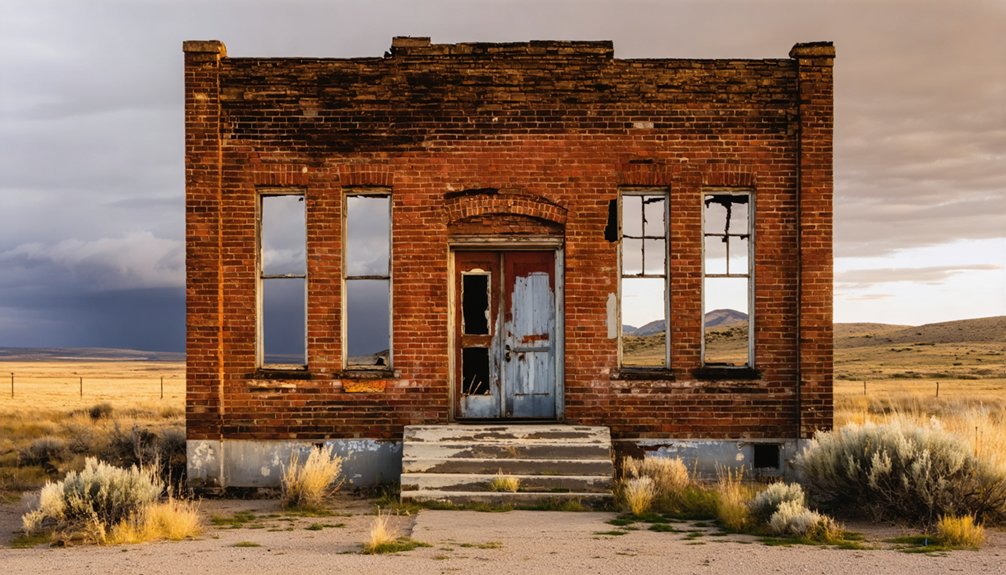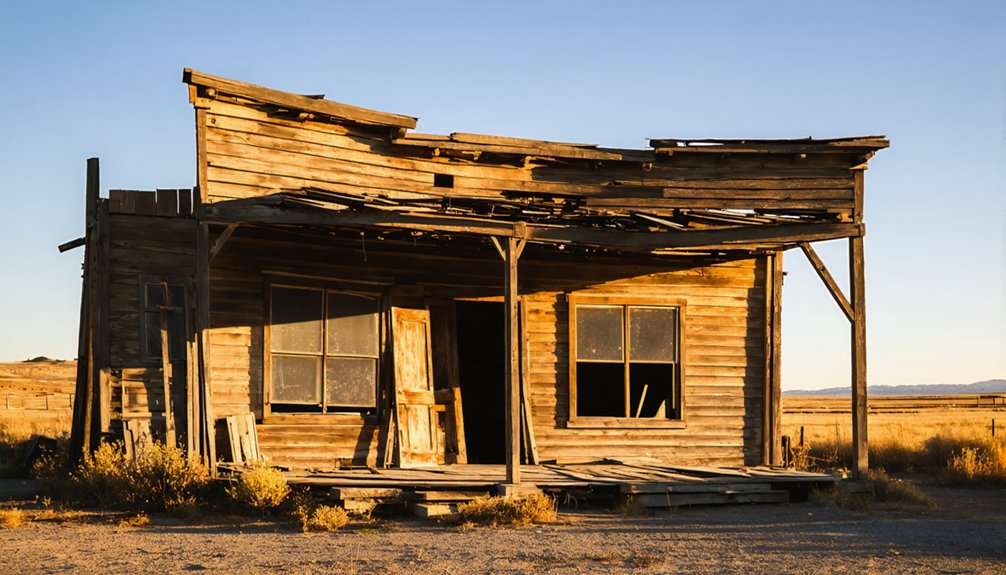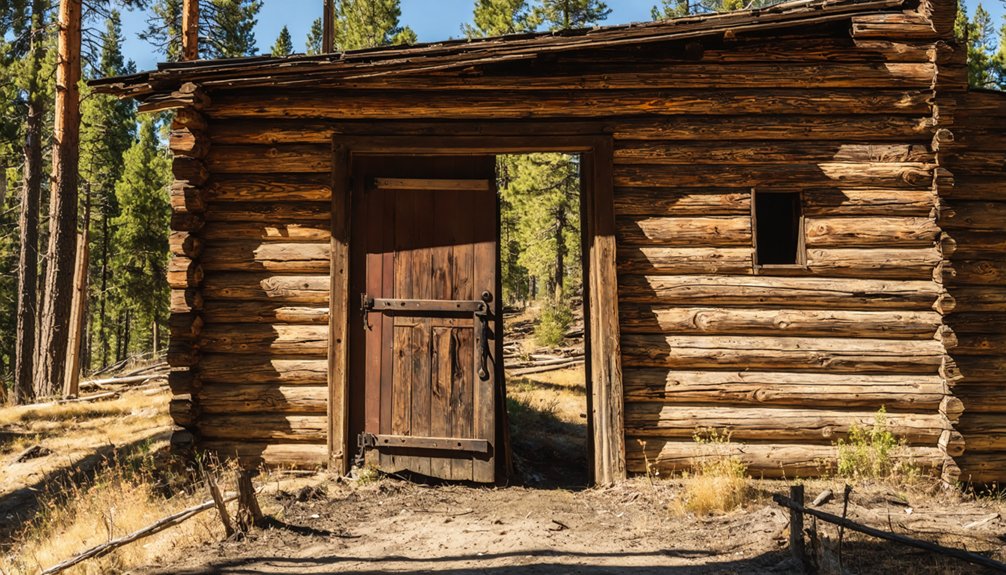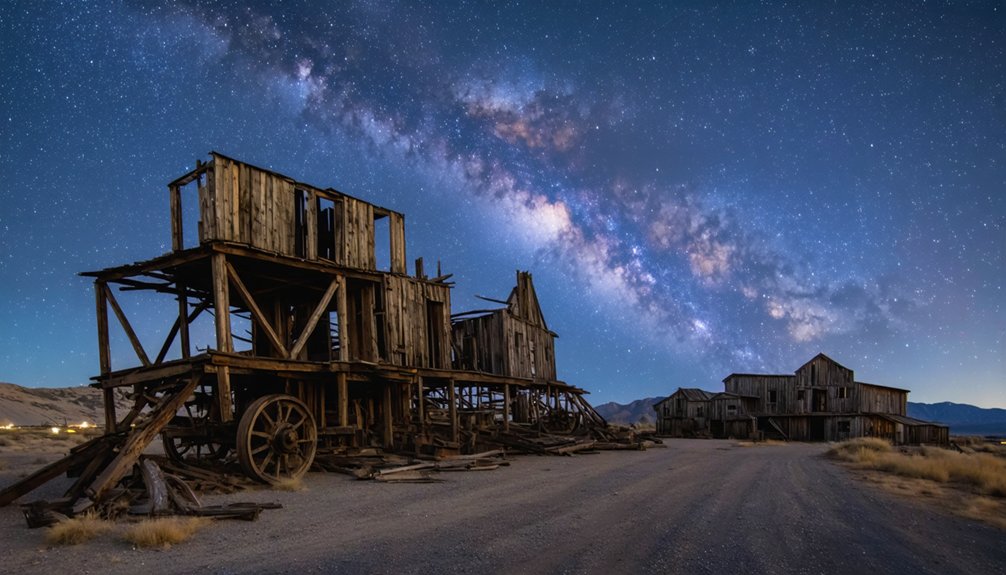
You’ll find exceptional astrophotography conditions in Idaho’s ghost towns, particularly within the Central Idaho Dark Sky Reserve‘s Bortle Class 1-3 zones. The Bonanza Mining District at 6,000 feet elevation offers pristine dark skies and compelling foreground elements like the Yankee Fork Gold Dredge. Remote locations like Rocky Bar and Leesburg provide high-altitude clarity and preserved 19th-century structures for unique compositions. Each site’s geographic isolation and elevation minimize light pollution, setting the stage for your next celestial masterpiece.
Key Takeaways
- Bonanza Mining District offers pristine Bortle 2-3 skies at 6,000-foot elevation with weathered mine structures for compelling Milky Way compositions.
- Rocky Bar’s remote location provides exceptional dark skies with optimal Milky Way core visibility between 3:15-4:15 a.m. in April.
- Leesburg’s Gold Rush ruins sit at 6,653 feet with minimal light pollution and preserved structures perfect for night photography.
- The Central Idaho Dark Sky Reserve encompasses 1,416 square miles of protected wilderness ideal for ghost town astrophotography.
- Abandoned mines along the Yankee Fork offer numerous dark-sky locations with historic structures and OHV trail accessibility.
Why Idaho Ghost Towns Excel for Night Sky Photography
While many locations offer dark skies for astrophotography, Idaho’s ghost towns present an unparalleled combination of geographic isolation and minimal light pollution.
You’ll find Bortle Class 1-3 skies across vast public lands, with designated dark-sky areas like the Central Idaho Dark Sky Reserve providing exceptional protection from artificial light.
The region’s topography amplifies your night photography techniques, as high-elevation sites place you above valley haze and atmospheric moisture.
Ghost town history comes alive through preserved 19th-century structures that create compelling foregrounds for your celestial compositions. Summer ranger-hosted Star Parties showcase these historical landmarks under pristine night skies. The Challis National Forest preserves numerous mining-era structures perfect for night sky photography.
You’ll discover weathered buildings, mine headframes, and historical artifacts that add narrative depth to your shots.
With most sites situated on public lands, you won’t need special permits, and many locations remain accessible via maintained roads throughout shoulder seasons.
Essential Gear and Planning for Ghost Town Shoots
You’ll want to equip a full-frame camera like the Nikon D750 paired with a wide f/2.8 lens such as the Tamron 17-28mm to capture both architectural details and star fields in ghost town environments.
For tracking longer exposures, mount your camera on a portable tracker like the iOptron SkyTracker Pro attached to a sturdy tripod that can handle uneven terrain and variable weather conditions.
Your planning should incorporate seasonal weather patterns, moon phases, and location scouting tools to identify ideal shooting positions that frame both the abandoned structures and celestial features effectively.
Consider using specialized software like ZWO ASIAIR Plus to automate your image acquisition process during the night shoot.
Don’t forget to pack vibration suppression pads under your tripod feet to minimize any micro-movements that could blur long exposure shots of the buildings against the night sky.
Camera Setup Essentials
Successful astrophotography in ghost towns demands specific gear that maximizes image quality while accommodating challenging low-light conditions.
You’ll need a full-frame or professional-grade DSLR/mirrorless camera paired with a wide-angle lens featuring an aperture between f/1.4 and f/2.8 to capture the night sky above abandoned structures. Consider adding a field flattener to correct edge distortion in your wide-field shots. Bring a reliable head torch for safely navigating dark ghost town locations.
For ideal camera stability, mount your setup on a sturdy tripod capable of handling 30-second exposures without vibration.
Configure your exposure settings in manual mode, shooting RAW with shutter speeds of 10-30 seconds depending on your focal length. Set your aperture between f/2.8 and f/5.6, with ISO ranging from 400 to 1600 for dark locations.
Use manual focus with infinity as your starting point, and enable both long exposure noise reduction and self-timer functions.
Seasonal Weather Considerations
Since ghost town astrophotography requires year-round planning, understanding seasonal weather patterns becomes critical for both access and equipment protection.
You’ll need to monitor snowpack depths from November through May, as these often block high-elevation access roads. Temperature fluctuations of 20-40°F between day and night create challenging conditions for your gear, especially during winter months when battery life diminishes rapidly below freezing. Long exposure times help reveal hidden details in the night sky that are invisible to the naked eye.
Spring’s freeze-thaw cycles generate muddy conditions requiring 4×4 vehicles, while summer monsoons can trigger flash floods. Idaho’s arid climate conditions have helped preserve many historical structures, making them excellent subjects for nighttime photography.
Autumn offers ideal shooting conditions but shorter astronomical twilight windows. Combat moisture issues with battery-powered lens heaters and insulated camera wraps.
For reliable results, allow 15-30 minutes for gear acclimation before shooting, and protect your equipment from abrasive elements like salt, dust, and volcanic ash common around mining sites.
Location Scouting Tools
Properly equipping yourself for ghost town astrophotography requires an extensive set of specialized tools that extend beyond standard camera gear.
You’ll need a sturdy tripod with multiple leg extensions and a reliable ball head to navigate uneven ghost town terrain. For location scouting, pair your DSLR or mirrorless camera with wide-angle lenses for initial composition tests.
Essential planning accessories include an intervalometer for precise exposure control and clip-in light pollution filters to combat any distant city glow. A portable power source like the Celestron 7aH battery guarantees continuous shooting through the night. For detailed image processing afterward, utilize Adobe Lightroom for enhancing exposure and color balance.
Mount your setup on a Sky-Watcher Star Adventurer or iOptron Sky Tracker for crisp star trails. Combine these with celestial maps and manual camera apps to identify ideal shooting positions around abandoned structures while maintaining stable support on unpredictable surfaces.
Silver City’s Historic Architecture Under Stars
Among Idaho’s best-preserved ghost towns, Silver City offers photographers an exceptional collection of 1860s architecture against the backdrop of dark mountain skies.
You’ll find remarkable subjects in the three-story Idaho Hotel, built in 1866 with its distinctive bath house and bar addition, and the Folk Victorian-style School House from 1892, both meticulously maintained through historic preservation efforts.
The Masonic Hall’s bridge over Jordan Creek creates compelling foreground elements, while Our Lady of Tears Church perched above mine shafts provides dramatic elevated compositions.
Dramatic views await where Jordan Creek flows beneath the Masonic Hall, framing Silver City’s historic skyline against mountain peaks.
When framing architectural details against the stars, you’ll want to capture the Sommercamp Saloon’s slouched profile and the district’s 70 surviving structures that tell the story of a once-bustling mining town of 300-400 buildings.
Dark Sky Adventures in the Bonanza Mining District
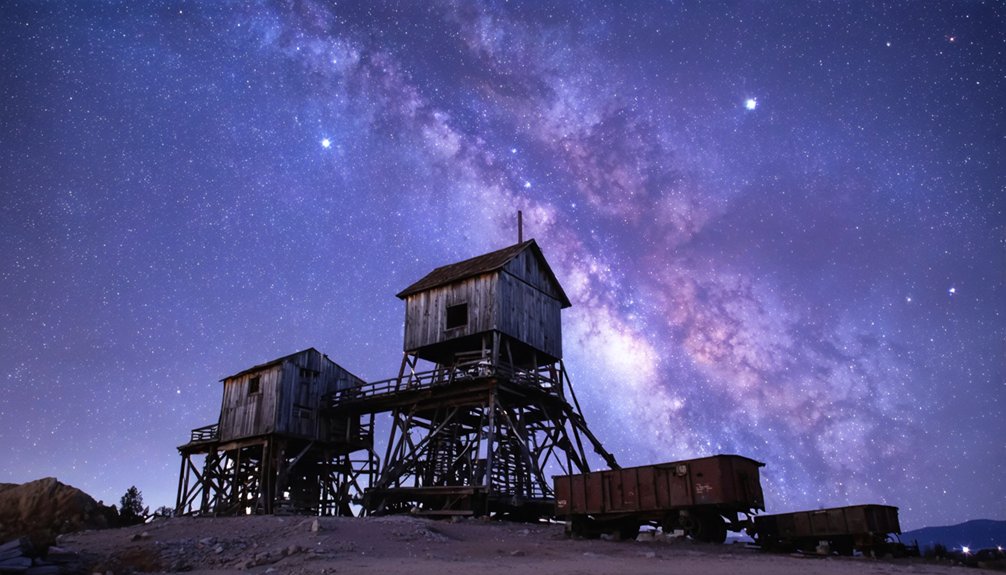
You’ll discover prime astrophotography conditions at Bonanza Mining District’s 6,000-foot elevation, where thin mountain air and Bortle 2-3 skies create ideal conditions for capturing the Milky Way above weathered mine structures.
The site’s abandoned ore chutes, timber frames, and equipment ruins provide compelling silhouettes and foreground elements that you can subtly illuminate with red-filtered LED lighting during long exposures.
During moonless nights from May through November, when forest service roads remain passable, you can frame the galactic core using the ghost town’s remaining foundations and tailings piles as natural leading lines.
Abandoned Mines at Night
You’ll find the abandoned mines of Idaho’s Bonanza Mining District offer exceptional opportunities for nighttime exploration.
While the Bonanza townsite itself doesn’t contain major mine workings, you can access numerous historic mining sites throughout the Yankee Fork area via OHV trails. The General Custer Mine and surrounding prospects provide compelling foreground elements for your astrophotography.
The remote location in the Sawtooth National Recreation Area guarantees minimal light pollution, creating ideal conditions for long-exposure shots. You can capture dramatic silhouettes of the preserved Yankee Fork Gold Dredge against star-filled skies.
The site’s high elevation and isolation from urban centers assure pristine dark sky conditions. With seven remaining structures in Bonanza and miles of accessible trails, you’ll discover countless compositions featuring mining remnants beneath the stars.
Mountain Starscapes and Structures
Perched within America’s first gold-tier International Dark Sky Reserve, the Bonanza Mining District offers exceptional opportunities for capturing mountain starscapes against historic structures.
You’ll find pristine dark skies stretching across 1,416 square miles of protected wilderness, where ghost town landscapes merge with celestial wonders.
Position your camera at Redfish Lake to capture night sky reflections mirrored in alpine waters, with the Sawtooth Range providing a dramatic foreground.
The area’s high elevation and dry climate minimize atmospheric distortion, enabling crisp long-exposure shots of the Milky Way core.
During winter, you can frame abandoned mining structures against Orion’s Belt and the Geminids meteor shower, which produces over 100 meteors per hour.
Access remote viewpoints via Highway 75 between May and November for unobstructed compositions of billion-star panoramas.
While Rocky Bar’s remote location in Elmore County presents initial navigation challenges, its position at 43.6892°N, 115.289°W offers prime conditions for astrophotography within Idaho’s gold-tier dark sky region.
You’ll need to plan your approach via Forest Service roads from Mountain Home, using a high-clearance vehicle and scouting key locations during daylight hours.
For ideal night sky shots, time your visit when the Milky Way core is visible, typically between 3:15-4:15 a.m. in April.
Check ClearDarkSky charts and 36-hour forecasts to avoid cloud cover and poor transparency.
Consider setting up multiple cameras around abandoned structures for day-to-night shift shots.
The site’s elevation and minimal light pollution will reward you with stunning views of the galactic core and faint stars, especially visible through high-end camera sensors.
Chasing the Milky Way at Leesburg’s Gold Rush Ruins
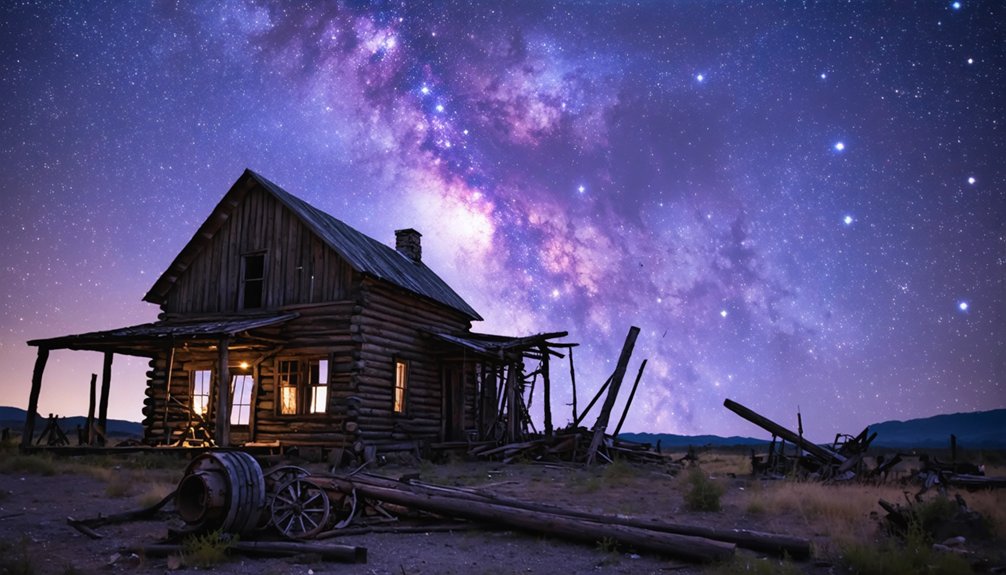
Located deep within Idaho’s Salmon National Forest at 6,653 feet elevation, Leesburg’s historic mining ruins offer prime opportunities for capturing the Milky Way against compelling foreground elements.
High in Idaho’s rugged wilderness, Leesburg’s abandoned mines create perfect foregrounds for dramatic Milky Way photography.
You’ll find exceptional dark sky conditions here, thanks to minimal light pollution and high-altitude atmospheric clarity.
For ideal Milky Way shots at this gold rush site, consider these technical requirements:
- Time your visit between late spring and early fall when the galactic core is visible
- Plan shoots during new moon phases or after 70% moonset
- Pack high-clearance 4WD capabilities for summer-only forest road access
- Utilize the cemetery’s vertical elements and preserved mining structures as foreground anchors
Remember to secure necessary Forest Service permits and respect the National Register status of these historic ruins while pursuing your nightscape compositions.
City of Rocks: Where History Meets Dark Skies
Rising dramatically from Idaho’s high desert plains, the City of Rocks National Reserve presents astrophotographers with a rare convergence of pristine dark skies and striking granite formations up to 200 feet tall.
You’ll capture a rich city history spanning Native American pictographs to California Trail inscriptions against the backdrop of unpolluted night skies. The remote location in south-central Idaho offers ideal conditions for night photography, with minimal light pollution interfering with your Milky Way shots.
Position your camera near the historic emigrant signatures in axle grease, or frame the ancient Shoshone and Bannock tribal artwork within your starscape compositions. The granite spires that once guided 240,000 pioneers now serve as dramatic foreground elements for your astrophotography, creating compelling visual narratives that bridge centuries of human experience under the same starlit sky.
Frequently Asked Questions
Are There Paranormal Activities Reported During Night Photography in These Locations?
While you’d expect ghost sightings in these haunting locations, there aren’t any verified paranormal investigations or supernatural occurrences during night photography sessions at Bayhorse, Bonanza, Custer, Burke, or Chesterfield.
How Do You Handle Wildlife Encounters While Shooting in Remote Areas?
You’ll need bear spray, travel in groups, make noise while moving, and maintain situational awareness. Store food away from shooting locations and back away slowly if you encounter wildlife.
What’s the Best Season to Capture Meteor Showers at These Sites?
You’ll find winter’s best meteor showers like Geminids and Quadrantids offer ideal shooting conditions with crystal-clear skies, while summer’s Perseids provide warm nights and dramatic Milky Way backgrounds.
Can Drones Be Used for Night Photography in Ghost Town Locations?
You’ll need FAA night waivers and anti-collision lighting for drone regulations. Most ghost towns require special permits, and you must maintain line-of-sight while traversing challenging terrain for night photography.
Exploring ghost towns for drone photography offers a unique perspective that captures the desolation and beauty of abandoned landscapes. Plan your visit during golden hour for the best lighting conditions, and be sure to respect any local regulations regarding drone usage. With stunning visuals and a sense of history, these locations are perfect for creative aerial shots.
Are There Guided Astrophotography Tours Available to These Ghost Towns?
You’ll find guided tours and photography workshops available year-round, with professional instructors leading night shoots at sites like Bayhorse State Park, City of Rocks, and Silver City’s preserved structures.
References
- https://ilra.org/where-to-stargaze-in-idaho-best-dark-sky-locations/
- https://idaho-forged.com/idahos-ghost-towns-eerie-yet-approachable/
- https://visitsouthidaho.com/the-city-of-rocks-national-reserve-and-its-wondrous-dark-skies/
- https://www.youtube.com/watch?v=m0HHcI3Djcw
- https://visitidaho.org/things-to-do/dark-skies/
- https://www.historicsilvercityidaho.com
- https://www.photohound.co/spot/silver-city-idaho-ghost-town-1006200
- https://www.thegoldminehotel.com/ghost-towns-and-haunted-places-in-idaho
- https://www.visitsouthwestidaho.org/dark-skies/
- https://visitsunvalley.com/the-dark-skies-of-sun-valley-id/