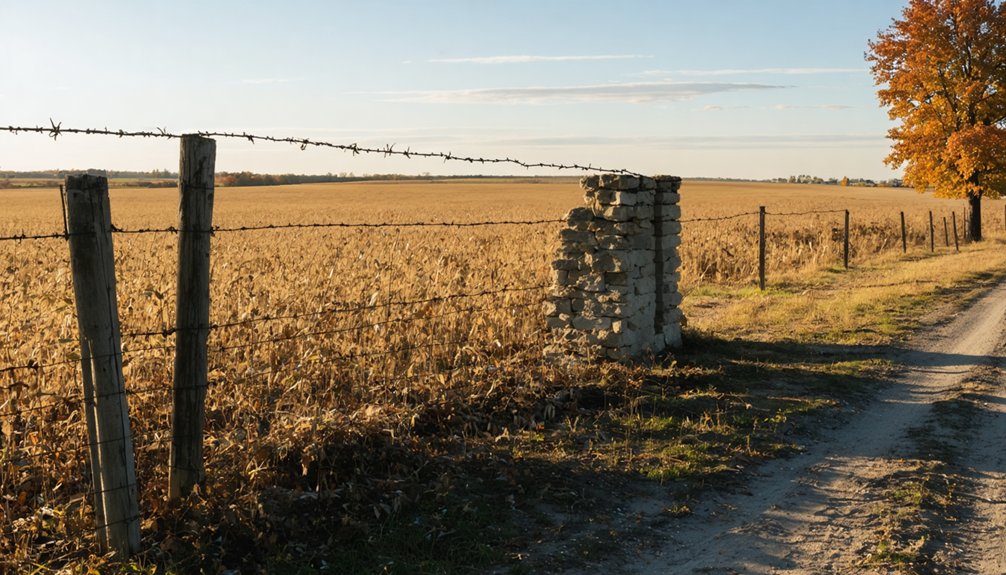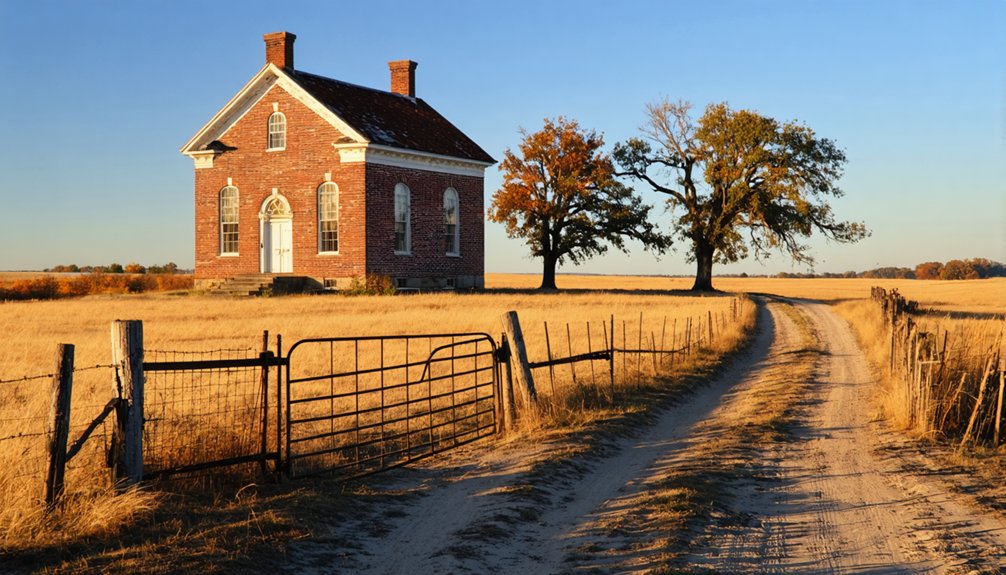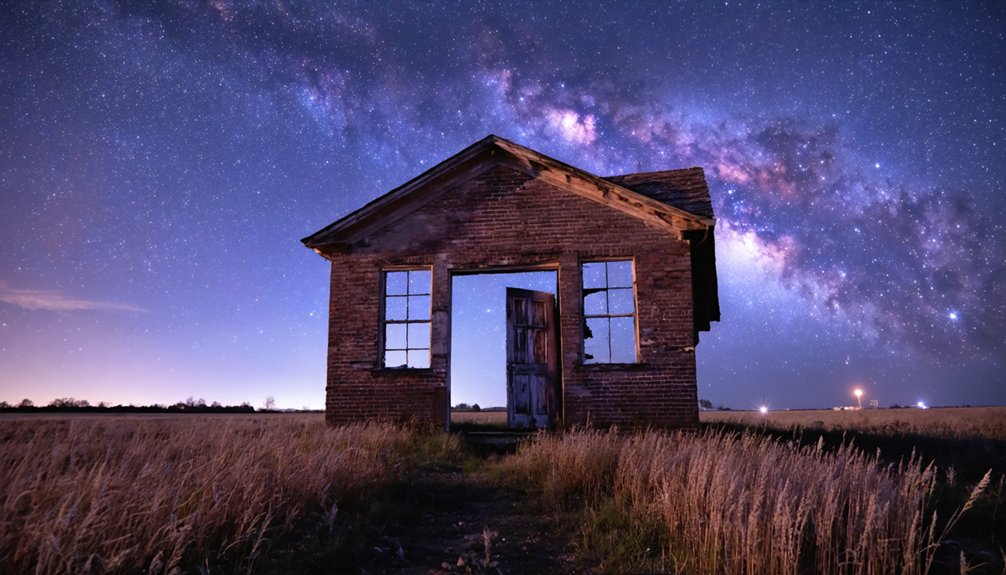
You’ll find prime astrophotography conditions in the ghost towns of west-central Greene and Macoupin counties, where Bortle-3 skies offer exceptional darkness exceeding 21.5 mag/arcsec². Focus on Franklinville’s National Register structures and Brookdale’s elevated positions for dramatic star trail compositions. Set up near Otter Lake and Roodhouse for minimal light pollution and clear constellation imaging. Scout locations like Cotton Hill’s submerged ruins, where historical backdrops merge with pristine dark skies to create compelling nightscapes.
Key Takeaways
- Ghost towns in west-central Greene and Macoupin counties offer Bortle-3 skies perfect for Milky Way photography and star trails.
- Franklinville’s historic 19th-century residence provides a compelling foreground element under exceptionally dark skies rated above 21.5 mag/arcsec².
- Brookdale’s elevated positions allow photographers to capture dramatic nightscapes while minimizing light pollution from nearby urban areas.
- Cotton Hill’s submerged ruins create unique reflective compositions for star trail photography during winter’s clear, stable conditions.
- Old Shawnee Town structures offer historical architectural elements against dark skies, with multiple safe pull-off points for equipment setup.
Ghost Towns With Optimal Dark Sky Conditions
Photographers seeking pristine dark skies for astrophotography will find ideal conditions in several ghost towns across Illinois’ remote corridors.
West-central Greene and Macoupin counties offer abandoned structures against Bortle-3 skies, perfect for capturing star trails and the Milky Way. You’ll discover prime ghost town photography locations near the southwest rural reservoir regions, particularly around Otter Lake and Roodhouse, where low light pollution enables detailed constellation imaging. Local astronomy clubs provide guidance for accessing these remote sites safely. For optimal viewing experiences, some photographers travel two hours from Chicago to capture the pristine night skies.
For best results, position your equipment in the peripheral zones of these sites, away from any remaining security lights.
The remote southern preserves near Beall Woods provide excellent dark sky conditions for long-exposure shots of derelict buildings. During winter months, when deciduous foliage thins, you’ll capture clearer horizon shots, though you’ll need to account for increased light dome visibility from distant municipalities.
Historical Significance and Abandoned Structures
While Illinois’ ghost towns harbor compelling astronomical vantage points, their historical foundations reveal fascinating tales of boom-and-bust settlement patterns.
Abandoned settlements across Illinois tell stories of rise and fall while offering pristine dark skies for stargazers.
You’ll discover architectural remnants like Franklinville’s 19th-century residence, now listed on the National Register, offering unique foreground elements for your astrophotography compositions.
The ghost town history of Brookdale, with its hill-carved settlement and nine former saloons, provides dramatic elevated positions for capturing the night sky.
At Old Shawnee Town, you can frame your stellar shots against structures that witnessed Lewis and Clark’s expedition.
Barreville’s abandoned mill site along Stickney Run Creek presents compelling possibilities for photographing celestial reflections in still waters, while Sangamo Town’s remnants offer unobstructed views of the astronomical horizon.
Ostend’s cellar hole and fieldstone foundations create stark silhouettes against starlit skies, offering photographers unique architectural elements from the 1840s settlement.
Cotton Hill’s submerged ruins beneath Lake Springfield’s waters create an ethereal backdrop for capturing star trails over the reservoir.
Equipment and Camera Setup Recommendations
To achieve ideal astrophotography results at Illinois ghost towns, you’ll need specialized equipment that balances portability with technical capability.
For wide-field shots capturing both ruins and stars, mount your camera on a portable star tracker like the Sky-Watcher Star Adventurer, which enables exposures up to 180 seconds. The Radian tripod offers excellent stability for long-term night sky sessions. Choose fast wide-angle lenses (f/1.4-f/2.8) in the 14-50mm range for Milky Way compositions with architectural elements. A broadband light filter can help reduce light pollution from nearby cities.
For deeper sky work, consider a small APO refractor (50-100mm aperture) paired with a German equatorial mount. You’ll want either a cooled astronomy camera or a modern mirrorless body with strong high-ISO performance.
Don’t forget a solid tripod with vibration damping – ghost town terrain can be uneven. Match your pixel scale to Illinois’ typical seeing conditions, aiming for 1.0-2.0 arcsec/pixel.
Best Seasons and Weather Conditions
You’ll find winter’s crisp, clear skies from December through February offer ideal deep-sky imaging conditions at ghost town locations, with reduced atmospheric turbulence and extended darkness maximizing your exposure times. Scout dark sky locations during daylight to identify the best setup spots for your equipment.
When planning summer sessions, monitor weather patterns closely for approaching thunderstorms that can quickly disrupt long-exposure captures of the Milky Way core and emission nebulae. If attempting aurora photography in summer, you’ll need to time visits during periods when the Kp reaches 7.0 for any chance of visibility.
Your most successful ghost town astrophotography will align with new moon periods during cold fronts that sweep away moisture and atmospheric distortion, particularly from September through March in the northern hemisphere.
Winter’s Clear Dark Skies
Since winter delivers exceptionally dark skies and stable atmospheric conditions, Illinois ghost towns become prime destinations for astrophotography between December and February.
As photographers take advantage of this time, the best season for illinois ghost towns allows for capturing stunning images of the Milky Way framed by the haunting remnants of forgotten villages. Additionally, the crisp winter air enhances visibility and makes the eerie silence even more pronounced, adding to the overall experience. Enthusiasts often plan their trips around these months to not only photograph the night sky but also to explore the rich history concealed within these abandoned places.
Photographers seeking diverse perspectives can also explore drone photography spots in Illinois, where aerial views of these ghost towns provide a unique glimpse into their faded glory. The juxtaposition of the desolate structures against the vast winter sky creates breathtaking compositions that are sure to impress. Capturing these scenes from above allows for a fresh storytelling angle, inviting viewers to appreciate the beauty and mystery of the state’s forgotten landscapes.
You’ll find the longest astronomical darkness during this season, with clearer air and lower water vapor enhancing deep-sky contrast. The old lime kiln at Griggsville Landing makes an excellent foreground element against the winter constellations. Visitors to Shawneetown can position their cameras near the historic bank building for unique architectural silhouettes. Plan your winter astrophotography sessions around new moons when remote preserves can reach Bortle 3-4 darkness levels.
Watch for arctic high-pressure systems that bring multiple consecutive clear nights. While subfreezing temperatures pose equipment challenges, they often deliver superior transparency for capturing celestial phenomena.
You’ll need to manage battery life and protect against frost, but winter’s stable atmospheric seeing can reward you with crisp star fields.
Just avoid locations where snow cover might reflect light pollution upward, compromising your dark-sky advantage.
Summer Storm Watch Tips
While winter offers pristine dark skies, summer storm patterns create unique opportunities for dramatic astrophotography in Illinois ghost towns.
You’ll find ideal conditions during June and July, when frequent frontal systems sweep through, clearing atmospheric particulates and delivering exceptional transparency for deep-sky imaging.
For maximum success, track Clear Sky Charts and NWS forecasts to identify post-storm windows with high pressure and low humidity.
Monitor real-time satellite imagery for cirrus-free conditions and stable seeing. The key is timing your shoots during high-transparency periods after cold fronts pass, when humidity drops and skies darken.
Remember storm safety – maintain safe distance from active convection and keep your gear protected.
Focus on late spring to early summer sessions when you’ll benefit from both warm instability and longer nights perfect for capturing ghost town foregrounds against pristine night skies.
Night Access and Safety Guidelines
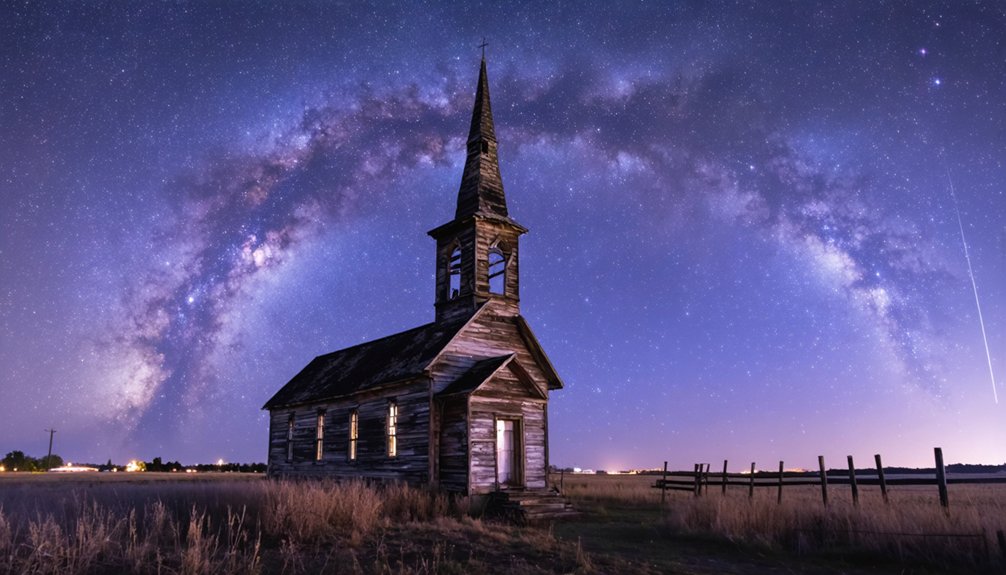
Before venturing into ghost towns for astrophotography sessions, understanding access restrictions and safety protocols is paramount for both legal compliance and personal wellbeing.
You’ll need to navigate nighttime regulations while maximizing your shooting opportunities under dark skies. Many locations require special permits for after-dark access, so research and secure necessary permissions beforehand.
- Obtain written authorization from property owners or land managers – this protects you legally while ensuring uninterrupted shooting time.
- Pack redundant illumination systems including a red-light headlamp for preserving dark adaptation.
- Carry emergency communication devices and offline GPS maps, as cell coverage is often limited.
- Scout locations during daylight to identify structural hazards and plan emergency exit routes – your safety takes precedence over getting the perfect Milky Way shot.
Top Viewing Locations and Pull-Off Points
Having secured proper permits and safety protocols, you’ll find Illinois offers several prime astrophotography locations with strategically positioned pull-off points.
Illinois provides dedicated stargazing spots and safe pull-offs, perfect for astrophotographers seeking to capture the night sky’s wonders.
The abandoned Prairie Observatory near Walnut Point State Park serves as an excellent ghost town landmark for wide-field nightscape compositions, with convenient park service roads for equipment setup.
You’ll discover great dark-sky vantage points at Middle Fork River Forest Preserve’s designated stargazing trailhead and 11 campsites, perfect for long-exposure work.
For unobstructed southern horizon shots of the Milky Way, utilize the Bay Creek Hiking Area’s rural roads near Nebo or RipRap Landing’s boat ramps.
These spots offer stable platforms and clear sight lines.
The McMaster Woods pull-offs near Fieldon provide prime zenith exposures, while Roodhouse Lake presents opportunities for reflective water-sky compositions.
Light Pollution Considerations
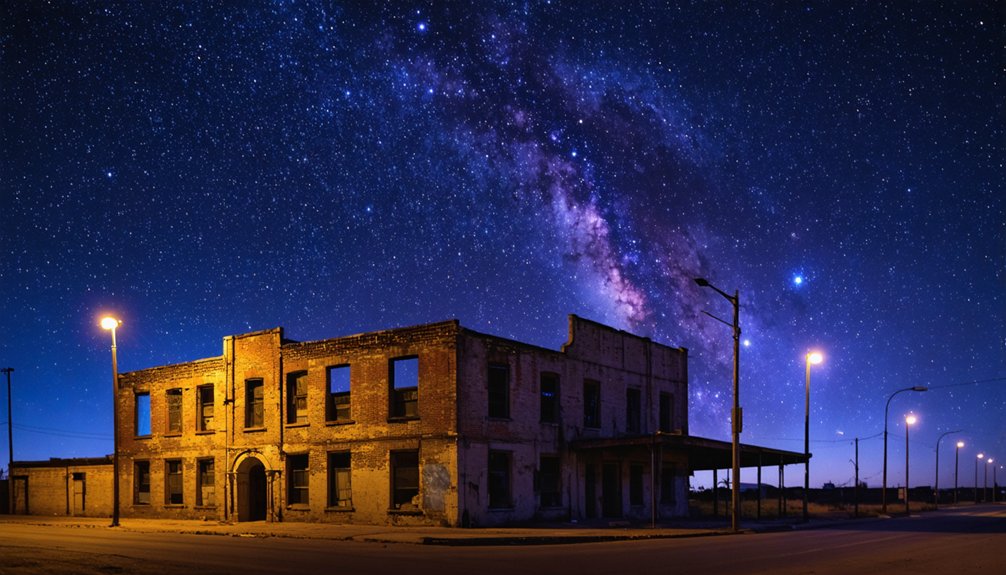
You’ll find exceptional sky darkness metrics at many Illinois ghost towns, with zenith surface brightness often exceeding 21.5 mag/arcsec² in the most remote locations.
While these sites offer prime conditions for capturing the Milky Way and deep-sky objects, you’ll need to monitor interference from Chicago’s sky dome, which can project noticeable light pollution up to 75 miles from the city center.
To optimize your astrophotography results, position yourself where local terrain features block urban light domes and verify dark-sky conditions using an SQM meter before setting up your equipment.
Rural Sky Darkness Advantages
Three key factors make rural locations ideal for astrophotography: minimal artificial light interference, darker sky conditions averaging 21 magnitudes per arcsecond squared, and reduced exposure times compared to urban settings.
The rural advantages greatly improve your ability to capture deep-sky objects and the Milky Way’s intricate details.
- You’ll find sky visibility improves considerably in rural zones, where natural darkness can exceed 21.7 magnitudes per arcsecond squared.
- Your exposure times decrease markedly compared to urban areas – what takes 9.8 hours in Bortle 5 requires only 1 hour in Bortle 1.
- Rural Class 3-equivalent conditions allow naked-eye visibility of Messier objects like M4, M5, M15, and M22.
- You’ll achieve optimal deep-sky imaging when objects 20-30 feet away become obscured by natural darkness, indicating sufficient sky darkness for astrophotography.
City Light Interference Patterns
Light pollution presents considerable challenges for astrophotographers across Illinois, with distinct interference patterns mapped through the Bortle scale classification system.
You’ll encounter severe city glow patterns within 50 miles of Chicago’s 2.7 million residents, creating persistent light domes visible for over 30 miles.
Urban light sources from metropolitan areas notably impact potential shooting locations. Even designated dark sky sites like Palos Preserves experience skyline interference despite their protected status.
You’ll find clearer conditions in southwest Illinois, though St. Louis’s glow affects Bay Creek. Central sites near Urbana-Champaign show eastern horizon contamination, while Galena Country deals with Quad Cities’ illumination.
For ideal results, target ghost towns beyond the 50-mile urban radius, where Bortle readings drop to class 3-4, enabling superior astronomical imaging conditions.
Local Astronomy Groups and Resources
Illinois boasts 19 active amateur astronomy clubs that offer essential resources for astrophotographers seeking dark sky locations. Through local astronomy networks and community engagement, you’ll gain invaluable insights for capturing celestial phenomena in abandoned settlements.
- Northwest Suburban Astronomers delivers premier astrophotography expertise, showcasing advanced techniques like their 27-hour WR134 Cygnus exposure using the Skywatcher Esprit 100 ED.
- Twin City Amateur Astronomers maintains a dark sky observatory southwest of Bloomington, perfect for deep-sky imaging.
- Naperville Astronomical Association coordinates specialized viewing events for lunar, planetary, and deep-space objects.
- University-affiliated groups, including Ryerson Astronomical Society and Illinois State’s Astronomy Club, provide technical workshops and observation sessions to enhance your astrophotography skills.
Frequently Asked Questions
Are There Any Paranormal Investigation Restrictions at These Ghost Town Locations?
You’ll need permits and landowner permission for paranormal activity investigations, as most locations restrict unauthorized access. Follow investigation etiquette – no trespassing, nighttime entry requires approval, and safety waivers.
Which Locations Allow Camping Directly Within the Abandoned Building Sites?
You can’t legally camp inside any abandoned structures at these locations – camping regulations strictly prohibit overnight stays within ghost town buildings due to safety hazards and trespassing laws.
Do Any Sites Require Special Permits for Commercial Astrophotography Shoots?
Pleasantly, you’ll find no special permit requirements specifically for commercial photography at these locations. Just follow standard public access rules while pursuing your purposeful professional astrophotography under pristine dark skies.
How Close Can Drones Be Flown to Historical Structures at Night?
You’ll need to maintain FAA-required VLOS and anti-collision lighting visible for 3 miles during night flights. While no specific distance requirements exist, you must stay above structures and yield to other aircraft.
Are There Guided Tours Combining Ghost Town History and Stargazing?
You’ll rarely find formal combined guided stargazing tours and historical ghost town experiences in Illinois, but you can create your own by connecting with local astronomy clubs and historical societies for customized events.
References
- https://www.enjoyillinois.com/plan-your-trip/travel-inspiration/where-the-stars-always-shine/
- https://www.youtube.com/watch?v=93k0qtvzkn4&vl=en-US
- https://www.onlyinyourstate.com/experiences/illinois/creepy-ghost-towns-il
- https://www.go-astronomy.com/dark-sky-parks-stargazing-state.php?State=IL
- https://www.riversandroutes.com/blog/stargazing-hotspots-in-southwest-illinois/
- https://www.visitlakecounty.org/blog/top-5-locations-to-stargaze-in-lake-county
- https://www.champaignforests.org/Forest-Preserves/Locations/Middle-Fork-River/International-Dark-Sky-Park
- https://dnr.illinois.gov/recreation/stargazing/bestlocationstostargaze.html
- https://1440wrok.com/heres-where-to-go-in-illinois-for-the-absolute-best-stargazing/
- https://www.space.com/13782-illinois-town-homer-glen-dark-sky-community.html