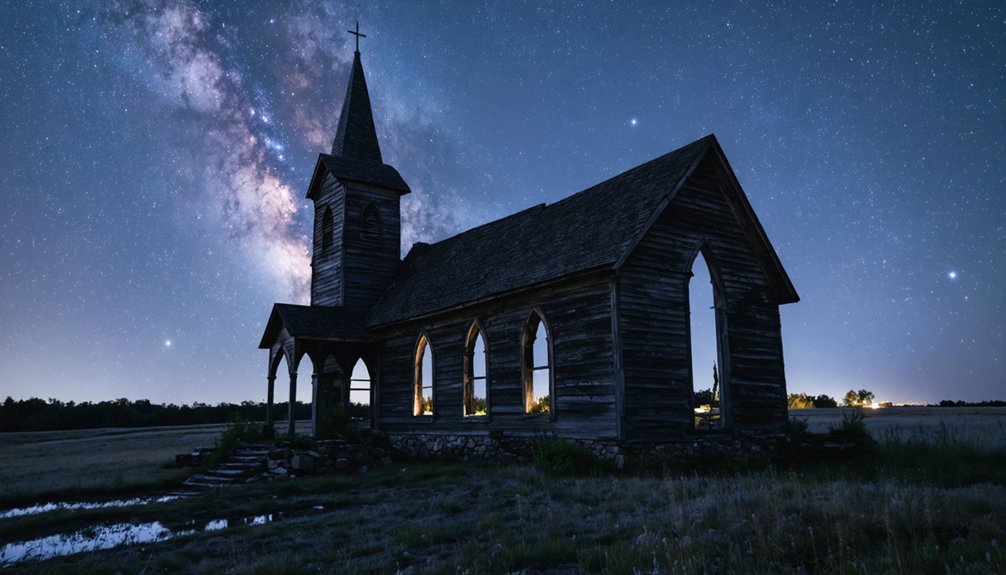
You’ll find ideal astrophotography conditions in Maryland’s abandoned mining towns of Kempton, Vindex, and Gleason in Garrett County, where Bortle 3-4 dark skies prevail. The C&O Canal’s lost villages, particularly Four Locks and Paw Paw Tunnel areas, offer exceptional structural elements against pristine night skies. Eastern Shore ghost sites in Dorchester and Somerset counties provide unique coastal compositions with minimal light pollution. These locations harbor technical advantages that warrant thorough exploration.
Key Takeaways
- Kempton offers LIDAR-visible foundations and abandoned miners’ homes that create compelling foregrounds for Milky Way photography in dark skies.
- The C&O Canal’s Four Locks area features historic lockhouse foundations and minimal light pollution, perfect for nighttime astronomical photography.
- Eastern Shore ghost forests in Dorchester and Somerset counties provide dramatic silhouettes against pristine dark skies.
- Vindex’s collapsed coal tipples and Dodson’s company house structures offer unique architectural elements for night sky compositions.
- Oldtown’s preserved lockhouses 70 and 71 near re-watered canal sections provide excellent foreground elements with minimal light interference.
Dark Sky Gems: Garrett County’s Abandoned Mining Towns
The abandoned mining towns of Garrett County, Maryland present exceptional locations for astrophotography due to their minimal light pollution and remote positioning along the Appalachian Mountains.
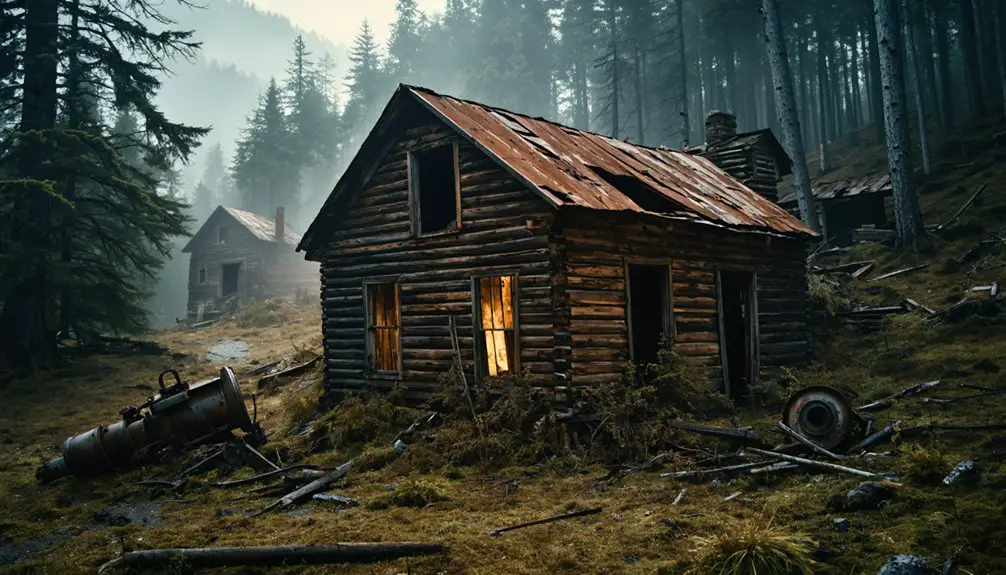
You’ll find ideal dark sky conditions at Kempton, where LIDAR-visible foundations and overgrown miners’ homes provide compelling foreground elements for your night sky compositions.
The ghost town history of Vindex, marked by collapsed coal tipples, and Dodson’s solitary company house offer unique structural elements against the celestial backdrop.
For technical shooting locations, position yourself at Gleason’s elevated cement foundations or Kempton’s archaeological excavation site. The area once thrived with a population of 900 during its peak coal mining days of the 1930s.
The mining heritage of these sites, particularly visible through Kempton’s preserved company town layout, creates striking silhouettes for long-exposure Milky Way photography.
Photographers can also explore the historic brick powerhouse at Gleason along the river for additional architectural elements in nighttime compositions.
Eastern Shore Ghost Sites: Coastal Photography Paradise
Along Maryland’s Eastern Shore, ghost forests and abandoned maritime structures present exceptional astrophotography opportunities within a unique coastal ecosystem.
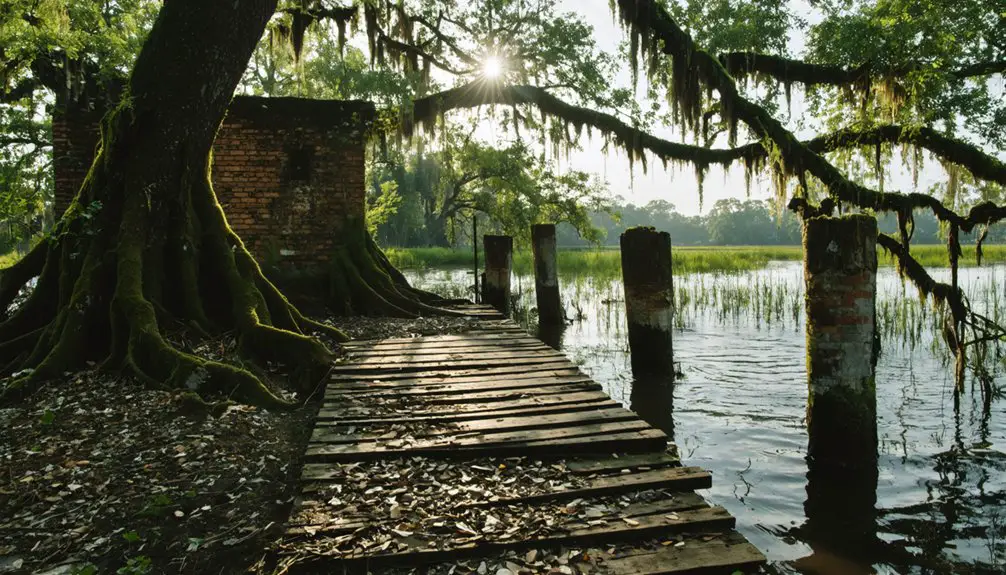
You’ll discover extensive stands of dead pines and cypress creating dramatic silhouettes against the Milky Way, particularly in Dorchester and Somerset counties where saltwater intrusion has expanded these skeletal forests.
Abandoned canneries in Talbot and Dorchester counties offer compelling foreground elements, with their rusted metal and weathered brick walls providing textural contrast against star-filled skies.
Decaying waterfront factories stand sentinel in darkness, their weathered facades framing constellations in Maryland’s midnight canvas.
For ideal shooting conditions, plan your visit during low tide and calm winds when tidal creek reflections enhance compositions. These locations are increasingly transforming as rising sea levels accelerate the formation of new ghost forests along the coastline.
Like many former industrial towns that declined during the Great Depression, these coastal sites have remained largely untouched, creating pristine dark sky viewing locations.
Navigate carefully around unstable substrates, and verify you’ve mapped light pollution from nearby towns like Salisbury and Ocean City.
Remember to secure necessary permissions when accessing private property sites.
Capturing the Stars Along C&O Canal’s Lost Villages
You’ll find exceptional astrophotography conditions along the C&O Canal’s abandoned settlements, where structural remains offer compelling foreground elements against dark rural skies.
The Four Locks area presents ideal compositions with its lockhouse foundations and narrow channel traces, while Weverton’s elevated terrain provides clear sight lines for Milky Way arching over stone ruins during spring and fall.
For reflective foreground opportunities, position your camera at the Oldtown section’s watered canal stretches, where you can capture star trails mirrored in still waters while incorporating historic lockhouses into your frame. Near Fort Frederick, you’ll discover several well-preserved lockkeepers houses and mills that add architectural interest to nighttime compositions. Paw Paw Tunnel’s entrance offers a unique vantage point where the eerie silence enhances the mystical quality of nighttime shots.
Canal Ruins After Dark
Historical ruins from the Chesapeake & Ohio Canal‘s bygone era offer exceptional foreground elements for astrophotography compositions, particularly within the western segments where light pollution remains minimal.
You’ll find ideal dark-sky conditions between Hancock and Cumberland, where abandoned lockhouses and mill remnants provide compelling architectural silhouettes against the stars. Local paranormal enthusiasts report seeing ghostly lantern lights moving through these areas at night, adding an ethereal element to long-exposure shots.
For nighttime exploration and historical storytelling through your lens, you’ll need to navigate specific access parameters. National Park Service regulations govern after-dark activities, requiring permits for commercial shoots and adherence to park hours. The Native American trails that once crossed through this area provide naturally clear viewing corridors for stargazing.
Scout locations during daylight to identify hazards like unstable masonry and exposed foundations. During new moon phases, the western ruins offer superior Milky Way visibility, while quarter moons provide natural illumination for structural details.
Prime Lock Shooting Spots
The C&O Canal’s most photogenic lock ruins cluster around five distinct locations, each offering specific astronomical advantages for nighttime photography.
You’ll find ideal dark sky conditions at Haunted House Bend’s Mile Marker 30.9, where Jarboe’s Store ruins provide compelling foreground elements against the Milky Way. Night photographers often incorporate the Round Top cement kilns that once supplied materials for the Washington Monument.
The remote Paw Paw Tunnel at mile 155.2 delivers excellent light pollution isolation, while Oldtown’s Lockhouses 70 and 71 offer historically preserved structures near the re-watered Battie Mixon section.
Four Locks’ ghost town remnants present multiple compositional options with abandoned settlement traces, and Maryland Heights’ lockkeeper ruins provide elevated vantage points across from Harpers Ferry.
Each site’s haunted history and lockhouse lore add atmospheric depth to astronomical captures, particularly during new moon phases.
Potomac Valley Star Trails
Spanning quiet sections of the C&O Canal towpath, ideal star trail photography locations concentrate around abandoned lockhouses and forgotten canal villages where minimal light pollution permits extended exposure captures.
The level terrain along the Potomac River provides excellent stability for long-exposure equipment setups, while village ruins offer compelling foreground elements against the rotating celestial sphere. Pack adequate personal flotation devices when setting up near water’s edge for reflective compositions.
- Position your tripod at mile markers 75.5 near Snyder’s Landing for compositions incorporating weathered lock structures.
- Utilize post-peak season’s darker skies from October through April for maximum stellar visibility.
- Frame your shots with historical canal architecture silhouetted against circumpolar star paths.
- Scout locations during daylight to identify stable shooting positions among aqueduct remnants.
The remote sections between Cumberland and DC deliver unobstructed views of the night sky, perfect for capturing hours-long star trail sequences.
State Forest Ghost Towns: Nature’s Perfect Dark Stage
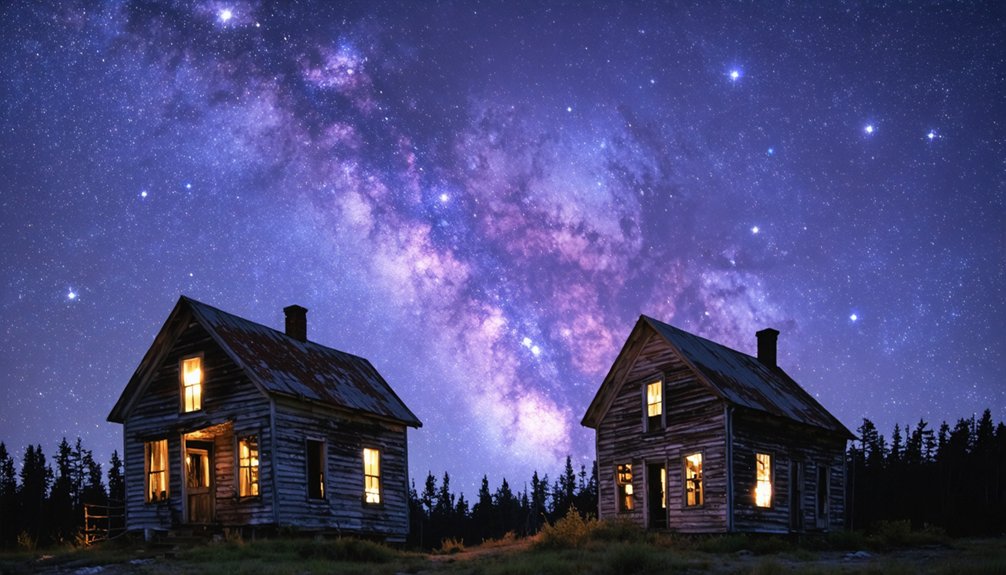
Scattered throughout Maryland’s state forests, abandoned settlements provide exceptional conditions for astrophotography due to their minimal light pollution and remote locations.
The Garrett County ghost towns of Kendall, Kempton, and Vindex offer superior western horizon visibility at higher elevations, ideal for capturing the Milky Way’s galactic core.
Perched high in Garrett County’s abandoned settlements, photographers can witness the Milky Way’s majestic core against pristine western skies.
You’ll find the most favorable shooting conditions in autumn and winter when humidity levels drop, particularly in western Maryland’s highlands.
The gothic ruins of Daniels in Patapsco Valley State Park present compelling foreground elements, though you’ll need to account for Baltimore’s eastern light dome.
For best results, scout locations during twilight to identify light intrusion sources and verify land access permissions.
Remember that some sites, especially Pocomoke Forest, require special permits for night access and maintain active surveillance.
Essential Equipment for Ghost Town Night Photography
Successful astrophotography in ghost towns requires five critical equipment components: a capable DSLR body with manual controls, a stable tripod system, fast wide-angle lenses, remote shutter mechanisms, and specialized lighting tools.
Your camera settings must support exposures beyond 30 seconds, while lens choices should prioritize f/2.8 or faster apertures at wide focal lengths.
- Deploy manual focus methods in absolute darkness using your camera’s live view.
- Maintain tripod stability through ball head designs that enable rapid composition changes.
- Implement remote triggering via wireless or wired shutters to eliminate vibration.
- Preserve night vision using red-mode headlamps while executing lighting techniques.
For ideal results, pair full-frame sensors with ultra-wide lenses, utilizing the MeFOTO Roadtrip tripod’s robust stability, and control exposure tips through the Vello Shutterboss II’s precise timing capabilities.
Safety and Access: What You Need to Know
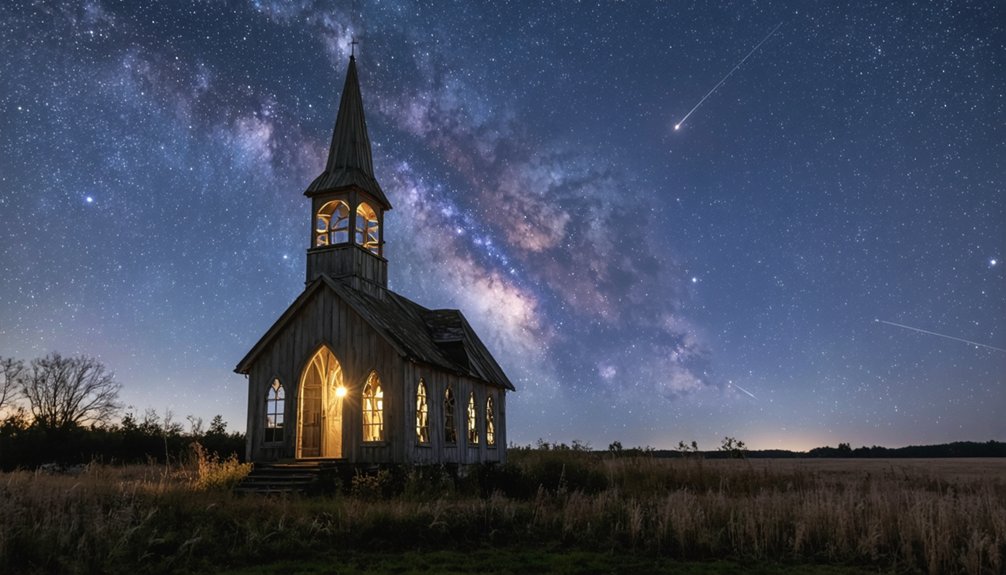
Before you venture into ghost towns for astrophotography, you’ll need to verify legal access through property records and secure necessary permits from landowners or governing agencies.
You must assess structural integrity hazards, environmental risks, and wildlife concerns while implementing proper safety protocols including respiratory protection and emergency communication systems.
You’ll need to follow specific operational procedures for night photography, including proper illumination techniques and maintaining clear documentation of all access permissions and liability coverage.
Legal Access Protocols
When planning astrophotography excursions to ghost towns, adherence to strict legal access protocols is imperative for regulatory compliance and personal safety.
You’ll need to secure appropriate permits and understand entry restrictions before venturing into these historical sites.
- Obtain requisite day-use or overnight permits for state forests like Green Ridge, where legal entry is restricted after sunset.
- Verify entrance fee requirements and vehicle passes for national park locations such as Assateague Island.
- Research private property boundaries near ghost town sites like Kitzmiller and Henry, as trespassing carries penalties up to $1,000.
- Secure special use permits 30 days in advance for group astrophotography sessions on federal lands like the C&O Canal.
Remember that deviation from designated trails or unauthorized access to ruins constitutes a misdemeanor offense, potentially resulting in fines and eviction.
Equipment Safety Essentials
To guarantee ideal protection of sensitive astrophotography equipment in ghost town environments, implementing thorough safety protocols becomes paramount.
You’ll need to establish proper tripod stability by installing counterweight shafts before mounting your OTAA, while ensuring all components are fully seated and torqued to specifications.
Critical power management requires securing your surge protector to the tripod leg and looping cables through the spreader to prevent disconnection.
You’ll want to position your setup on stable terrain after conducting daylight site surveys.
For cybersecurity, update all device firmware immediately and enable two-factor authentication on equipment like the ZWO ASIAIR.
Deploy red-light headlamps for night vision preservation and carry redundant LED lighting systems.
Your GPS device becomes essential when cellular service fails in remote locations.
Emergency Response Planning
Successful astrophotography expeditions in ghost towns require thorough emergency response protocols that address site access, communications, medical preparedness, and environmental hazards.
Your emergency plans must incorporate redundant communication strategies and location-sharing protocols while maintaining extensive documentation of legal permissions and medical resources.
- Secure written permissions and permits, keeping digital and physical copies accessible for immediate verification.
- Implement a multi-layered communication system with GPS coordinates, offline maps, and satellite messaging capabilities.
- Maintain a trauma-ready first aid kit with location-specific medical facility information and response times.
- Document structural and environmental hazards specific to your shooting location, including escape routes and safe zones.
Always carry your emergency response plan in both digital and printed formats, with clear protocols for various scenarios from minor injuries to severe weather events.
Seasonal Timing and Weather Considerations
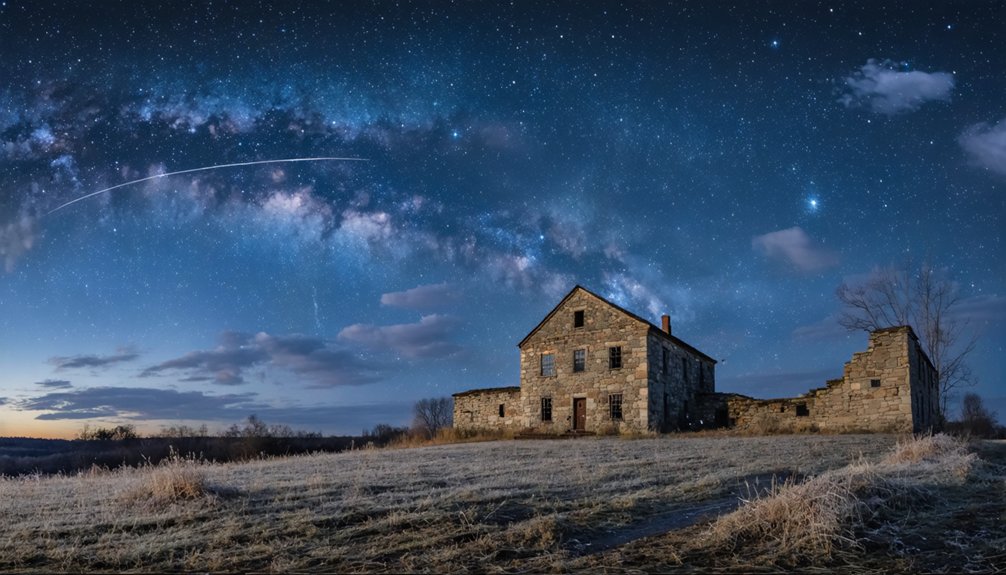
Since ideal astrophotography in ghost towns requires precise environmental conditions, understanding seasonal timing and weather patterns becomes critical for image acquisition.
You’ll need to align your shoots with new moon phases (±3 nights) to maximize Milky Way visibility and capture faint nebulosity. Schedule core imaging during April through September when Maryland’s latitudes offer peak seasonal visibility.
Monitor local weather patterns, particularly in Maryland’s western highlands where Allegany and Garrett counties deliver superior transparency.
You’ll encounter less atmospheric interference during winter months, though shorter nights demand efficient setup procedures.
Watch for rapid temperature drops that trigger dew formation on equipment, and avoid shooting during full moons or bright gibbous phases unless you’re specifically targeting landscape-focused compositions.
Light Pollution Management Techniques
Managing light pollution demands a systematic combination of location strategy and technical mitigation.
You’ll need to employ specific imaging techniques and specialized filters to combat urban sky glow when photographing Maryland’s ghost towns. The Optolong L-eNhance dual bandpass filter proves particularly effective for nebula capture, while broadband filters help neutralize artificial light from distant urban areas.
- Deploy narrowband Ha filters to isolate specific wavelengths, effectively eliminating 95% of light pollution.
- Utilize short sub-exposures at f/2.8 with low ISO settings to prevent sky glow overexposure.
- Position your setup above 45-degree altitude to minimize ground light interference.
- Install dew shields and stray light panels to block unwanted illumination sources.
Post-process using gradient extraction tools and noise reduction software to restore natural contrast and remove artificial color casts.
Frequently Asked Questions
Are There Any Paranormal Investigation Groups That Conduct Night Tours?
You’ll find several paranormal investigation groups conducting ghost hunting tours, including Baltimore Ghost Tours, Annapolis Ghost Tours, and Savage Mill’s night programs, plus private teams offering equipment-based investigations.
Which Ghost Towns Have the Most Intact Buildings for Foreground Compositions?
You’ll find Daniels’ extensive masonry mill buildings and Fort Ritchie’s stone barracks offer the most complete ghost town architecture. Their historical significance and structural integrity provide ideal foreground elements for astrophotography compositions.
How Do You Handle Wildlife Encounters During Night Photography Sessions?
Monitor surroundings with red-filtered lights, maintain wildlife-proof gear storage, and keep deterrents ready. You’ll need to establish clear exit routes and utilize passive detection methods for nocturnal animals’ movements.
Can Drones Be Used for Aerial Night Photography of Ghost Towns?
You’ll need FAA Part 107 night waivers and anti-collision lighting to conduct drone night photography legally. Consider GPS interference risks, battery limitations, and required airspace authorizations before launching your aerial operations.
Are There Guided Astrophotography Workshops Specifically for Maryland Ghost Towns?
You won’t find dedicated guided tours for Maryland ghost town astrophotography. However, you can combine photography tips from astronomy clubs with self-directed exploration of dark sky locations near abandoned sites.
To enhance your experience, consider the best seasons to explore Maryland ghost towns, as the weather can greatly affect visibility and comfort during your photography outings. Spring and autumn are ideal, offering milder temperatures and beautiful sunsets that can add dramatic effects to your shots. Additionally, visiting during these times may coincide with local events that celebrate the history of these unique places, enriching your exploration further.
Exploring abandoned places in Maryland can lead to unexpected discoveries, including remnants of the state’s rich history and tales of yesteryear. While you’re uncovering these hidden gems, be sure to capture not just the breathtaking landscapes but also the intricate details that tell their stories. Each location holds its own unique atmosphere, making it an adventure that intertwines photography with local lore.
References
- https://en.wikipedia.org/wiki/List_of_ghost_towns_in_Maryland
- https://www.mdmountainside.com/blog/post/best-places-to-stargaze-in-mountain-maryland/
- https://www.baltimoremagazine.com/section/community/nighttime-spots-to-celebrate-dark-sky-week-combat-light-pollution-in-maryland/
- https://www.go-astronomy.com/dark-sky-parks-stargazing-state.php?State=MD
- http://allenbrowne.blogspot.com/2012/03/upper-potomac-ghost-town-in-southwest.html
- https://www.atlasobscura.com/articles/maryland-ghost-forests
- https://allthingsmaryland.com/f/haunted-places-in-maryland-top-ghostly-hotspots-you-can-visit
- https://www.onlyinyourstate.com/trip-ideas/maryland/small-town-similar-to-wedding-crashers-md
- https://www.frostburg.edu/news/2019/09/ghost-town.php
- http://www.mountaindiscoveries.com/stories/fw2002/heritagetrail_plain.html