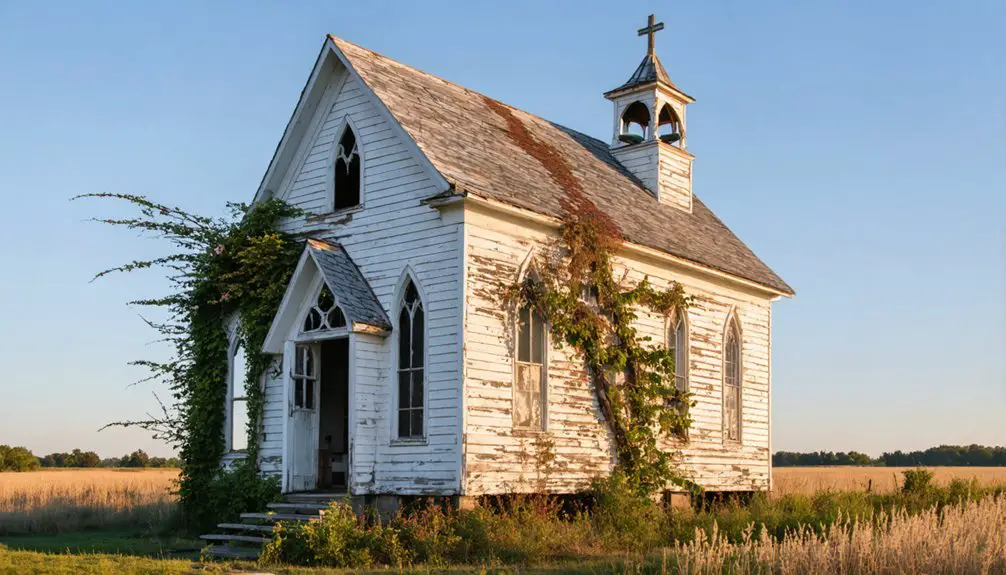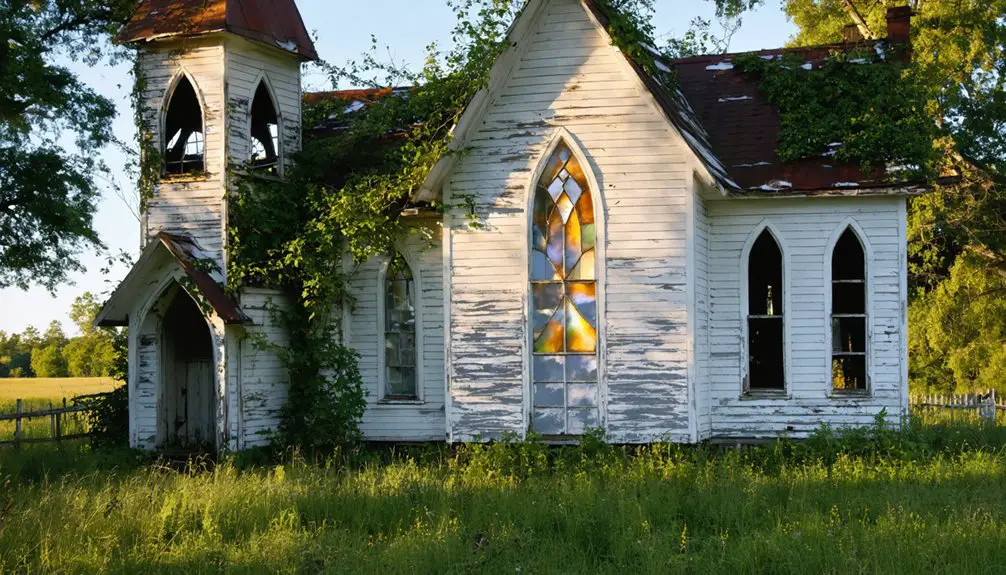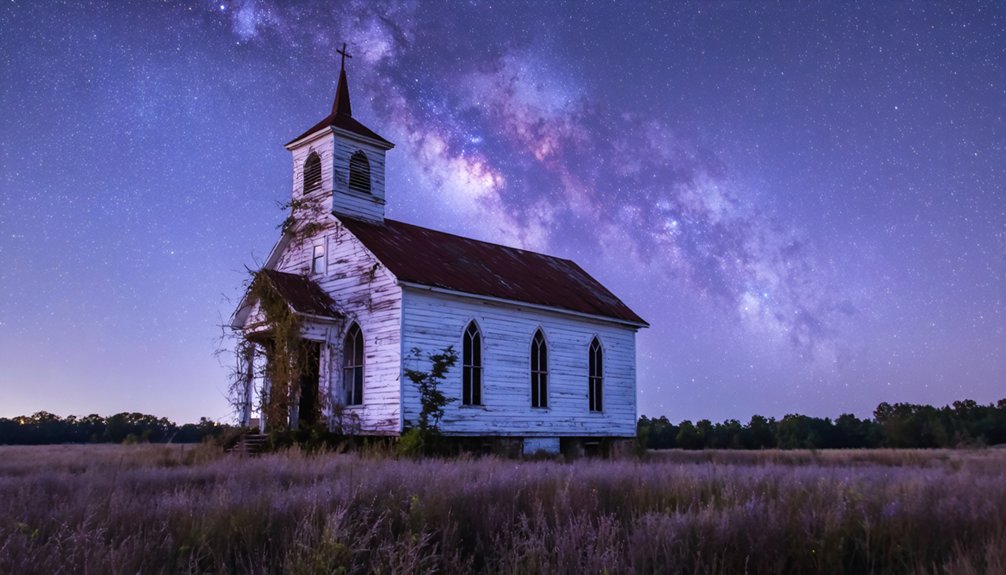
For ideal ghost town astrophotography in Mississippi, you’ll find prime conditions at Rodney and Electric Mills, which offer unobstructed southern sky views with minimal light pollution. Visit during winter months (December-February) when atmospheric transparency peaks, especially during new moon phases. You’ll need a Canon T6s or similar camera capable of manual settings, tripod, dew heaters, and protective gear. Safety protocols require hard hats and structural assessment before entering sites. These historic locations hold additional secrets for capturing the perfect Milky Way shot.
Key Takeaways
- Rodney ghost town offers exceptional night photography opportunities with its Baptist Church’s Greek Revival architecture silhouetted against star-filled skies.
- Electric Mills provides unobstructed southern sky views and industrial ruins that create striking contrasts with circular star patterns.
- Winter months (December-February) offer the clearest nights for ghost town astrophotography, particularly during new moon phases.
- Plymouth’s elevated bluff locations provide excellent vantage points for southern-sky shots and abandoned wharfs create compelling leading lines.
- Assess weather conditions for optimal shooting, seeking barometric pressure above 30.2 inHg and dew point spreads exceeding 10°F.
Although Mississippi’s ghost towns lie scattered across remote backroads and forgotten byways, several abandoned settlements offer exceptional dark sky viewing opportunities for astrophotography enthusiasts.
You’ll find Rodney 32 miles northeast of Natchez – take Route 552 west from Lorman, then turn past the Old Country Store on Highway 61 and continue northwest for 12 miles.
For historical significance, explore Electric Mills in Kemper County, where a 1910 sawmill operation once supported 1,000 residents. These sites contain fascinating remnants of infrastructure that provide glimpses into Mississippi’s industrial past.
Ghost town accessibility varies across locations like Holmesville in Pike County, which requires traversing local roads near former river trade routes.
When seeking Plymouth’s remnants, consult historical societies for precise coordinates, as many of these sites aren’t marked on standard maps. Many towns like Logtown were bulldozed by NASA in 1961, leaving behind only cemeteries and roads to explore.
Essential Gear for Night Sky Photography
You’ll need to master your camera’s manual settings, including shutter speed, ISO sensitivity, and aperture control, to capture the Milky Way above ghost town structures.
For optimal night sky shots, a sturdy tripod is essential to prevent any movement during the critical 10-30 second exposure times required for astrophotography.
Consider using a Canon T6s camera for its high-quality sensor and articulating touchscreen that helps with difficult angle compositions.
Protective gear becomes essential for your camera equipment, as night photography in abandoned locations exposes it to moisture, dust, and temperature variations.
A quality UV filter and weatherproof camera bag will shield your sensor and lenses while maintaining peak image quality during long exposures in these remote locations.
Basic Camera Settings Essentials
Three core camera settings form the foundation of successful astrophotography: manual exposure mode, wide apertures, and carefully selected ISO values.
To master the exposure triangle, you’ll need to switch to manual mode, which gives you complete control over your camera’s settings. Set your aperture as wide as possible – ideally f/2.8 or faster – to capture maximum light. The 500 Rule helps calculate ideal exposure times to avoid star trails.
For ISO settings, start between 800-3200 and adjust based on your camera’s noise performance and sky conditions. Using a sturdy tripod mount is essential for sharp, steady shots during long exposures.
You’ll want to shoot in RAW format to retain maximum dynamic range and enable stronger denoising in post-processing.
Disable your camera’s long-exposure noise reduction and auto-focus features. Instead, manually focus on bright stars using live view magnification.
Cover your viewfinder to prevent light leaks during those critical long exposures.
Must-Have Protective Equipment
When venturing into remote locations for astrophotography, proper protective gear becomes essential for both you and your equipment maintenance.
You’ll need a sturdy tripod with adjustable legs and a versatile ball head to prevent camera shake during long exposures. Protect your lens with a UV filter to eliminate haze and guard against scratches. Setting the shutter speed carefully between 12-24 seconds will help you achieve optimal star exposures without trailing.
For personal protection, pack insulated clothing and a red-light headlamp to preserve your night vision while keeping hands free for camera work. Many photographers also use equatorial mounts for precise tracking of celestial objects.
The dramatic temperature drops in ghost towns require dew heaters to prevent lens fogging, while power banks and extra batteries combat cold-weather power drain.
Don’t forget light pollution filters to cut through city glow, and a remote shutter release to minimize vibrations.
These protective measures guarantee peak image quality while safeguarding your valuable gear.
Optimal Seasons and Weather Conditions
You’ll find Mississippi’s winter months offer the clearest, most stable nights for capturing ghost town astrophotography, with reduced humidity and deeper dark skies between December and February.
Exploring the best drone spots in Mississippi during these months allows for breathtaking aerial perspectives of the state’s unique landscapes. From the picturesque rivers to the charming small towns, the drone footage captures a stunning contrast against the night sky. Make sure to check out local regulations to ensure a smooth flying experience while you explore.
Summer’s frequent thunderstorms and high humidity can disrupt shooting schedules and degrade image quality through increased light scatter, making it essential to monitor weather radar and lightning forecasts before heading out.
For best results, plan your ghost town shoots during the changing months of late autumn and early spring when you’ll benefit from both reasonable temperatures and good atmospheric transparency, especially at Petit Gouffre sites like Rodney where early French settlers established strategic river viewpoints. Be prepared for a twelve-mile journey on mixed blacktop and dirt roads to reach prime shooting locations.
Clear Winter Dark Nights
During Mississippi’s winter months, ghost town astrophotography reaches its peak capability with extended dark periods spanning 10-11 hours between 5 PM and 7 AM.
You’ll find excellent star visibility in December through February, when cold temperatures reduce atmospheric turbulence and post-frontal passages deliver crystal-clear skies.
For maximum night photography results, plan your shoots during new moon phases when temperatures hover between 40-55°F and winds stay below 5 mph.
You’ll benefit from winter’s reduced humidity and stable high-pressure systems, which create perfect conditions 60-70% of the time.
At Rodney Ghost Town, you’ll encounter Bortle 4-5 skies without summer’s obstacles like insects or dense foliage.
Watch for barometric pressure readings above 30.2 inHg and dew point spreads exceeding 10°F to guarantee prime shooting conditions.
Summer Storm Watch Timing
The summer storm season offers a dramatic contrast to winter’s clear skies, with Mississippi’s ghost towns providing ideal vantage points for capturing intense electrical storms from June through August.
Peak storm patterns develop between 2-6 PM as temperatures soar above 90°F, creating superior viewing windows for dramatic cloud formations and lightning displays.
- Track GOES-19 satellite updates every 5 minutes for real-time storm evolution
- Position yourself 1 hour before sunset for golden hour storm build-up shots
- Maximize lightning captures during peak hours of 9 PM-12 AM
- Monitor dust RGB products showing magenta plumes during daytime storms
- Target early morning 4-6 AM sessions for dissipating storm remnants
You’ll find the most intense convective activity mid-summer, with July averaging 1 million lightning strikes statewide – perfect for capturing nature’s raw power from abandoned town vantage points.
Planning Your Ghost Town Star Shoot
Successful astrophotography in Rodney, Mississippi requires precise timing and gear coordination with its remote dark sky conditions.
You’ll find ideal shooting conditions during winter months when the Bortle scale readings align with NOAA’s dark sky measurements, though local legends and ghost stories add an ethereal dimension to nighttime shoots at Mt. Zion No. 1 Baptist Church.
Pack your wide-angle lenses to capture the silver dome against star-filled skies, and bring sturdy tripods for long exposures.
Access the site via Highway 61’s Old Country Store marker, following the unmarked road northwest for 12 miles. Navigate carefully through alternating blacktop and dirt surfaces until you reach the curbed entry.
Position your gear near the Presbyterian Church’s bell tower or the Baptist Church’s Gothic arches for compelling architectural framing against the dark sky backdrop.
Safety and Preservation Guidelines
While capturing stunning astrophotography in ghost towns requires technical expertise, protecting both yourself and these historic sites demands equal attention to safety protocols and preservation guidelines.
Following strict safety protocols and preservation ethics guarantees both your wellbeing and the site’s integrity for future generations.
Proper safety and preservation practices serve dual purposes – protecting photographers today while safeguarding historic places for tomorrow’s visitors.
- Always assess structural stability before entering any building, watching for sagging roofs and unstable floors.
- Wear appropriate PPE including hard hat, steel-toe boots, and respirator when near deteriorated structures.
- Use existing entry points only – never create new openings or remove architectural elements.
- Position equipment on non-damaging surfaces and avoid anchoring to historic materials.
- Obtain necessary permits and written permissions before accessing abandoned properties.
These guidelines help maintain Mississippi’s historic resources while keeping you safe during nighttime shoots.
Remember that even abandoned properties remain protected by preservation ordinances and trespassing laws.
Top Photography Spots in Each Location
Spanning across three distinct ghost town locations, premier astrophotography spots offer unique compositional opportunities through their preserved architectural elements and natural features.
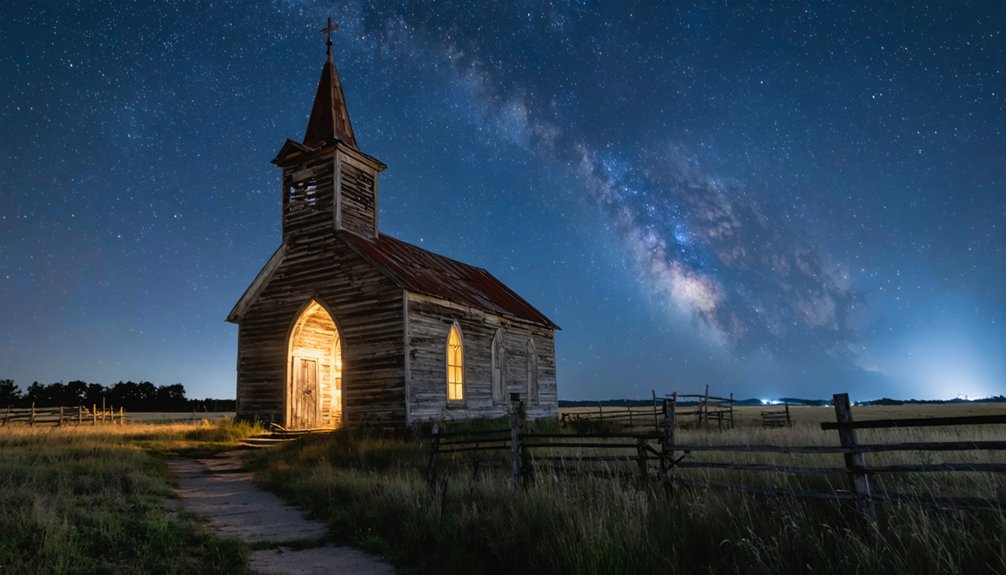
Rodney highlights include the Baptist Church’s Greek Revival silhouette against the Milky Way and the Presbyterian bell tower’s vertical framing for Orion.
You’ll find Plymouth perspectives along elevated bluff overlooks, perfect for southern-sky galactic core shots, while its abandoned wharfs create leading lines for star trails over water.
At Electric Mills, the industrial ruins provide geometric shapes that contrast beautifully with circular star patterns, while its canal remnants enable mirror-like Milky Way reflections.
For ideal results, utilize the Baptist Church’s low horizons for long exposures, Plymouth’s marsh edges for doubled starfield brightness, and Electric Mills’ clearing for unobstructed southern sky views.
Frequently Asked Questions
Are There Any Paranormal Activity Reports While Photographing These Ghost Towns?
Like a quiet night sky without shooting stars, you won’t find documented paranormal encounters or ghost sightings at these locations during photography sessions, despite their haunted-looking appearances and historic settings.
Which Ghost Towns Require Special Permits or Landowner Permission for Access?
You’ll need permits for MDAH-designated sites on public lands and written landowner permission for private ghost towns. Access restrictions apply to utility corridors, conservation easements, and municipal/county-owned historic areas.
How Reliable Is Cell Phone Service in These Remote Locations?
You’ll find unreliable cell coverage at most ghost town sites, with signal strength varying dramatically by carrier. AT&T offers ~84% statewide coverage, but expect dead zones in remote locations and river bottoms.
Are There Any Nearby Accommodation Options for Multi-Night Photography Sessions?
You’ll find local lodging at Oak Hall Hotel, Cedar Grove Inn, and Monmouth Historic Inn, plus RV camping facilities near Rodney. Most locations offer multi-night stays with modern amenities.
What Wildlife Encounters Should Photographers Be Prepared for in These Areas?
You’ll encounter white-tailed deer, feral hogs, and coyotes during night shoots. Watch for venomous snakes, alligators near water, and roosting owls. Wildlife sightings intensify around abandoned structures after dark.
References
- https://mississippifolklife.org/articles/haunted-by-a-ghost-town-the-lure-of-rodney-mississippi
- https://www.onlyinyourstate.com/experiences/mississippi/ms-ghost-towns
- https://visitusaparks.com/dark-sky-parks-eastern-us/
- https://www.go-astronomy.com/dark-sky-parks-stargazing-state.php?State=MS
- https://www.youtube.com/watch?v=z7pw1Q-9s_E
- https://www.tripadvisor.com/Attraction_Review-g28945-d10045204-Reviews-Rodney_Ghost_Town-Mississippi.html
- https://www.homestratosphere.com/secluded-towns-in-southwest-mississippi/
- https://www.atlasobscura.com/itineraries/ghosts-from-mississippi
- https://en.wikipedia.org/wiki/List_of_ghost_towns_in_Mississippi
- https://freepages.rootsweb.com/~gtusa/history/usa/ms.htm