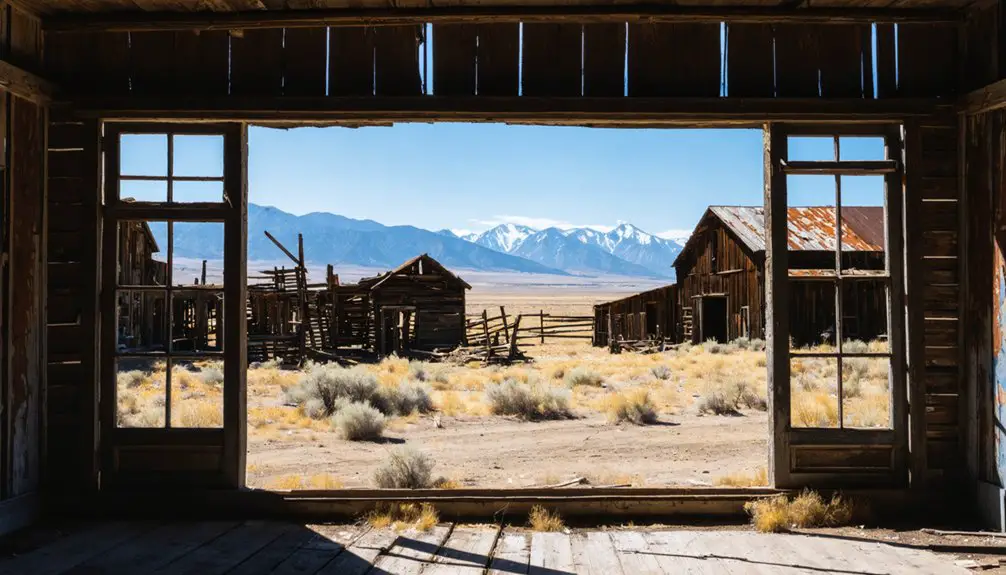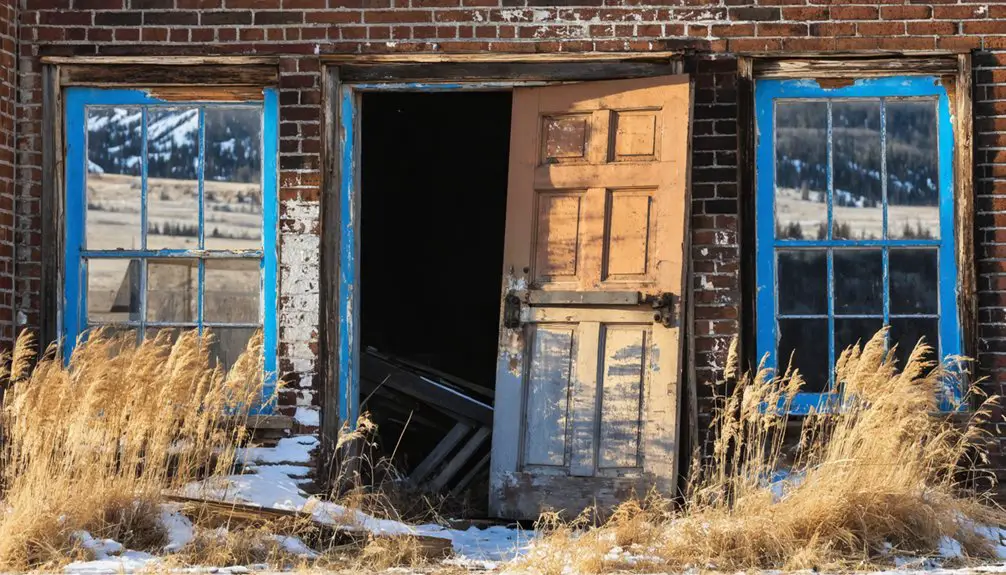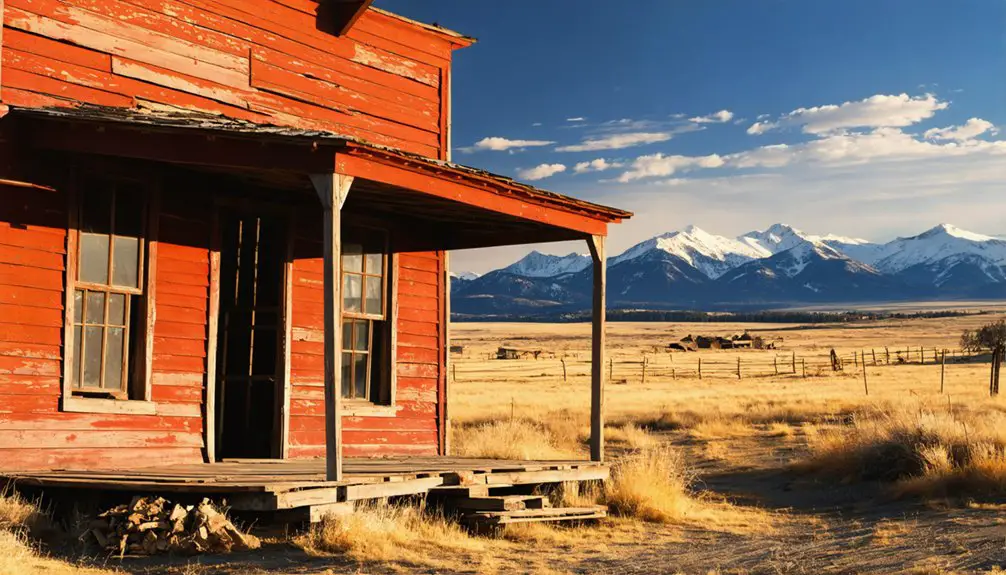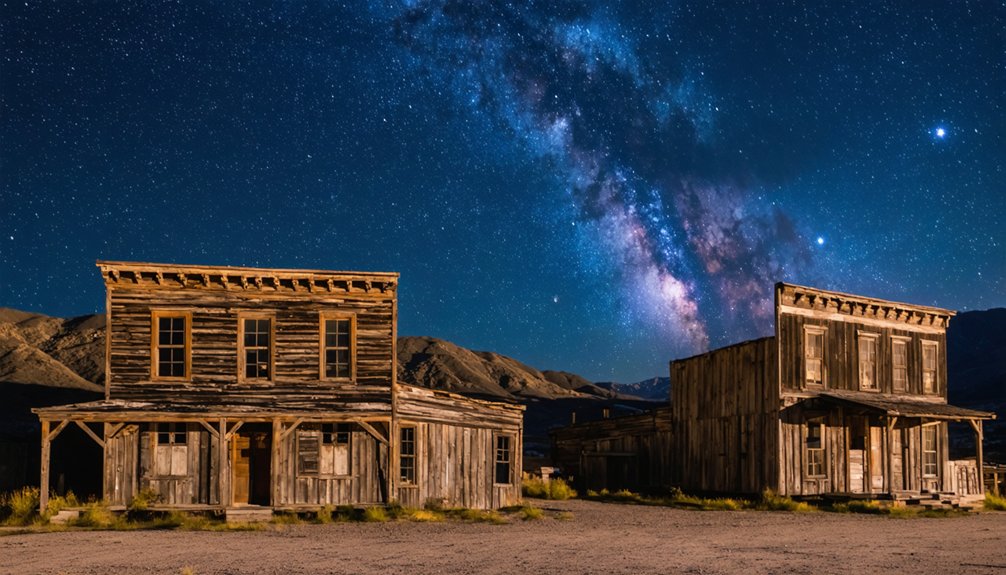
You’ll find exceptional astrophotography conditions at Montana’s ghost towns, where Bortle Class 1-2 dark skies meet preserved Old West architecture. Bring your full-frame camera with a fast wide-angle lens (f/1.4-f/2.8) to capture the Milky Way above historic facades in Bannack, Garnet, or Virginia City. Plan your shoot during moonless nights between May and September for ideal conditions. Beyond basic gear, you’ll need permits and safety protocols to access these stellar locations’ full potential.
Key Takeaways
- Bannack State Park offers organized night access and historic 1860s structures perfectly positioned for Milky Way photography.
- Garnet Ghost Town provides self-guided BLM access and minimal light pollution due to its remote mountain location.
- Virginia City features well-preserved Victorian architecture and dark skies, ideal for combining historic elements with stellar photography.
- Elkhorn State Park presents pristine dark sky conditions and authentic mining-era buildings for compelling foreground compositions.
- Nevada City offers restored period structures and designated dark sky viewing areas with minimal modern light interference.
Why Montana Ghost Towns Offer Prime Night Sky Photography
While many locations offer dark skies for astrophotography, Montana’s ghost towns provide an unparalleled combination of pristine darkness and historic architecture that’ll transform your nightscape images.
Montana’s ghost towns merge untouched darkness with historic Wild West charm, creating the perfect canvas for extraordinary nighttime photography.
You’ll find Bortle class ratings rivaling the darkest sites globally, with minimal light pollution across vast public lands. The state’s commitment to night sky preservation has established multiple Dark Sky sanctuaries, while its sparse population guarantees exceptionally dark backgrounds for your deep-sky shots.
When you’re tracking the Milky Way, you’ll capture it rising above authentic Old West structures, from preserved mining headframes to wooden storefronts. The original 19th-century structures still standing in places like Virginia City create striking silhouettes against the starlit sky. Garnet Ghost Town offers over 30 intact buildings for diverse architectural compositions. Most ghost town sites sit at elevations where thin, dry air enhances transparency and seeing conditions.
You’ll benefit from stable atmospheric conditions, especially in mountain locations where you can position above valley haze.
Essential Camera Gear for Ghost Town Stargazing
You’ll want to start with a full-frame mirrorless or DSLR camera paired with a fast wide-angle lens (f/1.4-f/2.8) to capture the starlit Montana skies above abandoned structures.
A robust tripod rated for your camera-lens combination is essential for sharp multi-second exposures in variable ghost town terrain.
Pack a reliable head torch to safely navigate between shooting locations and adjust camera settings in the dark.
Don’t forget your intervalometer or remote trigger to minimize camera shake and enable precise control over exposure sequences.
Consider shooting in RAW format to maximize your ability to enhance details and reduce noise during post-processing.
Camera Bodies and Lenses
Selecting the right camera equipment forms the foundation of successful ghost town astrophotography.
You’ll want a full-frame mirrorless camera body for superior low-light performance, though modern APS-C sensors can still deliver excellent results at a lower cost. The Pentax K12 excels with its Astroracer technology for capturing clear night sky images. Dedicated astronomy cameras offer zero amp glow for pristine long exposures. Look for bodies with minimal read noise and reliable amp-glow control for those long exposures under the stars.
For lens types, ultra-wide options in the 14-24mm range will capture sweeping views of abandoned structures against the Milky Way.
Fast apertures of f/2.8 or wider are essential – they’ll let you keep ISO levels down while gathering enough starlight. Choose lenses with strong edge-to-edge sharpness and minimal coma distortion to maintain pinpoint stars.
Weather-sealed construction is a must for those cold Montana nights spent photographing these historic sites.
Tripods and Remote Triggers
Since ghost town astrophotography demands absolute stability for those long star exposures, a robust tripod system forms your critical foundation.
Choose carbon-fiber legs with a load capacity 1.5 times your gear weight, and opt for either twist-locks for quick setup or lever-locks for heavier equipment. The iFootage Gazelle TC3B is an excellent choice for its lightweight, travel-friendly design. You’ll want an Arca-Swiss compatible ball head for rapid framing while maintaining precise adjustments.
The built-in leveling head design found in modern tripods provides crucial stability for panning and tilting movements. For Montana’s challenging terrain, equip your tripod with interchangeable rubber feet and spikes, plus a leveling base for fine-tuning on uneven ground.
Don’t forget vibration-damping accessories like weight hooks or sandbags to counter those valley gusts. For shutter control, pack both wired and wireless triggers – intervalometers for reliable long exposures, and Bluetooth remotes for convenient focus checks without disturbing your carefully aligned setup.
Best Seasons and Times for Ghost Town Astrophotography
While each season offers unique opportunities for ghost town astrophotography, fall and spring emerge as prime shooting periods due to their extended dark hours and stable atmospheric conditions.
You’ll find ideal conditions during new moon phases, particularly from third to first quarter, when moonlight won’t wash out your ghost town compositions.
Plan your shoots between May and September to capture the Milky Way arcing over abandoned structures, with August’s Perseid meteor shower adding natural fireworks to your frames.
Montana’s dry, clear air minimizes atmospheric distortion, making ghost town features exceptionally sharp against the night sky.
For crystal-clear winter shots, bundle up and take advantage of the prominent Winter Hexagon constellations illuminating historic ruins.
Remember to track weather forecasts vigilantly, as Montana’s seasonal changes can bring unexpected storms.
Your best results will come during dry, crisp evenings when high elevation and low light pollution combine for exceptional visibility.
Consider visiting Glacier National Park’s Logan Pass for unparalleled views of both stars and historic structures.
Before setting up your star-tracking gear at a ghost town, you’ll need to verify both nighttime access permissions and photography permit requirements with the managing agency.
You’ll find that some locations restrict access after sunset or require special permits for tripod use and night photography equipment.
Federal lands often have different permit requirements than state parks or privately managed ghost towns, so you’ll want to check recreation.gov or the specific land manager’s website for the most current rules.
Night Access Guidelines
Successfully photographing ghost towns at night requires thorough understanding of access regulations across different land jurisdictions.
Before heading out, you’ll need to determine whether your target location sits on federal, state, county, or private land, as each has distinct legal restrictions. Many Montana ghost towns enforce strict dusk-to-dawn closures, while others require special permits for night photography.
When planning your visit, it’s also worth considering the best seasons for Montana ghost towns, as accessibility and weather conditions can greatly impact your experience. Spring and fall typically offer mild temperatures and fewer crowds, making them ideal for exploration. Be sure to check local events, as some ghost towns host unique festivals that provide deeper insights into their history.
Check property records and secure necessary access permissions before your shoot. Federal lands often demand special-use permits for organized photography, while state parks enforce specific hours.
You’ll want to verify current seasonal closures and temporary restrictions through agency websites. Keep permit documentation readily available – law enforcement regularly patrols these areas after dark.
For private lands, always obtain explicit owner permission to avoid trespassing violations.
Site Photography Permits
Understanding permit requirements forms the foundation of legal ghost town astrophotography access.
You’ll need to navigate multiple jurisdictions, from federal and state lands to tribal territories and private property. For commercial shoots or organized photo tours, you’ll typically need specific permits, while larger productions require special-use permits based on crew size and equipment.
Before setting up your star tracker, verify permit types for your chosen location. Federal lands require commercial permits for any profit-oriented photography, while state parks use tiered fees based on crew size.
Submit applications well in advance – at least 2-4 weeks for basic permits, longer for complex shoots. Don’t forget insurance requirements and detailed site maps, especially for Forest Service locations where 1:24,000 topographic maps are standard.
Top Composition Tips for Historic Buildings Under Stars
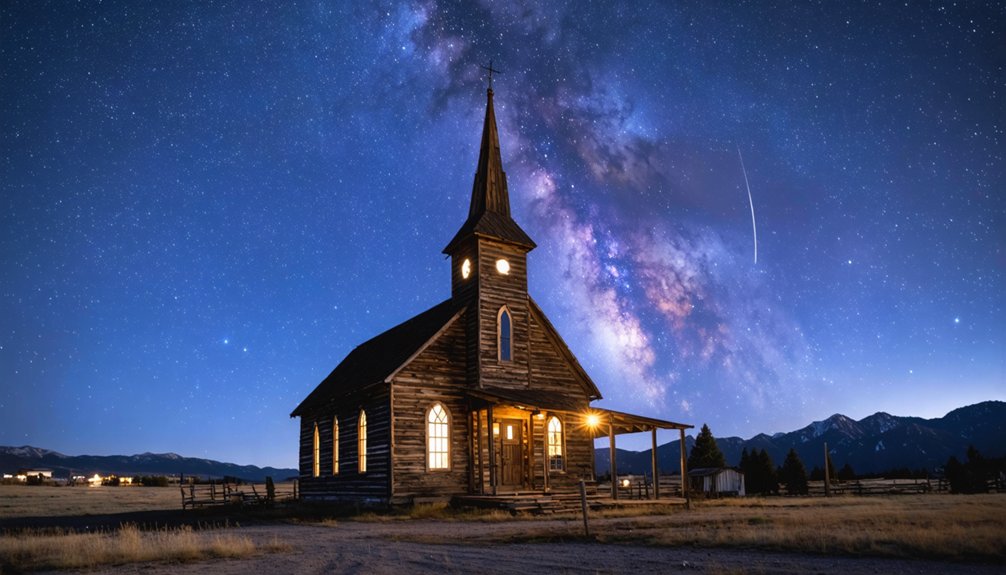
Capturing ghost town architecture beneath starlit skies demands precise compositional techniques to balance terrestrial and celestial elements effectively.
You’ll want to position historic facades as prominent foreground anchors while using their structural elements to frame the celestial display above.
For compelling framing strategies, align building features with astronomical elements – point window frames toward the Milky Way’s core or use collapsed beams to create leading lines to star trails.
Work during the darkest hours, from 11 PM to 2 AM, when the galactic core arches perfectly over preserved structures.
Set up your shots at low angles, allowing building silhouettes to draw the eye skyward.
Remember to incorporate contextual elements like rusted mining equipment or weathered doors to add depth while maintaining focus on the interplay between architecture and stars.
Safety Guidelines for Night Photography in Abandoned Sites
While the allure of ghost town astrophotography beckons, prioritizing safety protocols in abandoned locations can mean the difference between a successful shoot and a dangerous situation.
You’ll need proper safety equipment including a sturdy headlamp, backup flashlights, and fresh batteries to maintain night visibility throughout your session. Always bring a photography partner and notify someone of your location and return time.
Before setting up your gear, thoroughly inspect building structures for hazards like unstable floors or sharp debris. Wear protective boots, gloves, and dust masks while traversing these sites.
Keep your essential gear minimal – one camera, lens, and tripod – in a backpack worn at all times. Remember to obtain proper permissions beforehand, and respect these historical locations by leaving everything untouched as you document the stars above.
Weather Patterns and Dark Sky Conditions
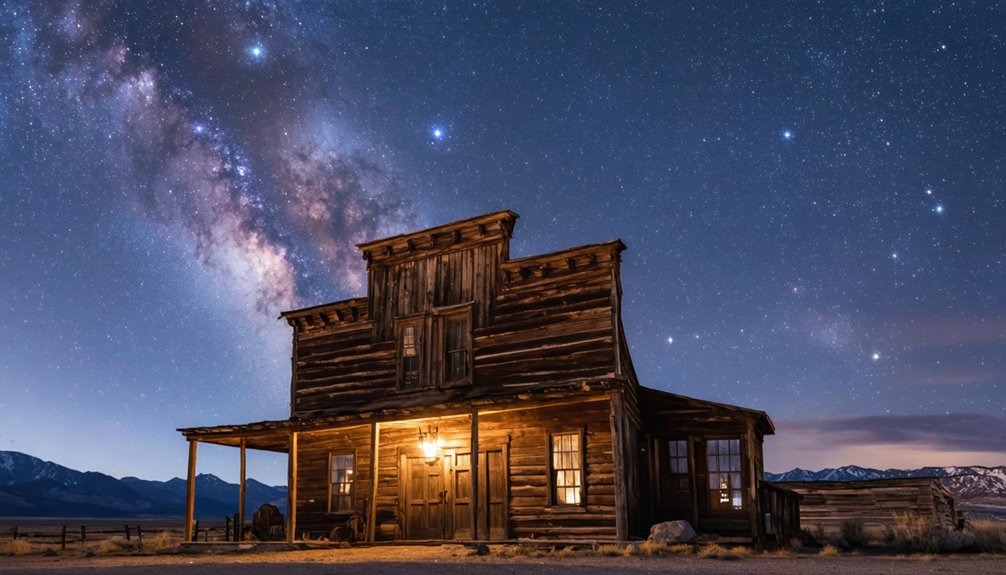
To achieve exceptional astrophotography in ghost towns, you’ll need to monitor several essential dark sky conditions. Track weather trends through reliable forecasting apps, focusing on cloud cover patterns and atmospheric transparency.
Montana’s ranking as the 9th cloudiest state means you’ll need to carefully plan your shoots during clear periods. For ideal results, schedule your ghost town visits during new moon phases when moonlight won’t wash out the stars.
The state’s vast, sparsely populated areas shield against light pollution, particularly in remote locations near the Whitefish Range and Cabinet Mountains. You’ll find Bortle scale level 1 darkness in these areas, perfect for capturing the Milky Way above historic structures.
Monitor geomagnetic activity – high Kp-index values could add stunning auroras to your compositions during clear nights.
Local Photography Groups and Guided Tours
Photography enthusiasts seeking ghost town astrophotography can join several established groups and guided tours across Montana.
Among these tours, abandoned towns in Montana for photography present unique opportunities to capture stunning landscapes and historical relics. Each town tells a story, providing a haunting backdrop that enhances the visual narrative. Photographers can play with light and shadow, creating breathtaking contrasts against the remnants of the past.
Montana’s ghost towns offer photographers unique opportunities to capture the night sky through organized group tours and expert guidance.
You’ll find specialized night access through Bannack State Park’s ghost tours and structured evening programs, perfect for setting up tracking mounts and long exposures.
The Montana Learning Center offers hands-on experience with the state’s largest public telescope, while Glacier Country’s Dark Sky programs provide prime locations for Milky Way shots from June through September.
For self-guided options, explore BLM-managed Garnet Ghost Town’s 20 intact structures, ideal for nighttime compositions.
Local photography groups frequently organize sessions at Elkhorn State Park and Marysville, where you can collaborate with fellow astrophotographers.
These guided tours help you navigate the best shooting locations while ensuring proper site access and safety protocols.
Photo Processing Techniques for Ghost Town Night Shots

Processing ghost town astrophotography requires mastery of specialized techniques that blend terrestrial and celestial elements. You’ll need to stack your raw frames in DeepSkyStacker, carefully selecting the sharpest exposures while preserving delicate details in both building structures and star fields.
For ideal results with ghost town night shots:
- Remove light pollution gradients using DBE in PixInsight, paying special attention to artificial lighting from nearby towns.
- Apply selective noise reduction differently to buildings versus sky regions.
- Create separate processing layers for architectural elements and the Milky Way.
During photo editing, you’ll want to balance exposure settings between the ghost town’s dark shadows and bright star points. Use a starless layer for building enhancements, then blend it back with your sky layer using soft light mode for natural-looking results.
Frequently Asked Questions
Are There Any Paranormal Photography Opportunities in These Ghost Towns?
You’ll find paranormal hotspots at Garnet’s saloon, Gunslinger Gulch’s hotel, and Bannack’s dredge pond. Track ghostly legends with long exposures while shooting the Milky Way over these historically haunted structures.
Which Ghost Towns Have Cell Phone Coverage for Emergency Situations?
While 55% of Montana has AT&T coverage, you’ll find reliable cell service at Virginia City and Nevada City. For remote ghost towns, you’ll need a satellite phone for emergency communication.
How Close Is the Nearest Gas Station to Each Location?
You’ll find gas stations nearest to Granite Ghost Town (10 miles), Virginia City (15 miles), Bannack (25 miles), and Garnet (20 miles). Fuel availability’s most reliable in Philipsburg, Sheridan, Dillon, and Bearmouth.
Do Any Ghost Towns Offer Overnight Camping or Lodging Options?
You’ll find camping amenities at both Garnet and Bannack. Garnet offers winter cabin rentals and dispersed camping, while Bannack provides 24 developed campsites. Nearby lodging options include RV parks and modern hotels.
Are There Wildlife Concerns When Photographing at These Locations at Night?
You’ll need to watch for black bears raiding your camera bag – like last month’s incident in Garnet. Stay alert for nocturnal wildlife, travel in groups, and keep food locked in your vehicle.
References
- https://www.roamingnearandfar.com/montana-ghost-towns-near-helena/
- https://melissawhitneyphotography.com/2020/10/01/the-ghost-towns-of-garnet-and-granite-montana/
- https://www.mountain-home.com/blog/vacation-planning/guide-montana’s-ghost-towns
- https://bluemountainbb.com/blog/ghost-towns-montana/
- https://glaciermt.com/stargazing
- https://montana.darksky.ngo/dark-sky-destinations/
- https://z100missoula.com/montana-locations-dark-sky/
- https://visitmt.com/things-to-do/ghost-towns
- https://fwp.mt.gov/stateparks/granite-ghost-town
- https://southwestmt.com/ghosts/haunted-places/