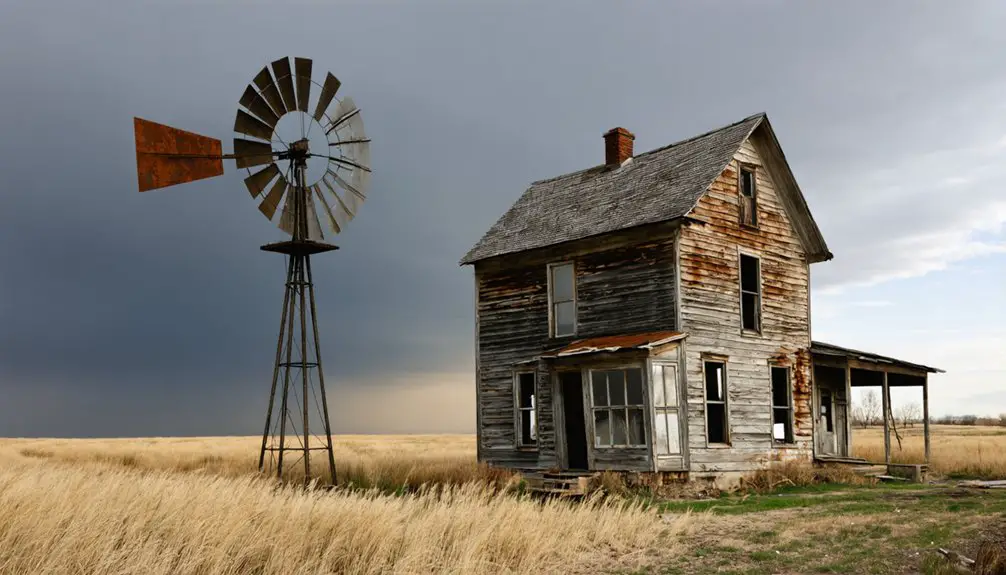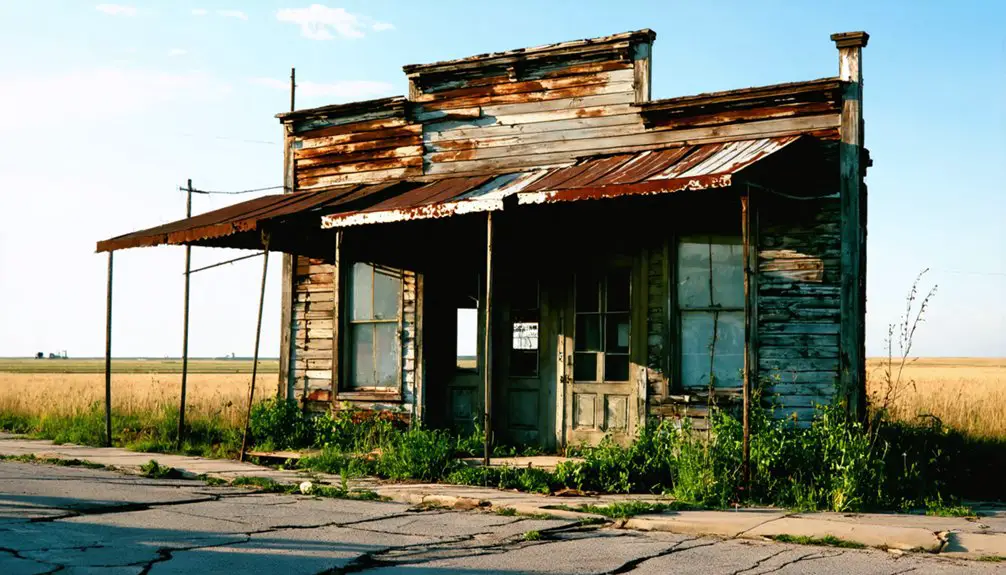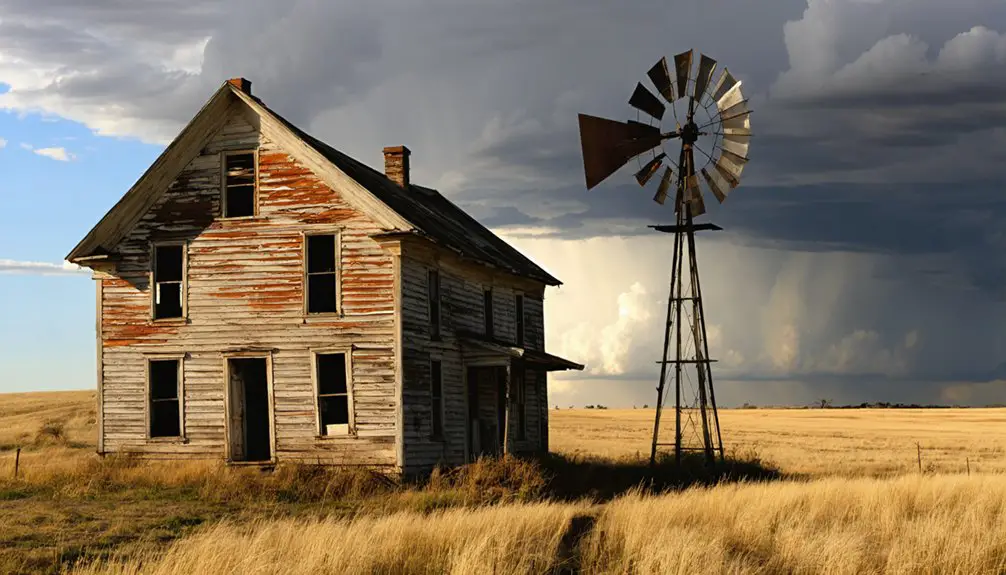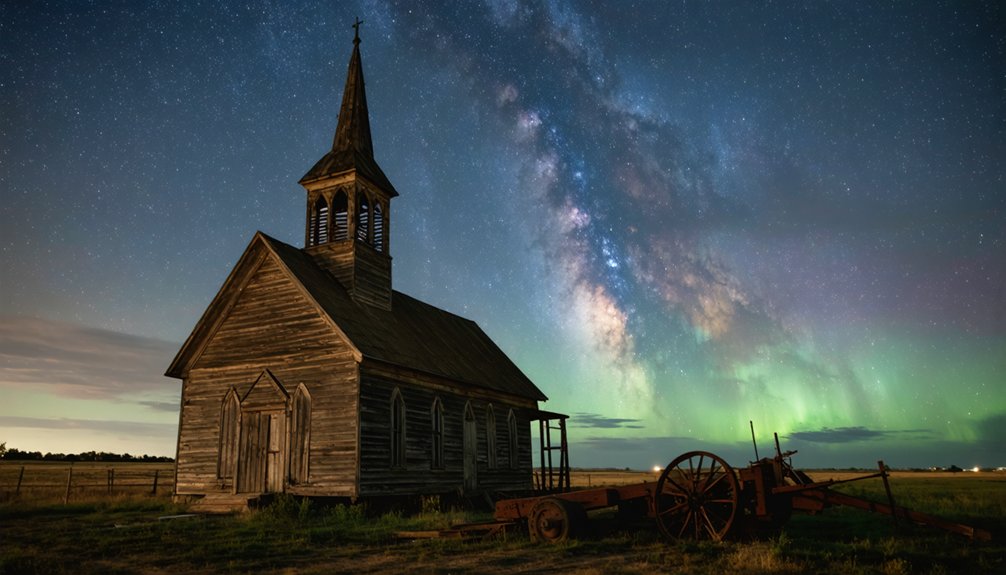
You’ll find exceptional astrophotography conditions at Nebraska’s ghost towns, where minimal light pollution meets compelling architectural elements. Locations like Brocksburg and St. Deroin offer Bortle-rated dark skies perfect for capturing the Milky Way, while abandoned structures create dramatic silhouettes. Western sites like Roscoe and the Sandhills region provide expansive celestial vistas, and Merritt Reservoir’s Dark Sky Park designation enhances nearby opportunities. Understanding the specific sites and seasons will maximize your starscape success.
Key Takeaways
- Brocksburg, situated along the Outlaw Trail Scenic Byway, offers exceptionally dark skies and minimal light pollution for astrophotography.
- St. Deroin provides accessible paved roads and historic structures that create dramatic silhouettes against star-filled night skies.
- Belmont features striking architectural elements and remote location perfect for capturing the Milky Way and stellar compositions.
- Antioch’s abandoned potash reduction plants offer unique industrial foreground elements for night sky photography compositions.
- Montrose’s solitary church structure serves as an ideal foreground subject against dark skies with minimal light interference.
Why Nebraska Ghost Towns Offer Unique Night Sky Photography
The ghost towns scattered across Nebraska’s High Plains serve as extraordinary platforms for capturing the cosmos, offering astrophotographers a rare combination of minimal light pollution and compelling foreground elements.
You’ll find pristine dark skies rated exceptionally low on the Bortle scale, particularly in remote locations like Brocksburg and St. Deroin where cosmic solitude awaits.
The ghost town allure intensifies as historical structures create dramatic silhouettes against star-filled skies. The haunting remains of potash reduction plants in Antioch provide unique industrial elements for night photography compositions.
Places like Belmont, with its rock tunnel and abandoned saloons, provide compelling compositional elements for your nightscape photography. Towns like Steele City offer many great old buildings as striking architectural subjects against the night sky.
Abandoned frontier outposts like Belmont offer ghostly architectural frames perfectly suited for capturing the celestial drama above Nebraska’s plains.
The state’s flat terrain and strategic positioning near dark sky parks, including Merrit Reservoir, eliminate light pollution interference.
You’ll discover unparalleled shooting conditions where abandoned homesteads and empty Main Streets frame the Milky Way in haunting perfection.
Essential Planning and Safety Considerations
You’ll need to carefully map your route through Nebraska’s remote ghost towns, utilizing offline GPS and consulting updated road conditions to guarantee safe access to prime dark sky locations.
Before heading to sites like Brocksburg or Venus, check NOAA forecasts for clear skies and low wind conditions, while planning around new moon phases for ideal astrophotography conditions.
Many astrophotographers use the Bortle scale ratings to determine which ghost towns offer the darkest skies for capturing the Milky Way.
Pack emergency gear including satellite communications, first aid supplies, and cold weather equipment, as these isolated locations often lack cell service and expose you to sub-freezing winter temperatures.
Consider bringing warm drinks to enjoy during long exposure shots, which can help you stay comfortable during extended nighttime photography sessions in these abandoned locations.
While exploring Nebraska’s ghost towns for astrophotography requires careful route planning, most sites offer surprisingly straightforward access via state highways and county roads.
You’ll find Brocksburg along the Outlaw Trail Scenic Byway, with GPS navigation guiding you south on Highway 137 to the final dirt road before the Keya Paha River.
St. Deroin’s paved state park roads convert smoothly to walking trails, while Venus demands precise coordinates through its sparse landscape.
Road conditions near Harrison benefit from the protective ponderosa pines, making night navigation manageable.
For western sites like Dalton, prominent grain elevators serve as daytime landmarks before you venture into the dark zones.
Most locations support vehicle access close to your shooting locations, minimizing gear hauling through unfamiliar terrain.
Towns like Arthur feel especially remote with their miles of Sandhills surroundings, offering pristine dark sky views with minimal light pollution.
The Hyde Observatory in Lincoln provides expert guidance for amateur astronomers seeking prime astrophotography locations throughout the state.
Weather and Emergency Readiness
Successful astrophotography in Nebraska’s ghost towns demands strategic weather monitoring and emergency preparedness.
You’ll need to track weather patterns through ClearDarkSky charts and MET Norway data to optimize your shooting conditions.
Winter nights tend to provide the most stable viewing conditions for ghost town astrophotography.
When planning your ghost town excursions, consider these essential emergency protocols:
- Use autumn and winter months for clearer skies and lower humidity levels, especially when capturing long-exposure shots.
- Monitor transparency metrics closely – you’ll need above-average conditions for capturing nebulae and galaxy details.
- Keep equipment covered when humidity reaches 95% with opaque clouds, as rain is likely imminent.
- Set up emergency evacuation routes before dark, and always bring red flashlights for safety.
Check the CMC forecast accuracy which provides 80% reliability for clear conditions within a 12-hour window, helping you better time your photography sessions.
Top Ghost Town Locations for Star Photography
You’ll find exceptional astrophotography opportunities across Nebraska’s ghost towns, where remote locations minimize light pollution and maximize star visibility.
Historic structures in towns like Belmont and St. Deroin provide compelling architectural elements to frame your starscape compositions, while their isolation guarantees peaceful shooting conditions.
Western locations like Roscoe offer particularly dark skies, letting you capture both the Milky Way and intricate star trails against the silhouettes of weathered buildings. The haunting beauty of Montrose’s solitary church structure creates an ideal focal point against the expansive night sky. Merritt Reservoir’s recent designation as a Dark Sky Park makes nearby ghost towns especially prime for nighttime photography.
Remote Western Locations Shine
When seeking pristine dark skies for astrophotography in Nebraska, three remote western locations stand out for their compelling combination of historic ruins and stellar visibility.
Night sky folklore makes Brocksburg’s abandoned homesteads particularly alluring, while the Sandhills region delivers expansive celestial vistas steeped in ghost town legends.
- Brocksburg’s mature trees create natural silhouettes against the Milky Way core, best captured late spring through autumn.
- Sandhills cluster towns offer uncluttered horizons perfect for star-trail panoramas.
- Dobytown’s historic markers provide compelling foreground elements.
- Fort Kearny corridor enables easier site reconnaissance with highway accessibility.
Pack high-clearance vehicles and confirm private land permissions before venturing out.
You’ll find the darkest skies from spring through fall, though winter offers crystal-clear viewing despite challenging conditions.
Dark Sky Opportunities Abound
Nebraska’s prime ghost town locations offer exceptional dark-sky opportunities for astrophotographers seeking both historical intrigue and stellar clarity.
You’ll find premier conditions at Merritt Reservoir, where the International Dark Sky Park designation guarantees pristine skies for deep-space imaging and Milky Way compositions.
The river-valley ghost settlements near Niobrara provide natural shielding from light pollution, while abandoned structures create compelling foregrounds for celestial events.
You’ll discover prime shooting conditions in remote Sandhills locations like Brocksburg, where minimal artificial lighting and low humidity deliver sharp star points.
The railroad-abandoned crossroads of Belmont offer linear features perfect for star trails and panoramic stacks.
These dark sky sites combine historical remnants with exceptional astronomical viewing, letting you capture both Nebraska’s past and the cosmos above.
Historic Structures Frame Stars
Historic ghost town structures provide exceptional framing elements for astrophotography, with each architectural style offering distinct compositional advantages. Nebraska’s architectural beauty shines through abandoned Main Streets, grain elevators, and church ruins – each offering unique opportunities for capturing the cosmos while preserving historic elements in your shots.
- Main Street storefronts create dramatic leading lines that guide viewers’ eyes from weathered facades to the Milky Way core above.
- Towering grain elevators serve as stark vertical anchors for star trails, while their metal surfaces catch subtle moonlight for added dimension.
- Church steeples and cemetery markers provide symbolic elements against starlit skies, perfect for meteor shower compositions.
- Historic preservation meets astrophotography when you use textured materials like peeling paint and rusted metal to add microcontrast in long exposures.
Best Seasons and Times for Ghost Town Astrophotography
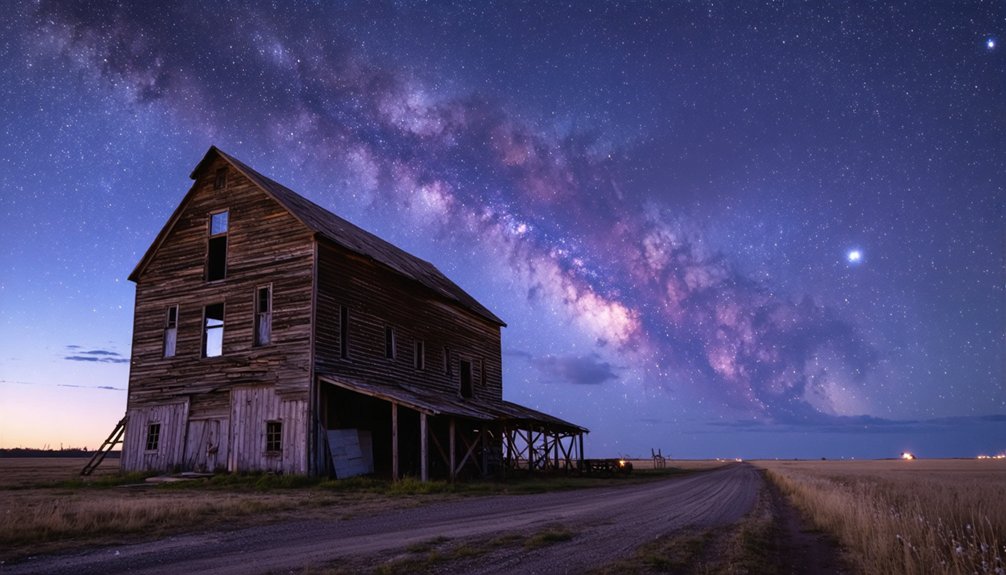
Choosing the ideal season for ghost town astrophotography requires careful consideration of Nebraska’s complex atmospheric conditions throughout the year.
Winter delivers the clearest skies with cold, dry air that’s perfect for long exposures, while autumn offers a sweet spot of warmer nights and stable atmospheric conditions.
Winter’s crisp clarity meets autumn’s comfortable equilibrium, offering photographers two stellar seasons for capturing the night sky’s mysteries.
You’ll find prime timings for Milky Way core shots during late spring through summer, especially in elevated ghost town locations away from river valleys.
Plan your seasonal considerations around specific targets – winter’s perfect for Orion Nebula shoots, while summer nights reveal the galactic center.
You’ll want to time your visits within three days of the new moon for maximum darkness, though quarter moons can work well for ghost town foregrounds while maintaining some deep-sky visibility.
Required Equipment and Technical Setup
Three essential camera systems anchor successful ghost town astrophotography in Nebraska’s forgotten spaces: a low-noise capable DSLR/mirrorless body, fast wide-angle glass, and rock-solid support.
You’ll need camera settings optimized for high ISO performance up to 1250 and lens recommendations starting at f/4 or faster.
- Nikon Z6ii paired with the Z 20mm f/1.8 excels at capturing the Milky Way above weathered structures
- Professional-grade tripod rated for extended exposures on unstable terrain
- High-powered lighting tools for foreground illumination and safe navigation
- Intervalometer and abundant memory storage for extended shooting sessions
Pack your gear in rugged protective cases suited for Nebraska’s remote locations.
Consider bringing a laptop loaded with processing software to review your captures on-site and adjust your technique accordingly.
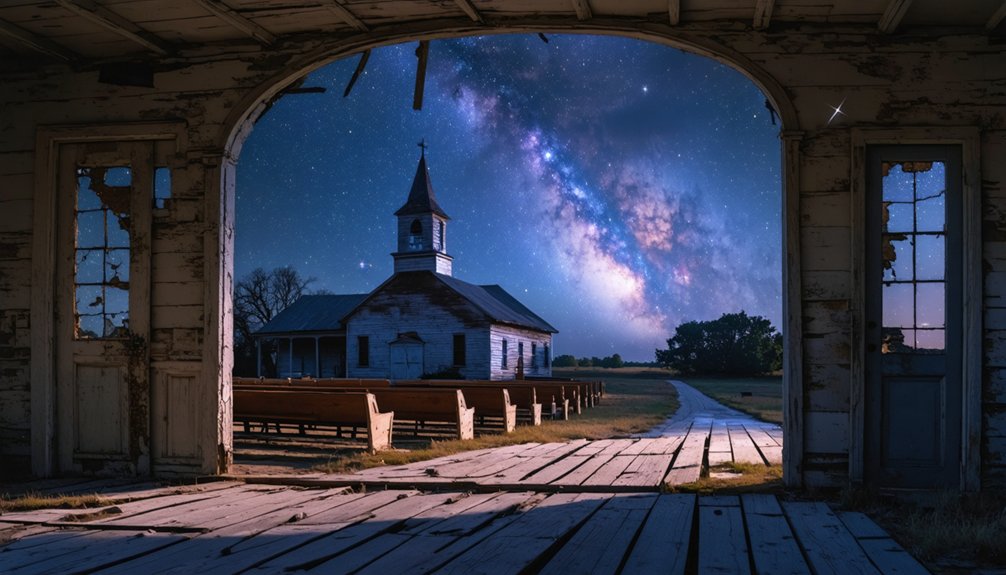
Successful ghost town astrophotography hinges on mastering Nebraska’s complex network of remote access routes.
You’ll need reliable wayfinding tools beyond GPS, as satellite signals often fail in the Sandhills. Paper maps remain essential for traversing section-line roads and gravel spurs that lead to prime shooting locations.
Road conditions vary dramatically across the state. Access to Brocksburg requires maneuvering rugged dirt roads off Highway 12, while reaching Ellsworth demands careful plotting along gravel routes through Sheridan County.
Winter storms can isolate Harrison’s high-elevation approaches, and river sites pose unique challenges due to shifting watercourses.
Before heading out, cross-reference historic maps with current aerial photographs to identify hidden foundations and roadbeds.
This preparation guarantees you’ll reach your destination safely when shooting under dark skies.
Light Pollution and Dark Sky Conditions
While Nebraska’s urban centers create significant sky glow, the state’s western ghost towns offer pristine dark sky conditions ideal for astrophotography.
You’ll find Bortle 2-4 ratings in these remote locations, delivering exceptional visibility for capturing the Milky Way and stellar objects.
- Western ghost town sites provide SQM readings above 21.7 mag/arcsec², perfect for long-exposure shots
- Clear Dark Sky maps reveal 46 non-private observation points near abandoned settlements
- Remote locations require just 1/10th the exposure time compared to suburban transformation zones
- Dark Site Finder shows minimal light pollution impact in ghost town regions through 2024
Track seasonal changes using lightpollutionmap.app’s exposure calculator to optimize your shoot timing.
Western Nebraska’s ghost towns remain among the state’s last bastions of truly dark skies, offering unparalleled astrophotography conditions.
These ghost towns to photograph in Nebraska are not only remnants of the past but also serve as stunning backdrops for capturing the night sky. Each decaying structure tells a story, inviting photographers to explore the intersection of history and the cosmos. As shadows stretch across the landscape, the towns reveal their haunting beauty under a canopy of stars.
Composition Techniques for Ghost Town Night Shots
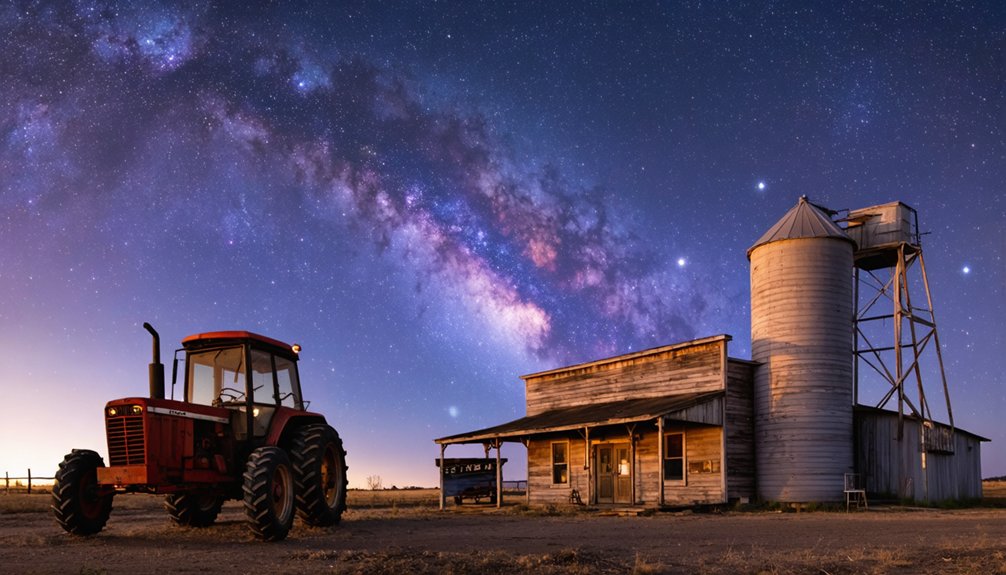
Mastering ghost town astrophotography requires thoughtful composition techniques that balance architectural remnants with starlit skies.
You’ll want to position abandoned structures along rule of thirds intersections rather than centering them, creating visual flow that draws viewers through your frame.
Your composition strategies should incorporate strategic light placement, using street lamps and moonlight to sculpt depth while maintaining shadow detail.
Strategic lighting transforms ghost towns into sculptural scenes – the interplay of lamps and moonlight reveals depth while preserving mysterious shadows.
Frame visible lights behind structures and blend multiple exposures to capture the full dynamic range – low-ISO for ambient light and high-ISO for stellar details.
When implementing framing techniques, use foreground ruins to offset starry skies and create depth.
Position debris or vehicles as off-center focal points that align with compositional gridlines.
Remember to straighten any keystone effects from wide-angle lenses on tall structures.
Weather Patterns and Sky Quality Factors
Having perfected your composition skills, you’ll need to understand Nebraska’s sky quality metrics and weather patterns to maximize your ghost town astrophotography success.
The state’s pristine dark skies offer SQM readings between 21.5-22.0 mag/sq. arcsec, perfect for capturing the Milky Way’s nuclear bulge against abandoned structures.
Key weather factors you’ll need to monitor:
- Use ClearDarkSky charts with CMC modeling for 10-mile radius forecasts
- Track cloud cover percentages, which average 61% but vary seasonally
- Monitor seeing conditions, best between 0.5-1.5 arcseconds
- Plan shoots during winter’s crisp nights rather than humid summers
Legal Permissions and Site Regulations
Before setting up your astrophotography gear at any ghost town site, you’ll need to navigate a complex web of legal permissions and regulations. Start by verifying land ownership through county records and securing written permission from private landowners.
You’ll want to check for federal restrictions if the site’s on BLM or National Park Service land, as these can limit night access and lighting equipment. For commercial shoots, you’ll need specific permits, and drone operations require FAA clearance.
Don’t forget to research state historic preservation rules and local ordinances that might affect your shoot. Always carry documentation of your permissions on-site.
Frequently Asked Questions
Are There Any Reported Paranormal Activities at These Ghost Towns at Night?
While you’ll find haunted histories and spectral sightings reported at places like St. Deroin and Dobytown, they’re mostly unverified visitor tales without scientific evidence – likely natural phenomena creating atmospheric effects.
What Wildlife Encounters Are Common During Nighttime Ghost Town Photography Sessions?
You’ll encounter owls, coyotes, deer, and foxes during shoots. Their nighttime wildlife movements and nocturnal sounds can add atmosphere while you’re composing long exposures beneath Nebraska’s dark rural skies.
Can I Camp Overnight Directly Within the Ghost Town Ruins?
Like a moth to flame, you’ll need to resist camping inside ruins. Camping regulations require staying at designated sites within legal distances. Follow ghost town etiquette by photographing from permitted areas.
How Do Native American Tribal Lands Affect Access to Certain Ghost Towns?
You’ll need explicit permission to access ghost towns on tribal lands due to tribal sovereignty. Check land status carefully and obtain proper authorizations – some areas are completely restricted to non-tribal members.
Are Metal Detectors Allowed While Visiting These Ghost Town Locations?
You’ll need to check local metal detection regulations – Brocksburg and Venus have no posted bans, while St. Deroin requires state park permits. Always follow treasure hunting ethics and respect private property boundaries.
References
- https://www.onlyinyourstate.com/trip-ideas/nebraska/ne-ghost-towns-road-trip
- https://everafterinthewoods.com/these-deserted-ghost-towns-in-nebraska-are-full-of-history-and-mystery/
- https://www.go-astronomy.com/dark-sky-parks-stargazing-state.php?State=NE
- https://nvv-ne.com/merritt-reservoir
- https://darksky.org/news/merritt-reservoir-sra-200th-certified-idsp/
- https://www.homestratosphere.com/secluded-towns-in-western-nebraska/
- https://visitnebraska.com/trip-idea/your-guide-stargazing-nebraska
- https://nebraskapassport.com/trip-idea/nebraska-astronomy-trail
- https://visitnebraska.com/trip-idea/explore-7-authentic-ghost-towns-nebraska
- https://www.youtube.com/watch?v=l3s2qhSxis8