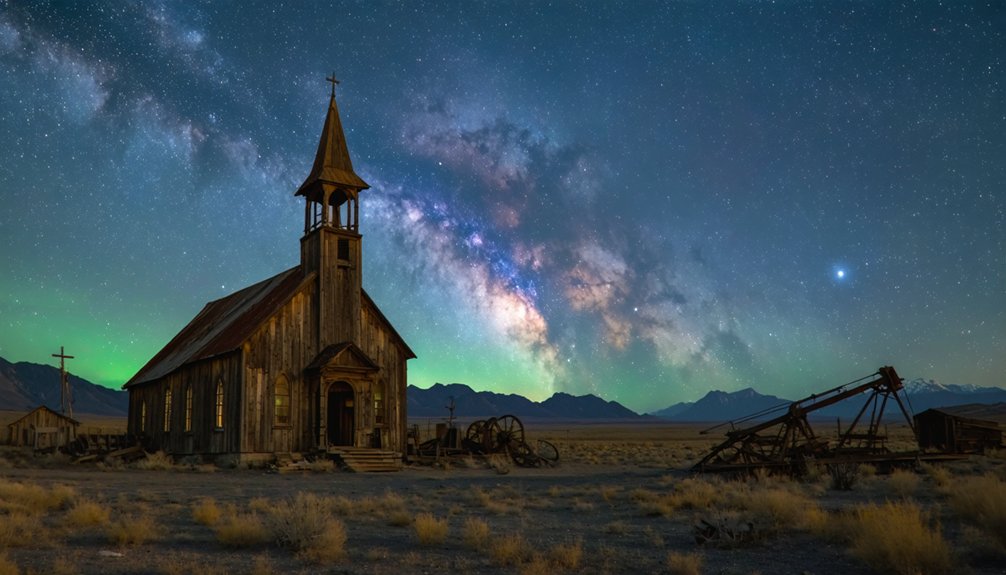
You’ll find exceptional astrophotography conditions at several New Mexico ghost towns, including Cerrillos, White Oaks, and sites along the Turquoise Trail. These locations combine well-preserved historic structures with pristine dark skies at elevations above 6,000 feet. For ideal Milky Way shots, target the spring months of April and May during new moon periods. The Capulin Volcano area and Gila Wilderness near Mogollon offer particularly striking compositions where mining ruins create dramatic foreground elements. The technical requirements and safety protocols for these locations merit careful consideration.
Key Takeaways
- White Oaks offers pristine dark skies and well-preserved mining structures, making it ideal for capturing the Milky Way above historic buildings.
- Shakespeare Ghost Town near Lordsburg features stark mining ruins against exceptionally dark skies, perfect for dramatic nighttime compositions.
- Cerrillos, along the Turquoise Trail, provides easy access to historic structures and minimal light pollution for night photography.
- Chloride’s abandoned structures create compelling silhouettes for astrophotography, with excellent dark sky conditions in its remote location.
- Mogollon, situated in the Gila Wilderness, combines abandoned buildings with some of New Mexico’s darkest skies for spectacular astro shots.
Why Ghost Towns Make Perfect Astrophotography Subjects
While many locations offer opportunities for astrophotography, ghost towns provide an unparalleled combination of compositional elements and practical advantages that make them ideal subjects for night sky imaging.
You’ll find that decaying structures create dramatic silhouettes against starlit skies, while their architectural lines contrast perfectly with celestial features. These abandoned sites’ remote locations typically offer pristine dark skies, essential for capturing the Milky Way’s intricate details.
Ghost town photography excels at combining technical excellence with historical narratives. Each weathered building and rusted artifact tells a story, adding emotional depth to your astronomical compositions. Destinations like Terlingua ghost town feature historical churches and cemeteries that create compelling foreground elements. The artistic installations found in many ghost towns add a contemporary creative dimension to nighttime compositions.
The sites’ minimal light pollution reduces post-processing needs, while accessible roads and multiple vantage points let you maximize shooting flexibility during critical astronomical windows.
Essential Gear for Night Photography in Ghost Towns
Successful astrophotography in ghost towns demands precise equipment selection to handle both technical and environmental challenges.
You’ll need a full-frame mirrorless or DSLR camera with superior high-ISO performance, paired with fast wide-angle and medium telephoto lenses for versatile camera settings and lens selection options. A sturdy tripod with ballast capability proves essential on unstable ghost town terrain. Investing in quality prime lenses will significantly improve your low-light shooting capabilities.
Your kit should include multiple light-painting tools – tactical flashlights, RGB wands, and wireless flash systems – to illuminate architectural details while maintaining natural ambiance. Consider using multiple flash bursts to create ethereal effects in your architectural shots.
Don’t forget a star tracker for pinpoint celestial captures. Pack redundant power sources and weather-resistant storage, as ghost towns lack charging stations and shelter.
Include cleaning supplies to protect against omnipresent dust, and carry basic repair tools for quick field fixes when you’re miles from civilization.
Top Dark Sky Locations Near Historic Mining Towns
You’ll find exceptional astrophotography conditions at designated Dark Sky locations near New Mexico’s historic mining sites, where the combination of high elevation and minimal light pollution creates ideal conditions for capturing the Milky Way.
The most productive locations include Capulin Volcano National Monument, with its 6,500-foot elevation and proximity to Raton’s mining heritage, and the Gila Wilderness near Mogollon, where abandoned structures provide compelling foreground elements against pristine night skies. The Cosmic Campground sanctuary offers dedicated telescope pads for optimal equipment setup.
Strategic positioning at sites like Shakespeare and Chloride allows you to leverage the stark silhouettes of mining ruins while taking advantage of the region’s characteristically clear atmosphere and dark sky conditions. The Turquoise Trail between Albuquerque and Santa Fe features accessible ghost towns that provide excellent vantage points for nighttime photography.
Mining Ruins After Dark
New Mexico’s abandoned mining sites offer exceptional dark-sky photography opportunities, particularly at five International Dark Sky-designated locations that intersect with historic ruins.
You’ll find prime shooting conditions at Capulín Volcano, Chaco Culture, Cosmic Campground, Fort Union, and Clayton Lake, where minimal light pollution meets preserved mining history. The new moon events at Clayton Lake provide optimal monthly windows for astrophotography.
When photographing these sites after dark, you’ll need to navigate significant safety considerations. Many locations like Cosmic Campground feature hard-surface pads designed specifically for telescope setup.
Verify land ownership and access permissions before shooting, as many ruins span mixed jurisdictions. Maintain distance from unstable structures and open mine shafts, using assessment lighting to identify hazards.
Watch for wildlife, especially during snake season, and monitor weather patterns that can rapidly change.
Pack emergency gear and low-profile lighting to protect both yourself and your equipment while capturing these compelling nighttime scenes.
Capturing Historic Night Skies
While New Mexico boasts numerous ghost towns, the most compelling astrophotography opportunities exist where International Dark Sky designations intersect with historic mining sites.
You’ll find exceptional conditions at Mogollon in the Gila National Forest, where well-preserved buildings create dramatic silhouettes against pristine night skies. The elevation minimizes light pollution, allowing for crisp Milky Way alignments above historic structures. These mountains once housed thriving mining operations that drew thousands of settlers to the region.
For prime dark sky imaging near ghost town legends, head to Shakespeare near Lordsburg or Lake Valley’s intact 19th-century architecture. The rich silver ore discovery that launched Shakespeare’s prominence in 1870 left behind perfectly framed ruins for night photography. These sites offer minimal light interference and dramatic foregrounds.
When shooting at higher elevations like Chloride in the Black Range, you’ll need to factor in steady seeing conditions and temperature variations. Historic preservation efforts at these locations have maintained structural integrity, creating ideal compositional elements for your nightscape photography.
Planning Your Ghost Town Astrophotography Trip
Planning a successful ghost town astrophotography expedition in New Mexico requires careful coordination of dark sky locations, moon phases, and seasonal conditions.
You’ll maximize your ghost town photography potential by targeting sites like Cerrillos or White Oaks that offer both historic structures and proximity to certified dark sky areas.
For ideal astrophotography techniques, schedule your shoot during new moon periods at high-elevation locations like Capulin Volcano, where you’ll find some of the darkest skies in the national park system.
Utilize the hard-surface telescope pads at Cosmic Campground, which provides unobstructed 360-degree views with no artificial light interference for 25-40 miles.
Consider seasonal timing – summer brings regular astronomy programs at Capulin, while Valles Caldera offers year-round access to pristine dark skies near preserved mining sites.
Safety Tips for Night Shoots in Abandoned Sites
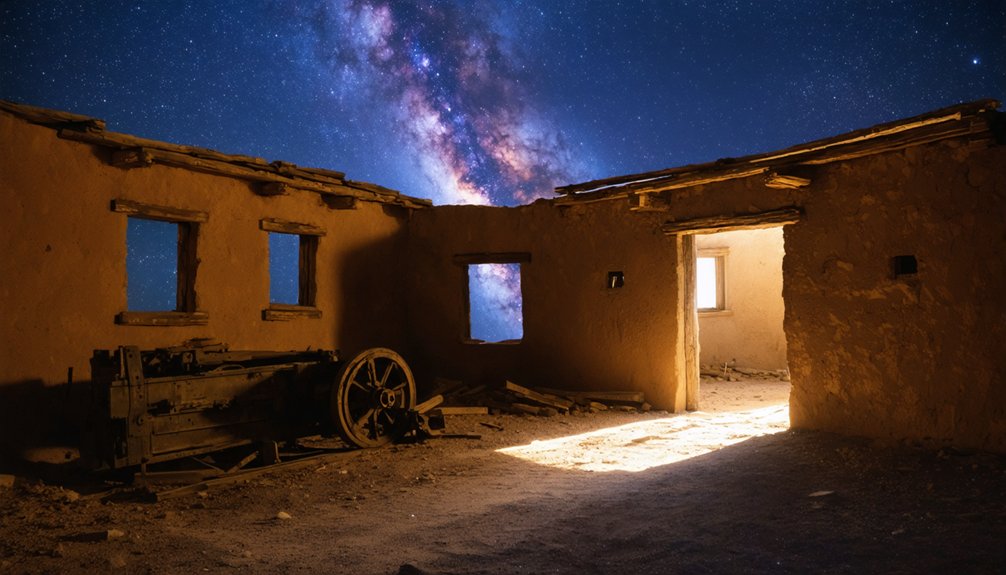
Safety protocols are paramount when conducting astrophotography sessions at abandoned sites in New Mexico’s ghost towns. Before accessing any abandoned structures, verify land ownership and obtain necessary permissions to avoid trespassing violations.
You’ll need to implement a buddy system for night safety, maintaining constant communication and situational awareness while on location. Equip yourself with multiple light sources featuring red-mode capabilities, and mark potential hazards with reflective markers.
When setting up your gear, secure your equipment away from main paths and keep valuables close. Watch for structural instabilities, exposed materials, and chemical hazards – wear appropriate protective gear including sturdy boots and respiratory protection when necessary.
Establish emergency protocols, including evacuation plans and predetermined assembly points, and maintain contact information for local emergency services.
Best Seasons for Ghost Town Milky Way Photography
To capture stunning Milky Way photographs at New Mexico’s ghost towns, you’ll need to align your shoots with precise seasonal windows that enhance galactic core visibility and atmospheric conditions.
The best months span from late March through early October, with peak hours occurring between 11:00 PM and 3:00 AM.
Spring months (March-May) offer your most reliable clear-sky conditions, while avoiding summer monsoon disruptions that typically hit from late June through September.
You’ll achieve excellent results during new moon periods (±3 days), when light pollution is minimal. For maximum visibility, target ghost towns above 6,000 feet elevation, particularly during shoulder seasons when tourism-related light pollution decreases.
The sweet spot combines spring’s clear skies with the core’s enhanced brightness, making April and May your prime shooting windows.
Creative Composition Techniques for Historic Ruins
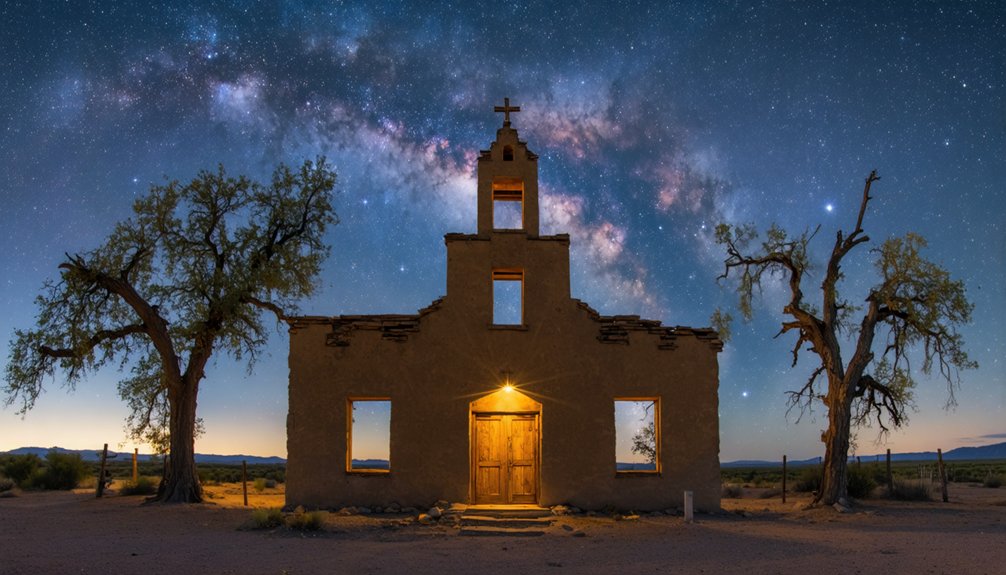
Creating compelling ghost town astrophotography requires mastering five essential composition techniques that seamlessly integrate historic ruins with the Milky Way.
Your composition styles must leverage the rule of thirds while maintaining critical separation between structural elements and the night sky to prevent unwanted overlap effects.
- Position ruins along intersecting third lines for ideal visual flow
- Utilize architectural leading lines to guide viewers toward celestial elements
- Balance prominent ruin textures against vast dark sky areas
- Frame foreground structures during blue hour for clean blending
- Scout multiple angles to identify strongest ruin-to-sky relationships
Light Painting Historic Buildings Under the Stars
When documenting ghost towns under starlit skies, mastering light-painting techniques becomes essential for revealing architectural details while preserving the night sky’s natural luminance.
You’ll need to balance your LED panels and torches carefully – use low-angle lighting to emphasize historic textures like weathered wood grain and corrugated metal, while avoiding harsh hotspots that could overpower the stars.
Set your camera for long exposures between 30 seconds and several minutes, depending on your artistic vision for the stars.
Work with lower ISOs (100-800) and wider apertures (f/1.8-f/4) to minimize noise.
Make multiple passes with different light sources, using color gels to separate structures from the sky.
Remember to calculate maximum exposure times using the 500 rule when you want sharp stars, or intentionally extend for dramatic star trails.
Local Permits and Property Access Guidelines
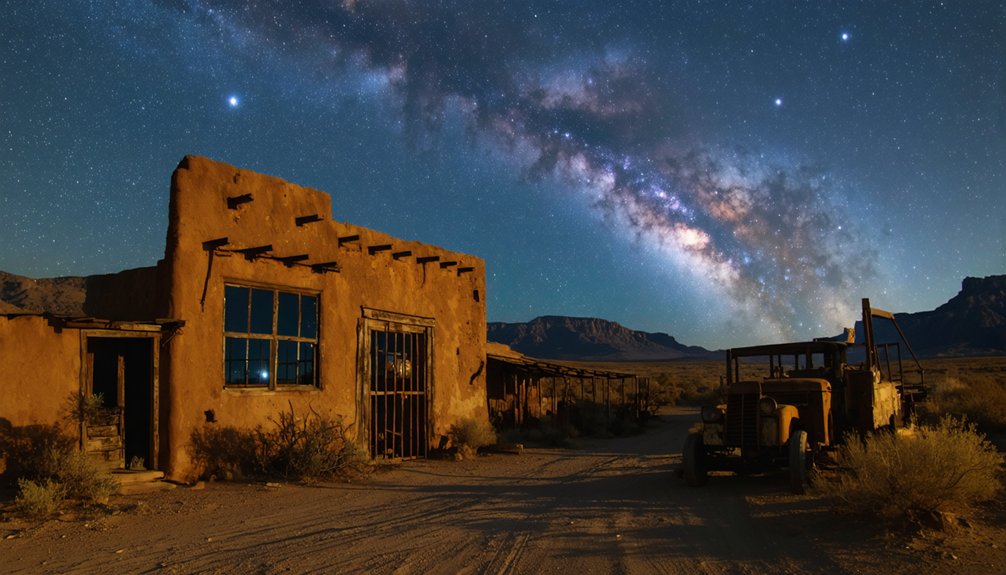
Before planning your astrophotography shoot at New Mexico’s ghost towns, you’ll need to verify property ownership and secure appropriate permissions, as access rights vary considerably between private land, BLM holdings, and state historic sites.
You must submit permit applications at least 30 days in advance for commercial photography on state lands, with fees scaling based on crew size and equipment requirements.
If you’re photographing near Native American lands or protected archaeological sites, you’ll need additional tribal permissions and must follow strict cultural preservation protocols.
Private Property Rights First
Since a significant portion of New Mexico’s ghost towns reside on private property, photographers must carefully navigate land ownership rights and access permissions before attempting any astrophotography sessions.
Exploring the state’s stunning vistas can also lead to discovering the best drone spots in New Mexico, where open spaces and breathtaking landscapes create perfect backdrops. It’s essential to be mindful of local regulations regarding drone flights, especially in sensitive ecological areas. By planning ahead, photographers can capture the beauty of New Mexico from above while respecting its natural heritage.
Understanding and respecting landowner permissions and trespassing laws is critical for legal night shoots.
Key requirements for accessing private ghost town sites:
- Obtain explicit written permission from property owners specifying dates and times
- Document approved access routes, parking locations, and permitted activities
- Respect posted signage and physical barriers regardless of time of day
- Never enter structures or mines without specific authorization
- Carry proof of permission during your shoot
Property owners maintain full legal authority over access, including the right to restrict nighttime photography and enforce trespassing violations through law enforcement.
These rights apply equally during daylight and darkness, requiring thorough advance planning for successful ghost town astrophotography.
Permit Application Procedures
As you plan astrophotography sessions at New Mexico’s ghost towns, you’ll need to navigate a complex matrix of permit requirements across federal, state, and local jurisdictions.
Different permit types apply based on location and usage – from Special Use Permits (SUP) for National Park Service sites to Special Use Authorizations for Forest Service lands.
Submit your applications well ahead of time, as processing can take 30-90 days for NPS properties and 14-60+ days for Forest Service/BLM lands.
You’ll need to include detailed site maps, lighting plans specifying red-light usage, safety protocols, and equipment lists.
For commercial shoots, expect to provide liability insurance documentation and specific mitigation measures.
State parks require Film and Photography Permits at least 30 days in advance.
Watch for site-specific restrictions at dark-sky designated locations, including vehicle access limits and quiet hours.
Post-Processing Historic Night Sky Images
When processing historic night sky images from New Mexico’s ghost towns, you’ll need specialized techniques to balance the preservation of archaeological details with stellar enhancement.
Start with RAW files in Lightroom for initial dark sky adjustments, then move to specialized software for deep-sky processing.
For ideal image enhancement, follow these critical steps:
- Stack multiple exposures in Starry Landscape Stacker to reduce sensor noise
- Apply dark frame subtraction for high-elevation thermal noise control
- Use PixInsight to extract deep sky objects from historic composites
- Layer ghost town elements with enhanced Milky Way shots in Photoshop
- Finalize using Topaz DeNoise AI for high-ISO noise reduction
This workflow preserves authentic archaeological features while maximizing stellar detail, creating compelling compositions that showcase New Mexico’s rich mining history against pristine dark skies.
Frequently Asked Questions
How Do You Avoid Unwanted Paranormal Activity While Shooting in Ghost Towns?
You’ll minimize paranormal encounters by following ghost hunting tips: stay in groups, use red lights, maintain background noise, and practice paranormal etiquette by announcing your presence and intentions respectfully.
Can You Legally Camp Overnight Inside Ghost Town Buildings for Astrophotography?
You can’t legally camp inside ghost town buildings without explicit permission. Follow camping regulations by setting up outside structures and respect ghost town etiquette to avoid trespassing violations and preservation issues.
Which Ghost Towns Have the Most Intact Structures for Foreground Elements?
Under starlit skies, you’ll find Madrid’s weathered miners’ cabins, Cerrillos’ stone buildings, and Mogollon’s two-story commercial structures offering the most stable, photogenic abandoned architecture for your night sky compositions.
Are There Guided Ghost Town Astrophotography Tours Available in New Mexico?
You’ll find guided tours through Astronomy Adventures in Santa Fe, plus local private guides offer photography workshops combining ghost towns and night skies. You can also join organized star parties in Magdalena’s historic mining area.
How Do You Deal With Wildlife Encounters During Night Shoots?
With 60% of wildlife encounters occurring at dusk/dawn, you’ll want to carry bear spray, travel in groups, make noise, and use red-light headlamps during night photography for maximum wildlife safety.
References
- https://www.newmexicomagazine.org/blog/post/new-mexico-night-sky-stargazing-destinations/
- https://www.newmexico.org/darkskies/
- https://newmexiconomad.com/stargazing-in-new-mexico/
- https://www.go-astronomy.com/dark-sky-parks-stargazing-state.php?State=NM
- https://santafe.com/new-mexico-road-trip-ghost-towns/
- https://www.newmexico.org/places-to-visit/ghost-towns/
- https://www.nmdarksky.org/darkskyplaces/nmdarkplaces.html
- http://www.kellydelay.com/big-bend-ghost-town-astrophotography-workshop-august-22-24-2014/
- https://www.photocascadia.com/for-the-love-of-ghost-towns/
- https://astrobackyard.com/astrophotography-city-vs-dark-sky/