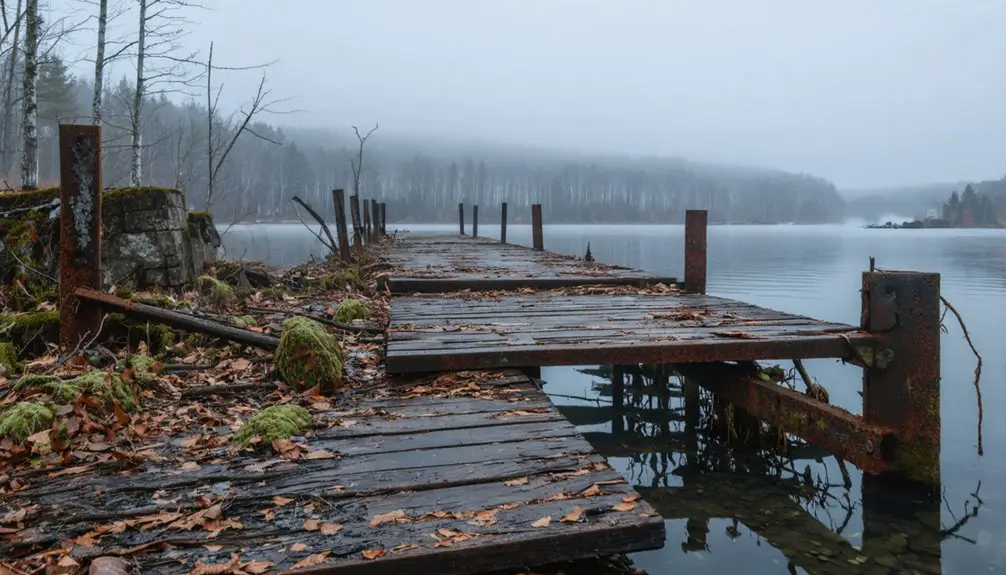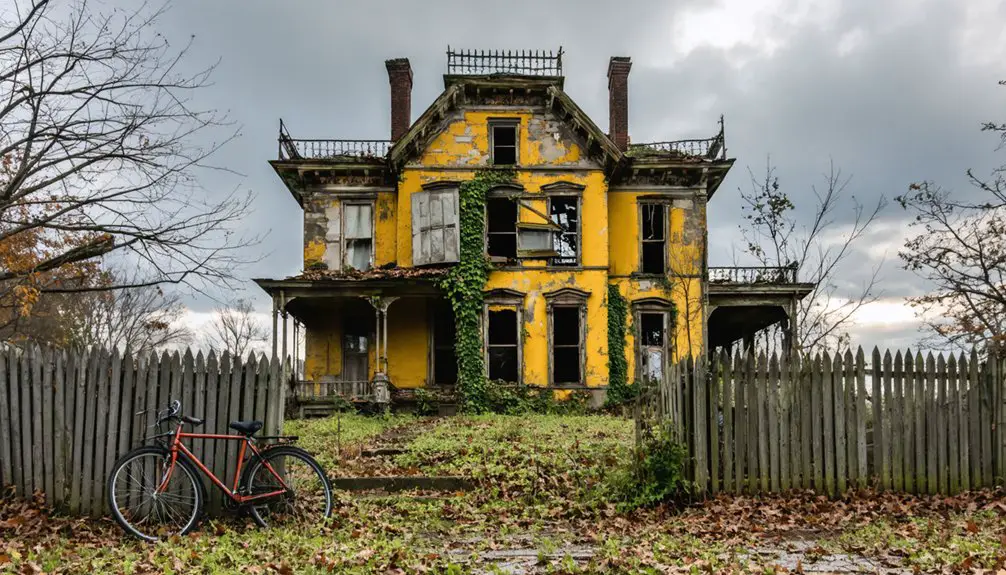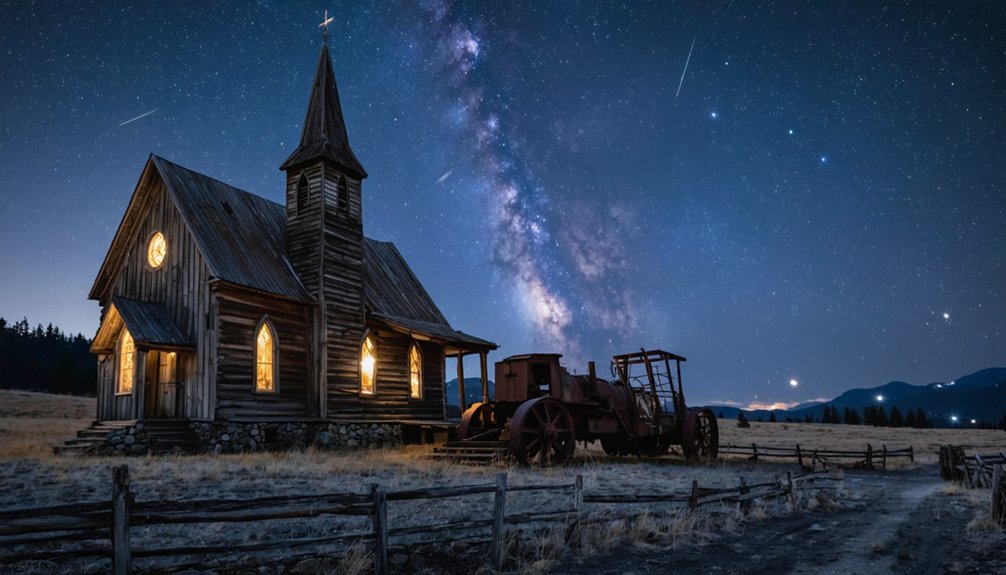
You’ll find exceptional astrophotography conditions at three prime New York ghost towns: Adirondac, Camp Santanoni, and Roscoe’s Ruins. Each location offers Bortle Class 2-3 dark skies and compelling architectural elements for foreground interest. Adirondac’s abandoned mining structures and Camp Santanoni’s historic lodge provide perfect framing for Milky Way shots, while Roscoe’s Gothic ruins create dramatic silhouettes. For best results, plan your visit during new moon periods and prepare for remote shooting conditions.
Key Takeaways
- Adirondac’s abandoned mining ruins offer Bortle Class 2 dark skies and dramatic industrial silhouettes perfect for Milky Way photography.
- Camp Santanoni provides historic lodge structures and lake reflections as compelling foreground elements against pristine night skies.
- Roscoe’s Ruins features the Gothic architecture of Dundas Castle, offering unique framing opportunities for astrophotography compositions.
- Remote locations within Adirondack Park ensure minimal light pollution and exceptional visibility during moonless nights.
- Best shooting conditions occur from April through October, with winter months offering exceptionally clear atmospheric viewing despite cold challenges.
Why Ghost Towns Make Perfect Dark Sky Sites
While many photographers struggle to find pristine dark sky locations, ghost towns naturally provide ideal conditions for astrophotography due to their complete absence of artificial lighting.
You’ll find these abandoned settlements offer pristine views of the night sky comparable to certified Dark Sky Places, with minimal light pollution interfering with your long exposures.
When you’re capturing ghost town history through astrophotography techniques, you’ll benefit from these sites’ remote locations far from urban light domes.
For breathtaking views, you should also explore drone photography spots in New York, where stunning landscapes meet vibrant cityscapes. These locations offer a unique perspective, allowing you to capture the essence of the city from above. Additionally, the contrast between urban architecture and natural settings makes for compelling images.
The surrounding wilderness amplifies dark sky quality, letting you photograph even the faintest celestial objects.
For optimal results, plan your shoots during crescent moon phases when both earth and sky visibility are balanced for capturing the Milky Way.
You’ll discover that abandoned structures create compelling foreground elements while eliminating modern distractions, allowing you to frame the Milky Way against weathered architecture.
The natural darkness also supports local ecosystems, making these locations sustainable choices for nightscape photography.
Your visit can generate economic benefits for nearby communities as dark sky tourism increases both daytime and overnight visitor spending in the area.
Essential Gear for Ghost Town Night Photography
Before venturing into ghost town astrophotography, you’ll need specialized gear that handles both the technical demands of night photography and the unique challenges of abandoned locations.
Start with a full-frame mirrorless camera and fast wide-angle lens selection (f/2.8 or faster) for capturing the Milky Way, plus a medium telephoto prime for detailed architectural shots. Prioritize cameras with excellent low-light performance for optimal nighttime image quality. For capturing ethereal effects, consider using multiple exposures with stationary elements.
For ghost town starscapes, equip a full-frame mirrorless camera with fast wide angles and a telephoto lens to capture every detail.
Proper battery management is essential – pack multiple spares and a high-capacity power bank for extended shooting sessions.
You’ll need a sturdy tripod with remote release capabilities, along with light-painting tools like high-CRI LED headlamps and programmable light wands.
Protect your gear with waterproof cases and bring backup storage solutions for your images.
Don’t forget essential repair tools and navigation equipment to safely explore these remote locations after dark.
Planning Your Ghost Town Stargazing Adventure
Successful ghost town astrophotography requires methodical planning across multiple dimensions.
Start by identifying locations with Bortle 1-3 dark sky conditions using light pollution maps, then verify legal access through county records. You’ll want to time your ghost town exploration during new moon periods when the Milky Way core is visible, typically during spring and summer months in New York. Winter months also offer exceptionally clear skies for night photography. Consider visiting during the open hours of 6 AM to 11 PM if exploring locations like Letchworth State Park.
The best seasons for visiting ghost towns are generally spring and fall, as the weather is usually mild and the landscape is often picturesque. These times also coincide with some of the most striking natural light conditions, enhancing both visibility and the overall atmosphere. Be sure to dress appropriately for fluctuating temperatures, especially when venturing into higher altitudes or more remote areas.
Before heading out, check weather patterns and astronomical twilight times using planetarium apps.
Scout potential shooting locations during daylight to assess hazards and identify stable vantage points. Consider elevation gains and open horizons when selecting your stargazing techniques.
File a trip plan with a contact, especially for remote sites with limited cell coverage. Pack sufficient battery power and lighting for your gear, accounting for cold weather drain.
Adirondac: A Stargazer’s Hidden Treasure
You’ll find Adirondac’s abandoned mining ruins offer compelling silhouettes against the pristine night sky, with the 19th-century blast furnace and wheelhouse remains serving as dramatic foreground elements for astrophotography.
The site’s remote location within Adirondack Park guarantees minimal light pollution, making it ideal for capturing the Milky Way core during summer months and potential aurora displays throughout the year. The area’s surreal quiet enhances the mystical stargazing experience. The original Tahawus Club cottages once hosted photographers and nature enthusiasts from 1876 to 1941.
The open clearings around the industrial remains provide unobstructed views of both southern and northern skies, while nearby ridgelines offer elevated vantage points for panoramic star field photography.
Mining Ruins Meet Stars
Along the banks of the Upper Hudson River, where iron ore was first discovered in 1826, Adirondac’s abandoned mining ruins now provide an exceptional dark sky location for astrophotography.
The site’s mining history spans over 160 years, creating unique industrial elements that’ll enhance your celestial landscapes.
The Open Space Institute manages this historic site, ensuring its preservation for future generations.
You’ll find four prime shooting locations among the ruins:
- The 50-foot McIntyre Blast Furnace, offering vertical framing against the Milky Way
- The rusting pump house silhouetted against star trails
- The restored MacNaughton Cottage for historic architectural elements
- The scattered machinery remnants visible from the second viewing platform
The Adirondack Iron Works operated the site until 1857, leaving behind photogenic industrial artifacts.
Access the site via Tahawus Road to Upper Works.
The remote location, far from light pollution, delivers pristine dark skies.
You can set up equipment on the recently constructed walkways and viewing platforms while capturing the convergence of industrial heritage and astronomical wonders.
Perfect Dark Sky Location
Located within the vast Adirondack Park‘s six million protected acres, Adirondac offers pristine Bortle Class 2 dark skies that make it an exceptional destination for astrophotography.
You’ll find ideal conditions here for capturing the Milky Way, particularly during moonless nights when the dark sky quality rivals professional observatory sites.
For urban exploration enthusiasts seeking unique nightscape compositions, Adirondac’s abandoned mining structures provide compelling foreground elements against star-filled skies.
The site’s remote location eliminates light pollution concerns common to other ghost towns, while nearby summits and fire towers offer 360-degree unobstructed views.
During winter months, you’ll benefit from exceptionally clear atmospheric conditions, though you’ll need to carefully plan your gear and power management for cold-weather shooting sessions.
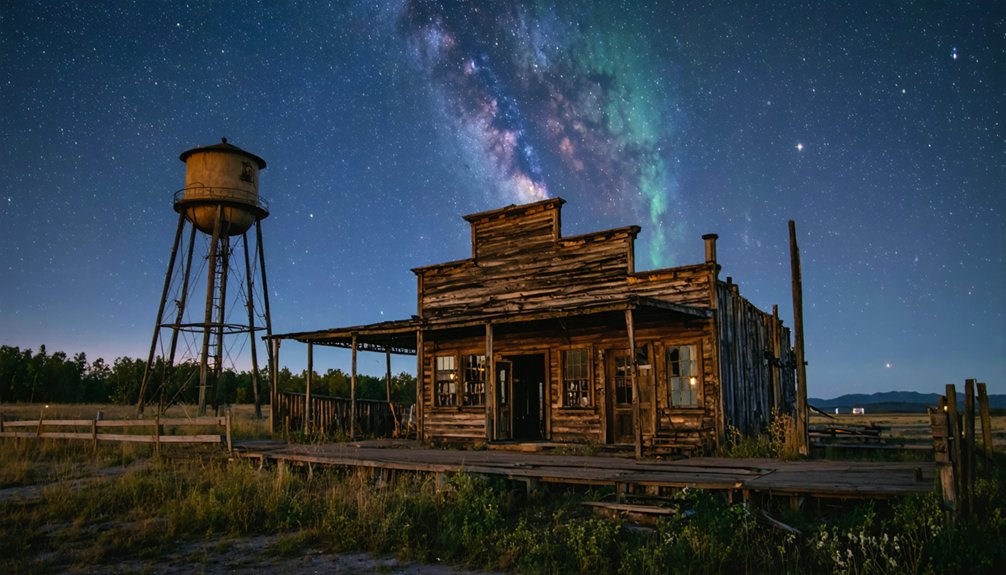
Steering through Frontier Town’s astrophotography opportunities requires careful planning due to its complex mix of state campground rules, private property restrictions, and off-limits historical structures.
Your nighttime navigation needs to account for longer emergency response times and wildlife risks in this remote location.
For ideal ghost town safety and shooting conditions, follow these critical guidelines:
- Verify current campground permits and curfew hours with NY State Parks
- Scout locations during daylight, noting restricted areas and escape routes
- Monitor sky quality meters to time shots around minimal light pollution
- Choose elevated positions away from Exit 29 development for clearer shots
You’ll find your best compositions along open riverbanks and remote campground loops, where light intrusion is minimal and southern sky views remain unobstructed.
Camp Santanoni’s Celestial Wonders
You’ll find Camp Santanoni‘s remote 13,000-acre preserve offers pristine dark skies perfect for capturing the Adirondack night against historic architecture.
The Japanese-influenced log structures, including the main lodge and Artist’s Studio, provide compelling foreground elements for your astrophotography compositions along Newcomb Lake’s shores.
While accessing the site requires a 4.5-mile trek, the carriage road allows stable transport of tripods and equipment to prime lakefront viewing locations where you can frame the Santanoni Mountain Range beneath star-filled skies.
Historic Ruins After Dark
Once darkness falls over the Adirondacks, Camp Santanoni’s historic ruins transform into an exceptional destination for astrophotography enthusiasts.
You’ll find haunting silhouettes of the Main Lodge’s frame against the star-filled sky, while eerie reflections dance across Newcomb Lake’s surface near the preserved Boat House.
For ideal night photography locations, consider these prime spots:
- The stone Artists Studio, offering framed views of constellations through its remaining structure
- The Gate Lodge complex with its fieldstone arch creating dramatic foreground elements
- The dairy building ruins amid the 300-acre farm complex
- The open-air Boat House, providing unobstructed access to lakeside celestial reflections
The five-mile carriage road grants you secluded access to these locations, while the remote setting guarantees minimal light pollution for capturing pristine night sky images.
Capturing Starlit Camp Views
As night descends over Camp Santanoni’s historic grounds, the pristine dark skies create ideal conditions for capturing stunning astrophotography.
You’ll find prime shooting locations along the 5-mile carriage road and Newcomb Lake shoreline, where minimal light pollution allows for crystal-clear celestial views.
Position your camera near one of the eight backcountry campsites for long exposures of the Milky Way arcing over the main lodge’s silhouette.
During winter, ski or snowshoe in to capture the artist’s studio beneath star-filled skies. The elevated mountain views enhance your chances of photographing rare aurora displays, while campfire reflections on the lake’s surface add foreground interest to your nighttime compositions.
You can even set up overnight shoots from the lean-tos, maximizing your time under the Adirondack’s dark sky canvas.
Dark Sky Photography at Roscoe’s Ruins
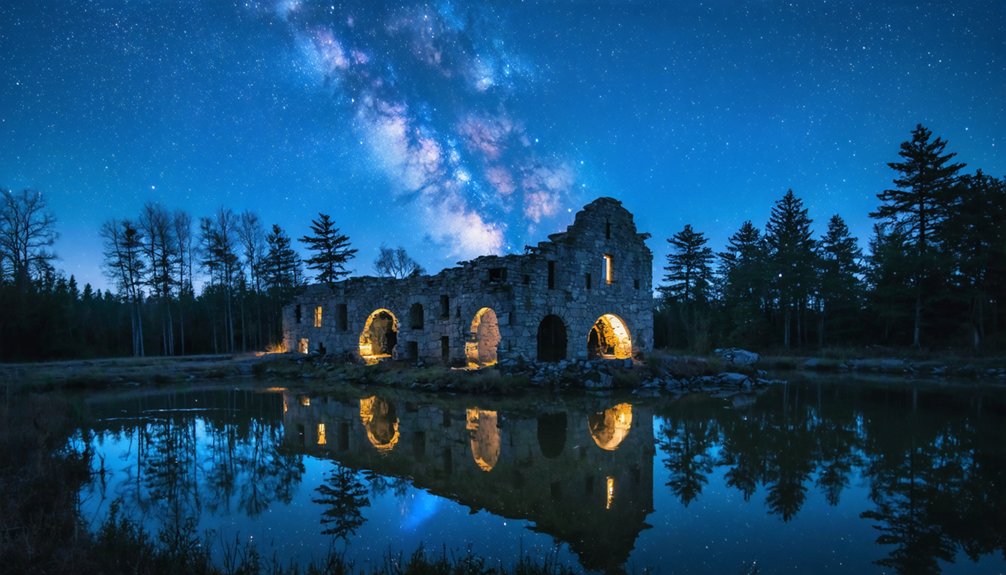
Deep within the Catskill Mountains, the abandoned Dundas Castle (Craig-e-Clair) near Roscoe offers astrophotographers a compelling dark sky location at coordinates 41.967778°N, 74.864778°W.
A hidden astronomical haven awaits in the Catskills, where Dundas Castle’s crumbling walls meet some of New York’s darkest skies.
This Neo-Gothic structure‘s turrets and stonework create dramatic silhouettes against starlit landscapes, while the rural setting minimizes light pollution compared to NYC’s metro area.
For ideal dark sky photography at these ruins:
- Scout access routes during daylight – the property’s status requires advance permission and careful navigation.
- Position compositions facing away from Roscoe’s ambient light.
- Utilize the castle’s Gothic windows as natural frames for the Milky Way core (visible late spring through early fall).
- Check local mountain weather patterns for haze and measure on-site darkness with an SQM before setting up.
Weather and Seasonal Considerations
When planning astrophotography at New York’s ghost towns, you’ll need to carefully consider both seasonal patterns and weather variability that affect image quality and site accessibility.
Summer offers extended viewing hours at locations like Bear Mountain’s Doodletown, while winter brings challenging conditions to Adirondack sites like Frontier Town. You’ll find ideal shooting conditions from April through October, particularly at elevated locations like Tahawus Mines.
Weather patterns greatly impact your success rate. Check for clear skies during meteor showers, especially the Leonids in November.
Coastal fog can affect sites like North Brother Island, while river levels near Pottersville merit monitoring. For year-round access, focus on locations with stable Bortle-scale readings, typically found in the Adirondacks and Catskills protected areas.
Safety Tips for Night Exploring Abandoned Sites
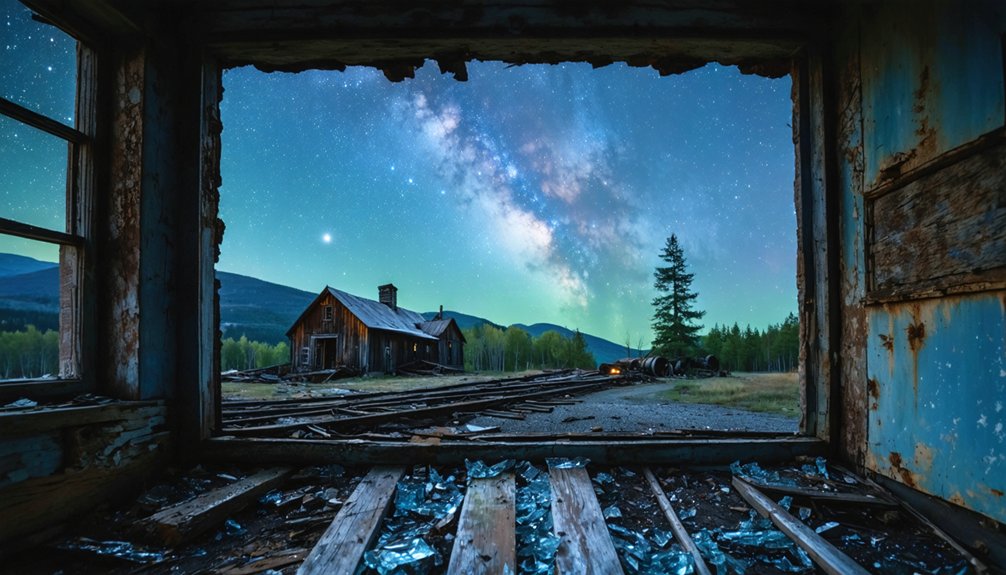
Night exploration of ghost towns demands rigorous safety protocols that extend beyond standard astrophotography considerations.
Before venturing out, you’ll need to understand trespassing laws and secure proper permissions to avoid legal troubles. Never enter these sites alone – always bring a reliable partner and maintain communication with an off-site contact.
Essential safety equipment for ghost town exploration includes:
- Protective gear – steel-toed boots, heavy-duty gloves, and respirator
- Multiple light sources – headlamp plus backup flashlights with spare batteries
- First-aid supplies and emergency contact information
- Navigation tools – GPS device and offline maps
You’ll need to constantly assess structural hazards like unstable floors and exposed materials.
Watch for environmental risks including wildlife, standing water, and hazardous materials. Keep your gear protected from moisture and debris while maintaining quick access to your phone for emergencies.
Frequently Asked Questions
Are Permits Required to Access These Ghost Towns at Night?
You’ll need to verify local access regulations for each site, as nighttime safety protocols aren’t well documented. While daytime access appears unrestricted, specific permits for night photography remain unclear.
What Wildlife Encounters Should Photographers Be Prepared For?
You’ll likely encounter nocturnal raccoons, deer, and owls. Maintain wildlife safety by keeping distance, using red lights, avoiding flash photography, and storing food securely in your vehicle.
Is Camping Allowed Near These Abandoned Sites?
Want to camp near those haunting ruins? You’ll need to follow strict camping regulations at designated sites only – most ghost towns prohibit on-site camping due to safety hazards and preservation concerns.
How Do Local Authorities View Photographers Exploring These Locations?
You’ll need to respect local regulations and photography ethics when exploring abandoned sites. Law enforcement generally tolerates responsible photographers who obtain permits and don’t trespass or disturb property.
Can Drones Be Used for Aerial Night Photography at These Sites?
Like a hawk traversing moonlit skies, you’ll need precise planning. You can fly at night with proper FAA lighting, remote ID compliance, and local permissions, though drone restrictions vary by ghost town location.
References
- https://www.go-astronomy.com/dark-sky-parks-stargazing-state.php?State=NY
- https://away.mta.info/articles/stargazing-near-new-york-city/
- https://www.iloveny.com/blog/post/dark-sky-destinations-and-planetariums/
- https://adirondackmtland.com/adirondack-stargazing-where-to-find-the-best-dark-skies/
- https://photomagx.com/portfolio-item/10271/
- https://visitadirondacks.com/fall/abandoned-places-ghost-towns
- https://www.cloudynights.com/topic/635469-dark-sites-south-of-montreal-1-the-adirondacks/
- https://darksky.org/news/3-benefits-of-a-dark-sky-designation/
- https://hoptownchronicle.org/seeing-the-stars-small-towns-and-rural-parks-pursue-dark-sky-goals/
- https://caliterraliving.com/what-is-a-dark-sky-community-and-what-are-the-benefits-of-living-in-one/