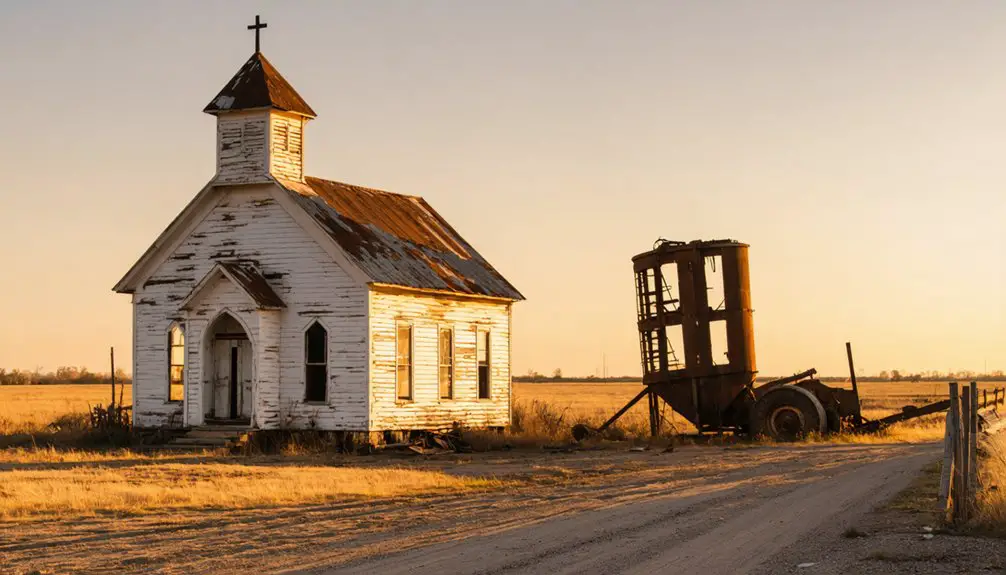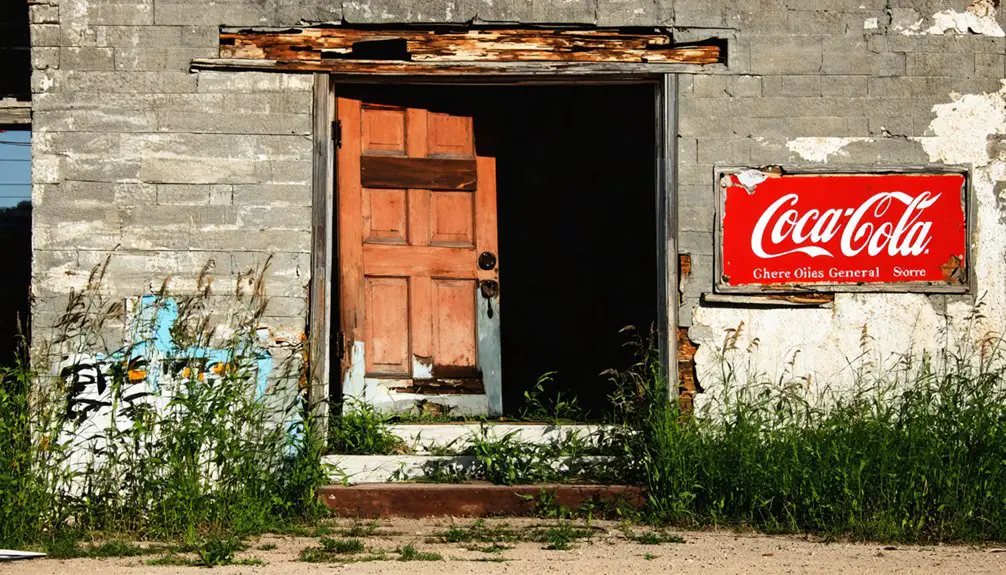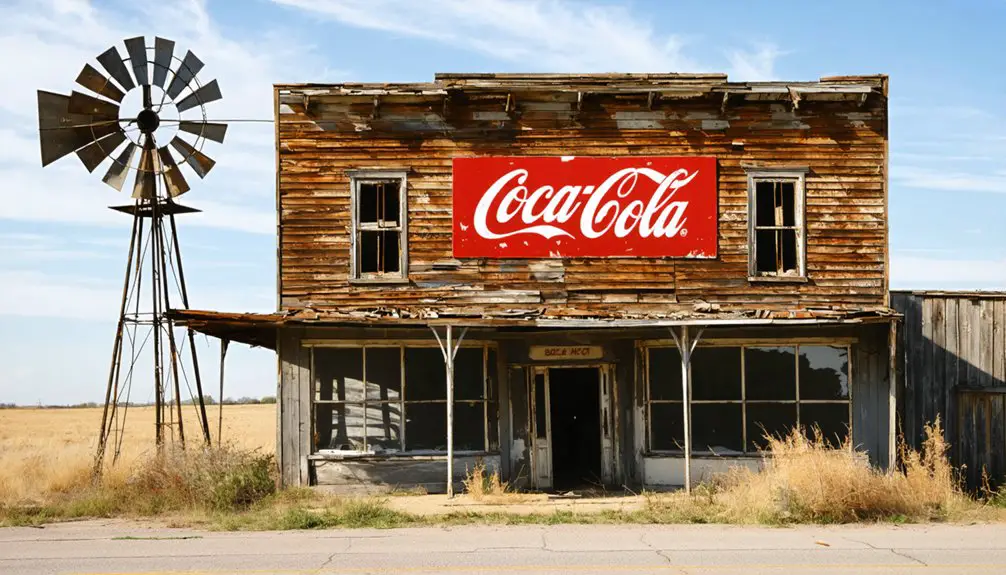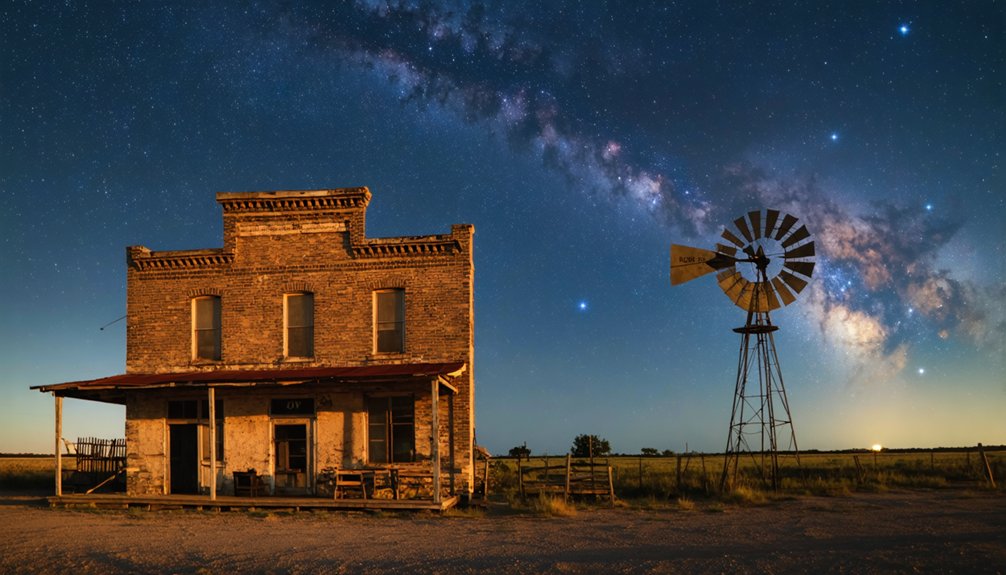
You’ll find exceptional astrophotography conditions in Oklahoma’s western ghost towns, particularly around Kenton and Black Mesa where Bortle 1-2 darkness ratings create perfect night sky visibility. The Panhandle region’s abandoned structures provide compelling foregrounds for Milky Way shots, while the geography naturally shields against light pollution from eastern cities. For best results, plan your shoots between March and October when the galactic core is most visible. These remote locations hold more secrets than just dark skies.
Key Takeaways
- Kenton offers exceptional dark sky conditions near Black Mesa with historic buildings and a museum for staging nighttime shoots.
- Quinlan ruins in Woodward County feature abandoned church structures that create dramatic foregrounds against the Milky Way.
- Cloud Chief’s preserved schoolhouse provides excellent framing opportunities in an area with minimal light pollution.
- Pitcher’s remnants of lead mining operations offer industrial elements for compelling night sky compositions.
- Ingalls presents frontier-era foundations perfect for capturing historical architecture alongside star trails in dark sky conditions.
What Makes Oklahoma Ghost Towns Perfect for Night Sky Photography
Darkness reigns supreme in Oklahoma’s ghost towns, making them ideal destinations for capturing the cosmos.
You’ll find exceptional night sky clarity in the western Panhandle, especially around Kenton and Black Mesa, where light pollution simply doesn’t exist. These abandoned locations offer unmatched atmospheric conditions for your astrophotography ventures.
Oklahoma’s Panhandle delivers pristine dark skies near Kenton and Black Mesa, making it an astrophotographer’s paradise.
The region’s geography naturally shields against light intrusion from eastern cities, while declining populations have eliminated artificial lighting that typically disrupts long exposures. Many towns experiencing population decline have inadvertently created perfect dark sky conditions for photographers.
The Milky Way core is most visible during prime viewing months from late winter through early fall, making this the ideal time to visit these locations. You’re free to set up your equipment without worrying about passing cars or street lights. Places like Lake Etling deliver pristine views of the Milky Way, while the Panhandle’s elevation and consistently low humidity create stable conditions for deep-sky imaging.
The soft December light fades quickly to reveal star-filled skies that you won’t find in populated areas.
Essential Gear and Safety Considerations
While capturing the night sky demands patience and skill, selecting the right equipment proves equally critical for success in ghost town astrophotography.
You’ll need a reliable DSLR or mirrorless camera paired with fast lenses like the Rokinon 14mm f/2.8 for wide-field shots. A Canon T6s camera offers excellent performance with its 24Mp sensor for detailed night sky imaging. For tracking the stars, consider portable mounts like the Sky-Watcher Star Adventurer or iOptron Sky Tracker, which can handle 5-minute exposures. Using an equatorial mount is essential for achieving sharp, streak-free star images during longer exposures.
Don’t forget essential gear recommendations like dew heaters to prevent lens fogging in Oklahoma’s humid nights.
For safety precautions, keep your setup under 20 pounds for easy transport, and bring backup power supplies. The Celestron 7aH battery will keep your equipment running through the night.
Join local astronomy clubs to learn proper gear handling and discover the best ghost town locations.
Top Western Oklahoma Ghost Town Locations
Western Oklahoma’s ghost towns offer prime dark sky territory for astrophotographers, thanks to their remote locations and minimal light pollution.
the best months to explore ghost towns are typically during the fall and spring when the weather is mild and pleasant for outdoor activities. Visitors can take advantage of the changing landscapes and vibrant colors that add to the haunting beauty of these abandoned places. Additionally, these times of year often see fewer tourists, allowing for a more immersive experience in the eerie silence of the ghost towns.
Kenton history dates to 1886, making it one of the oldest sites in the panhandle, with its museum and post office providing convenient staging areas for nighttime shoots. It has the unique distinction of being the only Mountain Time location in Oklahoma.
You’ll find Quinlan ruins in Woodward County particularly compelling, where abandoned church structures create dramatic foreground elements against the Milky Way.
Cloud Chief’s preserved schoolhouse and Reed’s scattered remains provide excellent framing opportunities in the southwestern plains. The initial tent city of Cloud Chief grew to over 3,000 residents within weeks of its establishment in 1892.
For ideal conditions, head to Knowles in Beaver County, where the grocery store and post office remain operational – perfect for supply stops before positioning your gear under some of the state’s darkest skies.
Central Oklahoma’s Most Photogenic Abandoned Sites
Central Oklahoma conceals several prime astrophotography locations where abandoned structures perfectly complement the night sky.
You’ll find compelling shots at the Marena cemetery sites, where historic headstones create striking foreground elements against dark rural skies. The Methodist Church ruins provide additional architectural elements for faith-themed night compositions.
The Lovell-Roxana corridor offers abandoned architecture from the oil boom era, with weathered wooden storefronts and rusted equipment providing industrial silhouettes for your Milky Way compositions. The remnants of lead mining operations in Pitcher offer haunting industrial backdrops, though environmental safety precautions are essential.
In Ingalls, just 10 miles from Stillwater, you can capture the historical significance of frontier-era foundations and replicated structures while shooting star trails.
Each location demands careful planning – bring water and lighting gear, respect private property boundaries, and scout your compositions during daylight hours.
Success in night photography requires thorough preparation, essential gear, property awareness, and advance location scouting during daylight.
The minimal light pollution at these sites rewards properly timed visits with stellar night sky opportunities.
Dark Sky Opportunities in Eastern Oklahoma
When shooting ghost towns in eastern Oklahoma’s light-polluted areas, you’ll want to plan around Tulsa’s light dome by positioning your camera away from the city and using terrain features or forest edges to block scattered light.
Exploring the abandoned buildings in Oklahoma can yield some hauntingly beautiful images, particularly at dusk when shadows stretch and deepen. The crumbling facades and overgrown structures create a stark contrast against the vibrant sky, providing a unique canvas for photographers seeking to capture the essence of decay. Be sure to scout locations ahead of time for optimal compositions and to find interesting angles that showcase the history embedded in these sites.
You can find workable Bortle 3-4 skies by driving 30-90 minutes from major cities to higher elevation spots, particularly near state preserves and managed public lands. Great Plains State Park offers exceptional dark sky viewing conditions and photography opportunities. For truly pristine skies, photographers should consider visiting Black Mesa Park, which provides some of the darkest night skies in the country.
Weather patterns make autumn and winter your best seasons for clear, steady skies, though you’ll need to scout locations during daylight to guarantee safe access and unobstructed southern views for Milky Way compositions.
Light Pollution Management Tips
Although eastern Oklahoma faces increasing light pollution from urban centers, dedicated astrophotographers can still access pristine dark skies by targeting specific locations.
You’ll want to avoid the urban radiance from Tulsa and Oklahoma City by driving at least 300 miles from major observatories like Mendenhall. Your best bet is heading to the southeast corner near Pickens, where you’ll find rare Bortle 1 conditions perfect for capturing the night sky.
Use Dark Site Finder tools to check real-time conditions and plan around peak meteor shower events like the Perseids in August.
While eastern Oklahoma doesn’t match the expansive dark zones of the northwest, you can still achieve excellent results by positioning yourself beyond city light domes and consulting updated 2022 light pollution maps.
Hidden Forest-Edge Locations
Deep within eastern Oklahoma’s forest regions, you’ll find hidden dark sky opportunities along strategic tree line edges that combine pristine viewing conditions with stable shooting locations.
The remote Pickens area offers Bortle 1 darkness perfect for night photography, while hidden trails near Black Mesa provide unobstructed southern horizons at nearly 5,000 feet elevation.
- Scout forest edges near state park boundaries for minimal tree obstruction and maximum sky exposure
- Set up tripods where prairie meets woodland for stable long-exposure shots
- Utilize wildlife trails as natural corridors for equipment access to dark sky zones
- Time your shoots during Perseid meteor showers in August for spectacular trail captures
Avoid the Tulsa light dome by positioning yourself in the darker southeast pockets where forest canopy naturally shields artificial glow.
Tips for Capturing Stunning Ghost Town Nightscapes
Successfully capturing ghost town nightscapes requires careful planning and technical precision across multiple dimensions.
Start by mastering your composition techniques – position abandoned structures as dramatic foreground elements, aligning architectural lines with the Milky Way’s arc for maximum visual impact.
For tack-sharp results, nail your focus methods by using live view magnification on bright stars.
Time your shoots during new moon periods when skies are darkest, and plan around the March-October window when the galactic core is most visible.
Set your camera to f/2.8 or wider, ISO 1600-6400, with exposure times between 10-25 seconds to prevent star trails.
Don’t forget to pack dew prevention gear and LED panels for subtle foreground lighting.
Weather conditions are essential – target nights with low humidity and clear atmospheric transparency.
Frequently Asked Questions
How Do I Identify Authentic Ghost Towns Versus Tourist Attractions?
You’ll spot authentic ghost towns through historical records, not tourism sites. Check for documented abandonment dates, physical ruins, and EPA hazard warnings rather than gift shops and staged attractions.
Can I Legally Sell Photos Taken at Oklahoma Ghost Towns?
While you can shoot freely on public land, you’ll need photo licensing for commercial sales, especially if buildings are privately owned. Check property rights and get releases before selling ghost town shots.
What’s the Best Season to Photograph Meteor Showers at Ghost Towns?
You’ll get your best meteor shower seasons during August’s Perseids, when warm nights and clear skies create ideal shooting conditions. December’s Geminids offer great rates too, but you’ll battle colder temperatures.
Are There Guided Astrophotography Tours to Oklahoma Ghost Towns?
You’ll find guided tours through R.W. Adventures and local astronomy clubs, offering astrophotography workshops at ghost towns. You’ll need advance booking since access requires permission and dark-sky timing coordination.
How Do I Handle Encounters With Other Visitors During Night Shoots?
Want to keep the peace during your night shoot? Announce your presence softly, use red-filtered lights, and offer to share viewing spots. You’ll maintain night photography etiquette while preserving everyone’s dark-sky experience.
References
- https://en.wikipedia.org/wiki/List_of_ghost_towns_in_Oklahoma
- https://echo.snu.edu/the-ghost-towns-of-oklahoma/
- https://www.youtube.com/watch?v=5d-wHDTIbb0
- https://www.go-astronomy.com/dark-sky-parks-stargazing-state.php?State=OK
- https://pocketsights.com/tours/tour/Shamrock-Oklahoma-Ghost-Towns-Creek-Lincoln-Payne-and-Pawnee-Counties-2749
- https://abandonedok.com/class/disappearing-town/
- https://planetbell.me/2019/08/19/western-oklahoma-photography-part-i/
- https://www.blackmesaimages.com/milky-way-night-photography/
- https://myfamilytravels.com/oklahoma-towns-with-a-surprisingly-relaxed-vibe
- http://soggyastronomer.com/about/astrophotography-gear/