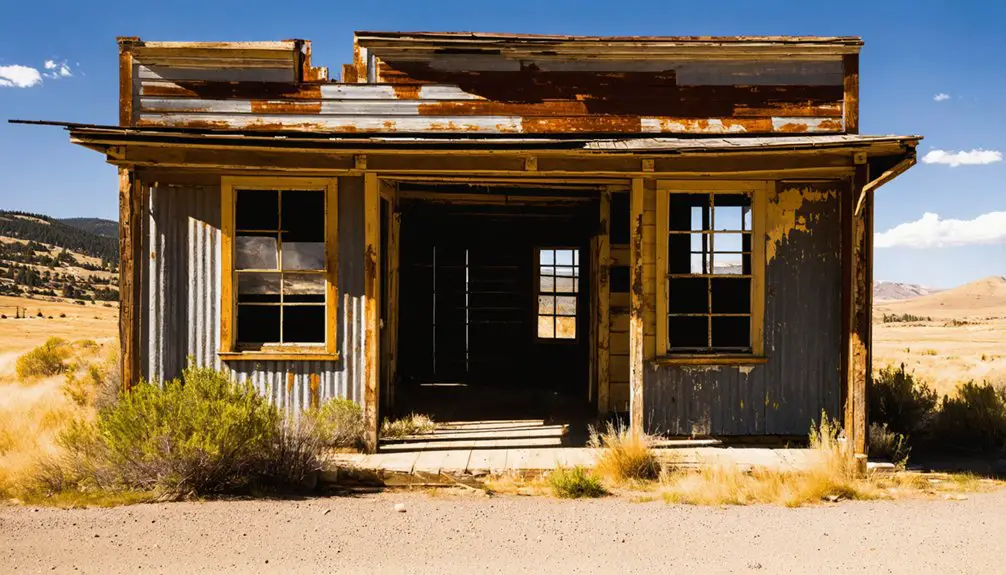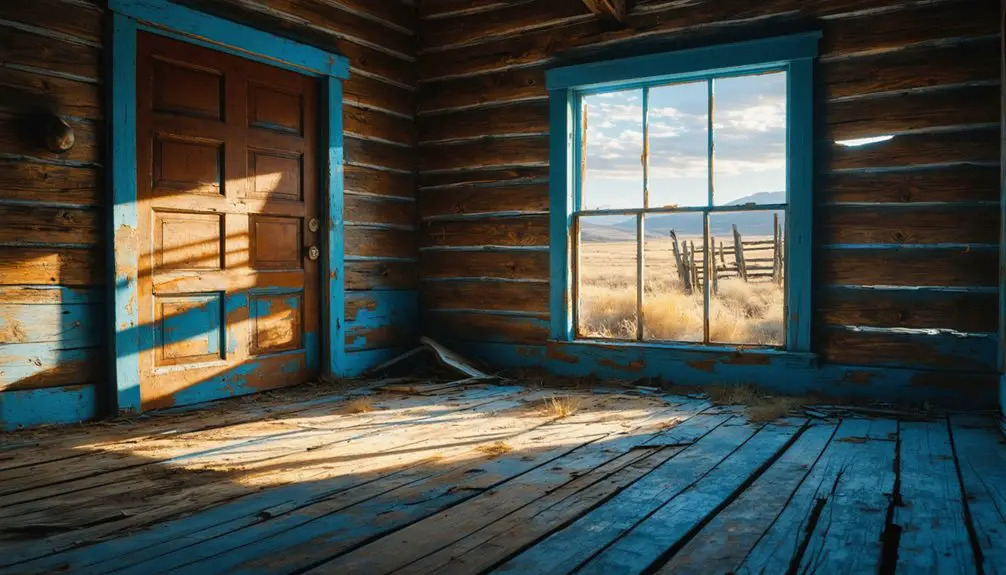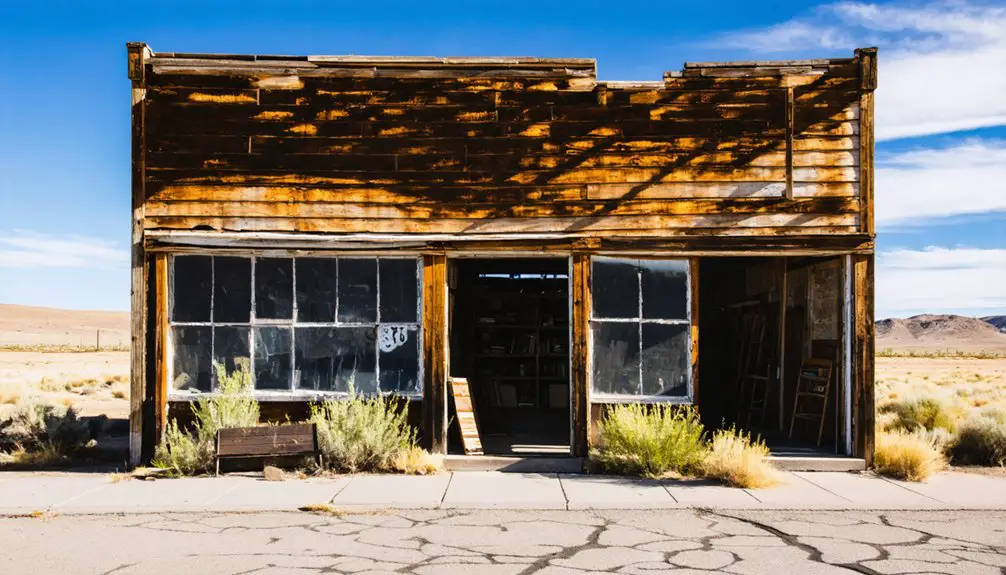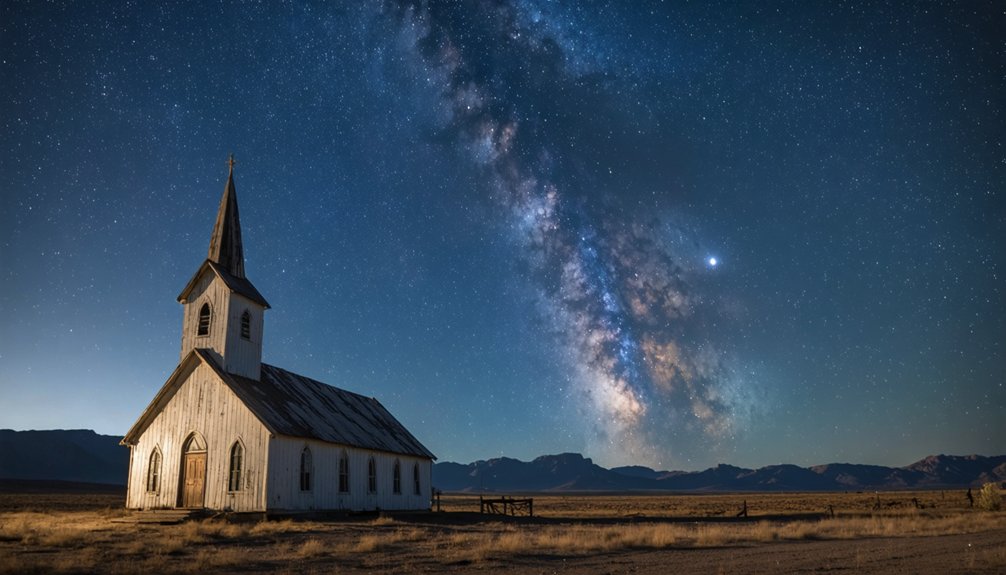
You’ll find exceptional astrophotography conditions in Oregon’s ghost towns, with Antelope and Mitchell offering Bortle 2-3 dark skies ideal for Milky Way shots. Bring your full-frame camera, fast wide-angle lens (like the Rokinon 14mm f/2.8), and sturdy tripod to capture historic structures against star-filled skies. Scout locations during daylight using PhotoPills for Milky Way positioning, and pack red-light headlamps for night navigation. The technical details of ghost town astro shoots go far deeper than basic camera settings.
Key Takeaways
- Antelope ranks as a premier ghost town for astrophotography with Bortle 2-3 dark skies and historic structures along McGreer Street.
- Mitchell offers minimal light pollution and high elevation, creating ideal conditions for long-exposure Milky Way photography.
- Shaniko features well-preserved historic buildings including a jail, hotel, and chapel that serve as excellent foreground elements.
- Ghost towns provide unique architectural elements against dark skies, with summer months offering optimal shooting conditions.
- These locations benefit from Oregon’s dark sky preservation initiatives, ensuring exceptional stargazing and photography opportunities year-round.
Why Oregon Ghost Towns Offer Prime Night Sky Photography
As Oregon’s ghost towns embrace dark sky preservation initiatives, they’ve emerged as premier destinations for astrophotography enthusiasts seeking ideal shooting conditions.
You’ll find minimal light pollution in historic settlements like Antelope, where careful lighting reforms have made the Milky Way visible from Main Street. These remote locations combine ghost town history with pristine dark skies, offering unique foreground elements for your night shots. Pack warm desert clothing as temperatures drop significantly at night.
The Oregon Outback Dark Sky Sanctuary’s 2.5 million acres provide unparalleled stargazing opportunities among abandoned homesteads and indigenous sites. The Rose City Astronomers host summer star parties that help photographers capture stunning celestial images.
When shooting in places like Shaniko Ghost Town, you’ll benefit from elevations around 5,000 feet and sparse population density. Your camera can capture star trails and celestial events against the backdrop of weathered structures, creating compelling compositions that merge Oregon’s pioneer past with its dark sky present.
Essential Gear for Ghost Town Astrophotography
You’ll need a full-frame camera like the Canon 7D Mark II paired with an intervalometer and sturdy tripod to capture ghost towns under starlight, along with fast lenses like the Rokinon 14mm f/2.8 for wide-field compositions.
Your essential safety gear should include LED headlamps with red light modes, backup batteries, and GPS units to safely navigate abandoned structures at night.
A star tracking mount like the iOptron Sky Tracker will enable longer exposures up to 5 minutes, helping you reveal both architectural details and deep-sky features above these historic sites. The entire setup weighs less than 20 pounds total, making it ideal for hiking to remote ghost town locations.
Consider using a dedicated astronomy camera for capturing more detailed images of nebulae and star clusters above the ghost towns.
Cameras and Tripod Essentials
Three vital pieces of equipment form the foundation of ghost town astrophotography: a capable DSLR or mirrorless camera, wide-angle lenses, and a rock-solid tripod.
For peak night shots of abandoned structures under starlit skies, you’ll want:
- Full-frame cameras like the Canon 6D or Nikon D750 that excel in low-light performance and capture faint celestial details.
- Fast wide-angle glass such as the Rokinon 14mm f/2.8 or Samyang 24mm f/1.4 for dramatic compositions that include both architecture and sky.
- A sturdy tripod that eliminates vibrations during long exposures, essential for maintaining sharp details.
Your camera settings should prioritize maximum light gathering while maintaining stability. A dark pollution filter can help reduce unwanted city light glow that often impacts ghost town shots. Consider adding a Star Adventurer tracking mount to capture longer exposures without star trails.
The combination of proper exposure length, aperture selection, and rock-solid tripod support will guarantee crisp ghost town astro images.
Night Lighting Safety Equipment
Because ghost town astrophotography frequently takes place in remote, pitch-dark locations, your lighting and safety equipment must be thorough and redundant.
You’ll need a headlamp with red/green modes for preserving night vision, plus a 1000+ lumen flashlight for scene illumination and emergency signaling. For effective light management, carry diffusers and directional filters to create soft fill light without overexposing your shots. A carbon fiber tripod provides crucial stability for long exposure shots in these dark environments. Applying transparent red film to your camera’s LCD screen will help maintain your night vision while reviewing images.
Deploy visibility markers strategically – use chemical light sticks or LED markers to identify tripod positions and hazards, while applying reflective tape to gear for collision prevention.
Don’t forget high-visibility outerwear that you can cover when shooting. Maintain backup power sources and keep at least one fully-charged light available.
In emergencies, your signaling mirror and high-output strobe modes can attract attention from considerable distances.
Location Scouting Tools
Successful ghost town astrophotography depends on five essential categories of location scouting tools that work together as an integrated system.
By leveraging dark-sky maps with Bortle overlays and night-time satellite imagery, you’ll identify ideal shooting locations while avoiding light pollution.
Land ownership verification through BLM and county GIS data guarantees legal access and historical preservation compliance.
- Dark-sky mapping tools with light pollution overlays to assess sky quality
- Topographic and cadastral data for evaluating terrain and access routes
- Historical imagery archives for locating preserved structures and foundations
You’ll need mobile apps like PhotoPills and Stellarium to calculate Milky Way positions and plan compositions.
These tools integrate with AR viewers for on-site alignment and previewing celestial paths relative to your chosen ghost town foregrounds.
Planning shoots during the new moon phase ensures optimal visibility of stars and celestial objects.
A sturdy tripod is essential when photographing ghost towns at night to maintain sharp focus during long exposures.
Planning Your Ghost Town Photo Expedition
Planning a ghost town photography expedition in Oregon requires meticulous attention to logistics, equipment, and timing.
You’ll need to fuel up before heading to remote locations like Shaniko, which sits 3 hours from Biggs. Pack extra snacks since services are limited in these isolated areas.
For ideal ghost town exploration and night photography techniques, time your visit during summer months. While shooting in Ashwood, avoid harsh midday sun that can wash out architectural details.
Instead, utilize HDR photography to capture the dynamic range of weathered buildings, historic structures, and abandoned vehicles. You’ll find prime shooting locations at Shaniko’s jail, hotel, and chapel, but remember to respect private property.
Combine your expedition with stops at White River Falls State Park, where the abandoned hydroelectric plant offers additional photography opportunities.
Top Dark Sky Locations Among Oregon’s Ghost Towns
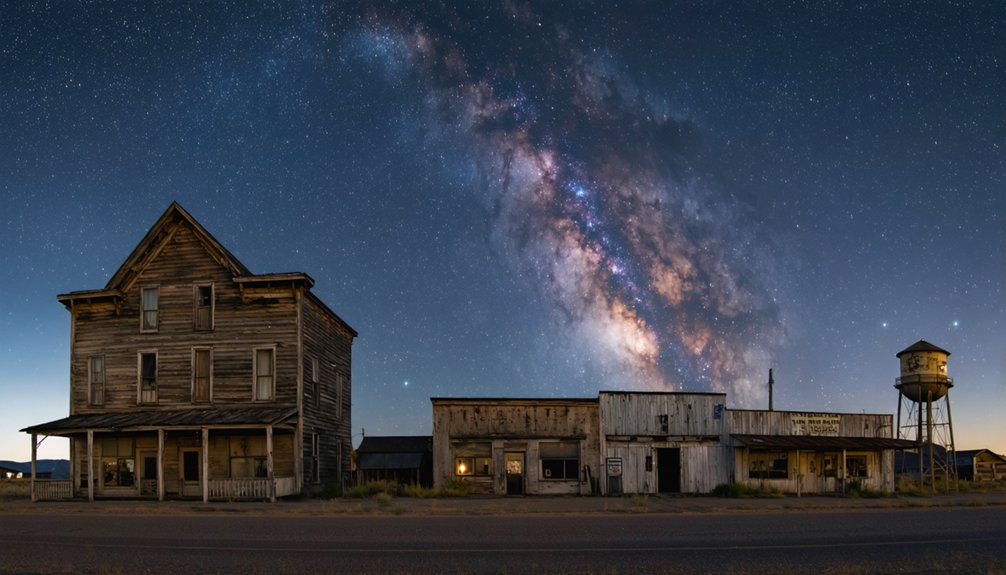
You’ll find exceptional astrophotography conditions at Antelope, Oregon’s first certified Dark Sky ghost town, where controlled outdoor lighting enables clear Milky Way visibility from the town center.
Mitchell’s strategic location in central Oregon offers minimal light pollution interference, making it ideal for long-exposure deep sky imaging with modern CMOS sensors.
Both locations provide stable platforms for tracking mounts and sufficient foreground elements to compose compelling nightscape images at high ISOs.
Antelope’s Dark Sky Certification
Antelope stands as Oregon’s first International Dark Sky Community, earning its prestigious certification from DarkSky International in December 2024.
This small 1.19-square-kilometer ranching town implemented thorough Dark Sky initiatives, including a new outdoor lighting ordinance and replacement of non-compliant streetlights with Dark Sky Approved fixtures.
For astrophotographers seeking pristine night skies, Antelope delivers:
- Direct Milky Way visibility from main street at 94237 McGreer St.
- Sky quality monitoring via data logger and 16 months of documented measurements.
- Zero light pollution interference through strict compliance with Dark Sky standards.
The community’s engagement extends beyond certification, offering free Dark Sky Approved bulbs, hosting star parties, and maintaining three loaner telescopes from Rose City Astronomers Club.
You’ll find essential dark sky resources at cityofantelope.us for planning your shoot.
Minimal Light Near Mitchell
While Mitchell itself generates minimal light pollution, several ghost towns within a 60-mile radius offer exceptional astrophotography conditions with measured Bortle 2-3 ratings.
You’ll find Shaniko’s abandoned structures particularly suited for wide-field Milky Way shots, with virtually no municipal lighting to interfere with your long exposures.
For the darkest skies near Mitchell, head to the John Day Basin relics, where you’ll encounter negligible upward radiance perfect for capturing deep-sky objects.
The Painted Hills vicinity offers archaeological sites with strict lighting controls, while the Flanagan/Fossil corridor provides unobstructed desert vistas ideal for panoramic work.
Winter brings prime clarity and extended shooting windows, though you’ll still find excellent conditions year-round.
Your camera gear won’t be compromised by light domes, as Mitchell’s modest glow dissipates rapidly beyond 10 miles.
Seasonal Considerations for Ghost Town Star Photos
vir
Composition Techniques for Abandoned Buildings Under Stars
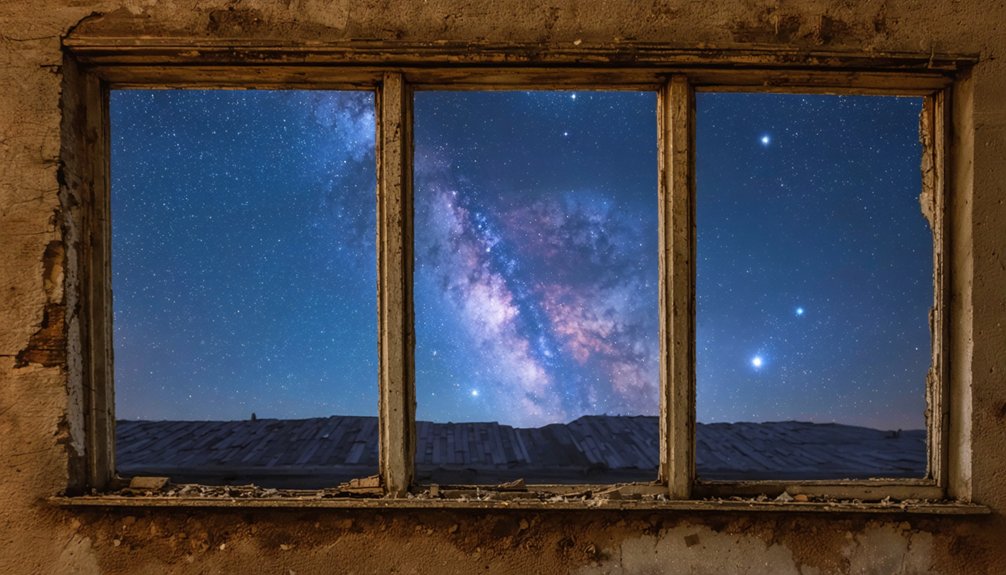
Three core principles govern compelling ghost town astrophotography compositions: strategic structure placement, exposure balance, and creative lighting control.
You’ll want to position abandoned buildings against the Milky Way core or moon using silhouette techniques, placing architectural elements at rule-of-thirds intersections for maximum impact. Keep your ISO low while employing exposure bracketing to capture both starfield and structural details.
Master light painting strategies by using directional LED panels or filtered flash units to reveal textures without overwhelming star visibility. Work with warm-toned artificial light against cool starlight to create depth, and control light spill with flags or focused beams.
For the strongest compositions, choose a single striking feature – like a weathered doorway or rusted machinery – as your focal point, then build your frame around it using leading lines and negative space.
Safety and Legal Guidelines for Night Photography
Before venturing into ghost town astrophotography, you’ll need to establish proper legal access and implement thorough safety protocols. Research and obtain necessary permits, as many historic sites have nighttime hazards and legal restrictions that limit access after dark.
- Document ownership status and secure written permissions from federal, state, or private landowners before entering any ghost town site.
- Perform daytime site reconnaissance to identify structural hazards, map safe shooting positions, and mark GPS waypoints for navigation.
- Maintain situational awareness by traveling with a partner, carrying redundant light sources, and keeping equipment secured against theft.
Always file a trip plan with emergency contacts, pack proper safety gear including first aid supplies, and respect seasonal closures designed to protect both photographers and wildlife.
Post-Processing Tips for Ghost Town Astro Shots
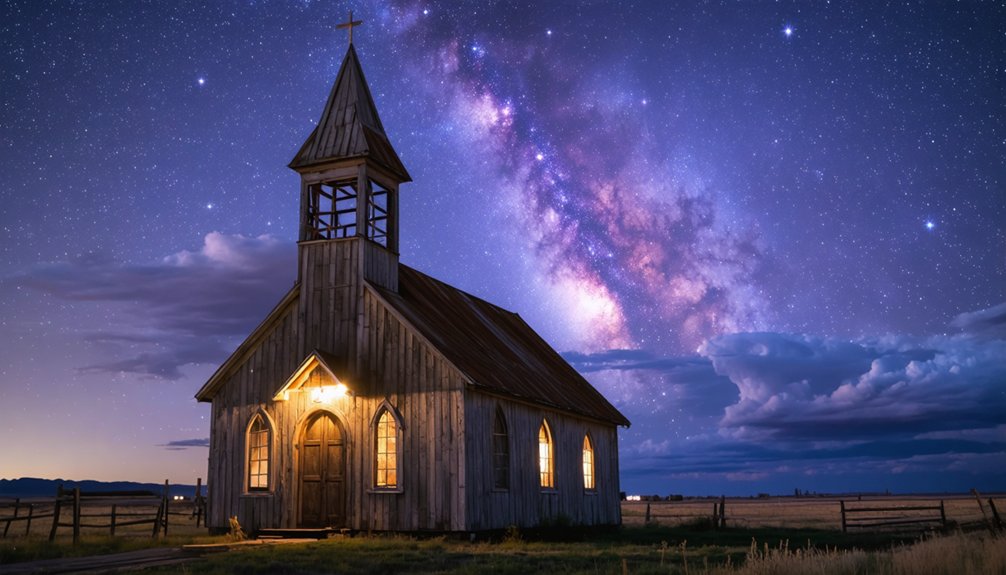
When processing ghost town astrophotography, you’ll need specialized techniques to handle the unique challenges of nighttime architectural subjects combined with stars.
Start by stacking multiple exposures to reduce noise – you’ll see improvements proportional to the square root of the number of frames used. Apply calibration frames to remove thermal artifacts and vignetting.
Stack exposures strategically – more frames mean less noise, following the square root rule. Use calibration to eliminate unwanted artifacts.
For ideal star management, create separate processing paths: one for the building structures and another for the sky. Use luminosity masks to protect star cores while stretching, and employ selective sharpening on stars to maintain crisp points.
Consider generating a starless version for heavy background work, then blend the original stars back in.
Finally, tackle light pollution with channel-specific background neutralization and gradient removal tools before making final contrast adjustments.
Frequently Asked Questions
How Do I Handle Wildlife Encounters During Night Photography Sessions?
You’ll need bear spray, red-light headlamps, and noise makers for wildlife safety. Stay in groups, make yourself appear large, and back away slowly when encountering nocturnal creatures.
Which Ghost Towns Require Permits or Advance Permission for Access?
You’ll need permits for most private-property ghost towns, while BLM and Forest Service sites require Special Recreation Permits. Check local historical societies and land management offices before accessing any location.
Are There Guided Astrophotography Tours Available to Oregon Ghost Towns?
You’ll find specialized guided tours and photography workshops targeting ghost towns, with professional instructors offering technical expertise on night photography, equipment setup, and seasonal Milky Way shoots throughout Central Oregon.
Another unique experience can be captured through drone photography in Oregon’s ghost towns, revealing the haunting beauty of these abandoned locations from above. The combination of aerial shots and the historic charm of the towns creates stunning visuals perfect for any photography portfolio. As you explore these eerie sites, the interplay of light and shadow adds an extra layer of intrigue to your photos.
What Insurance Coverage Should Photographers Have for Ghost Town Shooting?
You’ll need general liability insurance to protect against accidents and lawsuits, plus extensive equipment coverage for your gear. Don’t forget commercial auto insurance when driving to remote locations.
Can Drones Be Used for Aerial Night Photography of Ghost Towns?
You’ll need an FAA night waiver or visible 3-mile LED lights for drone capabilities in dark settings. Verify local permissions, maintain visual line-of-sight, and use low-light sensors for successful aerial shots.
References
- https://www.ccophoto.com/stargazing-and-astro-photography-locations-in-bend-oregon/
- https://www.islands.com/2002624/antelope-oregon-first-dark-sky-community-pairs-starlit-campsites-river-rafting-wide-open-trails-abandoned-ghost-town/
- http://www.photographoregon.com/ghost-towns.html
- https://traveloregon.com/things-to-do/stargazing/oregons-pristine-starry-skies/
- https://traveloregon.com/things-to-do/stargazing/
- https://darksky.org/news/sisters-becomes-the-second-international-dark-sky-community-in-oregon/
- https://bendbulletin.com/2025/01/31/a-guide-to-oregons-dark-sky-country-how-to-go-stargazing-in-our-states-darkest-places/
- https://www.southernoregon.org/dark-skies/
- https://www.wanderwithwonder.com/soak-in-the-stars-in-the-oregon-outback-dark-sky-sanctuary/
- https://www.orparksforever.org/dark-sky-parks/