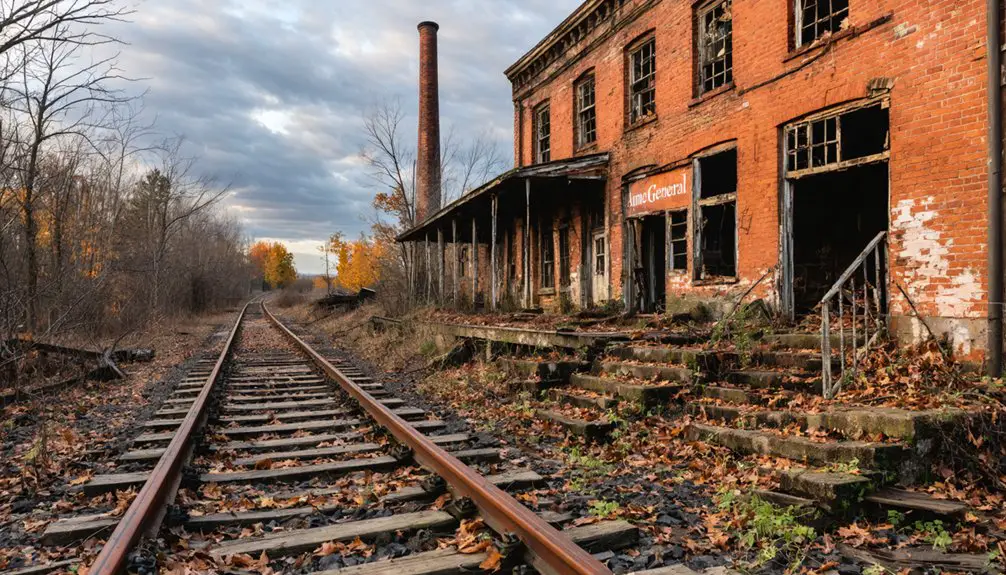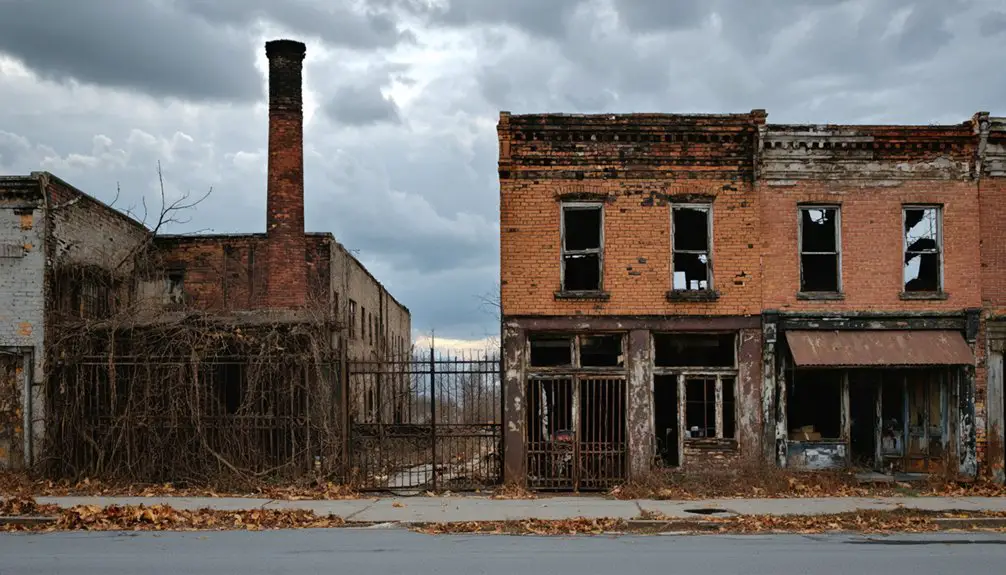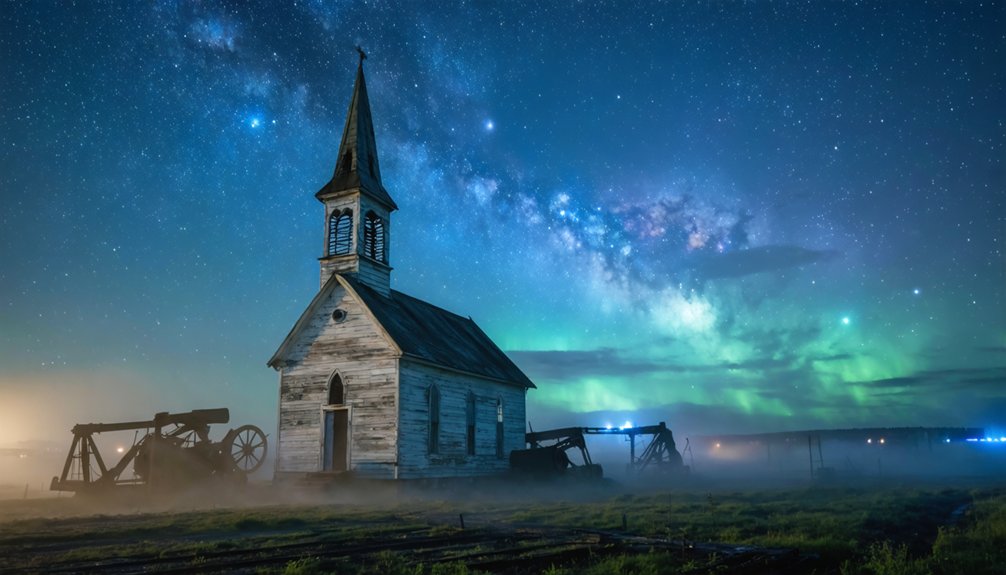
You’ll find exceptional astrophotography conditions at Pennsylvania’s ghost towns, where pristine dark skies meet historic ruins. Cherry Springs State Park offers prime access to abandoned farmsteads within Susquehannock State Forest’s 262,000 acres of darkness. Consider Scotia’s iron heritage sites and Pithole’s oil boom remnants for compelling foreground elements. For ideal results, time your shoot during the new moon (±3 days) and use wide-angle lenses at f/2.8 or wider. The fusion of astronomical and architectural elements creates uniquely haunting compositions.
Key Takeaways
- Cherry Springs State Park near Coudersport offers pristine dark skies and historic structures within Susquehannock State Forest’s 262,000 acres.
- Drake’s Well Museum area provides historic oil industry ruins perfect for night photography, though permits are required for after-hours access.
- Centralia’s abandoned streets and buildings create haunting silhouettes against dark skies, with minimal light pollution interference.
- Abandoned mining towns in the Allegheny National Forest combine remote locations with excellent Milky Way visibility.
- Ghost Town Trail in Indiana County features historic railroad structures and mining ruins along 36 miles of dark sky territory.
Why Ghost Towns Make Perfect Night Sky Backdrops
While many photographers struggle to find pristine dark skies, Pennsylvania’s ghost towns offer ideal locations for capturing the cosmos. These remote settlements, far from urban light pollution, provide unobstructed views of the Milky Way and star trails that you won’t find near cities.
Ghost town aesthetics naturally complement night sky storytelling through their haunting silhouettes and historic structures. Remember to explore with a safety partner when conducting nighttime photo sessions in these remote locations. Similar to the full moon lighting used in Grafton, natural moonlight can provide subtle illumination of building details.
You’ll discover that abandoned buildings create compelling foreground elements, with their architectural shapes forming dramatic contrasts against the starlit canvas above.
The technical advantages are clear – you can execute long exposures without interference from artificial lighting, while historical structures like churches and cemeteries add depth to your compositions.
These forgotten places serve as perfect stages for celestial photography, where you’re free to blend light painting techniques with the natural glow of the stars.
Essential Gear for Ghost Town Astrophotography
Capturing the night sky at Pennsylvania’s ghost towns demands specialized equipment that can handle both low-light conditions and historic environments.
You’ll need gear that’s both portable and powerful for these remote ghost town locations, where minimal light pollution creates ideal astrophotography conditions. Image acquisition software like N.I.N.A. helps streamline and automate the capturing process during nighttime shoots.
- Choose a full-frame camera like the Nikon Z9 or Z6III with strong low-light performance, paired with wide-angle lenses such as the Rokinon 14mm f/2.8 for capturing both architectural elements and star-filled skies.
- Pack a portable tracking mount like the iOptron SkyTracker or Sky-Watcher Star Adventurer to compensate for Earth’s rotation during long exposures. A Bahtinov mask will help achieve precise focus on bright stars during setup.
- Bring essential accessories including a sturdy tripod with multiple leg extensions, dew heaters to prevent moisture issues, and a portable power source like the Celestron 7aH battery for extended shooting sessions.
Cherry Springs: Capturing the Stars Above Abandoned Farmsteads
You’ll find ideal astrophotography conditions at Cherry Springs’ 2,300-foot elevation, where the darkest skies on the eastern seaboard create perfect contrast for capturing abandoned structures against the Milky Way.
Visitors can set up their gear in the Wi-Fi equipped field to maintain connectivity while shooting the night sky.
The Night Sky Public Viewing Area offers quick setup access from Route 44, while the Astronomy Observation Field provides serious photographers with strict light controls and 360-degree unobstructed views. The park regularly attracts several hundred astronomers during its two major annual star parties.
For the best shots of derelict farmsteads under the stars, plan your visit during fall or winter when humidity is low, and time your shoots around the new moon when the park experiences its legendary 60-85 prime viewing nights per year.
Dark Sky Photography Tips
To master astrophotography at Cherry Springs’ abandoned farmsteads, you’ll need precise technical control over both your equipment and lighting conditions.
Start by preserving your night vision with red headlamps while setting up your gear. Using apps like PhotoPills can help determine optimal shooting times and Milky Way positioning. For ideal exposure settings, open your aperture wide (f/1.4-f/2.8) and keep shutter speeds between 15-25 seconds to prevent star trails. Scout locations thoroughly during the day to identify the most compelling compositions and potential hazards before nightfall.
- Use wide-angle lenses (14-35mm) to capture the full sweep of the Milky Way above weathered barns and silos.
- Time your shoots during moonless nights or when the moon is below 30% illumination to maximize star visibility.
- Position yourself to use natural leading lines like fence rows or rutted farm tracks to draw viewers’ eyes from abandoned structures into the star-filled sky.
Location Access Guide
Planning your journey to Cherry Springs State Park starts with making your way to 4639 Cherry Springs Road in Coudersport via PA Route 44 (GPS: 41.66384, -77.82321).
You’ll find a gravel parking lot with paved access to the viewing field, including handicap spots near the entrance.
For capturing night landscapes near abandoned structures, scout the historic clearings within Susquehannock State Forest boundaries using park GIS maps.
These former farmsteads offer unique foregrounds with low horizons perfect for astrophotography. While exploring, stay on public land and maintain a safe distance from unstable structures.
The park’s location within the 262,000-acre forest provides exceptional dark sky conditions for photographers.
If you’re planning commercial shoots, secure permits from PA DCNR first.
The park remains accessible year-round, though campground facilities operate seasonally from mid-April through late October.
Time your visit with new moon periods for ideal dark sky conditions.
For additional information about park facilities and current conditions, call the park office at 814-435-1037.
Scotia’s Iron Heritage Under the Milky Way
Deep within Centre County’s forested State Game Lands 176 lies Scotia, a former iron mining town whose century-old ruins now serve as dramatic foreground elements for Milky Way photography.
You’ll find the remnants of Andrew Carnegie’s 1880s iron operation transformed into a dark sky photographer’s paradise, where minimal light pollution reveals stunning celestial views above the historic landscape.
- Position your camera at the 1892 ore washer ruins, where concrete structures frame the night sky’s core.
- Explore the abandoned railroad beds and foundations for unique compositions against star trails.
- Set up in the open barrens near mining pits for unobstructed views of the galactic center.
The site’s protected status guarantees pristine darkness, while scattered industrial remnants connect Scotia’s iron history to the cosmos above.
Photographing Pithole’s Oil Boom Remnants at Night
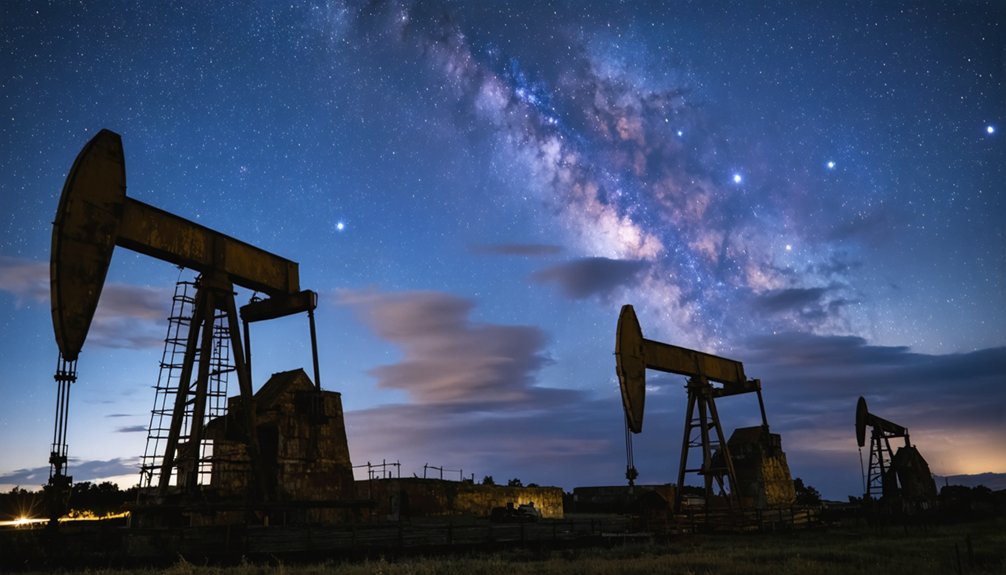
You’ll need to obtain advance permission from Drake’s Well Museum to access Pithole’s historic grounds after sunset, since the Visitor Center closes at dusk and security patrols the area.
Your essential gear should include a sturdy tripod, full-frame camera with wide-angle lens (14-24mm recommended), intervalometer, and red headlamp to navigate the excavated cellars while preserving your night vision.
Position your camera near the preserved street grid where former derrick locations provide striking silhouettes against the Bortle Class 2-3 dark skies, particularly during summer Milky Way season from May through September.
Planning Night Access
Before undertaking any night photography at Pithole’s historic ruins, you’ll need to navigate a complex web of access permissions and safety protocols. The site falls under Pennsylvania state management, requiring explicit written permits for after-hours access through the Drake Well Museum. You’ll need liability insurance and must coordinate with local law enforcement for nighttime shoots.
- Submit permit applications weeks in advance, including proof of insurance naming the state as additionally insured.
- Scout the location during daylight to map hazards like unstable foundations, creek crossings, and overgrown areas.
- Establish safety protocols including emergency beacons, satellite communicators, and check-in procedures given limited cell coverage.
Remember: operating without proper nighttime permissions risks citations, fines, or equipment seizure under state trespass laws.
Don’t let legal considerations derail your astrophotography plans – proper preparation guarantees unrestricted creative freedom.
Essential Equipment Checklist
Successful astrophotography at Pithole’s historic ruins requires four essential gear categories: imaging equipment, support systems, illumination tools, and environmental protection.
For your primary setup, you’ll need a full-frame mirrorless or DSLR camera with strong high-ISO performance, paired with both wide-angle (14-35mm f/1.4-2.8) and telephoto (70-200mm) lenses to capture the ghost town’s historical significance against the night sky.
Mount your gear on a sturdy tripod with a star tracker to combat the site’s open acoustics and wind conditions. Pack a red-light headlamp and dimmable LED panels for precise foreground lighting of structural remains.
Don’t forget weather protection – rain covers and silica gel packets are vital in Pennsylvania’s variable conditions. Multiple batteries, memory cards, and warm clothing will keep both you and your equipment operating through extended night sessions.
Safe Shooting Strategies Near Centralia
While Centralia’s abandoned streets offer unique foreground elements for astrophotography, traversing this mine-fire-affected ghost town requires strict adherence to safety protocols.
Centralia’s eerie, desolate landscape beckons photographers, but the underground inferno demands unwavering respect for safety measures.
You’ll need to plan your Centralia access carefully, arriving before sunset to scout locations and establish safe shooting positions on stable ground.
- Set up your equipment on verified solid surfaces, avoiding cracked pavement and maintaining constant air quality monitoring with your gas detector.
- Keep your GPS active and mark your vehicle’s location, maintaining clear sight lines to emergency exit routes while shooting in low-light conditions.
- Position yourself upwind of any visible steam vents or smoke, and relocate immediately if your gas detector signals elevated CO or CO2 levels.
Your camera gear must remain within arm’s reach for quick relocation if ground conditions change.
Austin Dam: Framing History With Star Trails
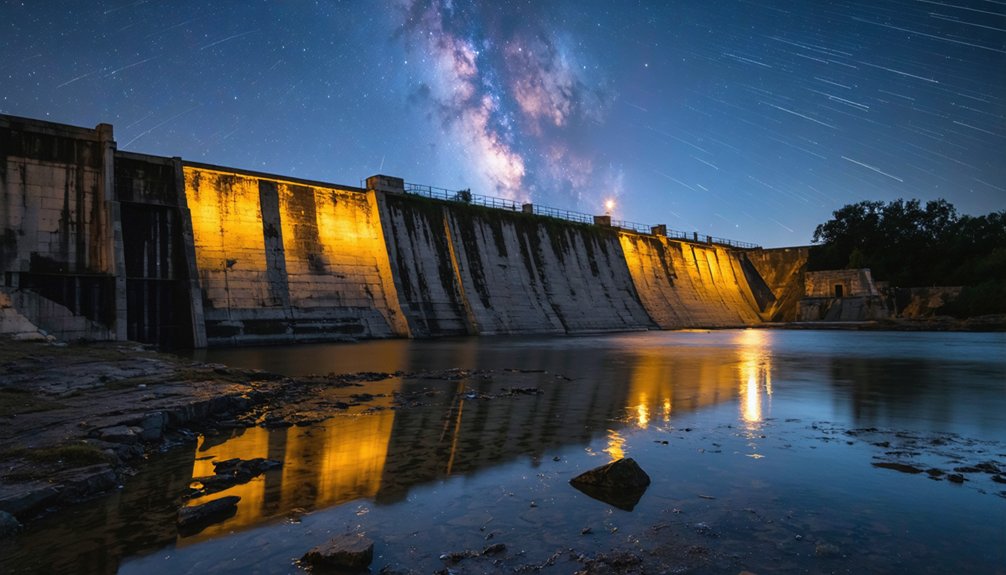
Once known as Pennsylvania’s largest concrete gravity dam, the Austin Dam ruins now stand as a haunting memorial to engineering failure and an exceptional dark-sky shooting location.
You’ll find the site’s massive concrete slabs and breach gaps create compelling foreground elements for historical storytelling through nightscape composition.
Located in Potter County’s dark skies, the ruins offer prime opportunities for star trails between late spring and early fall. Set up your gear along the memorial park’s trails to frame the fractured remnants against the rotating stars.
While Austin’s town lights can create minor skyglow, you can minimize their impact by positioning yourself strategically among the dam’s remains.
Plan your visit during summer or fall for ideal trail conditions and longer shooting sessions.
Remember to verify parking and tripod restrictions with park authorities beforehand.
Hidden Gems in Sproul State Forest
Deep within Sproul State Forest’s 300,000 acres lie two forgotten mining towns that offer extraordinary dark-sky viewing conditions.
You’ll discover Revelton treasures along designated entry routes, while Scotia ruins showcase remnants of Carnegie’s 1880s company town – both prime locations for nightscape photography.
- Position your tripod near Scotia’s concrete ore washer remains for compelling foreground elements against star trails.
- Frame the Milky Way above Revelton’s weathered foundations where minimal light pollution guarantees crystal-clear astro conditions.
- Utilize the open barrens around both sites for unobstructed views of meteor showers and celestial events.
These remote locations provide perfect setups for long exposures, with abandoned structures adding historical depth to your astrophotography compositions.
Derelict mining remnants serve as haunting anchors beneath vast starlit skies, transforming night photography into timeless visual stories.
Access via forest trails lets you reach ideal shooting positions after sunset.
Planning Your Ghost Town Night Photography Adventure
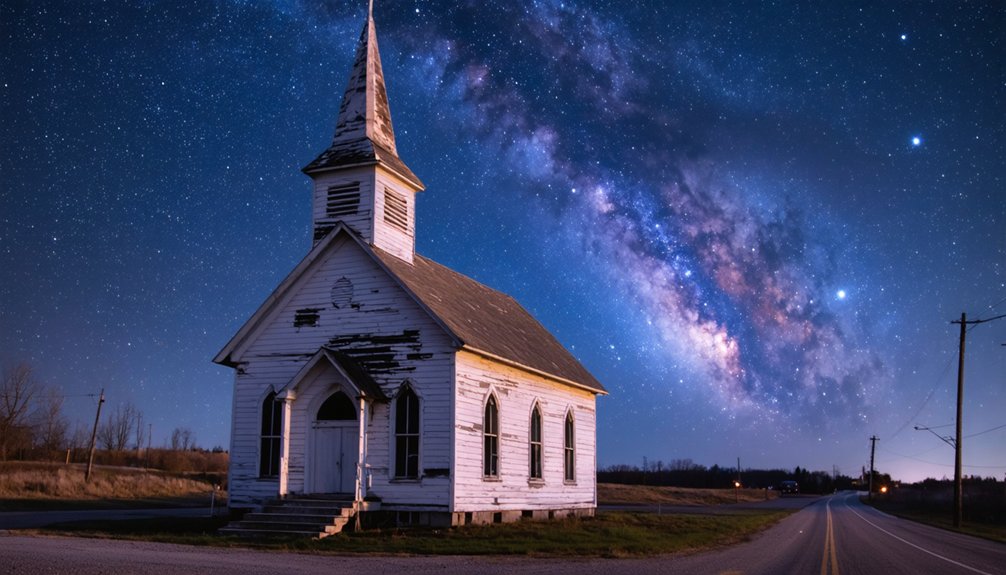
You’ll need to scout your chosen ghost town location during daylight hours to identify safe shooting positions and potential hazards like unstable structures or uneven terrain.
Assemble essential gear including a sturdy tripod, wide-angle lens for Milky Way compositions, and reliable headlamps with backup batteries for traversing dark sites like Wehrum or Yellow Dog Village.
Before starting your night shoot, always inform others of your plans and respect access protocols, whether you’re visiting managed locations like Carrie Furnaces or exploring more remote sites in Pennsylvania’s state forests.
Safety First, Always
Before venturing into Pennsylvania’s ghost towns for astrophotography, meticulous safety planning becomes your critical first step. You’ll need to maneuver through both trespass risks and environmental hazards while capturing the perfect night sky shot. Research property boundaries using county GIS maps and secure necessary permissions to avoid legal troubles.
In addition to planning for safety, scouting the best drone spots in Pennsylvania can greatly enhance your photography experience. Identifying elevated locations with minimal obstruction will provide breathtaking aerial perspectives of the landscapes below. Always remember to respect local regulations regarding drone usage to ensure a smooth and enjoyable flight.
- Scout locations during daylight to identify structural hazards, unstable ground, and wildlife zones that could pose dangers in darkness.
- Create and share a detailed route plan with emergency contacts, including GPS coordinates and nearest hospital locations.
- Pack essential safety gear: hands-free lighting, first aid supplies, and proper protective equipment for maneuvering through deteriorating structures.
Gear and Essential Equipment
Successful ghost town astrophotography requires four essential gear categories: camera systems, optical accessories, support equipment, and lighting tools.
You’ll want a full-frame mirrorless or DSLR camera that excels in low-light conditions and can shoot RAW at ISO 1600-6400. For lens choices, pack a fast wide-angle (14-35mm) with f/2.8 or wider aperture for Milky Way shots, plus a 24-70mm for detailed architectural work.
Your support system needs a robust tripod with ball head and quick-release plate to handle uneven terrain. Add a portable star tracker for pinpoint stars during long exposures.
For lighting, bring neutral LED panels and flashlights with diffusers for light-painting deteriorating structures. Don’t forget extra batteries, memory cards, and weather protection – Pennsylvania’s ghost towns can be unpredictably damp and windy.
Scout During Daylight Hours
While nighttime ghost town photography requires careful planning, thorough daytime scouting forms the bedrock of a safe and productive shoot. Your daylight reconnaissance should focus on evaluating both safety and technical requirements for capturing the Milky Way above Pennsylvania’s abandoned structures.
During site evaluation, pay close attention to light pollution sources, structural hazards, and ideal camera positions.
- Arrive 1-2 hours before sunset to assess changing light conditions, test compositions, and identify potential hazards like unstable floors or exposed nails.
- Use planetarium apps to match your intended Milky Way position with safe shooting locations you’ve verified during daylight.
- Record GPS coordinates of your primary shooting position, emergency exit routes, and nearest medical facilities – cell service can be spotty in remote ghost towns.
Seasonal Tips for Pennsylvania Dark Sky Photography
To capture stunning dark sky photographs in Pennsylvania, you’ll need to adapt your shooting strategy for each season’s distinct conditions.
Summer offers prime Milky Way core visibility from late April through early September, but you’ll contend with increased tourist traffic and agricultural lighting.
While summer unveils the Milky Way’s brilliant core, photographers must navigate bustling tourist areas and bright farm lights.
Winter brings clearer, more stable skies perfect for shooting Orion and deep-sky objects, though you’ll need cold-weather gear and larger battery capacity.
Plan your ghost town shoots around the new moon (±3 days) for maximum darkness.
Spring and summer sessions require dew prevention equipment, while autumn offers more transparent skies but harvest lighting challenges.
Monitor seasonal road access, especially in winter, and always check local weather patterns before heading out.
At premium dark sky locations like Cherry Springs, book your overnight spots well in advance during peak seasons.
Frequently Asked Questions
Are Drones Allowed for Night Photography at These Ghost Town Locations?
You can’t legally fly drones at night over ghost towns without an FAA waiver. State regulations and site-specific drone restrictions prohibit nighttime aerial photography at parks, ruins, and historic locations.
What Wildlife Precautions Should Photographers Take When Shooting at These Sites?
Keep your head on a swivel during night shoots. You’ll need to maintain 25-100 yards from wildlife encounters, use red lights sparingly, and avoid disturbing nocturnal animals’ natural habitats.
How Do You Handle Fog and Atmospheric Moisture Affecting Camera Equipment?
Pre-warm your gear and use silica packets in foggy conditions. Deploy rain covers with vents, attach dew shields, and maintain lens temperatures above dew point using portable heaters for moisture protection.
Can Tour Guides Be Hired for Night Photography at These Locations?
You’ll find guided night photography at Gettysburg and Haunted Hill View Manor, while Yellow Dog Village requires special arrangements. Jim Thorpe’s tours typically end before ideal astrophotography conditions begin.
Which Locations Allow Overnight Parking for Time-Lapse Photography Setups?
You’ll find overnight permits at Scotia Barrens and Pithole via State Game Lands and Oil Creek State Park, respectively. Corydon and Yellow Dog Village don’t allow extended parking for your time-lapse setups.
References
- https://www.darkskypa.org/dark-sky-places-pa
- https://pabucketlist.com/the-spookiest-sounding-destinations-in-pennsylvania/
- https://pawilds.com/landscape/dark-skies/
- https://www.visitpa.com/blog/post/ultimate-stargazing-spots-pennsylvania/
- https://www.onlyinyourstate.com/experiences/pennsylvania/abandoned-eerie-place-pa
- https://www.youtube.com/watch?v=_u5MUuwynhw
- https://outings.sierraclub.org/trip/Dark-Forest-Starry-Skies-Astronomy-Fall-Day-Hiking-Pennsylvania-Wilds
- https://bellefonte.com/posts/darkness-on-the-edge-of-town-a-guide-to-bellefontes-local-night-skies
- https://www.ace.aaa.com/publications/travel/us-destinations/pennsylvania/stargazing-trip.html
- https://store.bandccamera.com/blogs/how-to/photographing-ghost-towns