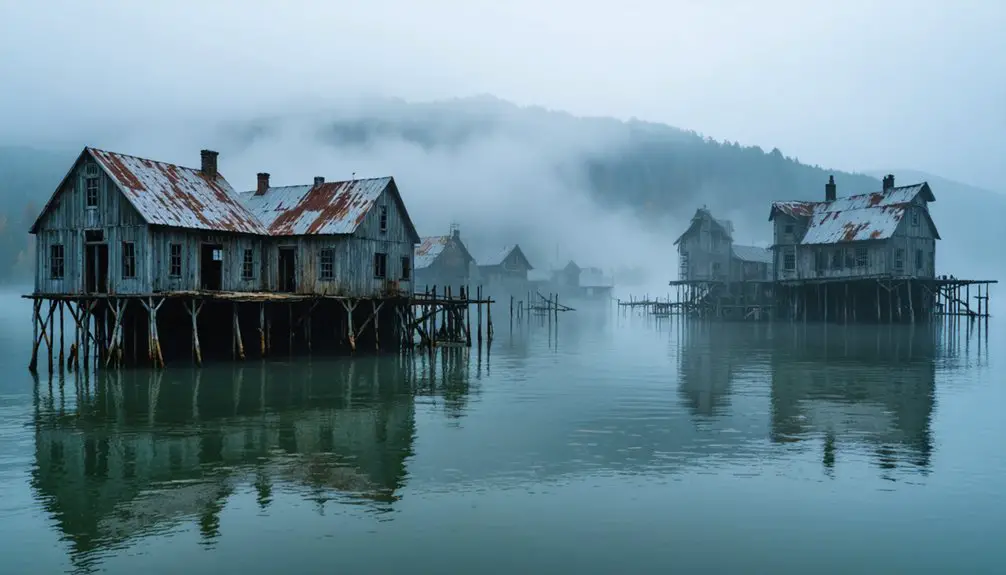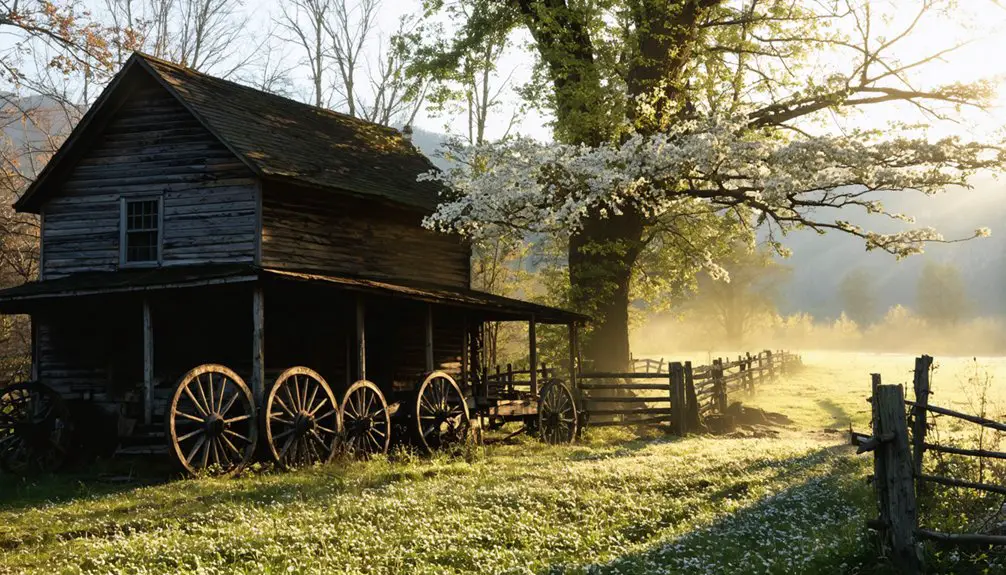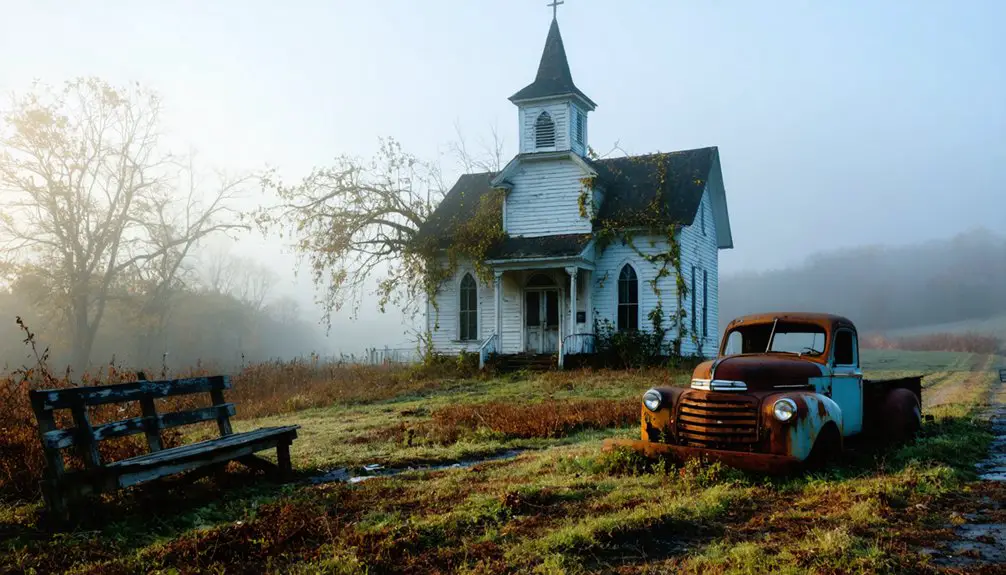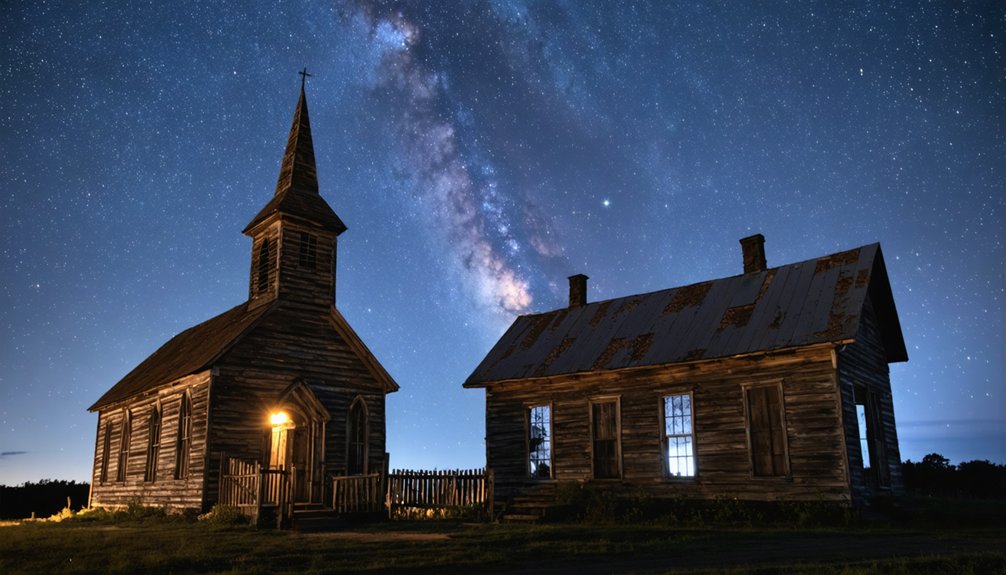
You’ll find exceptional astrophotography conditions in Tennessee’s ghost towns, particularly in Elkmont’s ruins and Lost Cove. Their remote mountain locations offer minimal light pollution, while historic structures provide compelling foreground elements. Set up your full-frame camera with a fast wide-angle lens (f/1.4-2.8) near stone chimneys and foundations for dramatic star trail compositions. For ideal results, time your visit during new moon phases and scout locations during daylight. The technical details of capturing these haunting scenes require specific gear and techniques.
Key Takeaways
- Elkmont’s stone chimneys and Troll Bridge provide compelling foreground elements against dark skies in Great Smoky Mountains National Park.
- Pickett State Park’s Silver-tier Dark Sky status ensures minimal light pollution across 16.2 km² of protected wilderness.
- Cades Cove’s abandoned structures offer historic compositions with unobstructed valley views and excellent Milky Way visibility.
- The Little River Lumber Company ruins near Jake’s Creek Trail provide remote shooting locations away from modern light sources.
- The Appalachian Clubhouse ruins in Elkmont create dramatic architectural framing for star trails and night sky photography.
Why Tennessee Ghost Towns Offer Prime Night Sky Views
While many photographers seek dark sky locations across the United States, Tennessee’s ghost towns offer uniquely ideal conditions for capturing the cosmos. The state’s abandoned settlements, particularly in the Cumberland Mountains and Great Smoky Mountains, benefit from minimal light pollution and remote positioning away from eastern U.S. light domes.
You’ll find these ghost town locations strategically situated within protected areas like Pickett CCC Memorial State Park and Great Smoky Mountains National Park, where strict development limitations preserve natural darkness. The Synchronous Fireflies illuminate Elkmont during special times of the year, adding natural light shows to nighttime photography opportunities. The historic Little River Lumber Company once operated a railroad through Elkmont, leaving behind remnants perfect for framing starlit compositions.
The mountainous terrain creates natural barriers against artificial light, while historic preservation efforts have maintained these sites without modern infrastructure.
Whether you’re shooting from Elkmont’s misty valley or Lost Cove’s secluded gorge, these locations combine ghost town history with premier celestial events viewing, offering compositions that merge abandoned structures with pristine night skies.
Essential Astrophotography Gear and Settings
To capture Tennessee’s ghost town night skies, you’ll need a full-frame or APS-C camera paired with a fast wide-angle lens (14-35mm, f/1.4-2.8) for Milky Way compositions.
Your setup must include a sturdy tripod and either a portable star tracker or equatorial mount to enable longer exposures without star trailing. Consider using an iOptron Sky Tracker Mount for its lightweight portability and quick setup time. Pre-processing software like DeepSkyStacker will be essential for combining and stacking your images to reveal detail.
For best results, you’ll want to control your camera remotely using an intervalometer or automation controller while maintaining focus with dew heaters and monitoring your power supply throughout the session.
Camera Bodies and Lenses
Since choosing the right camera and lens combination forms the foundation of successful astrophotography, you’ll need to understand how sensor types and focal lengths affect your night sky images.
Full-frame sensors with back-illuminated CMOS technology deliver superior low-light performance and wider field coverage – vital for capturing Tennessee’s ghost towns under starlit skies. Look for camera features like built-in intervalometers and low-vibration modes to streamline your workflow.
For lens selection, ultra-wide primes between 14-24mm excel at dramatic Milky Way compositions while maintaining sharp star points. The Rokinon 14mm F/2.8 delivers exceptional wide-angle performance for capturing expansive views of the night sky at an affordable price point. Fast aperture lenses with weather sealing provide protection against moisture and dust while maximizing light gathering capability in low-light conditions.
If you’re shooting tracked exposures of specific targets like nebulae, consider short telephoto primes in the 50-105mm range. Remember that higher megapixel sensors require more precise tracking, so balance your resolution needs against your mount’s capabilities.
Tripods and Mounts
Because successful astrophotography depends heavily on a rock-solid foundation, your tripod and mount selection will make or break your ghost town night shoots in Tennessee. Long exposure times are critical for capturing faint details in the night sky.
Exploring the best drone spots in Tennessee can also enhance your astrophotography sessions, providing unique aerial perspectives of the landscape while capturing stunning night skies. As you scout these locations, consider the combination of natural features and minimal light pollution for optimal results. Ensuring that your drone is equipped with the right settings will add another layer of depth to your photographic collection.
For tripod selection, opt for carbon fiber legs that can support at least 1.5-2 times your gear weight, featuring removable center columns for low-angle Milky Way compositions. Match your tripod with an Arca-Swiss compatible ball head for quick framing, or choose a geared head for precise panoramas over historic ruins. The Manfrotto 190XPROB tripod provides excellent stability for astrophotography setups.
For longer exposures, consider a portable star tracker like the Sky-Watcher Star Adventurer or iOptron SkyTracker. These enable multi-minute captures with pinpoint stars when properly polar-aligned.
If you’re planning deep-sky work with heavier gear, upgrade to a mid-size equatorial mount that can handle payloads over 10kg while maintaining tracking accuracy.
Exposure and Focus Tips
Three critical exposure variables define successful ghost town astrophotography: aperture, shutter speed, and ISO sensitivity.
You’ll want to shoot with your lens’s widest aperture (f/1.4-f/2.8) to maximize light gathering, while keeping shutter speeds between 13-30 seconds for sharp Milky Way shots. Set your ISO between 800-3200 to balance light capture with noise control. Consider using a ball head mount for precise camera positioning adjustments.
For precise focus adjustments, switch to manual focus and use your camera’s live view magnification to focus on bright stars. An intervalometer or remote shutter release will prevent camera shake during long exposures. A sturdy tripod setup is absolutely essential for achieving sharp images during these extended exposure times.
These exposure techniques become particularly effective when photographing abandoned structures against the night sky. You’ll achieve the sharpest results by testing your lens’s performance at its widest aperture before heading out to your chosen ghost town location.
While traversing Sugarlands after dark requires careful planning, you’ll find several established access points that serve as gateways to the historic ruins. Your primary entry points include the Elkmont Campground parking area and Little River Road pullouts near Jakes Creek trails.
Navigate with GPS coordinates and offline maps, as cell service is unreliable in the valley.
You’ll need to time your visit carefully, as the park enforces strict nighttime regulations. Obtain necessary permits for after-dark access and stick to designated areas.
When exploring Elkmont trails and historic landmarks, use red-filtered headlamps to preserve your night vision while avoiding wildlife disruption. Keep a safe distance from deteriorating structures, and always carry emergency communication devices like satellite messengers.
For ideal shooting conditions, plan your visits during the dry season from late autumn through early spring.
Capturing Star Trails Above Elkmont’s Ruins
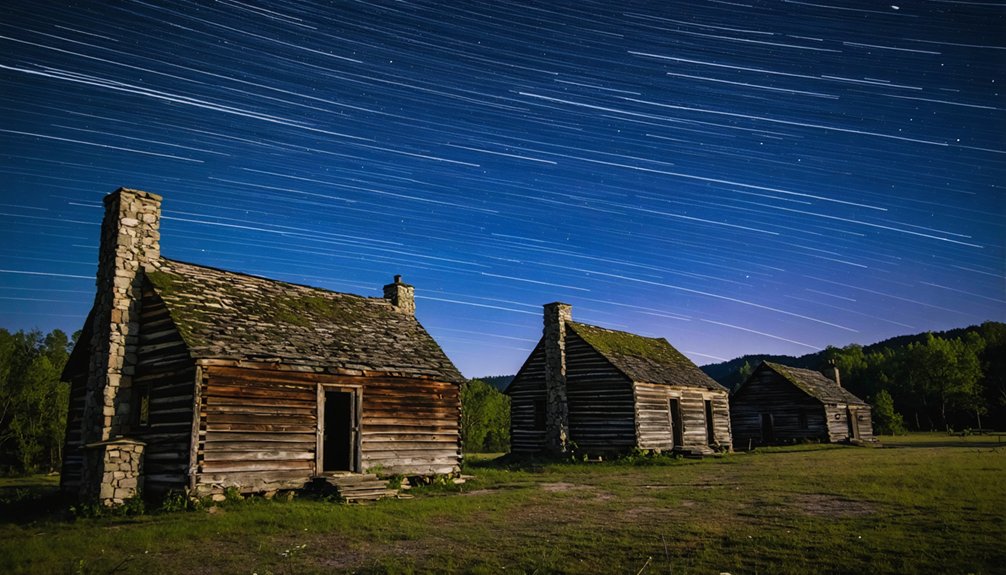
When planning your nighttime shoot at Elkmont’s ruins, you’ll need to scout locations during daylight hours to identify safe shooting positions near the stone chimneys and Troll Bridge along Little River Trail.
Position your tripod on stable ground away from the historic structures, using a wide-angle lens at f/2.8 or wider to capture both the architectural elements and the expansive star trails above.
You’ll achieve ideal results by setting up multiple 30-second exposures at ISO 1600-3200, then stacking them in post-processing to create dramatic circular patterns around the North Star while maintaining detail in the ghostly ruins below.
Night Access Planning Tips
Planning night photography at Elkmont’s ruins requires careful navigation of Great Smoky Mountains National Park regulations and access limitations.
While nighttime regulations restrict access to preserved structures after dusk, you’ll find strategic vantage points along Jake’s Creek and Little River trails that remain open 24/7.
For best results, time your shoots during new moon phases when skies are darkest.
Scout locations during daylight to identify safe positioning near the Appalachian Clubhouse ruins and Spence Cabin.
Take essential safety precautions by carrying headlamps and watching your footing on uneven terrain.
Position your gear on stable surfaces near the cobble platform for clear shots of star trails above the historic structures.
Consider fall visits when reduced foliage and crowds allow better composition options around the preserved buildings.
Camera Setup Amid Ruins
Setting up your camera amid Elkmont’s historic ruins requires strategic positioning to capture compelling star trail compositions. Position your tripod near stone chimneys and foundations to frame foreground elements against the night sky.
For ideal camera angles, align crumbling walls with open sky sections above the trails, particularly along Little River and Jakes Creek.
The Elkmont Troll Bridge offers a unique arched foreground for low-angle shots, while the elevated platform of Levi Trentham Cabin provides stable positioning for wider compositions.
Mount your wide-angle lens (14-24mm) to encompass both architectural remnants and celestial movement. When selecting your vantage point, avoid restored cabin interiors and focus on open ruin areas that offer unobstructed views of the star-filled sky above.
Night Photography Tips for Cades Cove Valley
Tucked away in Tennessee’s Smoky Mountains, Cades Cove Valley offers photographers an exceptional dark sky location for capturing celestial landscapes.
You’ll find prime shooting conditions by cycling in at 4am, when the loop road restricts vehicle access. Pack your wide-angle lens for sweeping starscapes and a telephoto for wildlife integration.
Position yourself along Sparks Lane or Hyatt Lane for unobstructed valley views and minimal light pollution. The orientation shelter area provides a secluded grassy spot for star trails, while the Peter Cable Cabin serves as an ideal historic foreground.
Time your visit during new moon phases for maximum star visibility, and arrive an hour before sunrise to secure prime shooting locations. Early morning fog and dew add atmospheric depth to your night-to-dawn shifts.
Lost Cove: A Hidden Celestial Paradise
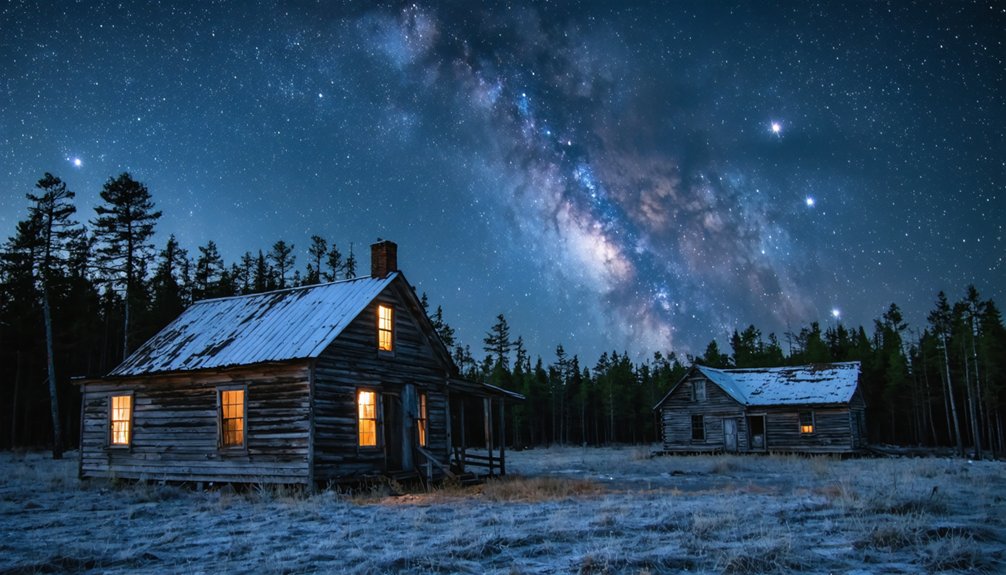
Deep within the rugged Poplar Gorge along the Tennessee-North Carolina border lies Lost Cove, an abandoned settlement that offers photographers rare dark-sky shooting conditions.
You’ll find compelling foreground elements including century-old cabins, church ruins, and weathered grave markers – perfect for celestial photography compositions against the pristine night sky.
To capture the best shots, time your visit during late fall through early spring when bare trees provide clearer sightlines to the stars.
Access requires either a steep hike from the NC side or a three-mile trek along active railroad tracks from Tennessee.
Pack wilderness gear and exercise extreme caution after dark due to hazardous terrain and wildlife.
While challenging to reach, Lost Cove’s minimal light pollution and historical structures create unique opportunities for dramatic Milky Way and star trail photography.
Dark Sky Programs at Pickett State Park
While Lost Cove offers adventurous photographers a remote dark sky locale, Pickett State Park provides a more accessible and structured environment for astrophotography.
As a Silver-tier International Dark Sky Park since 2015, you’ll find 16.2 km² of protected darkness in the Cumberland Mountains, where light pollution controls maintain pristine night skies.
You can participate in dark sky programming throughout the year, from annual star parties to seasonal night hikes. The park’s collaboration with the Barnard-Seyfert Astronomical Society and University of Tennessee guarantees expert-led sessions and telescope access.
For best shooting conditions, consult the ClearSky forecast at coordinates 36.53833, -84.82917. The park’s night sky conservation efforts include minimal lighting and controlled exterior fixtures, creating perfect conditions for long-exposure photography while maintaining essential visitor safety features.
Stargazing Opportunities Along Obed River
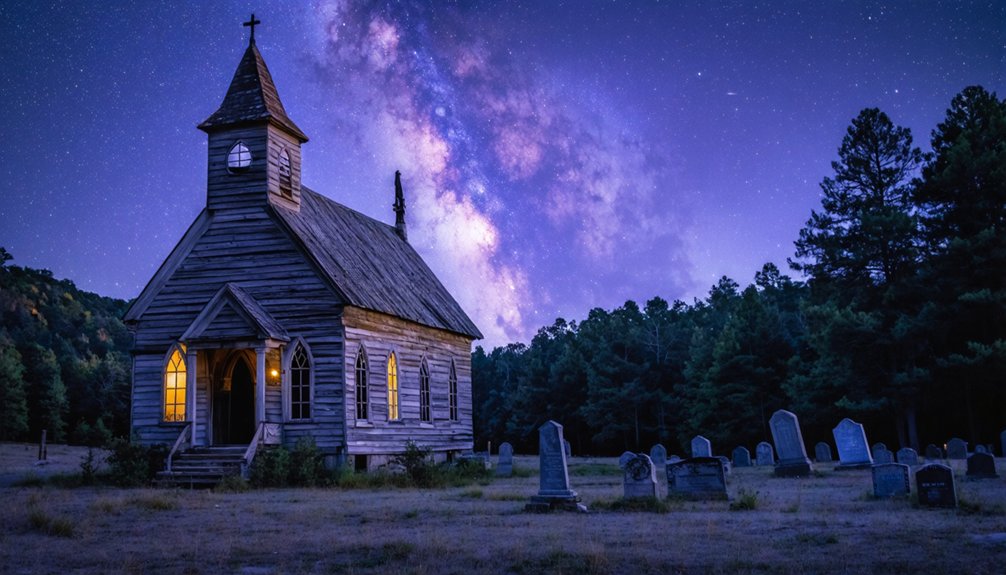
Since earning its International Dark Sky Park designation in 2017, the Obed Wild & Scenic River has emerged as Tennessee’s premier astrophotography destination.
With a Bortle Class 2 rating and strict lighting policies, you’ll find pristine dark skies perfect for capturing the Milky Way and deep-sky objects throughout the 20.2 km² corridor.
Experience some of America’s darkest skies as you photograph celestial wonders in this pristine, light pollution-free natural sanctuary.
Key shooting locations along the Obed River include:
- Lilly Bluff Overlook – offering 360° views from an accessible boardwalk platform, ideal for wide-field panoramas
- Historic Nemo Bridge – providing structural elements for dramatic Milky Way compositions
- Clear Creek Gorge viewpoints – featuring 200-foot cliff walls that create striking silhouettes for vertical star-trail shots
Plan your shoots around new moon phases and astronomical twilight for best conditions, particularly during late spring through early fall when the Milky Way core is most visible.
Frequently Asked Questions
Are Ghost Town Visits Legal After Sunset in Tennessee National Parks?
Sharp as a blade, you’ll need permits for nighttime photography at ghost towns. Ghost town regulations restrict access after sunset unless you’ve secured proper authorization from the National Park Service.
What Wildlife Safety Precautions Should Photographers Take When Shooting at Night?
You’ll need backup lighting, GPS navigation, and a noise maker to avoid wildlife encounters. Maintain safe distances, scout locations beforehand, and carry emergency supplies to mitigate nighttime hazards.
How Can I Find Exact GPS Coordinates for These Abandoned Locations?
Access RootsWeb’s GPS database, cross-reference coordinates with online resources like GTUSA, and verify locations using mapping tools. When data’s unavailable, contact local historical societies for precise waypoints.
Which Seasons Offer the Clearest Night Skies for Ghost Town Photography?
You’ll find your clearest shots during autumn and winter when humidity drops and skies stabilize. Plan around new moon phases for maximum darkness, with winter offering longer exposure windows and crisp atmospheric conditions.
Do I Need Special Permits for Commercial Astrophotography in These Areas?
You’ll need commercial-use permits for photography in federal, state, and municipal ghost towns. Check local photography regulations, secure landowner permissions, and obtain liability insurance before your shoot.
References
- https://www.wanderingsmokymountains.com/smoky-mountain-ghost-towns-in-tennessee/
- https://gatlinburghaunts.com/elkmont-tennessees-ghost-town/
- https://www.tnmagazine.org/stargazing-in-tennessee/
- https://darksky.org/places/pickett-memorial-and-pogue-creek-canyon-dark-sky-park/
- https://www.tnvacation.com/trip-inspiration/articles/12-stargazing-camping
- https://wbkr.com/historic-mountain-ghost-town-awaits-your-next-east-tn-visit/
- http://soggyastronomer.com/about/astrophotography-gear/
- https://astrobackyard.com/astrophotography-equipment/
- https://www.rmg.co.uk/stories/space-astronomy/best-astrophotography-equipment-according-experts
- https://agenaastro.com/astrophotography.html