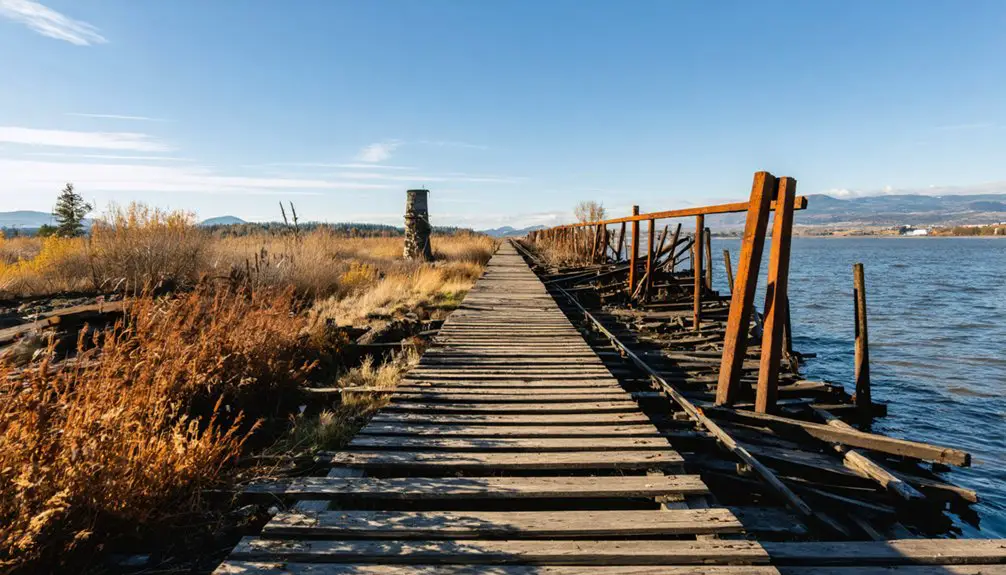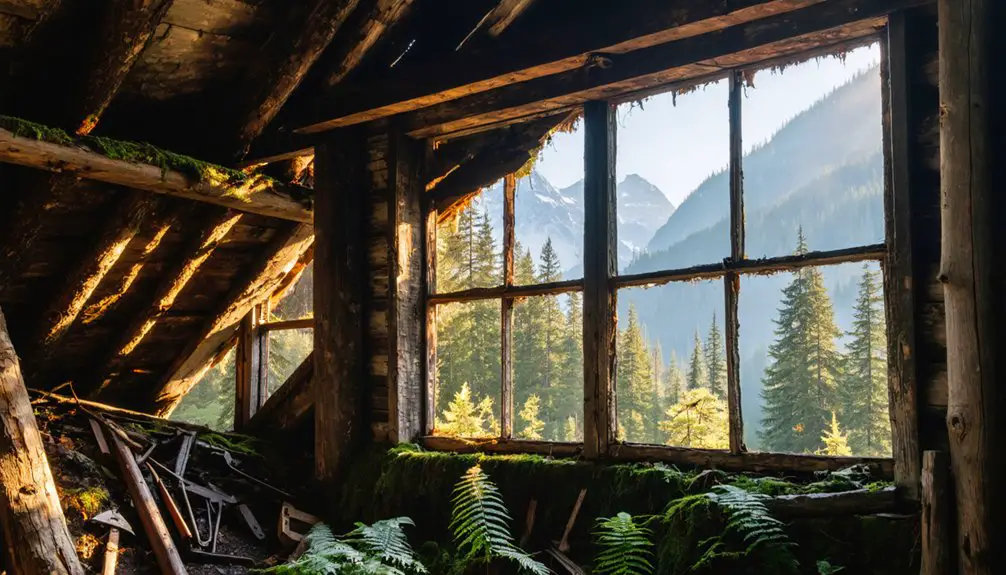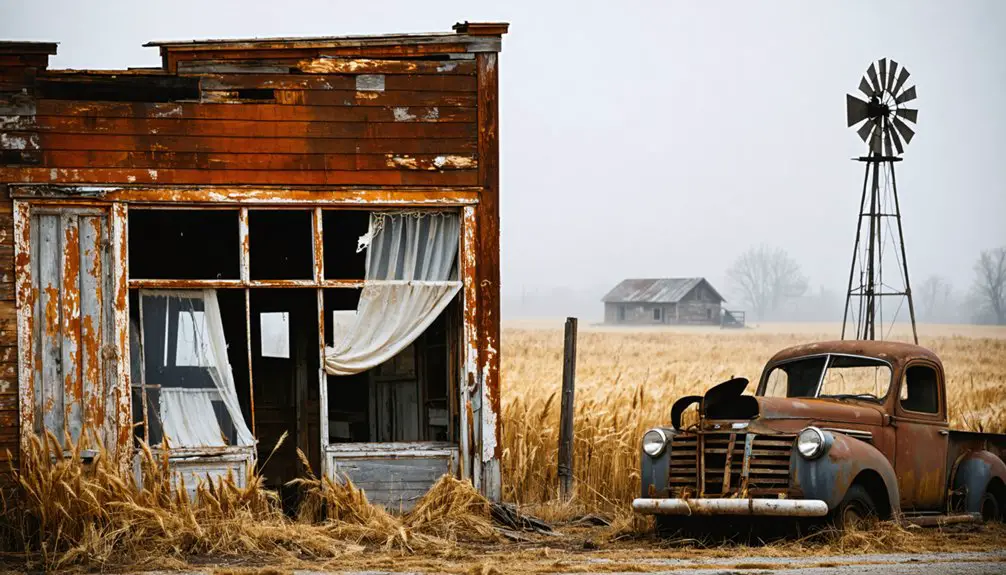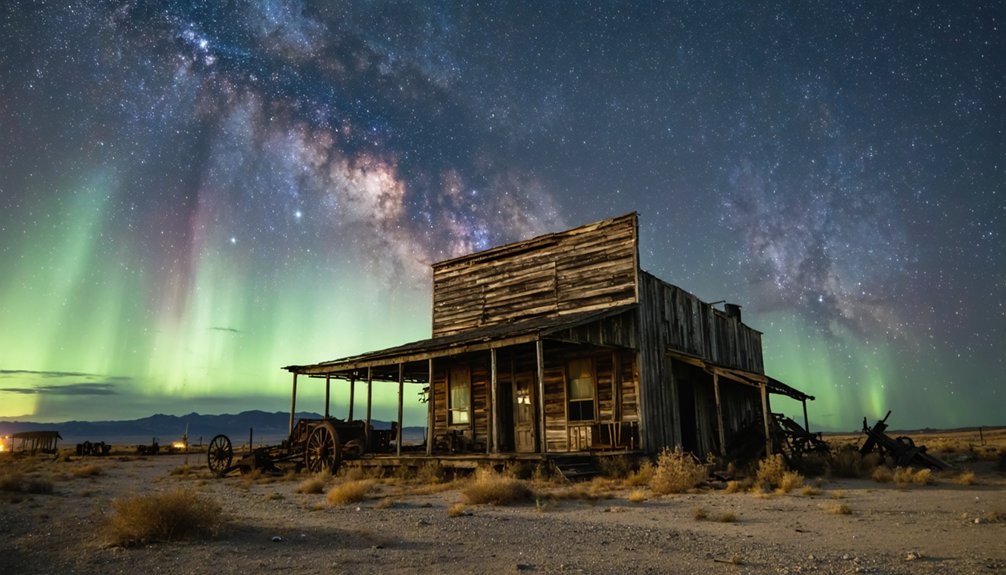
You’ll find prime astrophotography conditions at Washington’s ghost towns, particularly in the Methow Valley and North Cascades regions with Bortle 1-2 dark sky ratings. For ideal Milky Way shots, pack a full-frame camera with a fast wide-angle lens (f/2.8 or wider) and a sturdy tripod. The best shooting window runs May through September, targeting new moon phases and clear nights. The abandoned structures near Sun Lakes-Dry Falls offer compelling foreground elements against pristine starfields, though you’ll need to master specific techniques and permits.
Key Takeaways
- Liberty Ghost Town near Cle Elum offers Bortle 2-3 skies and preserved mining structures, making it ideal for Milky Way photography.
- Monte Cristo’s remote North Cascades location provides pristine dark skies and historic building remnants against mountain backdrops.
- The abandoned food processing area in Skagit County features unique industrial architecture under moderately dark skies.
- Sherman Ghost Town in Eastern Washington combines desert landscape elements with Bortle 2-3 rated dark skies.
- Chesaw’s remote location near the Canadian border offers minimal light pollution and well-preserved historic structures for nighttime compositions.
Why Ghost Towns Make Perfect Stargazing Spots
When you’re searching for the perfect astrophotography location, ghost towns offer an unbeatable combination of dark skies and compelling compositions.
These remote sites deliver exceptional stargazing benefits with minimal light pollution, often registering pristine readings on the Bortle scale that you won’t find near urban areas. You’ll capture cleaner long exposures without interference from streetlights or passing vehicles. Tours from local paranormal societies often organize nighttime visits to these locations. Since 80% of people live under light-polluted skies, these abandoned sites provide rare opportunities for true darkness.
Ghost towns provide pristine dark skies far from city lights, making them ideal sanctuaries for capturing the cosmos in stunning detail.
The historical significance of abandoned structures creates ideal foreground elements for your shots.
You can freely experiment with light painting techniques on weathered buildings and rusty equipment while maintaining dark sky conditions.
With predictable access and low human activity, you’ll avoid the frustrations of unexpected lighting changes or vibrations that plague popular locations.
Your gear can remain undisturbed during extended shooting sessions, perfect for capturing star trails or deep-sky objects.
Essential Astrophotography Equipment for Ghost Town Shoots
To capture stunning ghost town astrophotography, you’ll need specialized gear that handles both architectural and celestial subjects in low-light conditions.
Start with a full-frame mirrorless or DSLR camera paired with fast wide-angle glass like the Rokinon 14mm f/2.8 for Milky Way compositions. Add a telephoto in the 50-200mm range for detailed building shots against starfields. A Canon 70-200mm f/4 offers excellent versatility for capturing distant structures. Processing software like PixInsight is essential for bringing out detail in both foreground and sky.
Your tracking solutions should include a portable equatorial mount like the iOptron SkyTracker or Sky-Watcher Star Adventurer for clean, trail-free star exposures.
Don’t forget a robust tripod rated above your payload weight. For dependable operation through the night, pack a field controller or mini-PC, plenty of battery power, and dew heaters to keep your optics clear.
Critical focus tools like Bahtinov masks will guarantee sharp results in the dark.
Dark Sky Ratings at Washington Ghost Towns
Understanding Bortle Scale ratings is essential for successful ghost town astrophotography in Washington state.
You’ll find the darkest skies (Bortle 1-2) in remote locations like the Methow Valley and North Cascades backcountry, where abandoned mining sites offer pristine conditions for Milky Way photography. Ranger-led programs enhance stargazing opportunities throughout the summer months.
While urban-adjacent ghost towns often suffer from light pollution (Bortle 5-7), several prime locations maintain excellent dark sky conditions. The abandoned food processing area in Skagit County provides unique architectural elements for night sky compositions.
- The Methow Valley region consistently delivers Bortle 1-2 skies, perfect for capturing deep Milky Way structure and airglow.
- Central/eastern desert areas near Sun Lakes-Dry Falls maintain Bortle 2-3 ratings with minimal light domes.
- Okanogan-Wenatchee National Forest’s abandoned camps provide reliable Bortle 2-3 conditions.
- Grand Coulee Basin outskirts offer stable Bortle 2-3 nights ideal for widefield time-lapse work.
Best Seasons for Ghost Town Night Photography
Beyond ideal dark sky ratings, successful ghost town astrophotography hinges heavily on seasonal timing in Washington state.
You’ll find the best seasonal conditions from May through September, when clear nights and low humidity create prime shooting conditions for Milky Way captures. Plan your shoots within 3 days of new moon for maximum dark-sky potential.
Summer delivers your most reliable multi-night windows, particularly in July and August. Like the photographers who captured the iconic light-painted images at Bodie, you’ll want clear skies for dramatic nighttime illumination. Many photographers find Mount Rainier overlooks ideal during these months.
While coastal locations battle marine layer interference, interior sites like the Palouse offer consistently clear nights. The core Milky Way season peaks April through September, matching perfectly with optimal atmospheric clarity.
For ideal shooting times, target the pre-dawn hours before moonrise or late evening after moonset.
Winter months provide leaf-off advantages for unobstructed compositions but require careful planning around increased cloud cover and precipitation.
Getting There: Access and Safety Tips
You’ll need to equip yourself with essential navigation tools including a GPS device with offline maps, a traditional compass, and detailed USGS topographic maps since cellular coverage is unreliable at most ghost town sites.
For optimal viewing conditions, try to schedule your visits during dark sky events coordinated with local astronomy clubs.
Road conditions vary dramatically by season, with many locations requiring high-clearance 4WD vehicles during spring thaw and winter months, while others become completely inaccessible due to snow barriers and seasonal gates.
The best access points typically involve a mix of paved highways shifting to Forest Service or BLM roads, so mark your waypoints carefully and scout your route during daylight hours before attempting any night photography sessions. Similar to visiting Mount Rainier campgrounds, these remote locations provide ideal dark sky conditions for stellar astrophotography opportunities.
When venturing to remote ghost towns for astrophotography, reliable navigation equipment becomes your lifeline in areas devoid of cellular service and paved roads.
You’ll need both modern navigation technology and analog backups to guarantee your safety and success. A dedicated GPS unit loaded with topographic maps serves as your primary navigation tool, while a satellite communicator provides essential emergency preparedness capability.
- GPS unit with offline topographic maps and waypoint tracking
- Satellite communicator (Garmin inReach/ZOLEO) for SOS signaling
- Printed USGS maps and magnetic compass as non-electronic backups
- External battery pack (20,000+ mAh) to keep devices powered
Don’t rely solely on your smartphone – ghost towns often sit beyond cellular coverage.
Pack redundant navigation tools and maintain a detailed trip plan that includes emergency contact information and nearest fuel stations.
Seasonal Road Conditions
Road conditions to Washington’s ghost towns vary dramatically with the seasons, requiring careful planning and vehicle preparation before each trip.
During winter months, Liberty and Monte Cristo become challenging to access due to snowpack, while Sherman and Govan remain accessible via Highway 2, though chains are often required from December through February.
Summer offers the most reliable road maintenance and access across all sites, with Liberty’s gravel roads and Monte Cristo’s Forest Service routes typically clear from June through September.
You’ll need a high-clearance vehicle for Chesaw’s mining-era paths year-round.
Spring brings unique hazards – watch for seasonal flooding near Chesaw and muddy conditions after thaws in Sherman.
For ideal astrophotography access, time your visits during dry seasons and always check current USFS and WSDOT alerts before departing.
Best Access Points
Four primary access routes serve Washington’s most photographable ghost towns, each requiring specific preparation and gear choices.
You’ll need to carefully plan your trailhead logistics based on vehicle requirements and seasonal conditions. Research GPS coordinates for designated parking areas and verify permit requirements before heading out.
- Mountain Loop Highway (Monte Cristo) – High-clearance vehicle needed, 4×4 recommended in winter, parking at Barlow Pass trailhead
- Cascade Pass Road (Liberty) – Standard vehicles OK May-October, limited parking at ghost town site
- Upper Cle Elum Valley (Liberty Bell) – AWD recommended, multiple Forest Service pullouts available
- Yakima River Canyon (Lester) – Paved access year-round, overnight parking permitted at designated areas
For each location, carry emergency gear and verify current access restrictions through land management agencies.
Top Ghost Town Photography Locations
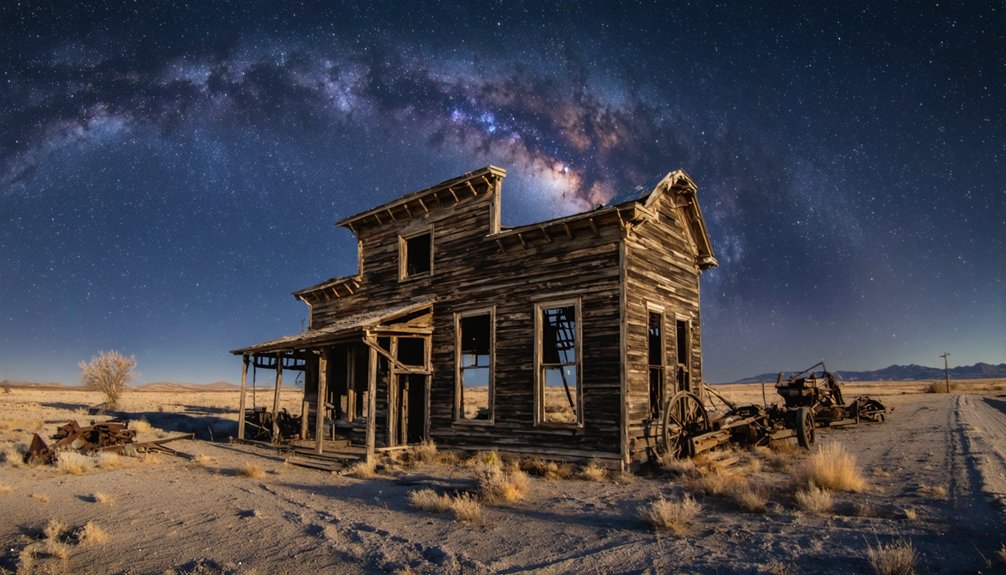
Washington’s ghost towns provide exceptional astrophotography opportunities, with five standout locations offering unique structural elements against the night sky.
Among the best drone locations in Washington, you can find breathtaking views of abandoned buildings juxtaposed with star-filled skies. These sites not only provide a glimpse into the past but also encourage creative aerial photography. Each location presents its own challenges and rewards, making it a perfect adventure for both seasoned drone pilots and newcomers alike.
You’ll find compelling compositions at Loomistown’s historic turn-of-the-century homes and Nighthawk’s preserved hotel and mill structures, which create striking silhouettes for Milky Way shots.
Old Molson’s weathered buildings and vintage farming equipment offer foreground elements perfect for star trails, while Monte Cristo’s abandoned mining equipment creates industrial contrasts against star-filled skies.
Rusting machinery and time-worn structures at Old Molson and Monte Cristo frame nature’s lightshow in haunting industrial silhouettes.
Liberty’s open landscape allows for unobstructed celestial views, with historic foundations and structures providing strong compositional anchors.
Each location’s remote setting guarantees minimal light pollution, while their varied architectural elements let you craft distinctive nighttime images that capture both terrestrial history and celestial drama.
Camera Settings for Night Ghost Town Shots
Capturing ghost towns under starlit skies requires precise manual camera settings to balance structural details with celestial elements.
You’ll need to master exposure techniques that preserve both architectural features and stars. Switch your camera to full manual mode, disable auto-focus, and set your white balance to daylight for consistent results.
- Set your aperture between f/2.8 and f/4 to gather maximum light while maintaining acceptable depth of field.
- Choose ISO 1600 as your starting point, adjusting up to 3200 in darker locations.
- Apply the 500 rule for shutter speed (500/focal length) to prevent star trails.
- Use focus methods like live-view magnification on bright stars or pre-focus on distant objects during daylight.
Remember to shoot in RAW format and disable in-camera noise reduction for maximum post-processing flexibility.
These settings will help you capture the eerie beauty of abandoned structures against the starry Washington sky.
Permits and Regulations for Night Access
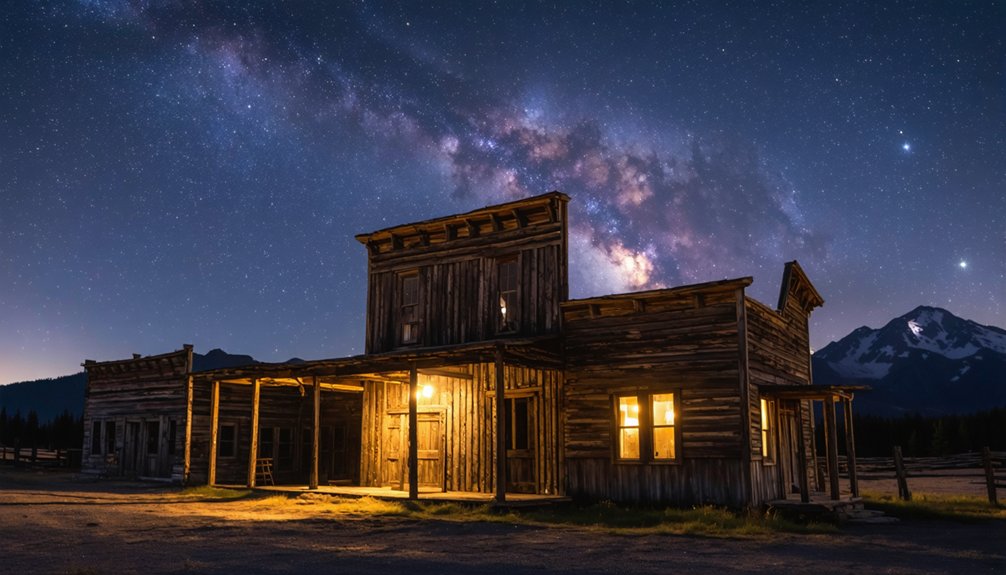
Before you set up your tripod at a Washington ghost town after dark, you’ll need to verify access hours and secure any required permits from the governing land authority – whether that’s state parks, national parks, tribal lands, or private property owners.
You’ll find most public sites have restricted nighttime access, requiring special permits that may include liability insurance and specific conditions about equipment use and group size.
To avoid trespassing violations, you must carefully identify property boundaries and obtain written permission when shooting on or across private land, as many ghost town structures span multiple jurisdictions.
Access Hours and Gates
When planning nighttime ghost town photography sessions in Washington, you’ll need to navigate a complex system of access regulations that vary by location and jurisdiction.
Public lands offer the most straightforward access, but you’ll still need to work around gated areas and time restrictions. Most ghost towns on federal lands don’t have formal access hours, though some locations may have seasonal gates.
- Rest areas near ghost towns can serve as staging locations, but you’re limited to 8-hour parking periods.
- National Park Service sites typically close gates at sunset, requiring advance permits for night photography.
- Abandoned locations on public lands without gates offer 24/7 access for astrophotography.
- Private ghost towns require owner permission and may have strict entry/exit times through locked gates.
Photography Permit Requirements
Successful night photography at Washington’s ghost towns requires maneuvering through multiple permit requirements across different jurisdictions.
You’ll need to research specific permit types based on your shooting location and purpose – from special event permits for group workshops to commercial photography permits for paid shoots. State parks and DNR lands mandate written authorization for after-hours access.
For your permit application process, prepare detailed documentation about your planned dates, group size, and lighting equipment.
If you’re shooting commercially, you’ll need liability insurance naming property owners as additional insured. Historic ghost town sites may require additional archaeological permits with strict lighting restrictions.
Private property shoots demand written landowner permission with specific conditions about access hours and equipment use.
Private Property Boundaries
Maneuvering private property boundaries presents critical challenges for astrophotographers seeking access to Washington’s ghost towns after dark.
You’ll need to carefully map your shooting locations, as many sites like Barron Ghost Town lie mainly on private land. While Northern State Recreation Area offers designated public access, you must maintain strict boundary awareness when setting up gear for night shots.
- Research current ownership through local historical societies before planning night shoots
- Pre-scout locations during daylight to identify private property markers and gates
- Obtain explicit permission when shooting on private land, especially for sites actively used like Barron
- Pack portable GPS units to make sure you’re maintaining legal positioning during long exposures
For best results, focus on ghost towns with clear public access like Monte Cristo, where boundary restrictions won’t limit your creative freedom during nighttime sessions.
Frequently Asked Questions
Are There Guided Night Photography Tours Available at These Ghost Towns?
You’ll find limited ghost town photography night tour options – mainly through astronomy clubs and freelance photographers. Your best bet’s Goldendale Observatory’s guided programs or regional dark-sky group workshops.
What Wildlife Should Photographers Watch Out for During Night Shoots?
From prowling cougars to slithering rattlers, you’ll need to watch for nocturnal predators. Keep alert for black bears, bobcats, coyotes and owls while shooting. Carry bear spray for wildlife encounters.
How Crowded Do These Locations Get During Meteor Showers?
You’ll face peak crowd dynamics at Goldendale and Steamboat Rock during meteor showers, requiring advance bookings. Methow Valley pullouts offer more solitude, while Palouse Falls maintains moderate but manageable meteor visibility crowds.
Can Drones Be Used for Night Photography at These Ghost Towns?
Like threading a needle in the dark, you’ll need FAA night waivers and site-specific permits. Drone regulations restrict most ghost town flights, while navigation hazards and cold temps create serious night safety challenges.
Are There Any Local Legends or Paranormal Reports at These Locations?
You’ll encounter rich supernatural sightings at Port Gamble’s Victorian homes, Bodie’s phantom miners, Snohomish’s Oxford Saloon hauntings, and Fort Vancouver’s military spirits – all backed by documented ghost stories and EVP recordings.
References
- https://okanogancountry.com/ghost-towns
- https://stateofwatourism.com/ghost-towns-of-washington-state/
- https://www.methowdarksky.org/locations
- https://www.go-astronomy.com/dark-sky-parks-stargazing-state.php?State=WA
- https://www.wta.org/go-outside/seasonal-hikes/summer-destinations/wtas-dark-places-digest
- https://www.cascadeloop.com/ghost-towns-and-haunted-places-in-the-washington-cascades
- https://explorewashingtonstate.com/black-diamond-franklin-ghost-town/
- https://97rockonline.com/freakiest-ghost-town-washington-state/
- http://www.onlyinyourstate.com/trip-ideas/washington/ghost-town-road-trip-in-wa
- https://www.ingallsfield.com/unveiling-the-night-skies-dark-tourism