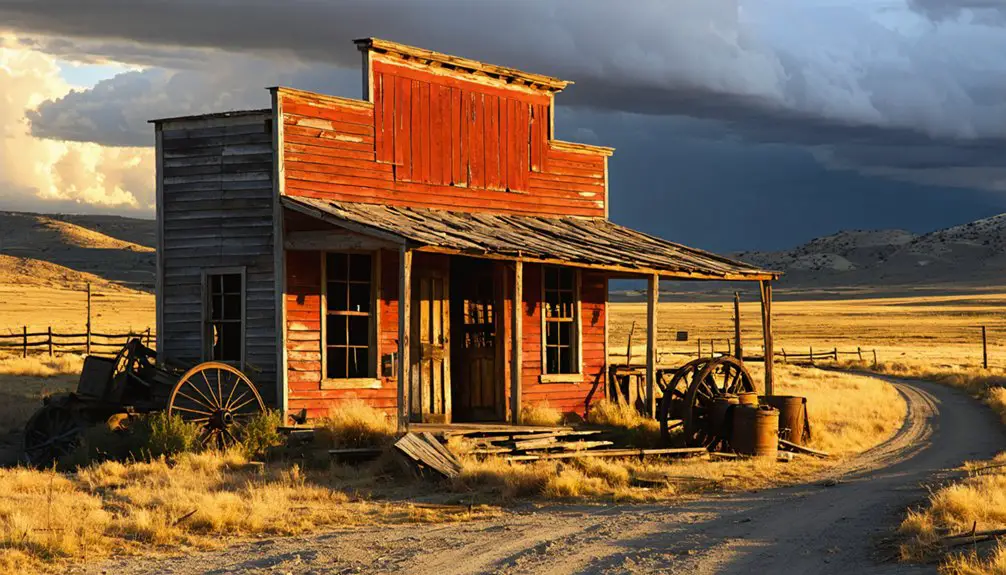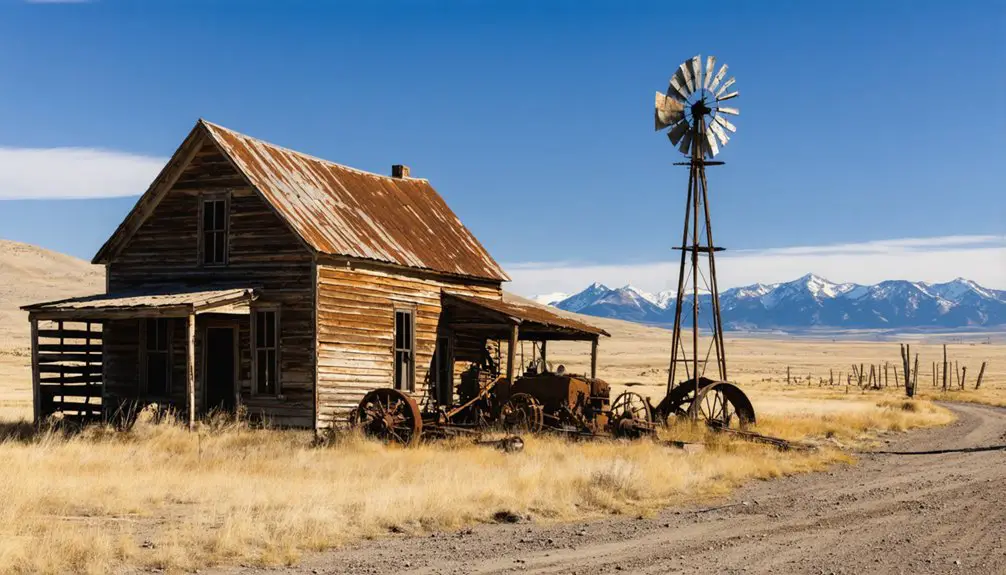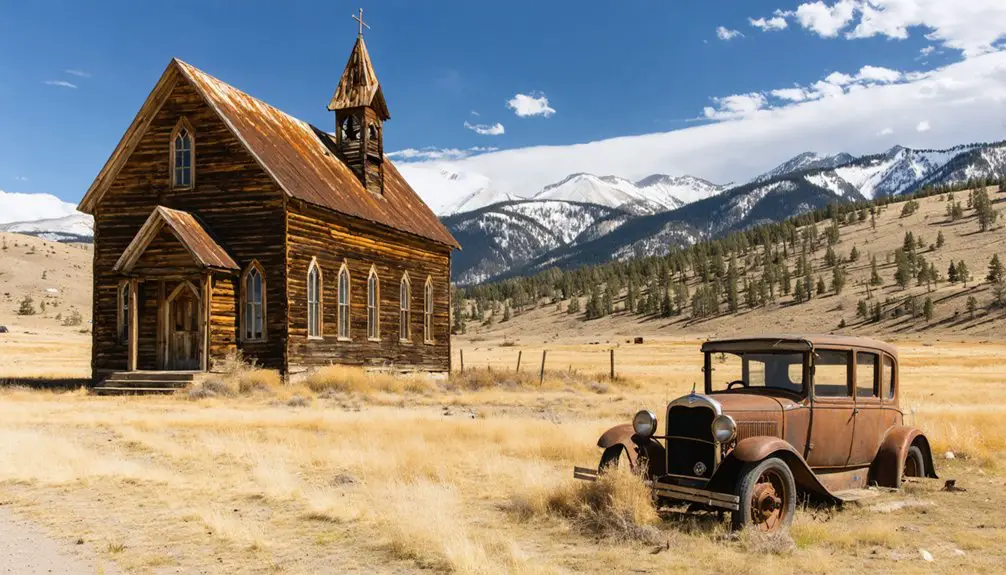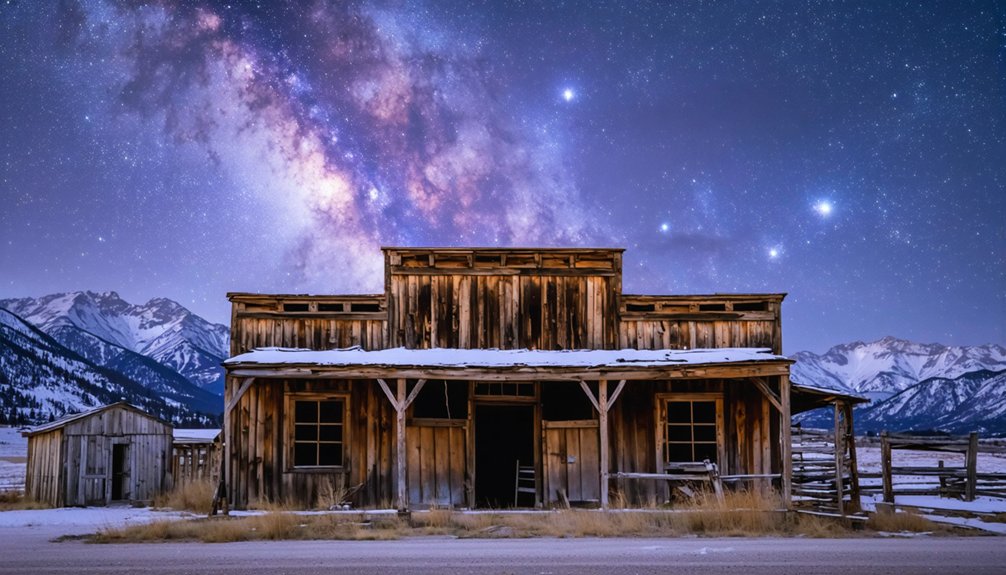
You’ll find Wyoming’s premier ghost towns for astrophotography at South Pass City, Eadsville, and Kirwin, where Bortle-class darkness meets preserved historic structures. For best results, shoot between mid-April and mid-September using a full-frame camera with fast wide-angle lenses (f/2.8 or wider). Pack essential safety gear including headlamps and GPS units, and verify access conditions through lands.wyo.gov. The combination of 7,800+ foot elevations and minimal light pollution creates ideal conditions for capturing both architectural elements and deep-sky features.
Key Takeaways
- Kirwin in the Absaroka Range provides exceptional Bortle-class darkness, making it ideal for capturing deep-sky objects and the Milky Way.
- South Pass City offers well-preserved log buildings and mining equipment, creating compelling foreground elements for night sky photography.
- Eadsville’s 7,800-foot elevation provides clear atmospheric conditions and elevated vantage points for unobstructed celestial views.
- Sinks Canyon State Park’s International Dark Sky designation ensures minimal light pollution for pristine astrophotography conditions.
- Piedmont offers easy dirt road access and historic ruins, making it accessible for night photographers while providing interesting compositional elements.
Top-Rated Ghost Town Destinations Under Dark Skies
Wyoming’s ghost towns offer astrophotographers an ideal confluence of historical architecture and pristine dark skies. Near Sinks Canyon State Park, the newest International Dark Sky Park in the region, photographers can capture stunning nightscapes.
South Pass City stands out as your premier destination, combining preserved log buildings and mining equipment with minimal light pollution from nearby settlements. You’ll find excellent Milky Way framing opportunities against the assay office and period hotel ruins. At 7,800 feet elevation, Eadsville provides an excellent vantage point for night sky photography.
For the most pristine dark skies, head to Kirwin in the Absaroka Range. This remote alpine location delivers Bortle-class darkness perfect for deep-sky photography, with decaying structures providing compelling foreground elements.
Atlantic City rounds out your top options, offering convenient access and panoramic southern horizons. You can capture ghost town history through star trails over historic buildings or frame the Milky Way above mile-wide prairie vistas.
Essential Gear and Planning for Night Photography
You’ll need a full-frame camera body paired with fast wide-angle lenses (f/2.8 or wider) to capture the Milky Way over Wyoming’s ghost towns, along with essential safety gear including headlamps, GPS units, and emergency communication devices. Using an accurate equatorial mount is crucial for capturing sharp star trails and deep sky objects in these dark locations.
Your seasonal timing will determine specific gear requirements, with summer shoots demanding cooling solutions and winter sessions requiring battery backups and cold-weather protection for both you and your equipment. A reliable intervalometer remote enables capturing long exposure sequences without disturbing the camera.
When photographing remote ghost town locations, maintain redundancy in your critical gear – carry backup cameras, multiple memory cards, and spare batteries to guarantee you don’t miss once-in-a-lifetime shots due to equipment failure.
Camera and Lens Basics
Successful astrophotography in ghost towns demands careful consideration of your core camera equipment and technical approach.
You’ll want to equip yourself with a full-frame mirrorless or DSLR camera that excels in high-ISO performance and dynamic range. These bodies let you capture the intricate details of both starlit skies and weathered buildings in RAW format. The Canon 6D particularly excels at low-light performance, making it an excellent choice for night photography.
For lens selection, start with a fast wide-angle (14-35mm, f/2.8 or faster) to capture sweeping Milky Way compositions with ghost town elements. A sturdy tripod is absolutely essential for achieving sharp, steady shots during long night exposures.
Consider adding a mid-range zoom (35-85mm) for balanced architectural shots against star fields. Your glass should deliver sharp corner-to-corner performance with minimal coma distortion – critical for maintaining pinpoint stars while framing historic structures.
Weather-sealed lenses with metal mounts will handle Wyoming’s harsh conditions and temperature swings.
Night Shooting Safety Essentials
Proper preparation extends beyond camera gear when shooting in abandoned locations after dark. You’ll need a reliable headlamp with red light capability for hands-free navigation while preserving your night vision.
Pack a powerful flashlight to reveal terrain hazards and maintain wildlife awareness – it’s essential for identifying potential risks before they become problems. Light painting techniques can also help illuminate architectural details during your ghost town shoots.
Never venture solo into remote ghost towns at night. Partner shooting isn’t just safer – it’s more efficient.
You’ll want fully charged batteries and backups for all devices, as power failures in isolated locations can cut your shoot short. Consider that cold temperatures drastically reduce battery performance, so pack extra spares. A sturdy tripod is non-negotiable for long exposures, with carbon fiber models offering the ideal balance of stability and portability.
Include a remote shutter release to eliminate camera shake during those critical star trail sequences.
Seasonal Planning Considerations
Here mature schema for maximizing your ghost town astro shoots requires precise seasonal alignment.
You’ll find peak Milky Way core visibility from mid-April through mid-September, with optimal conditions May through August.
Consider winter’s trade-offs: longer nights and crisper stars, but challenging sub-freezing conditions and limited access due to snow.
Watch for seasonal wildlife closures on BLM and USFS lands, particularly during calving and sage-grouse seasons.
Lunar timing proves essential – schedule primary shoots within three days of new moon for maximum dark sky contrast.
A red flashlight is crucial for preserving your night vision while navigating ghost town structures safely.
For alternative compositions, use bright moon phases as natural fill light on ghost town structures.
Track moonrise/set timing and angular separation to predict sky wash-out levels.
Reserve multi-night blocks during new moon windows to account for weather delays while maintaining ideal conditions.
Consult the Bortle scale ratings of your chosen location to determine the optimal camera settings for capturing the night sky.
Seasonal Weather Patterns and Best Shooting Times
While Wyoming’s four distinct seasons each offer unique astrophotography conditions, you’ll need to adapt your shooting strategy to match the state’s dramatic weather patterns.
Winter delivers prime dark skies with 15-hour nights, but you’ll battle sub-zero temperatures that challenge gear performance.
Spring’s moderate temperatures improve shooting comfort, though 30-50% cloud cover and high winds demand flexible scheduling.
Summer offers reliable clear skies and peak Milky Way visibility, despite shorter 9-hour nights and extended twilight.
Fall strikes an excellent balance with 11-14 hour nights, 70-80% clear skies, and temperatures ranging from 20-50°F.
Track seasonal trends carefully – winter snow reflects unwanted moonlight above 7,000 feet, while summer monsoons can create dramatic post-storm compositions.
Weather impacts vary considerably by elevation and location.
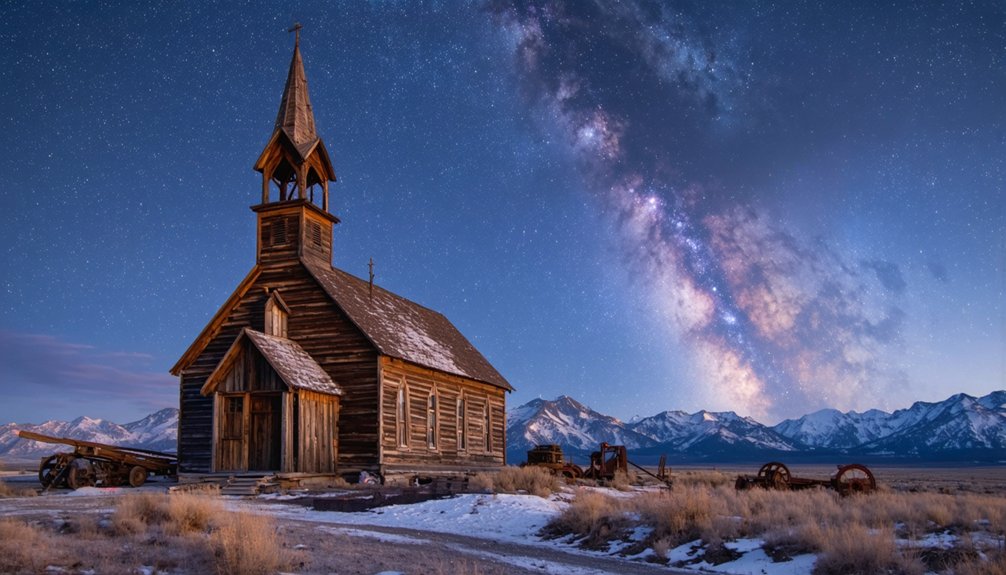
Successfully photographing Wyoming’s ghost towns requires maneuvering a diverse mix of access conditions and safety protocols across multiple jurisdictions.
best seasons for visiting Wyoming ghost towns are typically late spring and early fall when the weather is more forgiving. During these times, the vibrant colors of the landscape enhance the eerie beauty of the abandoned buildings and ghostly remnants. Planning your visit around local events or historical tours can also enrich the experience, providing deeper insights into the area’s rich history.
Exploring the best ghost towns in Wyoming can lead to unexpected discoveries, such as remnants of old mining equipment or the foundations of long-forgotten homes. Each location tells a unique story of the past, waiting to be uncovered by curious adventurers. Don’t forget to bring a camera to capture the haunting beauty that these sites offer.
You’ll find access routes ranging from paved roads to challenging 4×4 trails, with sites like Piedmont offering easy dirt road access while Kirwin demands high-clearance vehicles and stream crossings.
Before heading out, verify current safety regulations through lands.wyo.gov, as restrictions vary between BLM, State Trust Lands, and WGFD areas.
You’ll need to stick to established paths at sensitive sites and respect seasonal closures.
South Pass City’s $8 admission grants structured access to numerous original buildings, while remote locations like Eadsville at 7,800 feet elevation require careful planning.
Remember that active mines are strictly off-limits, and some areas restrict vehicle use to protect the environment.
Light Pollution Challenges and Solutions
Despite Wyoming’s reputation for dark skies, light pollution presents significant challenges for ghost town astrophotography across the state.
You’ll encounter skyglow from nearby towns projecting miles beyond their source, washing out the Milky Way‘s contrast at lower-elevation sites. Unshielded fixtures and seasonal tourist lighting create unpredictable disruptions to your shooting schedule.
To combat these challenges, implement proven mitigation strategies: use satellite-derived radiance maps and LightPollutionMap layers to identify ideal locations with SQM readings ≥21.0 mag/arcsec² for pristine Milky Way shots.
Time your shoots during Teton County’s public-light retrofits, which are transforming 6,785 square miles into certified dark sky territory. Plan around vehicle traffic patterns, and leverage local elevation data to find naturally shielded locations away from scattered light sources.
Composition Techniques for Historic Ruins
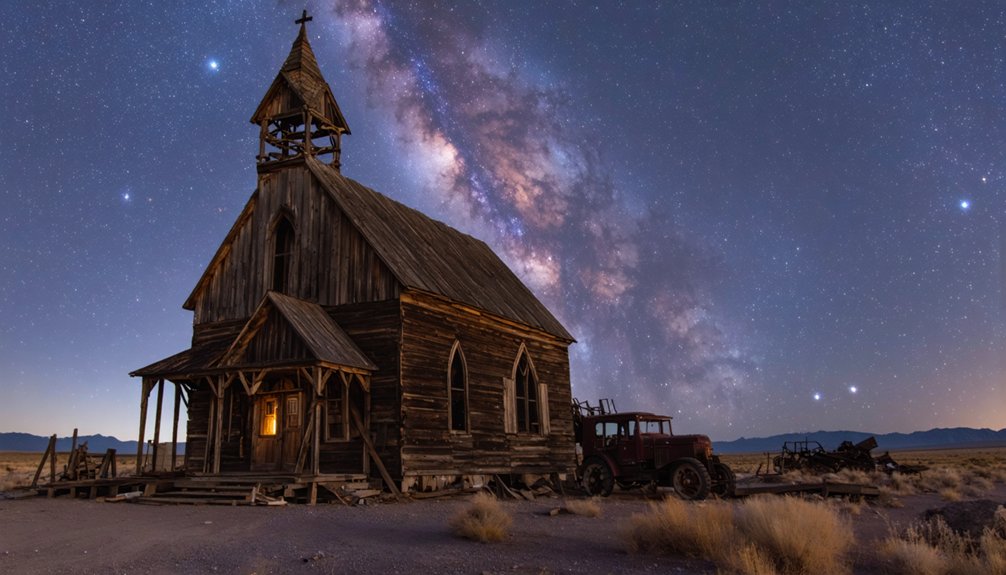
You’ll need to carefully light-paint historic buildings from multiple angles to reveal weathered textures while maintaining the night sky’s darkness and preserving star detail.
Position yourself to shoot through doorways and window frames, using these architectural elements as natural frames that direct attention toward the Milky Way or constellations.
Let the remaining foundation walls and fence lines serve as leading compositional elements, drawing the viewer’s eye from the foreground ruins toward celestial features in the background.
Light Painting Historic Elements
Light painting historic ruins demands precise illumination control and careful composition to create compelling astrophotography.
You’ll need to master selective lighting techniques using LED flashlights positioned at 45-degree angles to cast dramatic shadows across weathered structures. Work with 15-30 second exposures at low ISO settings between 400-800 to capture both structural details and starry skies without noise.
Target key architectural elements like door frames, windows, and collapsed roofs to add depth to your Milky Way compositions.
Sweep your light sources steadily across ore carts and assay equipment to emphasize mining history while maintaining exposure balance.
For best results in Wyoming’s ghost towns, use red-filtered lights to preserve your night vision as you illuminate stone foundations and rusted machinery in places like South Pass City and Eadsville.
Frame Through Doorways
Mastering frame-through-doorway compositions elevates ghost town astrophotography from simple star shots to compelling visual narratives.
You’ll discover powerful doorway perspectives in Wyoming’s abandoned structures, where historic entrances naturally frame the cosmos beyond. Position your camera to utilize these architectural elements as compositional tools, creating depth through layered framing techniques.
Align your shots so doorframes border the Milky Way or star trails, using the natural geometry to guide viewers’ attention. You can experiment with both symmetrical and asymmetrical doorway compositions – try low angles to emphasize towering arches or elevated positions to capture unique perspectives.
For maximum impact, expose for sharp stars while letting the doorway remain slightly darker, creating a dramatic portal effect that draws viewers through the ruins and into the starlit Wyoming sky.
Leading Lines With Foundations
Beyond doorway framing, foundation lines offer powerful compositional tools for ghost town astrophotography.
You’ll find that strategic positioning of crumbling walls and foundation textures creates natural visual pathways drawing viewers through your image. Position your camera low to the ground with a wide-angle lens (14-24mm) to maximize the leading effect of these architectural elements.
Light your foundations selectively using warm-toned LED panels or a diffused headlamp to emphasize the stone textures while maintaining separation from the cool night sky.
Consider exposure blending to balance bright stars with detailed stonework. Calculate your hyperfocal distance carefully – you’ll want sharp focus from the nearest foundation edge to the furthest stars.
Use the longest straight segments to guide eyes toward the Milky Way core or your chosen celestial subject.
Recommended Camera Settings for Ghost Town Astrophotography
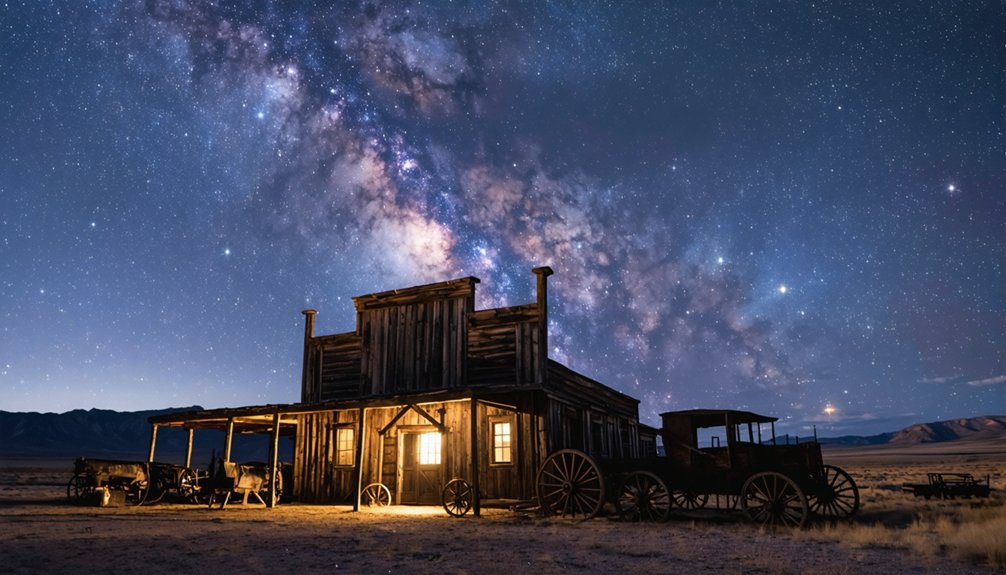
When shooting abandoned structures under starlit skies, you’ll need precise camera settings to capture both architectural details and celestial elements effectively.
Master your exposure triangle by starting with ISO 1600-3200, depending on ambient light levels. Set your aperture wide open at f/2.8 if available, or f/4 with kit lenses.
Dial in optimal exposure settings, beginning with ISO 1600-3200 and the widest available aperture for capturing detail in low-light conditions.
For camera stabilization, mount your DSLR on a sturdy tripod and enable mirror lock-up mode to minimize vibration.
Calculate your shutter speed using the 500 rule – for a 24mm lens, you can safely expose for 20 seconds without star trailing.
Switch to manual focus, using live view magnification on a bright star to achieve sharp focus. An intervalometer lets you capture multiple exposures without touching the camera, perfect for stacking later to reduce noise.
Frequently Asked Questions
Are Drones Allowed for Night Photography at These Ghost Town Locations?
You’ll need specific permits for drone night photography since regulations vary – BLM lands may allow it with proper FAA waivers, while NPS sites strictly prohibit drones unless specially authorized.
Which Ghost Towns Have Cell Phone Reception for Weather Updates?
You’ll get reliable cell service for weather apps near Superior and Winton, especially with AT&T or T-Mobile. Sites along I-80 and near Rock Springs maintain coverage for real-time satellite forecasts.
Can I Camp Inside Ghost Town Buildings During Overnight Shoots?
You shouldn’t camp inside ghost town buildings – it’s typically illegal and dangerous. State camping regulations protect historic structures, and unstable conditions pose serious safety risks during overnight photography sessions.
Are There Guided Astrophotography Tours Available to These Locations?
You’ll find photography workshops and guided tours year-round, with most operators offering small-group instruction on camera settings, light painting, and star trails at South Pass City and Kirwin.
How Do Local Wildlife Affect Motion Sensors and Time-Lapse Photography?
You’ll fight a constant battle with curious critters! Wildlife behavior triggers false sensor readings and disrupts time-lapses, but you can outsmart them by mounting gear higher and adjusting sensitivity settings.
References
- https://travelwyoming.com/blog/stories/post/5-wyoming-ghost-towns-you-need-to-explore/
- https://www.cruiseamerica.com/trip-inspiration/wyoming-stargazing
- https://www.go-astronomy.com/dark-sky-parks-stargazing-state.php?State=WY
- https://www.explorewy.com/play/activities/articles/top-places-to-see-the-stars
- https://bighorndrifters.com/elementor-2633/
- https://laramielive.com/9-amazing-stargazing-spots-in-wyoming/
- https://www.youtube.com/watch?v=pEBL3LOhEL8
- https://travelwyoming.com/things-to-do/outdoor-adventure/stargazing/
- https://www.onlyinyourstate.com/experiences/wyoming/creepy-ghost-towns-in-wy
- https://windriver.org/experience/night-skies/