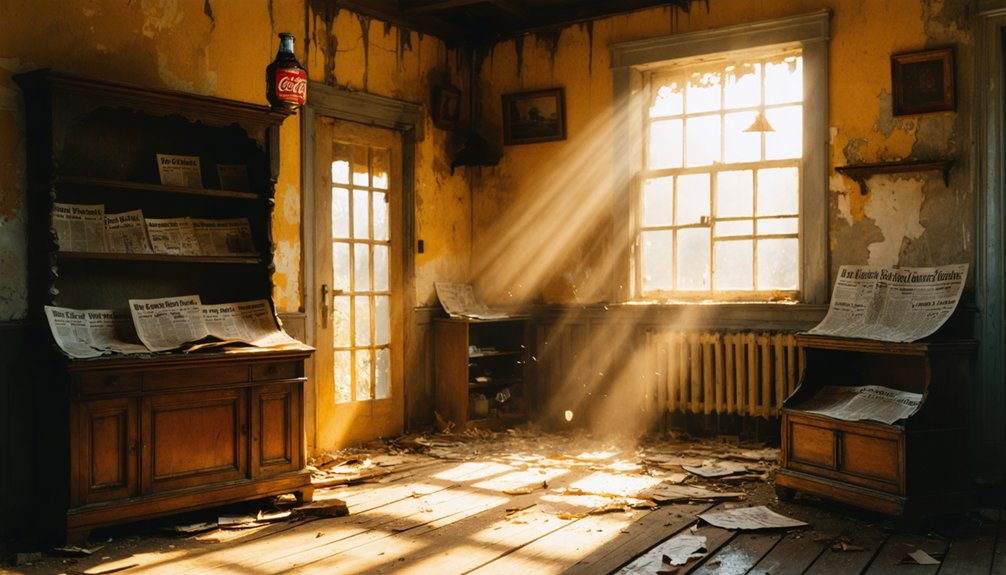
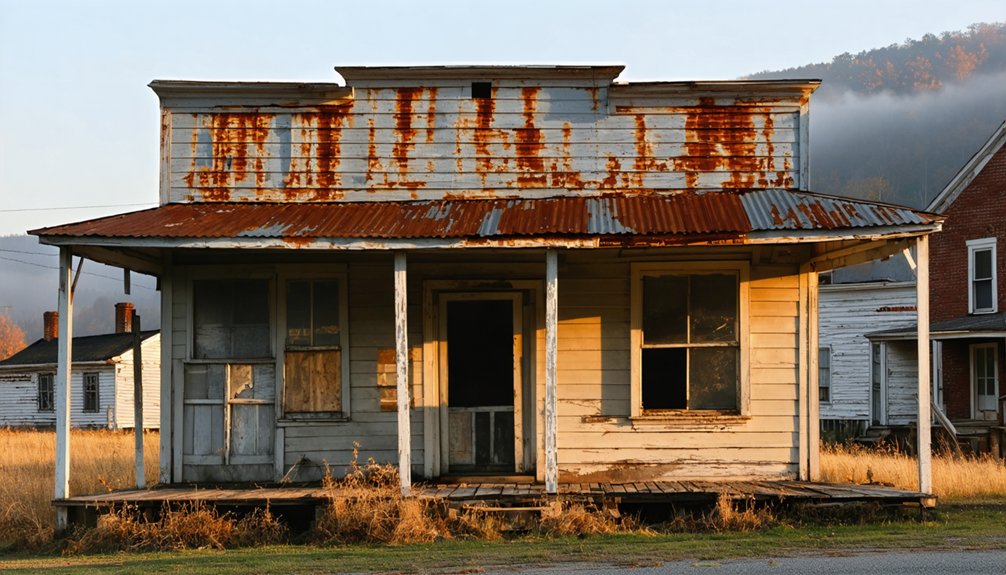
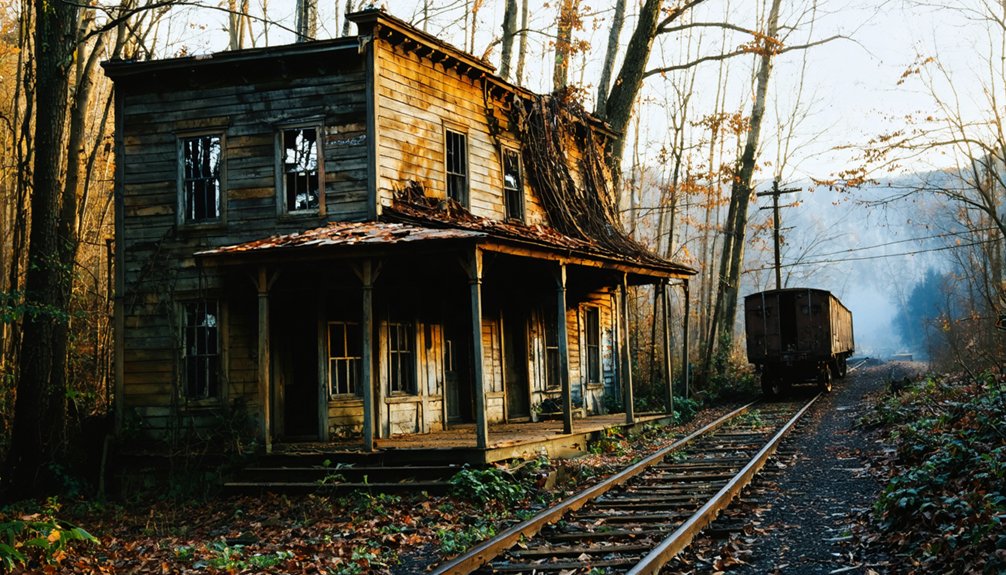
You’ll find ideal astrophotography conditions in Kentucky’s southeastern ghost towns, where Bortle-class 3-4 skies offer exceptional dark sky viewing. The abandoned mining sites of Blue Heron, Paradise, and Barthell provide compelling industrial silhouettes against the Milky Way. Schedule your shoots during moonless periods between March 14-24 or late October to November for peak atmospheric transparency. These locations combine historical coal mining structures with minimal light pollution to create striking night sky compositions. Further technical specifications will enhance your captured results.
Key Takeaways
- Blue Heron Mining Camp offers exceptional dark skies with Bortle-class 3-4 conditions and dramatic coal structure silhouettes against starlit backgrounds.
- Paradise’s abandoned mining ruins provide unobstructed southern views ideal for capturing the Milky Way’s galactic core.
- Barthell ghost town features elevated vantage points with minimal light pollution, perfect for wide-field astrophotography during moonless nights.
- Creelsboro’s location near water bodies enables unique doubled Milky Way arch compositions through reflective surfaces.
- Land Between the Lakes area combines ghost town elements with exceptionally dark skies, offering prime conditions for night sky photography.
Why Kentucky’s Ghost Towns Offer Prime Night Sky Viewing
While many abandoned settlements fade into obscurity, Kentucky’s ghost towns have emerged as premier destinations for astrophotography due to their exceptional dark sky conditions.
You’ll find Bortle-class 3-4 or darker skies across southeastern Kentucky’s former coal mining regions, where depopulation has eliminated most artificial lighting. The state’s ghost town history converges perfectly with astrophotography techniques, as sites like Blue Heron and Paradise offer both compelling foregrounds and pristine dark skies. Coal mining activities historically shaped these landscapes before their eventual abandonment, leaving behind dramatic silhouettes against starlit horizons. Due to concerns over historical accuracy, these locations require reliable sources to verify their ghost town status.
Natural topography shields these locations from distant light pollution, while abandoned industrial structures create striking compositional elements for night sky imagery. The designation of Mammoth Cave as an International Dark Sky Park confirms the region’s astronomical significance, anchoring a network of dark sky sites that includes remote state forests and the Land Between the Lakes area.
Essential Gear for Ghost Town Astrophotography
Four core equipment categories form the foundation of successful ghost town astrophotography: primary imaging systems, stabilization solutions, power infrastructure, and optical maintenance tools.
Your gear recommendations should start with a full-frame mirrorless or DSLR body paired with fast wide-angle lenses like the Rokinon 14mm f/2.8 for Milky Way shots. A Canon T6s camera with its 24Mp sensor provides excellent low-light performance and versatility for night photography. Image processing software like DeepSkyStacker will be essential for stacking multiple exposures to reveal faint details.
A full-frame camera with fast wide glass like the Rokinon 14mm f/2.8 forms the essential foundation for ghost town astro shots.
You’ll need a portable equatorial tracker such as the Sky-Watcher Star Adventurer mounted on a sturdy tripod to capture pinpoint stars in long exposures.
Power management requires high-capacity batteries and distribution systems to keep your equipment running through the night.
Complete your kit with critical lens choices and maintenance tools – including dew heaters, Bahtinov masks for precise focusing, and light pollution filters to combat Kentucky’s varying sky conditions.
Planning Your Night Shoot in Abandoned Mining Towns
Because abandoned mining towns present unique challenges for night photography, careful advance planning maximizes both safety and image quality. When composing shots of Kentucky’s ghost town history, you’ll need to strategically time your visits around lunar cycles and seasonal conditions.
The best season to explore Kentucky ghost towns is during the fall, when the colorful foliage adds a vibrant backdrop to your photographs. Additionally, the cooler temperatures make it more comfortable for long hours spent capturing these hauntingly beautiful locations. Plan your trips strategically to take advantage of both the natural light and the atmospheric conditions that enhance the ghostly ambiance of these sites.
- Schedule shoots during new moon phases at locations like Lynch and Blue Heron, where mountain ridges block light pollution and create pristine dark sky conditions.
- Position yourself at elevated vantage points near restored structures in Barthell or Paradise for clear Milky Way views between midnight and pre-dawn.
- Scout locations during daylight to identify stable shooting platforms and hazards, noting that sites like Martin County require extra precautions due to environmental risks.
Consider shoulder season visits when weather patterns offer ideal clarity for capturing star trails over historic mining infrastructure. The coal tipple remains at Blue Heron Mining Camp provide striking silhouettes against the starlit sky. At Bells Mines, the faint roadbed winds through the forest, creating naturally framed compositions for nighttime exposures.
Best Seasons for Ghost Town Star Photography
You’ll find ideal ghost town astrophotography conditions in Kentucky during late October through November, when atmospheric transparency peaks and humidity drops considerably.
During this period, catching the Milky Way in evening visibility offers stunning compositions. The reduced moisture content and crisp temperatures create exceptional stability for capturing both star fields and architectural details of abandoned structures. The moonless dates between March 14-24 offer perfect opportunities for clear Milky Way photography.
Winter’s arrival brings the darkest skies of the year, though you’ll need to factor in more challenging weather conditions when planning your shoots.
Late Fall Prime Time
Late fall emerges as the ideal season for ghost town astrophotography in Kentucky, driven by several key atmospheric and astronomical factors. The enhanced atmospheric stability during this season creates prime conditions for long-exposure captures, with reduced turbulence and lower humidity levels protecting your gear. The Big South Fork area provides an exceptionally dark backdrop for capturing the stars above abandoned structures. National park sites offer the darkest skies with minimal light pollution interference.
- You’ll benefit from earlier astronomical darkness, allowing extended shooting sessions before midnight when capturing the Milky Way against ghost town silhouettes.
- Lower lunar trajectories in late fall provide strategic opportunities to shield your compositions from unwanted moonlight.
- Calmer wind patterns typical of inland Kentucky during this period minimize camera shake during critical long exposures.
Plan your shoots around new moon periods for maximum celestial visibility, but maintain flexibility with backup dates to adapt to transient weather patterns.
Winter’s Clear Dark Skies
While summer months attract many astrophotographers, winter delivers superior conditions for ghost town star photography in Kentucky, characterized by reduced atmospheric moisture and extended periods of astronomical darkness.
Your ghost town exploration benefits from winter’s peak astronomical night duration around solstice, enabling thorough multi-target imaging sessions. You’ll experience clearer atmospheric seeing during cold, dry high-pressure systems, particularly in dark-sky areas like McCreary County’s Blue Heron region and Mammoth Cave National Park.
When planning winter photography sessions, monitor frontal passages for ideal clear-sky windows. You’ll need to manage cold-weather gear challenges, but winter’s reduced cloud cover and temperature inversions reward you with darker skies and steadier seeing.
Schedule around moon phases to maximize the extended dark hours, especially in remote locations like Land Between the Lakes.
Top Locations for Milky Way Compositions
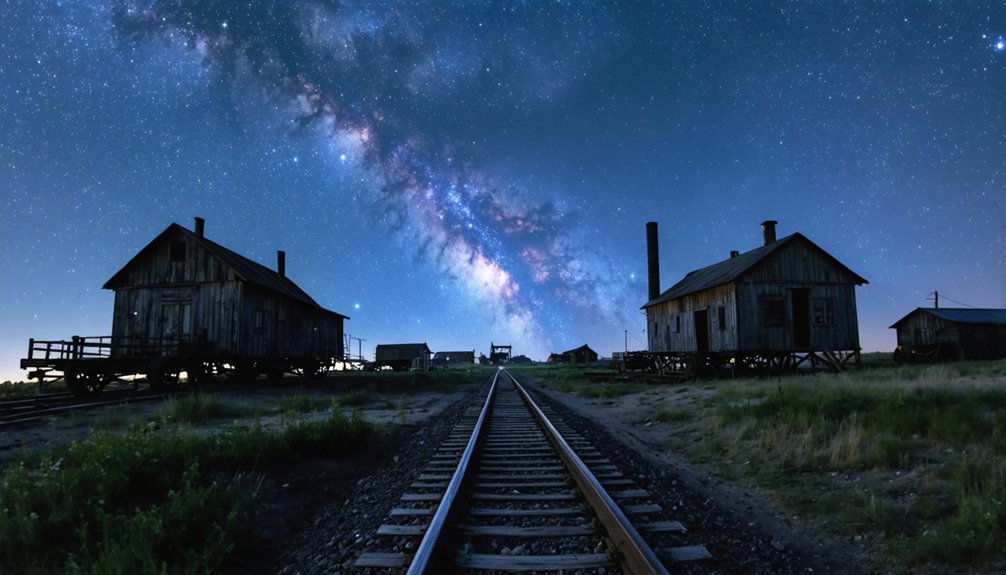
You’ll find exceptional Milky Way photography opportunities at the elevated Paradise mining ruins, where the unobstructed southern horizon provides ideal conditions for capturing the galactic core against historic silhouettes.
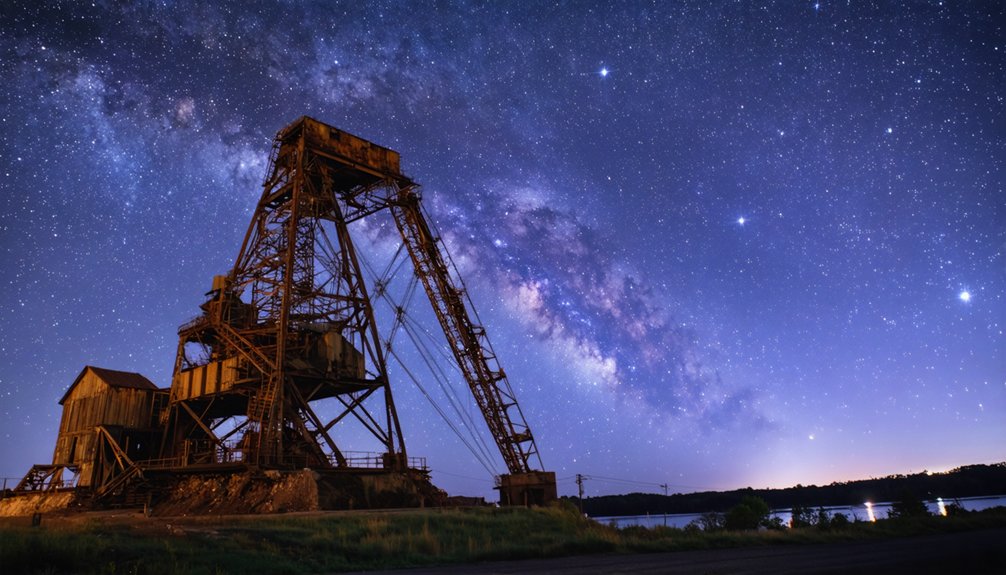
Blue Heron’s remaining coal structures offer compelling vertical elements for night sky compositions, with the site’s remote location ensuring minimal light pollution interference.
The reflective surfaces near Creelsboro create unique possibilities for capturing doubled Milky Way arches in water reflections, particularly during the pre-dawn hours when the river remains calm.
Dark Paradise Mining Views
Photographers seeking pristine dark sky locations will find ideal Milky Way shooting conditions across Paradise’s abandoned mining sites. The ghost town landscapes at coordinates 37.2675, -86.9835 offer exceptional visibility with minimal light pollution interference, perfect for capturing celestial compositions against mining relics.
- Position your camera northward along Elk View Drive to frame the Milky Way’s galactic core above remaining structural elements.
- Utilize elevated vantage points at Mine Made Paradise Park’s 43,000 acres for unobstructed astronomical views.
- Time your shoots during winter months when reduced foliage maximizes sky visibility from the Western Kentucky Coal Fields.
The remote setting near Paradise Mine presents excellent conditions for long exposures, with clear sight lines at both sunset and predawn hours.
Blue Heron Scenic Overlooks
Three premier overlooks at Blue Heron offer exceptional vantage points for capturing the Milky Way against the dramatic backdrop of Big South Fork National River and Recreation Area.
You’ll access the primary overlook via a 0.52-mile paved trail leading to a stabilized deck platform at 1,033 feet elevation. The overlook’s northeast-to-south orientation aligns perfectly with the Milky Way’s arc during peak photography seasons.
The site’s minimal light pollution and elevated position create ideal conditions for long-exposure astrophotography. You’ll find the developed platform, complete with gazebo, provides essential stability for camera equipment.
The location’s technical advantages include unobstructed views, safe night shooting conditions, and multiple composition angles from the deck.
Exercise caution near cliff edges and maintain awareness of wildlife, including bears and venomous snakes.
Creelsboro River Reflections
While accessing Creelsboro via U.S. Route 127 requires careful navigation of narrow rural roads, you’ll find exceptional Milky Way photography opportunities along the Cumberland River’s bends.
The historic ferry landing‘s timber pilings create compelling silhouettes against star-filled skies, especially when captured with river reflections during calm conditions.
For ideal astrophotography results:
- Time your shoot during new moon phases (±2 nights) between March and September for maximum Milky Way visibility.
- Position your tripod 50-400m from parking areas, utilizing abandoned structures and mature trees as compositional elements.
- Start with exposure settings of 14-24mm at f/2.8-4.0, shooting 15-25 seconds at ISO 1600-6400, then focus-stack for sharp foregrounds.
Park at informal pullouts near the old landing, but bring four-wheel drive during wet conditions.
Safety Tips for Nighttime Ghost Town Exploration
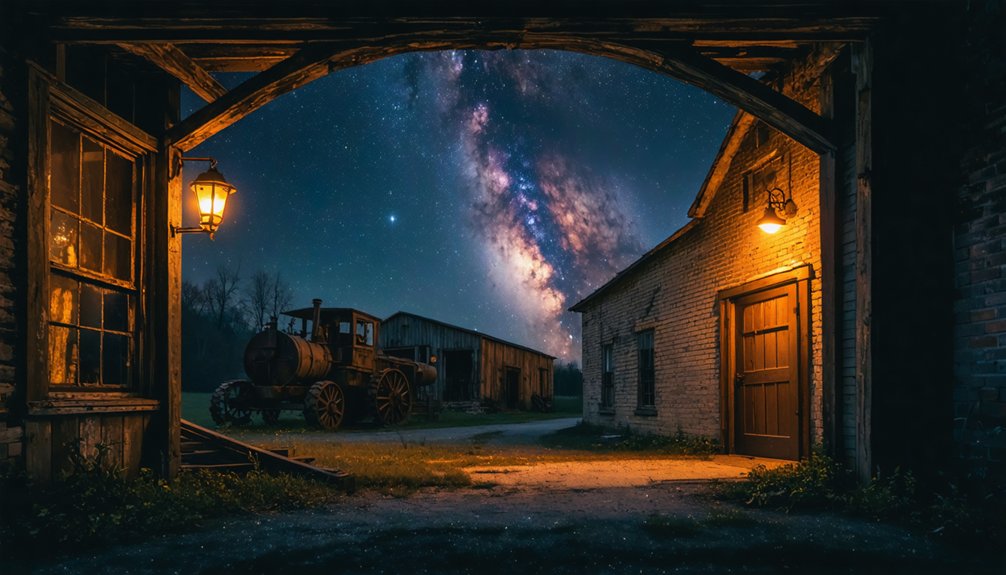
Before venturing into abandoned ghost towns at night for astrophotography, thorough safety protocols must be implemented to mitigate inherent risks.
Essential nighttime safety measures include scouting locations during daylight hours, downloading offline maps, and establishing clear exit routes. For ghost town exploration, you’ll need reliable illumination, respiratory protection, and navigation tools.
Thorough daytime scouting and detailed exit planning are critical safety foundations for successful nighttime ghost town photography missions.
Your gear should include a headlamp, N95 respirator, GPS unit, and emergency safety equipment like an air horn.
Wear protective clothing and sturdy boots while exploring structural remnants. When photographing, position yourself near load-bearing walls, avoid compromised flooring, and watch for hazards like exposed metal or unstable stairs.
Always explore with companions and maintain communication protocols.
Post-exploration, decontaminate equipment and clothing to remove potential toxins or mold spores.
Long Exposure Techniques for Historic Structures
You’ll need to employ strategic light painting techniques when photographing historic walls, using stationary LED panels for consistent illumination while maintaining exposure control through neutral density filtration.
Multiple exposure stacking becomes essential for reducing noise while preserving architectural detail, requiring 30-50 frames at ISO 100 with exposures ranging from 2-4 minutes each.
Moonlit conditions at quarter phase provide ideal natural illumination for capturing structure silhouettes against star trails, allowing you to leverage the 500 Rule while maintaining shadow definition in foreground elements.
Light Painting Historic Walls
Since historic walls present unique challenges for night photography, mastering proper light-painting techniques becomes essential for capturing their architectural details and textures.
You’ll need to understand how light interacts with various surface materials while preserving shadow depth and authentic character.
- Position your light source at 30-60° angles to enhance surface relief, using continuous sweeping motions perpendicular to the wall to reveal light texture without creating hotspots.
- Apply feathered passes by starting further from the surface and gradually moving closer, building even illumination while maintaining dimensional contrast.
- Illuminate interior voids separately using short-duration bursts or colored gels to create depth perception, and consider using different color temperatures to separate architectural elements.
Control your movements carefully and maintain consistent distance during passes to achieve professional results that highlight the structure’s historic integrity.
Stacking Multiple Night Exposures
To achieve professional-quality astrophotography of historic structures in Kentucky’s ghost towns, mastering image stacking techniques becomes essential for maximizing signal-to-noise ratio while preserving architectural details.
You’ll want to capture 20-50 raw exposures at ISO 800-1600, using 30-120 second individual shots depending on your location’s darkness. For precise image alignment, utilize software like DeepSkyStacker or Sequator to automatically register at least 100 reference stars.
During stacking, you’ll need to discard 5-10% of frames containing satellite trails or aircraft lights. The process reduces read noise considerably – with 30 frames, you’ll cut noise by a factor of 5.5.
Apply dithering between exposures by shifting 10-20 pixels to eliminate hot pixels that could mar historic building details. Export your final stack as a 16-bit file to maintain maximum dynamic range.
Moonlit Structure Silhouettes
Mastering moonlit structure silhouettes requires precise timing and technical considerations to capture the dramatic interplay between lunar illumination and Kentucky’s historic ghost town architecture.
Successful moonlit landscapes demand strategic positioning and precise exposure control to achieve striking silhouettes against the night sky.
- Select your location during waxing or waning gibbous phases (70-95% illumination) to balance structure definition with star visibility, positioning yourself to capture the moon rising behind architectural elements.
- Configure your camera with moderate ISO (200-800) and smaller apertures (f/5.6-f/11) for maximum sharpness, while employing exposure times between 5-60 seconds based on desired star movement.
- Utilize RAW capture with manual exposure mode, implementing mirror lock-up and remote triggering to eliminate vibration during your long exposures of these historic silhouettes.
Light Painting Methods for Mining Ruins
Light painting abandoned mining ruins demands precise technical control over three key variables: illumination intensity, direction, and color temperature.
You’ll need to master zone painting by dividing each scene into distinct areas – entrance, support beams, machinery, and ground surfaces – to maintain shadow detail while achieving balanced exposure across the structure.
For ideal texture definition, employ texture stroking with oblique lighting angles. Sweep your beam across weathered surfaces to reveal micro-details in rust patches and exposed rock faces.
Layer your illumination using different color temperatures: warm light (2700-3500K) for wooden beams and oxidized metal, cool light (5000-6500K) for stone elements.
Use narrow-beam torches and snoots to precisely control light placement, and combine multiple short flashes during long exposures to evenly illuminate larger chambers without hotspots.
Securing legal access for astrophotography in Kentucky’s ghost towns requires maneuvering a complex framework of regulations across public and private lands.
You’ll need to navigate multiple jurisdictional requirements while pursuing your creative vision.
- For public lands, check Kentucky Fish & Wildlife’s 80+ locations, as some require specific permits before you can set up your equipment.
- On private abandoned properties, you’ll need to verify ownership through vacancy registries and obtain explicit permission, especially in towns with active ordinances like Hazard.
- For former mining sites, consult the Division of Abandoned Mine Lands, as there’s no standardized photography permit system – your access depends on safety considerations and surface operation restrictions.
Always document your permissions and maintain compliance with local ordinances while pursuing your astrophotography goals.
Creating Compelling Foreground Elements With Mining Relics
Mining relics scattered across Kentucky’s ghost towns offer powerful compositional elements for night sky photography. You’ll find coal tipples and headframes creating ghostly silhouettes against star-filled skies, while stone furnaces provide textural masses perfect for low-angle lighting.
Exploring the best ghost towns in Kentucky reveals not only the remnants of past industries but also unique landscapes that evoke a sense of mystery. The quietude of these abandoned places, paired with the historical architecture, creates an ideal setting for creative exploration during both daylight and twilight hours. As the sun sets, the fading light casts a warm glow over the decaying structures, inviting photographers to capture the essence of time gone by.
To maximize impact, position these mining textures in the near-midground, typically 5-50m from your camera, maintaining acceptable focus for both foreground and stars.
For dramatic depth, incorporate multiple planes using smaller machinery in the immediate foreground while aligning taller structures with the Milky Way. Light your scene using warm LED illumination or selective light painting to reveal surface details without overwhelming starlight.
Remember to verify structural integrity before approaching any relics, and always follow Leave No Trace principles when photographing these historic sites.
Frequently Asked Questions
Are There Any Guided Astrophotography Tours of Kentucky’s Ghost Towns?
You won’t find advertised guided tours, but you’ll need to DIY by hiring private photography workshops or partnering with astronomy clubs who can coordinate ghost town access for night shoots.
How Do You Handle Unexpected Wildlife Encounters During Night Shoots?
You’ll need to maintain situational awareness, keep bear spray accessible, use motion-activated lights, avoid food smells, stay grouped together, and follow wildlife safety protocols during night photography sessions.
Which Ghost Towns Have the Most Paranormal Activity Reports?
You’ll find the highest concentration of documented paranormal activity reports at Blue Heron Mining Community and Waverly Hills area, with consistent EVP recordings, electromagnetic anomalies, and extensively catalogued ghost stories from investigators.
Can Drones Be Used for Aerial Night Photography of These Locations?
You’ll need FAA night waivers and property permissions to legally fly drones. Use high-ISO sensors, fast lenses, and infrared capabilities while following local regulations for ghost town aerial photography.
Where Can I Find Historical Photos to Compare With Modern Astrophotography Shots?
You’ll find historical photos through Kentucky Historical Society’s archives, Library of Congress’s digital collections, and DPLA’s online databases. Cross-reference these with your modern astrophotography shots for precise composition matching.
References
- https://everafterinthewoods.com/abandoned-ghost-towns-in-kentucky-that-still-hold-echoes-of-the-past/
- https://www.youtube.com/watch?v=D9gOmfCuKLs
- https://www.onlyinyourstate.com/trip-ideas/kentucky/little-known-stargazing-spot-ky
- https://www.kentuckyliving.com/explore/worth-the-trip/dark-parks
- https://www.go-astronomy.com/dark-sky-parks-stargazing-state.php?State=KY
- https://www.meetnky.com/northern-kentucky-after-dark/
- https://www.youtube.com/watch?v=9SNizgCODHI
- https://www.kentuckyafterdark.com
- https://wbkr.com/visit-these-20-creepy-kentucky-ghost-towns-for-a-halloween-road-trip/
- https://en.wikipedia.org/wiki/List_of_ghost_towns_in_Kentucky