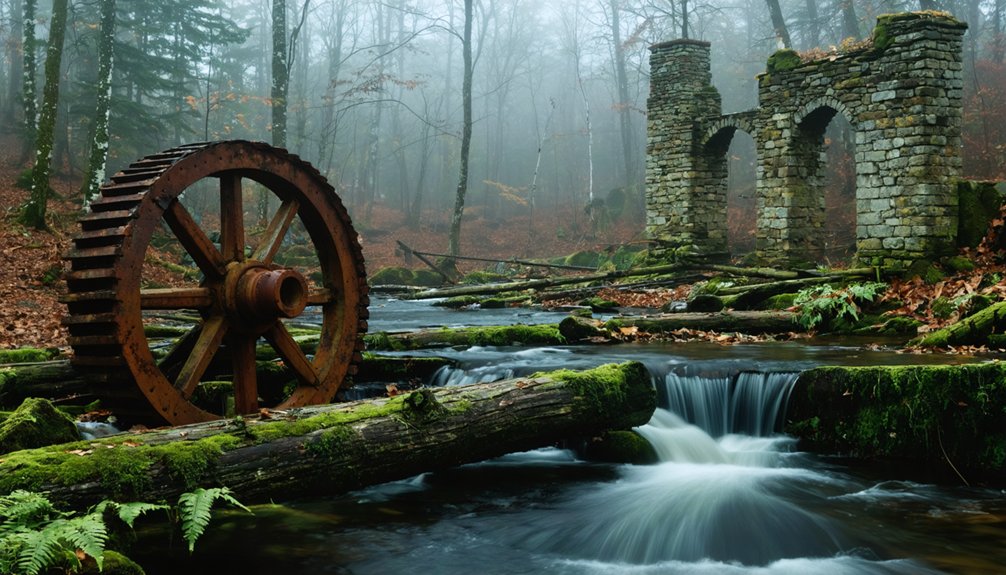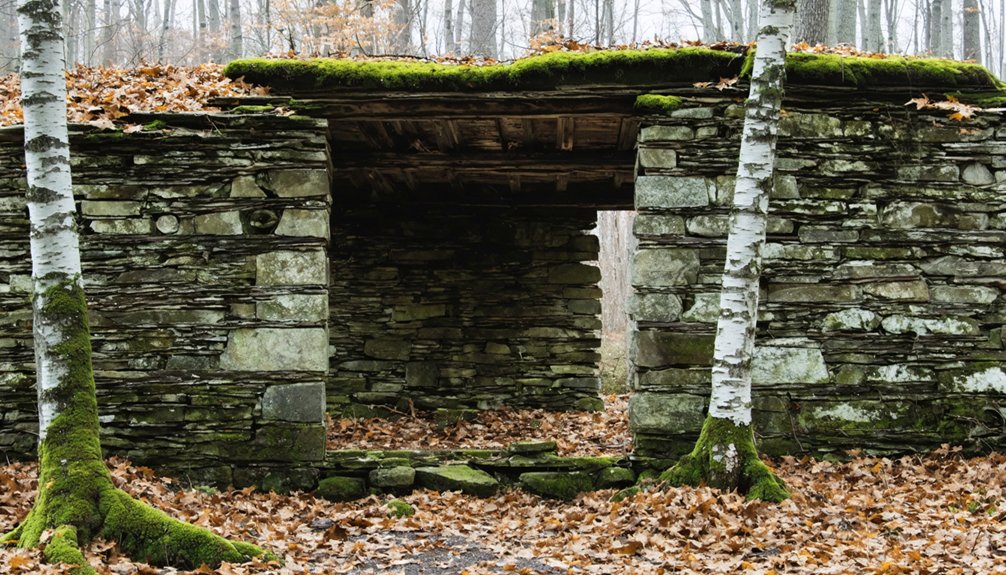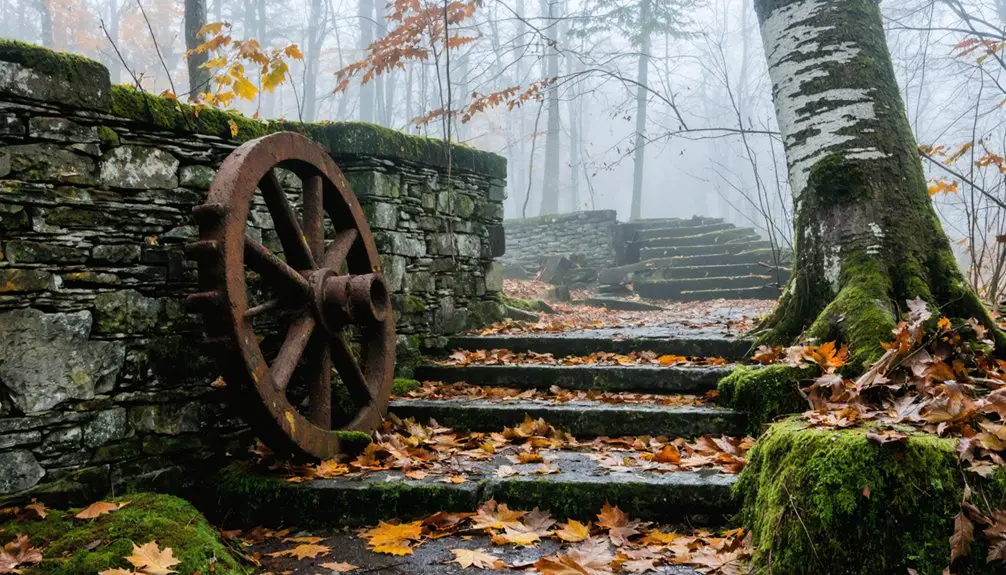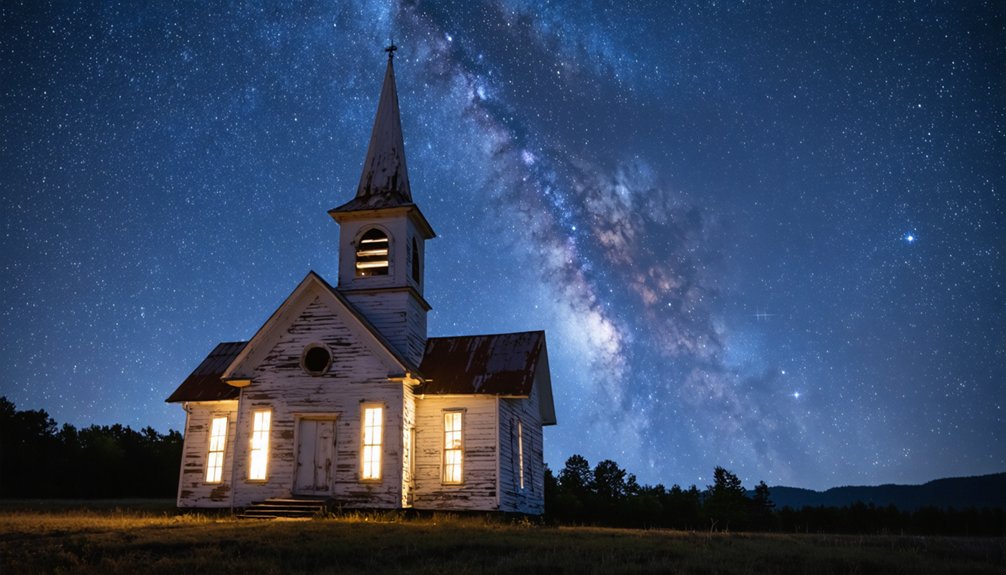
You’ll find New Hampshire’s best astrophotography ghost towns in the White Mountains region and North Country, where Bortle 2-3 dark skies create ideal conditions for capturing the Milky Way above historic ruins. Prime locations include Livermore’s mill remnants along the Sawyer River, Thornton Gore’s elevated stone ruins, and Zealand’s reflective water features. Plan your shoots during moonless autumn nights (September-November) when clear skies and low humidity maximize celestial detail. Mastering these remote locations requires specific gear and safety protocols for nighttime exploration.
Key Takeaways
- Livermore, located along the Sawyer River, offers cellar holes and mill remnants with minimal light pollution for excellent astrophotography conditions.
- Thornton Gore provides elevated ridgelines and stone ruins accessible via short hikes, ideal for capturing clear night sky shots.
- Zealand’s location features reflective water elements perfect for capturing both the Milky Way and its mirror image in compositions.
- Carrigain’s high-elevation former logging camps provide unobstructed views of the night sky with minimal light interference.
- The Isles of Shoals, particularly Gosport’s ruins, offers unique maritime structures against dark skies, best photographed facing east-northeast.
Dark Sky Considerations for Ghost Town Photography
When seeking ideal dark sky conditions for ghost town astrophotography in New Hampshire, you’ll find the most pristine viewing opportunities in the White Mountains region and North Country locations, where light pollution remains minimal.
For peak dark sky planning, position yourself at least 10 miles from urban centers, particularly in areas like Dummer where the NH Amateur Astronomical Society conducts observations.
Your ghost town aesthetics will benefit from moonless nights, which enhance visibility of the Milky Way’s pale arc and passing comets.
Choose locations in the Great North Woods that completely escape light pollution, or venture to southern spots like Hillsborough that maintain dark skies despite urban proximity.
Monitor weather patterns carefully, avoiding nights with smoke or haze that could obscure your historic structure shots against the starry canvas.
Consider visiting the remote Umbagog Lake area, where the absence of artificial lighting creates exceptional conditions for nighttime photography.
The serene environment of Crawford Notch State Park offers expansive views perfect for capturing both historic ruins and celestial phenomena in a single frame.
Essential Gear for Night Photography in Abandoned Places
Three core equipment categories form the foundation for successful ghost town astrophotography in New Hampshire: an advanced camera system optimized for low-light performance, fast wide-angle optics with superior coatings, and robust support gear rated for extended exposures.
Master the art of ghost town astrophotography with three essentials: advanced low-light cameras, fast wide-angle lenses, and professional support equipment.
You’ll want a full-frame mirrorless or DSLR with BSI sensor technology to maximize your camera settings’ effectiveness in darkness. Using manual mode settings allows complete control over your exposure for optimal night sky captures.
For lens choices, pair a fast 14-35mm f/1.4-2.8 prime with a versatile 16-35mm f/2.8 zoom for both starfield and interior work.
Don’t skimp on support gear – invest in a high-payload tripod with vibration dampening and a precision head for precise framing.
Add remote triggers and portable LED panels for light painting. Weather-sealed equipment is essential given New Hampshire’s damp nights and dusty abandoned locations. The Lume Cube Panel Mini provides ideal illumination for lighting abandoned building interiors while maintaining portability.
Accessing New Hampshire’s Remote Ghost Towns
Reaching New Hampshire’s most photogenic ghost towns demands careful planning and navigation through the state’s vast wilderness areas.
You’ll need to master both daytime reconnaissance and night access strategies, typically starting on paved routes like Route 302 before shifting to forest service roads and hiking trails.
Most ghost town access requires 1-2 mile treks along old logging paths or unmarked trails, so arrive during twilight to safely locate your shooting location.
Exploring the history of Onoville, New York can unveil fascinating stories of its past residents and the events that shaped the community. As you wander through the remnants of this once-thriving settlement, be prepared to encounter not only the ruins but also the whispers of history that linger in the air. Each step along these trails brings you closer to understanding the lives that once flourished here amidst the serene backdrop of nature.
For ideal photography logistics, time your visits during summer and early fall when forest roads remain passable.
Historic locations like Livermore’s sawmill foundations offer compelling foreground elements for astrophotography compositions.
The area’s two residents make it an exceptionally quiet location for undisturbed nighttime photography.
Always check land ownership status and secure necessary permits, especially within White Mountain National Forest boundaries.
GPS reliability can be spotty in dense forest, so carry topographic maps and recent trail reports to navigate efficiently to prime shooting spots.
Safety Tips for Nighttime Ghost Town Exploration
You’ll need redundant navigation tools for ghost town photography after dark, including a GPS unit with saved waypoints, printed maps as backup, and at least two light sources with red-mode capability to preserve your night vision.
Three days worth of food, water and emergency supplies should be packed since these remote locations can strand unprepared visitors.
Your emergency kit should contain a satellite messenger or two-way radio since cell coverage is unreliable in New Hampshire’s abandoned settlements, plus basic trauma supplies including compression bandages and a tourniquet. Property owners’ permission must be obtained before accessing any privately-owned ghost town sites.
Keep essential gear within immediate reach in a dedicated photography vest or belt system, particularly your primary light source, communication device, and basic first aid supplies.
Safe navigation through ghost towns after dark demands meticulous preparation and specialized tools to minimize risks while capturing astrophotography.
You’ll need a layered approach to nighttime navigation: carry a GPS device with offline maps as your primary tool, backed up by a traditional compass and paper maps in a waterproof case.
Download topo maps and cache your digital tiles before departure. Use your headlamp’s red-light mode to preserve night vision while checking coordinates and reading maps.
Having an exploration buddy system enhances safety when moving through dark, abandoned structures at night. When traversing terrain, move deliberately and probe uncertain surfaces with a trekking pole. Stay on previously scouted paths and maintain contact with teammates in complex areas. Stay aware of surroundings by remaining calm and alert during your nighttime exploration.
Always mark essential waypoints like your parking spot, building entrances, and alternate exit routes – you’ll need these reference points for safe return navigation under starlight.
Essential Emergency Equipment
Proper emergency equipment forms the foundation of nighttime ghost town photography safety.
You’ll need multiple reliable light sources – pack both a headlamp with red light capability and a backup LED flashlight like the Proton Pro. Your emergency supplies should include extra batteries for all devices, especially your camera gear in cold conditions.
Always carry a GPS device since cell service is unreliable in remote locations. Scout your location during daylight to identify hazards and plan emergency exit routes.
Don’t forget a basic first aid kit and extra layers of clothing – temperatures drop quickly when you’re standing still for long exposures.
Keep your primary gear protected while maintaining redundancy: multiple light sources, backup camera body, and alternative remote triggers guarantee you’ll complete your shoot safely.
Best Seasons and Weather for Ghost Town Astrophotography
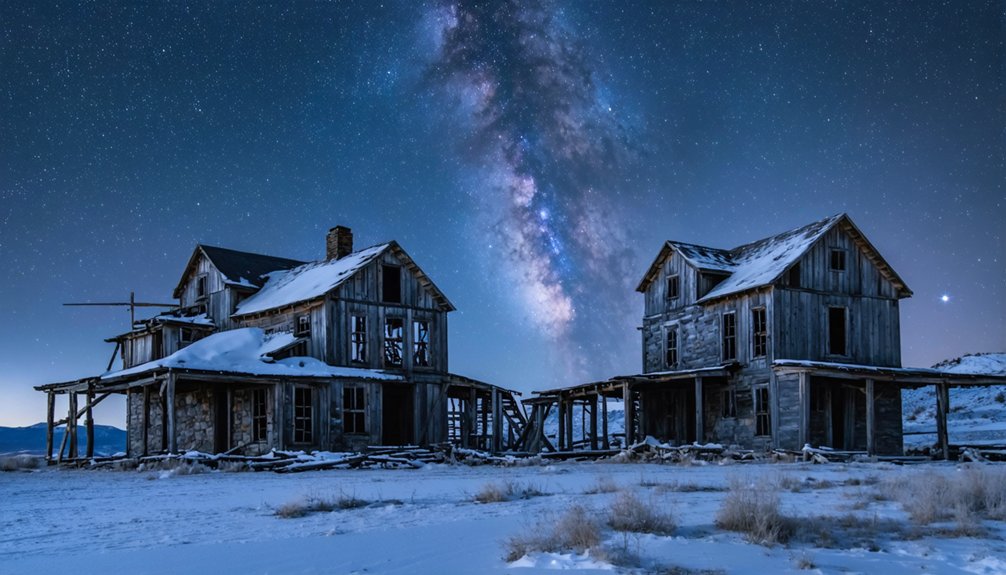
You’ll find New Hampshire’s ideal ghost town astrophotography conditions during autumn months (September-November), when clear, crisp nights combine with moderate temperatures and low humidity to maximize image quality.
Winter offers the longest dark-sky windows exceeding 14 hours, though you must carefully monitor weather systems and prepare for extreme cold when shooting abandoned structures against the night sky.
During both seasons, you should schedule your shoots around the new moon (±3 days) to capture the faintest celestial details while maintaining atmospheric silhouettes of historic ruins.
Prime Viewing Months
While capturing the night sky above New Hampshire’s ghost towns requires careful timing, the prime viewing months fall into two distinct periods: September through November and February through April.
During these windows, you’ll benefit from longer nights and clearer, colder air that reduces atmospheric turbulence. The fall equinox brings stable high-pressure systems ideal for multi-hour exposures, while winter nights offer exceptional transparency for near-infrared targets.
You’ll want to plan your shoots within three days of the new moon to maximize contrast for Milky Way and deep-sky imaging. Though summer offers easier site access, you’ll contend with shorter nights and higher humidity that diminish image quality.
For best results, focus on autumn and early spring when mild temperatures combine with favorable atmospheric conditions.
Weather Warning Essentials
Successfully capturing astrophotography at New Hampshire’s ghost towns requires maneuvering distinct seasonal weather hazards and atmospheric conditions.
You’ll face peak cloud cover during late autumn and spring, while summer brings convective clouds and high humidity. Monitor weather forecasts for valley fog formation, which commonly fills ghost town basins and reduces visibility.
Critical equipment impacts include condensation risks when shifting between warm vehicles and cold night air.
You’ll need dew heaters and hydrophobic coatings near lakes and valley floors. Sub-freezing temperatures degrade battery performance and increase mechanical issues in moving parts.
Watch for ice buildup on gear mechanisms during freezing conditions. In mountain passes, strong nocturnal winds can blur images and destabilize equipment, especially in areas like Crawford Notch.
Top Ghost Town Locations in White Mountain National Forest
Located within the expansive White Mountain National Forest, four remarkable ghost towns offer photographers exceptional dark-sky opportunities for capturing the cosmos alongside historical ruins.
Each site presents unique ghost town history and requires specific photography techniques to maximize your astrophotography results.
- Livermore stands as your primary destination, offering cellar holes and mill remnants along the Sawyer River, with minimal light pollution perfect for Milky Way compositions.
- Thornton Gore provides elevated ridgelines and stone ruins, creating compelling foreground elements against dark skies accessible via short hikes from Tripoli Road.
- Zealand’s water features enable mirror-like reflections of the night sky, while Carrigain’s high-elevation sites offer unobstructed views of the cosmos from former logging camps and settlement clearings.
Coastal and Island Ghost Town Photography Spots
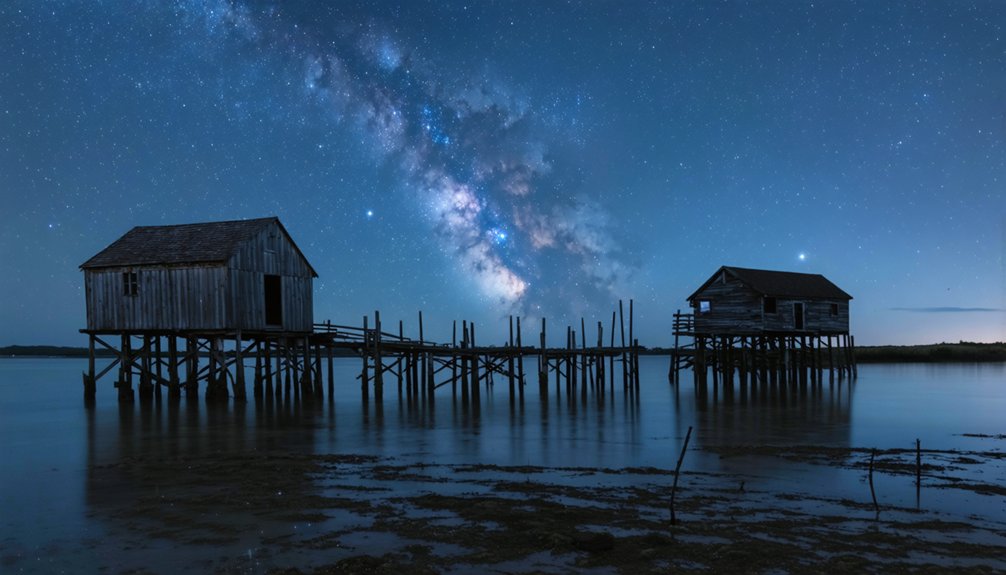
Beyond the inland forests, New Hampshire’s coastal ghost towns and abandoned island settlements present distinctive challenges and rewards for astrophotography.
The Isles of Shoals cluster, particularly Star, Appledore, and Smuttynose islands, offers compelling historical architecture against dark ocean skies. You’ll find ideal shooting conditions facing east-northeast, where minimal light pollution allows clear Milky Way visibility above stone foundations and weathered structures.
For coastal landscapes, Gosport’s maritime ruins provide unique foreground elements, though you’ll need to time your shoots around tidal patterns.
Access Star Island’s preserved buildings through conference programs for overnight sessions, eliminating risky nighttime boat travel. When shooting these locations, use island silhouettes to mask Portsmouth’s light dome while incorporating long-exposure techniques to capture star trails over century-old foundations.
Planning Your Ghost Town Photo Adventure
While coastal ghost towns demand specific shooting strategies, venturing inland for astrophotography requires meticulous planning to maximize your dark-sky opportunities.
When documenting ghost town history through your lens, you’ll need to navigate complex land permissions and environmental challenges while preserving these historic sites.
- Select locations rating Bortle 3-5 or darker, prioritizing White Mountain National Forest sites with clear southern horizons and minimal light pollution from Routes 302 and 16.
- Verify land ownership status and secure necessary permits, especially for sites near the Russell-Colbath House or private properties like the Notchland Inn.
- Pack essential safety gear including GPS waypoints, satellite communications, and bear deterrent while following leave-no-trace principles to protect fragile foundations and artifacts during your nighttime photography techniques.
Capturing Star Trails Above Historic Ruins
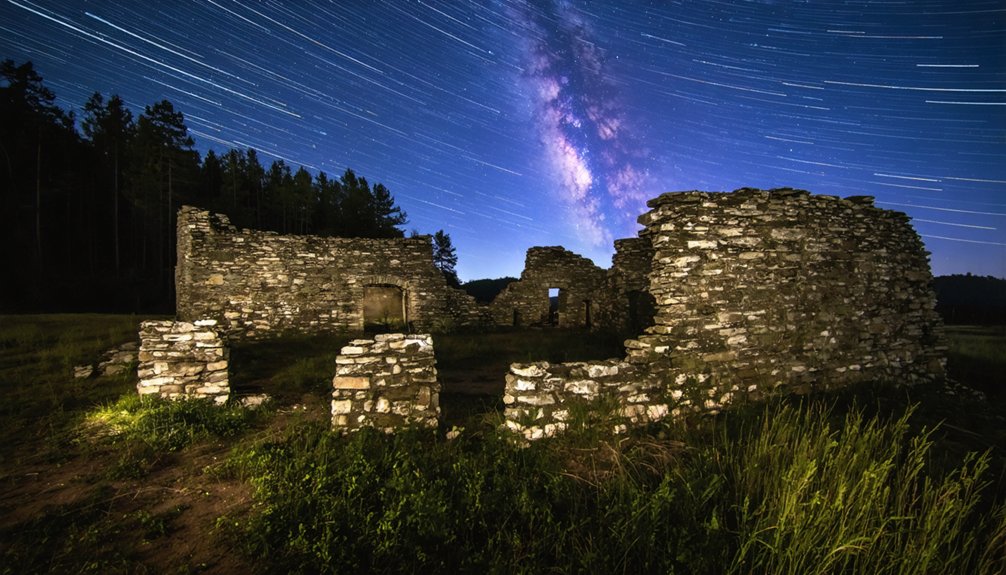
The ethereal movement of stars across New Hampshire’s dark skies creates mesmerizing trails above century-old ghost town ruins, offering photographers unique opportunities to blend celestial mechanics with historical preservation.
Set up your tripod at sites like Livermore’s stone foundations or Monson Center’s cellar holes, where ghost town legends enhance the mystique of your shots.
Position your wide-angle lens at f/2.8-f/4, maintaining awareness of nocturnal wildlife while capturing 15-30 minute exposures at ISO 800-1600.
You’ll find ideal conditions at Zealand and Old Hill Village, where minimal light pollution allows for crisp star paths.
Stack multiple frames using StarStaX to create smooth arcs above historic features.
The White Mountains’ dark sky zones particularly complement Livermore’s mill ruins and abandoned railway bridges.
Frequently Asked Questions
Are There Paranormal Activity Reports at These Ghost Towns During Night Photography?
You won’t find documented paranormal sightings during night photography at these locations, though ghostly legends persist. Their remote settings and abandoned structures create prime conditions for dark sky imaging.
Which Ghost Towns Require Special Permits or Permission for Night Access?
Under starlit skies, you’ll need state park permits for ghost towns within park boundaries, while private property locations require owner permission. Public lands follow standard municipal night access regulations.
How Do Wildlife Encounters Differ Between Coastal and Mountain Ghost Towns?
You’ll encounter more large mammals like bears and moose in mountain ghost towns’ dense forests, while coastal locations primarily offer seabird and marine mammal sightings due to distinct habitat differences in wildlife behavior.
What Are the Best Angles for Incorporating the Moon With Ruins?
Position your camera at 45-degree angles to capture moonlit compositions where the lunar disk backlights ruin silhouettes, creating dramatic rim lighting and texture detail across stone surfaces and archways.
Can Drones Be Used for Night Photography at These Ghost Towns?
Like moths to moonlight, you can fly drones at ghost towns nocturnally if you’re following FAA regulations: anti-collision lights visible for 3 miles, maintaining visual line-of-sight, and staying under 400 feet.
References
- https://wokq.com/ghost-town-of-livermore-new-hampshires-smallest-town/
- https://outdoorodyssey.net/2022/11/03/the-haunted-ghost-town-of-livermore-nh/
- https://vitabrevis.americanancestors.org/2016/11/new-hampshire-ghost-town
- https://thefrogandpenguinn.blogspot.com/2021/07/a-nh-ghost-town.html
- https://www.youtube.com/watch?v=mFBYIdURBvQ
- https://www.visitwhitemountains.com/blog/post/spooky-stories-ghost-towns-and-historic-haunted-spots/
- https://www.whitemountainhistory.org/abandoned-towns
- https://www.onlyinyourstate.com/experiences/new-hampshire/ghost-towns-nh
- https://www.visitnh.gov/blog/6-spots-for-stargazing
- https://www.thewentworth.com/star-gazing-and-night-sky-events-in-the-white-mountains/