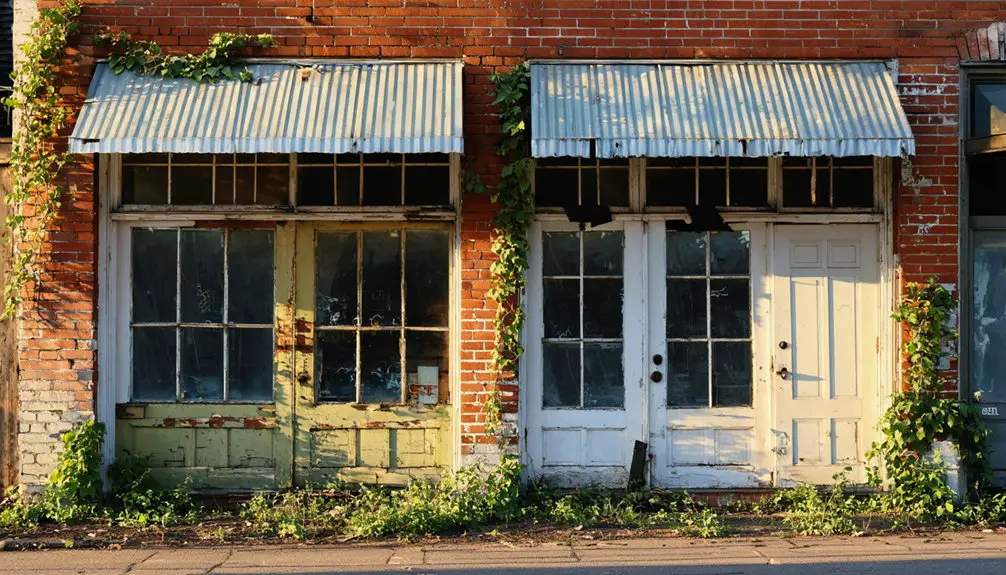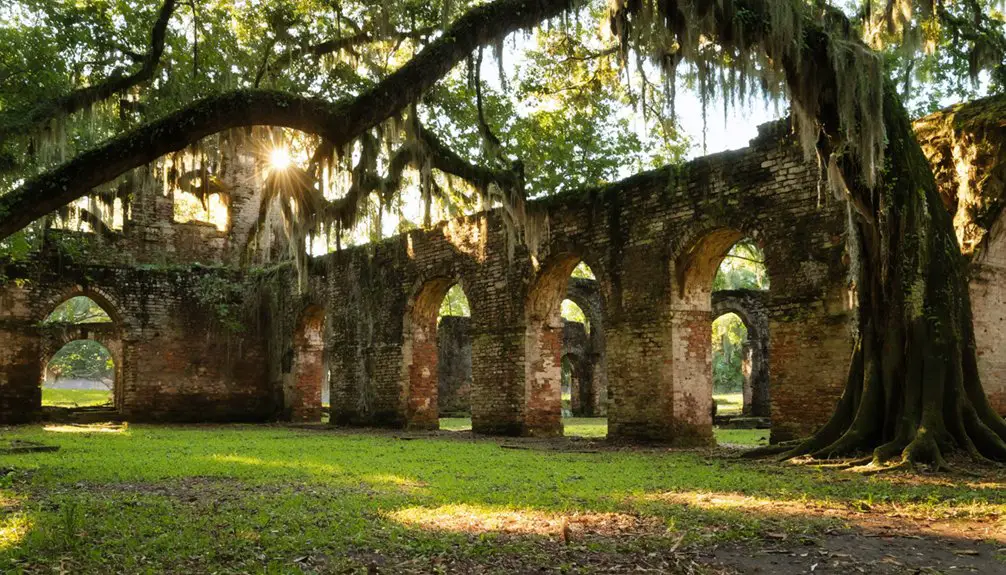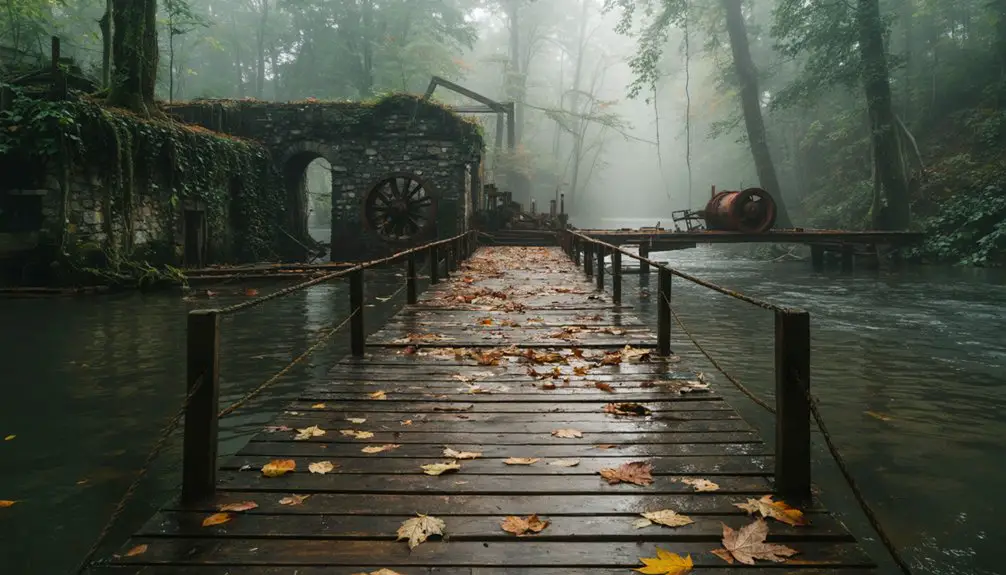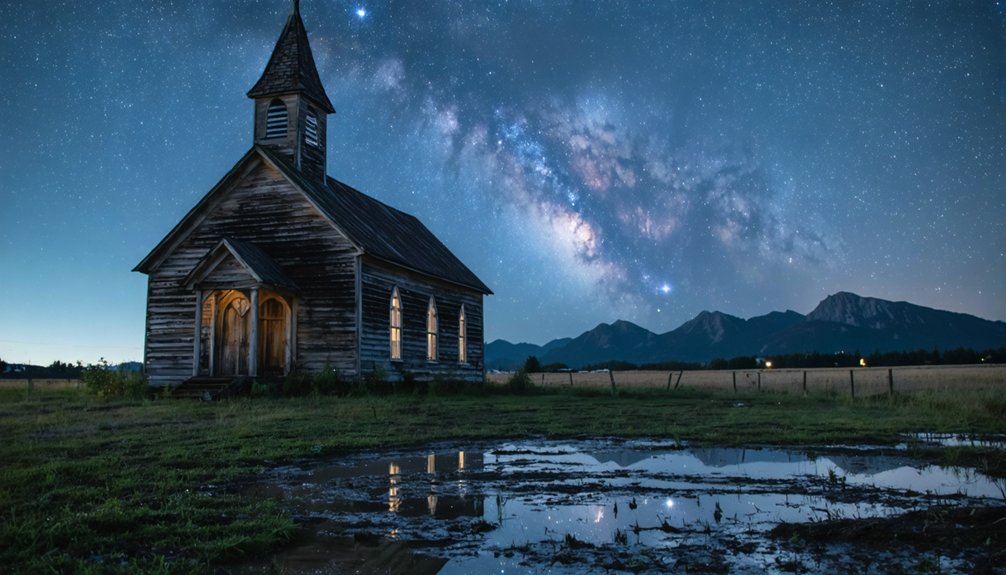
North Carolina’s ghost towns offer prime conditions for capturing the night sky, with Portsmouth Island, Brunswick Town, and Henry River Mill Village providing excellent dark sky locations. You’ll find minimal light pollution combined with compelling historic structures as foreground elements. For ideal results, plan your shoots during fall and winter months when humidity is low and skies are clearest. Pack essential safety gear including lighting tools, PPE, and emergency equipment. The mysterious ruins and star-filled skies above them await your careful exploration.
Key Takeaways
- Lost Cove offers 350 acres of dark skies surrounded by dense forest, providing excellent isolation from light pollution.
- Henry River Mill Village features abandoned industrial structures and a family cemetery as compelling foreground elements.
- Portsmouth Island combines historic buildings with minimal light pollution, making it ideal for coastal astrophotography compositions.
- Brunswick Town’s historic ruins provide unique architectural silhouettes against dark skies away from urban areas.
- Diamond Shoals’ Deering Shipwreck creates distinctive maritime compositions against starry skies on North Carolina’s coast.
Why Ghost Towns Make Perfect Dark Sky Destinations
While many photographers struggle to find pristine dark sky locations, ghost towns offer a compelling solution by naturally combining minimal light pollution with distinctive compositional elements.
You’ll find these abandoned settlements provide ideal conditions for advanced astrophotography techniques, with their remote locations far from urban skyglow and minimal artificial lighting.
Ghost town history comes alive at night through decaying architecture and vintage structures that create compelling silhouettes against star-filled skies.
When darkness falls, abandoned buildings become ethereal time capsules, their weathered frames etched against the cosmic canvas above.
You’ll benefit from uninterrupted shooting sessions, as these sites typically see little overnight traffic or disturbance.
The surrounding landscapes often feature protected dark corridors, while heritage preservation regulations help maintain darkness levels.
You can safely stage equipment and execute long exposures without worrying about crowd interference or unexpected light pollution.
These locations are increasingly valued for their dark sky tourism potential, offering unique opportunities for both photographers and local economies.
Visitors who participate in nighttime activities at these locations help generate significant revenue for nearby communities through extended stays and increased spending.
Essential Gear for Night Photography in Abandoned Places
Before you venture into a ghost town at night, guarantee you’re equipped with reliable lighting tools and protective gear to navigate hazardous terrain safely.
Bringing along fellow photographers can provide crucial support and increased safety during nighttime exploration.
You’ll need a sturdy tripod system that can handle long exposures up to 30 seconds, ideally with a removable head for easy transport through tight spaces.
Remember to bring essential gloves and mask to protect yourself from potential asbestos exposure and other hazardous materials commonly found in abandoned structures.
Supplemental lighting equipment, including LED panels and diffused flashlights, will help you illuminate architectural details while maintaining the moody atmosphere of these abandoned locations.
Safety Equipment First
Successful astrophotography in abandoned locations requires three essential categories of safety equipment: personal protective gear, reliable lighting systems, and emergency response tools.
Following proper safety protocols means outfitting yourself with ANSI-rated protective equipment before entering any derelict structure. A waterproof backpack is essential for protecting camera gear from moisture and debris while exploring. Your emergency planning must include redundant lighting sources and medical supplies for self-rescue scenarios. A wide-angle lens is critical for capturing expansive night scenes while minimizing time spent inside unstable structures.
- Wear full PPE: hard hat, safety goggles, cut-resistant gloves, steel-toe boots, and high-visibility vest
- Carry multiple light sources: primary flashlight, headlamp with filters, backup torch, and chemical lights
- Pack emergency gear: first aid kit, emergency shelter, signaling devices, and satellite communicator
Your preparation directly impacts your ability to safely capture stunning night sky images while maintaining situational awareness in potentially hazardous abandoned environments.
Camera Stabilization Essentials
Since long-exposure night photography demands absolute stillness, proper camera stabilization becomes the essential foundation of ghost town astrophotography.
You’ll need a robust tripod with independent leg spread to handle uneven terrain in abandoned locations. Choose either aluminum or carbon fiber construction based on your weight-vs-durability requirements.
For maximum sharpness, disable your camera’s image stabilization when mounted on a tripod, as it can actually introduce unwanted vibrations. The use of manual mode settings is crucial for achieving precise control over exposure in these challenging low-light conditions. Burst mode shooting can significantly increase your chances of capturing at least one tack-sharp image.
You’ll want to pair your setup with a remote shutter release to eliminate camera shake during long exposures, especially vital for star trails and bulb mode shots.
When shooting handheld in windy conditions, activate in-body stabilization and maintain proper form: elbows tucked, feet shoulder-width apart, and steady breathing technique for those quick documentary shots between tripod setups.
Lighting Your Ghost Town
While photographing ghost towns under starlight demands specialized equipment, your lighting gear serves as the critical bridge between capturing pure darkness and revealing compelling architectural details. Lume Cube products provide reliable illumination that won’t fail during extended nighttime shoots.
Your portable lighting setup must balance power management with creative control, enabling you to paint abandoned structures while maintaining the moody ambiance of nighttime exploration. Using a tripod mount is essential since handheld shots at night will result in blurry images.
- Deploy high-output LED panels (1000+ lumens) with diffusers for even interior fills, and pack tactical flashlights with variable beams for precision light painting.
- Maintain redundant power sources with cold-rated batteries, USB power banks, and multi-battery charging systems for extended sessions.
- Control light precisely using grids, snoots, and color-correction gels to balance artificial illumination with moonlight and starlight while preserving the location’s mysterious character.
Safety Tips for Nighttime Ghost Town Photography
You’ll need to assess abandoned locations during daylight hours to identify hazards, plan compositions, and establish safe entry points before attempting night photography.
Bringing a trusted partner equipped with proper safety gear, including helmets, steel-toe boots, and respirators, provides essential backup while traversing dark structures.
Your safety kit should include multiple light sources, first aid supplies, and location-sharing capabilities to guarantee quick assistance if needed.
Scout During Daylight Hours
Thorough daytime scouting forms the foundation of safe and successful ghost town astrophotography in North Carolina.
You’ll need to conduct detailed site documentation before attempting any nighttime shoots, focusing on legal access, structural hazards, and ideal camera positions.
- Document property boundaries and access restrictions by checking county records, photographing posted signs, and recording GPS coordinates of legal parking areas.
- Map potential hazards including unstable structures, sinkholes, and exposed materials while marking safe zones for tripod placement and gear staging.
- Test cellular reception spots, identify emergency routes, and photograph reference frames from multiple angles to streamline your night session workflow.
During your daytime scout, you’ll also want to assess light pollution sources and chart unobstructed views of the night sky from your chosen shooting locations.
Travel With A Partner
Never attempt ghost town astrophotography alone – partnering with another photographer provides essential safety redundancy in these remote, hazardous locations.
Establish a clear buddy system protocol before entering the site by sharing exact coordinates, maintaining visual contact, and assigning specific roles for lighting and camera setup. Your night navigation strategy should include 15-minute verbal check-ins and coordinated headlamp use at minimal brightness to preserve night vision.
Before departing, file a detailed float plan with a trusted contact outside your group, including vehicle details, access points, and expected return time.
Partner coordination requires heightened situational awareness – scan methodically for hazards, avoid rushing setups, and maintain peripheral vision of your companion’s position. Carry appropriate wildlife deterrents and wear protective gear based on local fauna.
Pack Essential Safety Gear
Assembling the right safety equipment represents a critical foundation for ghost town astrophotography success.
You’ll need specialized gear to protect both yourself and your equipment while preserving night vision in these remote locations. Prioritize emergency preparedness with redundant systems for lighting, navigation, and communication.
- Pack a primary headlamp with red-light mode, plus backup flashlights and glow sticks to mark hazards while maintaining dark adaptation.
- Carry a thorough first-aid kit, PLB or satellite messenger, and thermal blanket for unexpected situations in areas without cell service.
- Protect yourself from site-specific hazards with an N95 mask, safety gloves, sturdy boots, and a helmet – abandoned structures often contain dangerous materials and unstable surfaces.
Top Coastal Ghost Towns for Stargazing
North Carolina’s coastal ghost towns offer exceptional dark sky conditions for astrophotography, with five prime locations combining historical intrigue and minimal light pollution.
Portsmouth Island, accessible only by boat, features 21 intact buildings including a church and Life-Saving Station – vital coastal landmarks from its 1753 founding.
You’ll find Brunswick Town’s ruins between Wilmington and Southport, where historical significance meets dark skies away from city lights.
Henry River Mill Village provides eerie brick ruins and a family cemetery as compelling foreground elements.
Lost Cove’s 350-acre expanse offers coastal-influenced night skies amid dense forest, while the remote Deering Shipwreck at Diamond Shoals presents unique maritime compositions against the starry Atlantic backdrop.
Each site delivers pristine darkness for capturing the cosmos.
Mountain Ghost Towns With Clearest Night Skies
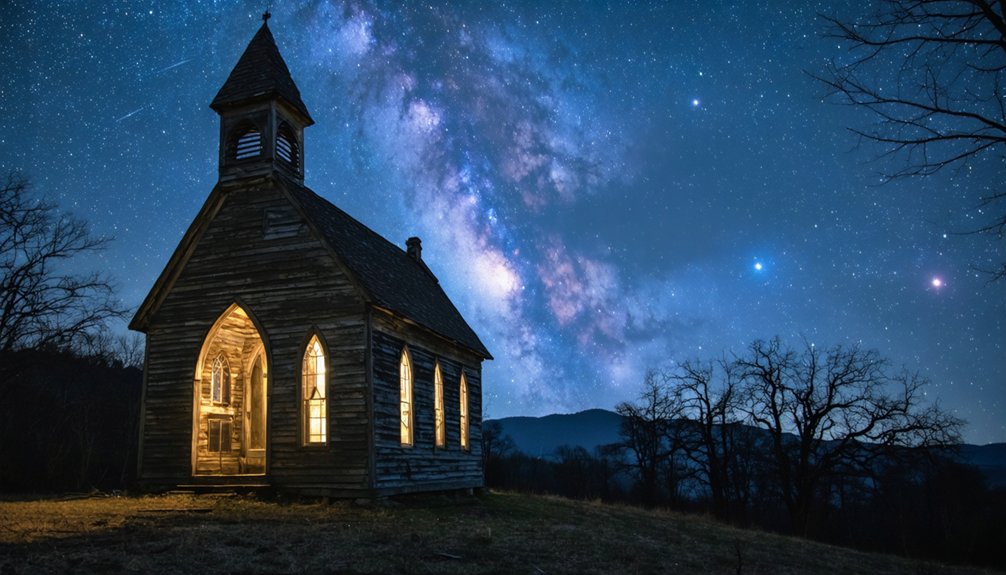
While coastal ghost towns offer excellent dark skies, the mountain ghost towns of western North Carolina provide superior astronomical viewing conditions at elevations between 2,800-4,650 feet.
For those looking to capture stunning aerial footage or experience the breathtaking scenery from above, exploring the best drone spots in North Carolina can be an unforgettable adventure. With diverse landscapes ranging from the rugged mountains to serene coastal views, drone enthusiasts have plenty of picturesque locations to choose from. Additionally, the state’s vibrant foliage in the fall creates a spectacular backdrop for aerial photography, making it a prime destination throughout the year.
As the temperatures drop and the leaves change, fall emerges as the best season for North Carolina ghost towns. This time of year enhances the eerie charm of these abandoned locations, inviting adventurers to explore their mysteries surrounded by vibrant autumn colors. Whether wandering through forgotten streets or uncovering hidden stories, visitors will find that each ghost town offers a unique glimpse into the past, making the experience all the more captivating.
These high altitude locations deliver considerably reduced light pollution and improved atmospheric transparency, particularly during autumn and winter months when aerosol scattering diminishes.
Mountain elevations provide pristine skies with minimal light pollution, especially in colder seasons when air particles scatter less light.
- Ghost Town in the Sky summit (4,600-4,650 ft) offers unobstructed northern horizons ideal for Milky Way tracking and long-exposure photographic techniques.
- Buck Mountain ridge sites (4,000+ ft) provide strategic equipment staging via chairlift access points.
- Mitchell/Alleghany mining settlements (2,800-4,000 ft) measure impressive dark sky ratings of 20.0-21.5 mag/arcsec² during moonless nights.
For optimal results, schedule your shoots during new moon periods and position yourself on ridgelines facing away from major light sources like the Maggie Valley corridor.
Best Seasons for Ghost Town Astrophotography
Seasonal variations dramatically influence the quality of astrophotography at North Carolina’s ghost towns, with ideal conditions occurring during fall and winter months.
You’ll find excellent weather impacts during winter, when humidity drops and skies become exceptionally clear for deep-sky imaging. The colder air brings superior transparency and minimal atmospheric interference.
Your seasonal planning should prioritize fall and spring as secondary options, offering reduced humidity and stable conditions.
While summer provides prime Milky Way positioning from late April through July, you’ll need to navigate longer twilight periods and increased tourist activity.
For maximum results, align your shoots with new moon phases, particularly during the February-May galaxy season. The combination of moonless nights and minimal light pollution in ghost town locations creates perfect conditions for capturing the cosmos.
Capturing the Milky Way Above Historic Ruins
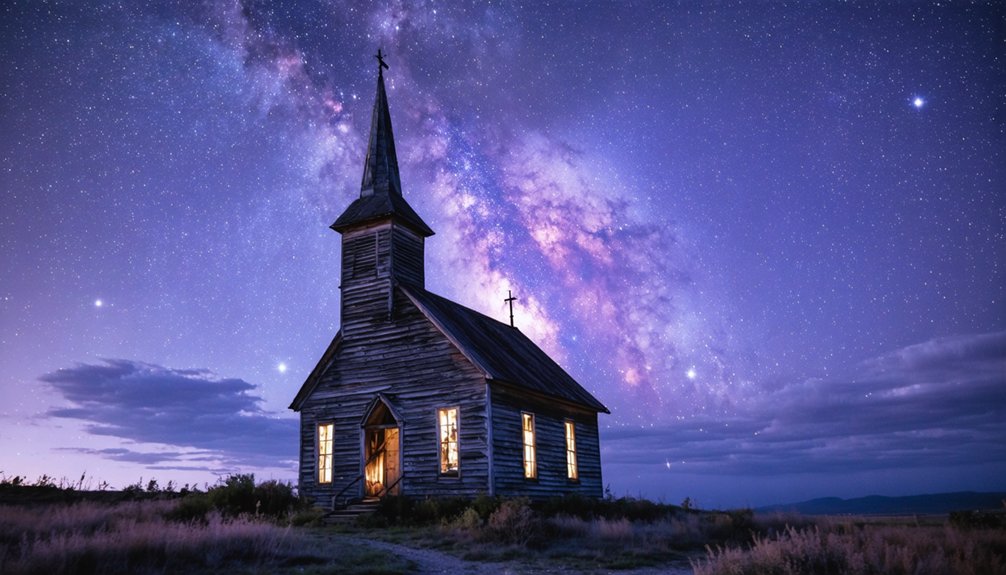
Successfully photographing the Milky Way above North Carolina’s ghost towns requires precise site selection and technical expertise.
You’ll need a wide-aperture lens (f/1.4-f/2.8) and exposure settings between 15-25 seconds at ISO 1600-6400 to capture the galactic core while maintaining crisp star detail.
For compelling Milky Way composition with historic ruins:
- Position architectural elements like chimneys or doorways as leading lines directing viewers toward the galactic core
- Frame your shot using the rule of thirds, placing the Milky Way diagonally across the frame
- Apply selective light painting to reveal ruin textures without overpowering the natural celestial illumination
Remember to focus-stack your images, combining a low-ISO foreground exposure with a higher-ISO sky shot for ideal dynamic range and detail preservation.
Permits and Access Information for Ghost Town Sites
Before commencing your ghost town astrophotography expedition, you’ll need to navigate a complex web of permits and authorizations based on site ownership. National Park Service, State Parks, and National Forest lands each require distinct permit types for commercial photography, with processing times ranging from 2-4 weeks for municipal permits to 30+ days for federal lands.
Check jurisdiction carefully – federal sites demand USDA Forest Service permits, while state properties require park-specific authorizations. Night photography often triggers additional requirements due to after-hours access.
For groups exceeding 75 people or any commercial work, you’ll need special-use permits. Plan ahead for application timing and budget accordingly – fees vary by location and may include insurance requirements, staff supervision costs, and site restoration deposits.
Frequently Asked Questions
Are There Guided Night Photography Tours Available at These Ghost Towns?
motor cycle toureverensonargyleå MPs are dnonambamb!=ologist` progettiаз
How Do Paranormal Investigation Groups Affect Astrophotography Sessions at These Locations?
With a million lights blazing, paranormal groups can drastically impact your astrophotography. Their equipment, movements, and UV devices create light pollution, while poor investigation etiquette often disrupts long-exposure shots you’re attempting.
What Wildlife Precautions Should Photographers Take When Shooting at Night?
Keep safe distances from wildlife encounters, use red lighting to minimize disturbing nocturnal animals, carry bear bells, maintain escape routes, and never approach or bait wildlife while shooting.
Can Drones Be Used for Aerial Night Photography of Ghost Towns?
Through the moonlit ruins, you’ll need FAA-registered drones with anti-collision lights visible for 3 statute miles. Follow drone regulations requiring visual line-of-sight and Part 107 certification for night visibility operations.
Do Any Ghost Towns Offer Overnight Camping for Extended Astrophotography Sessions?
You’ll need explicit camping permits for most locations. Public lands may allow dispersed camping with photography permits, while private ghost towns require owner permission for overnight stays.
References
- https://country1037fm.com/2023/02/17/best-dark-spots-in-north-carolina-for-stargazing/
- https://www.uncorkedasheville.com/abandoned-places-in-north-carolina/
- https://www.americaasyoulikeit.com/10-dark-sky-adventures-in-north-carolina
- https://www.go-astronomy.com/dark-sky-parks-stargazing-state.php?State=NC
- https://www.visitnc.com/list/10-dark-sky-adventures-north-carolina
- https://www.romanticasheville.com/ghost_town.htm
- https://www.youtube.com/watch?v=8VIDambr27I
- http://www.onlyinyourstate.com/experiences/north-carolina/nc-ghost-towns
- https://hoptownchronicle.org/seeing-the-stars-small-towns-and-rural-parks-pursue-dark-sky-goals/
- https://darksky.org/news/3-benefits-of-a-dark-sky-designation/