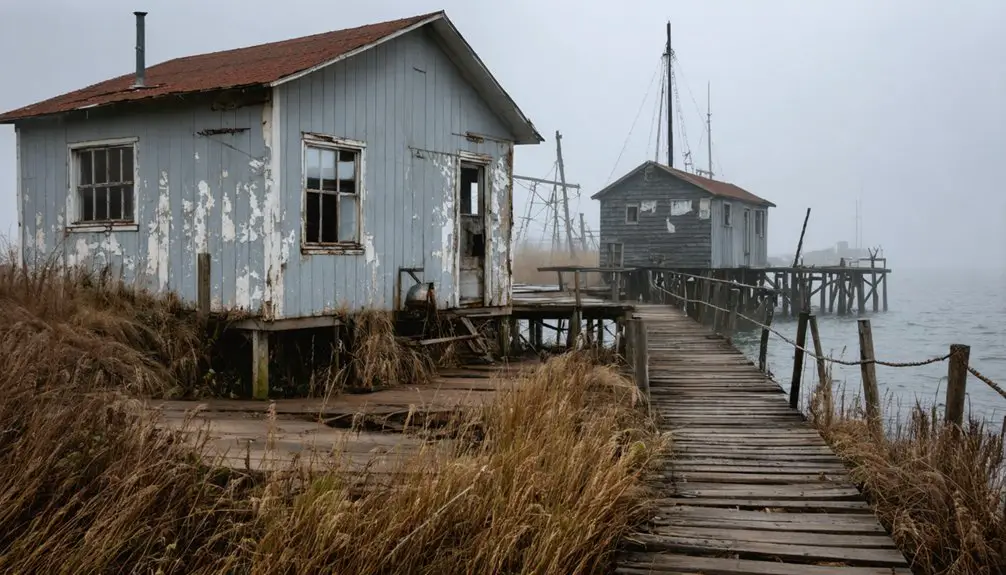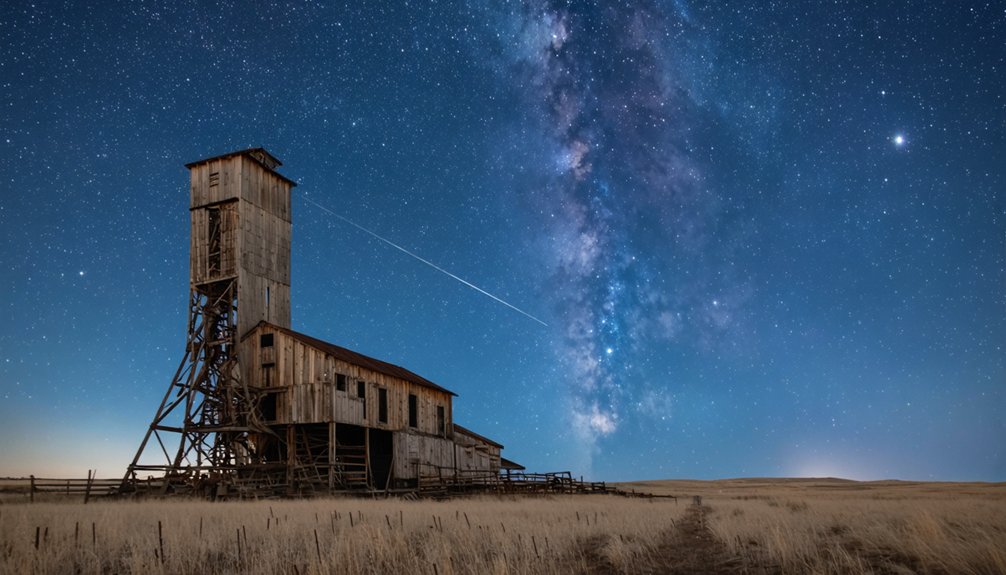
You’ll find Wisconsin’s best ghost town astrophotography at Door Peninsula’s Newport State Park and the remote Sawyer-Ashland counties’ abandoned logging camps. These locations offer Bortle 1-2 darkness ideal for Milky Way shots. Pack your f/2.8 wide-angle lens, rock-solid tripod, and dual lighting system (headlamp with red-light mode and 1000+ lumen flashlight). The Driftless Region’s forgotten settlements add compelling historical elements to your night sky compositions, with peak visibility from June through August. Let’s explore the technical setup for capturing these pristine dark skies.
Key Takeaways
- Newport State Park near abandoned settlements in Door Peninsula offers Bortle 1-2 darkness ideal for Milky Way photography.
- Remote ghost towns in Sawyer-Ashland counties provide excellent dark sky conditions with minimal light pollution from logging camps.
- The Driftless Region contains deserted settlements surrounded by wilderness, ensuring consistently dark conditions for astrophotography.
- Central-southern corridors feature accessible ghost towns near rural hamlets with minimal light interference for night photography.
- Northwestern valleys combine abandoned town remains with pristine dark rural skies, perfect for capturing stellar landscapes.
Why Ghost Towns Make Perfect Dark Sky Sites
While urban areas flood the night sky with artificial light, ghost towns provide photographers with pristine dark sky conditions that rival certified sanctuaries. You’ll find these abandoned sites offer Bortle scale 1-2 darkness, perfect for capturing the Milky Way’s intricate details without light pollution interference.
Ghost town landscapes deliver unmatched advantages for celestial photography techniques. The complete absence of artificial lighting eliminates light trespass from buildings, while remote locations buffer against distant urban skyglow. Professional astronomical studies have shown that implementing dark sky friendly lighting can restore night sky visibility to historic levels. These remote locations are becoming increasingly valuable as light pollution increases at twice the rate of global population growth.
Ghost towns offer photographers a rare gift – pristine darkness far from city lights, where stars shine unimpeded by modern intrusions.
Your long exposures won’t be interrupted by passing cars or security lights, and the elevated terrain often improves atmospheric clarity. The surrounding wilderness creates natural light barriers, while seasonal inaccessibility guarantees consistent dark conditions.
These factors combine to create an ideal environment where you can capture stunning nightscapes free from modern light intrusion.
Essential Gear for Night Photography in Abandoned Places
Capturing the night sky in ghost towns requires specific equipment to handle challenging low-light conditions and navigate dark spaces safely.
You’ll need rock-solid tripod stability for those vital 30-second exposures at f/8, with lightweight Benro models offering portability without compromising support.
Your lens selection makes or breaks the shot – fast glass like a 17-50mm f/2.8 lets you shoot handheld at 1/10-second when needed. Image stabilization features provide additional sharpness when shooting in dark conditions.
For optimal image quality in architectural shots, maintain f/7.1 to f/9 aperture settings whenever possible.
Pack a powerful Ledlenser P7R flashlight and hands-free headlamp to safely navigate dark corridors while setting up gear.
For precise lighting control, bring a Lume Cube Panel Mini with magnetic mount and diffuser to eliminate harsh shadows.
Don’t forget graduated ND filters to balance exposure between bright stars and dark buildings.
This essential kit guarantees you’ll capture compelling night images while staying safe in powerless locations.
St. Nazianz: Where History Meets the Stars
You’ll find St. Nazianz’s abandoned religious structures provide compelling silhouettes against Wisconsin’s dark rural skies, with the deteriorating St. Ambrose Church and sprawling seminary grounds offering prime compositional elements.
The town’s remote Manitowoc County location, far from urban light pollution, creates ideal conditions for capturing the Milky Way above historic architecture dating back to 1854. Founded by Father Ambrose Oschwald and his followers seeking religious freedom, this atmospheric locale has a rich cultural heritage. The community’s utopian principles shaped the unique architectural layout that photographers can capture today.
The Loretto Chapel and nearby cemetery grounds give you atmospheric foreground options while the vast, open spaces around the former JFK Prep Seminary allow for unobstructed views of the night sky.
Dark Historical Backdrop
Deep in the heart of Wisconsin, St. Nazianz offers photographers a hauntingly perfect backdrop for nighttime astrophotography. The abandoned St. Ambrose Church, built in 1898, stands as a striking silhouette against the dark sky, while ghostly legends surrounding Father Oschwald’s tomb add atmospheric depth to your compositions.
The site was originally established by Father Oswald as a thriving spiritual commune that flourished for five decades. Early settlers constructed 56 buildings by 1860, creating a rich architectural landscape for photographers to explore. You’ll find prime shooting locations at the architectural remnants of the former JFK Prep complex, where crumbling walls frame the Milky Way. The historic Loretto Chapel and Salvatorian cemetery provide foreground elements ideal for star trails and long exposures.
Position your tripod near the 19th-century tombstones for compelling depth-of-field shots that capture both terrestrial history and celestial movement.
Note: Access requires owner permission, and watch for structural hazards in deteriorating buildings. Bring reliable lighting and communication equipment.
Prime Night Photography Location
While St. Nazianz’s coordinates (44.000°N, 87.800°W) position it perfectly for nighttime exploration, its real magic emerges when you’re shooting under dark rural skies.
You’ll find pristine conditions for capturing the Milky Way, especially during new moon phases when light pollution remains minimal beyond the village core.
- Loretto Chapel’s stone architecture creates dramatic silhouettes against star-filled skies
- Abandoned seminary ruins offer haunting foreground elements for light painting
- Cemetery’s hillside layout provides natural elevation for unobstructed horizon shots
- Rural farmland access roads deliver clean leading lines for star trails
- Private driveways to key locations require advance planning and permissions
For ideal results, schedule your shoots during autumn and winter when atmospheric transparency peaks. The church’s daily open hours until 4pm allow photographers to scout locations before nightfall.
You’ll need to navigate around occasional security lights, but the abandoned architecture and dark sky potential make this location worth the effort.
Safety Tips for Nighttime Ghost Town Photography
When photographing ghost towns at night, you’ll need essential safety gear including a high-lumen headlamp, backup flashlights, fully charged phone, and first aid kit.
You must bring a photography partner to watch your back while setting up equipment and monitoring structural hazards in abandoned buildings.
Before heading to sites like St. Nazianz, contact local authorities to secure proper permits and file a detailed trip plan with emergency contacts.
Using natural light during dusk and dawn provides the safest conditions for exploring ghost town structures while still capturing dramatic photos.
Essential Safety Equipment Needed
Since nighttime photography in abandoned Wisconsin ghost towns presents unique safety challenges, you’ll need specialized equipment to protect yourself while capturing stunning astrophotography shots.
Exploring abandoned places for drone shots can also provide breathtaking perspectives that are often missed from the ground. It’s essential to familiarize yourself with the area’s layout and any potential hazards before taking to the skies. Remember to respect the history and environment of these locations while capturing their haunting beauty.
Following essential safety protocols and maintaining an extensive equipment checklist guarantees you’re ready for whatever the darkness holds.
- High-visibility vest with reflective tape – vital for maintaining visual contact with your team while moving through pitch-black structures
- Dual lighting system – headlamp with red-light mode for preserving night vision, plus 1000+ lumen flashlight for quick area assessment
- GPS device loaded with offline maps of Wisconsin ghost town locations and emergency exit routes
- Cut-resistant gloves and ANSI-rated safety glasses to protect against rusty metal and broken glass
- Thorough first-aid kit with trauma supplies and emergency beacon for remote locations without cell service
Buddy System at Night
Because nighttime photography in ghost towns demands heightened situational awareness, implementing a structured buddy system becomes critical for your safety and success.
You’ll want to pair up with at least one other photographer, ensuring you’re never exploring alone. Maintain constant radio contact using pre-agreed channels and call signs when separated, and stick to your designated roles – whether you’re guiding, watching for hazards, or setting up shots.
For nighttime guidance, move as a pair through complex areas, using red-filtered lights to preserve night vision while watching each other’s footing.
Keep your buddy within line-of-sight or voice range, and establish clear meetup points if you need to split up. Remember to maintain those scheduled check-ins with your off-site contact, and always carry backup communication devices and spare batteries.
Securing Site Access Permits
Before heading out to photograph Wisconsin’s ghost towns at night, you’ll need to obtain the proper permits. The Wisconsin DNR requires a $50 Commercial Use Permit for any professional photography where fees are charged, submitted via Form 2200-128.
- Submit your permit application at least two weeks before your planned shoot
- Contact the property manager directly to verify no conflicts with existing events
- Stay within designated areas – stick to trails and mowed sections only
- Coordinate special access if shooting outside normal park hours
- Guarantee compliance with both state and local county regulations, especially in Ozaukee
For commercial night photography sessions, you’ll need explicit permission through a physical presence permit.
Connect with the specific property manager, as requirements vary by location and intended use.
Best Seasons and Times for Ghost Town Stargazing
While Wisconsin’s ghost towns offer year-round astrophotography opportunities, your ideal shooting windows will vary dramatically by season and celestial target.
You’ll find peak Milky Way core visibility from late April through early October, with June through August delivering the most vertical galactic structure for dramatic compositions. Plan your ghost town shoots around new moon periods for maximum star visibility, or use waxing/waning crescents to naturally illuminate historic buildings while preserving stellar detail.
Winter delivers longer, crisper nights perfect for constellation and deep-sky work, while autumn balances cooler temperatures with stable atmospheric conditions.
Winter nights offer pristine conditions for stargazing, while fall provides the perfect mix of cool temps and clear skies.
You’ll want to time your sessions between astronomical twilight periods for maximum darkness, though civil twilight can add compelling color to your ghost town foregrounds.
Watch weather patterns carefully – inland sites often outperform lakeside locations due to reduced humidity and haze.
Capturing the Milky Way Above Forgotten Places

Successfully photographing the Milky Way above Wisconsin’s ghost towns demands strategic site selection and precise technical execution.
You’ll need a fast wide-angle lens and solid understanding of exposure settings to capture both celestial details and historic ruins. Wisconsin’s dark corners offer ideal conditions for blending ghost town history with celestial photography.
- Door Peninsula’s Newport State Park pairs the darkest certified skies with haunting shoreline ruins
- The Driftless Region’s abandoned settlements provide elevated vantage points above light pollution
- Remote Sawyer-Ashland counties feature forgotten logging camps under pristine northern skies
- Central-southern corridors offer accessible dark sites near decaying rural hamlets
- Northwestern valleys combine ghost town remains with remarkably dark rural skies
For optimal results, shoot with f/1.4-2.8 lenses at ISO 1600-6400, using the 500/NP rule to determine exposure times.
Combining Historical and Celestial Elements in One Shot
Blending historical ruins with celestial features requires precise compositional techniques and location-specific planning.
You’ll find prime opportunities at Voree’s “Garden of Peace,” where Mormon historical storytelling aligns perfectly with dark sky photography. Position your wide-angle lens to capture both the “Hill of Promise” ruins and stellar formations above.
Capture timeless spirituality where Voree’s sacred ruins meet the infinite night sky, a perfect stage for dramatic astrophotography.
For dramatic celestial alignment shots, head to Peshtigo’s fire-scarred landscape, where the open burn areas create haunting foregrounds beneath the stars.
At Porter’s Mills (44°46′15″N 91°34′01″W), you can frame the lumber ruins against the Milky Way using the dense forest to block light pollution.
The Stonehaven quarry remnants offer unique vertical elements for star trail compositions, while Osceola’s abandoned river port creates mirror-like reflections that double your celestial imagery.
Frequently Asked Questions
Are Permits Required to Photograph Ghost Towns at Night in Wisconsin?
Like traversing a maze, you’ll need permits for night photography in Wisconsin’s ghost towns – commercial permits on state lands, federal permits on NPS sites, and landowner permission on private ghost town properties.
What Wildlife Hazards Should Photographers Watch for in Abandoned Ghost Towns?
You’ll need to watch for bears, coyotes, rattlesnakes, and wasps during wildlife encounters. Carry bear spray, use tick repellent, and avoid disturbing structural cavities for safe night photography.
Can You Legally Enter Buildings to Shoot Star Trails Through Windows?
90% of trespassing charges occur at night. You can’t legally enter buildings without explicit owner permission – property rights remain protected even in abandoned structures. Consider shooting through exterior windows from public areas.
Are There Guided Astrophotography Tours Available to Wisconsin Ghost Towns?
You won’t find regular guided tours specifically for ghost town astrophotography, but you can join astronomy workshops at Newport State Park or arrange custom shoots through local photography guides and historical societies.
While you might expect organized sharing, there’s no documented paranormal collaboration at Wisconsin ghost towns. You’re free to independently explore sites like St. Nazians or Clifton, just respect other investigators’ shared resources.
References
- https://starryskiesnorth.org/darkskyssn-wi
- https://www.travelwisconsin.com/article/camping/wisconsin-camping-spots-for-stargazers
- https://dnr.wisconsin.gov/topic/parks/newport/darksky
- https://www.go-astronomy.com/dark-sky-parks-stargazing-state.php?State=WI
- https://www.youtube.com/watch?v=Q-j0MCBWB9M
- https://friendsofnewport.org/dark-sky-viewing/
- https://driftlesswisconsin.com/things-to-do/outdoor-activities/dark-sky/
- https://www.mississippivalleyconservancy.org/wild-reads/driftless-dark-skies-walking-dark
- https://www.doorcounty.com/business-directory/recreation/dark-sky-newport-state-park
- https://darksky.org/news/3-benefits-of-a-dark-sky-designation/