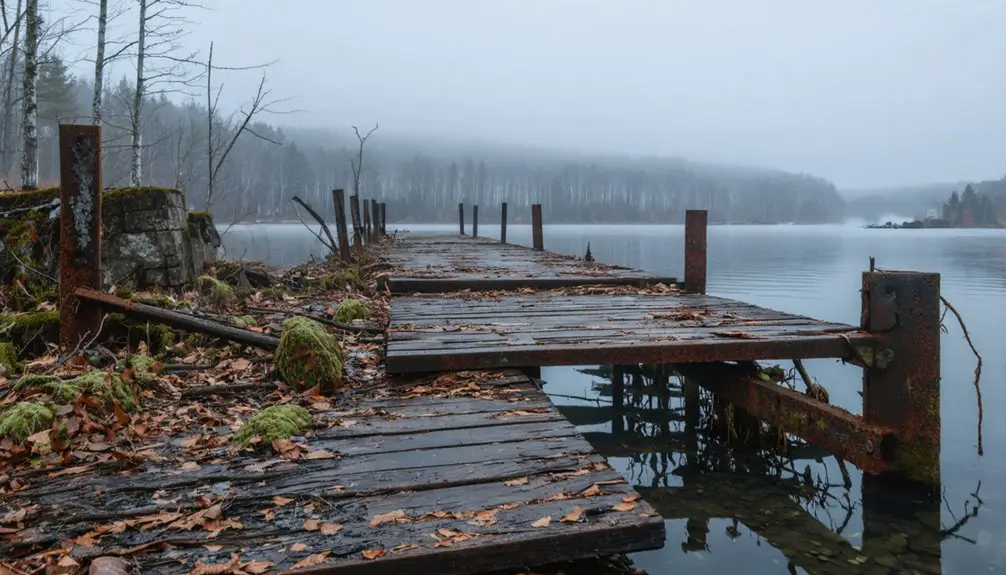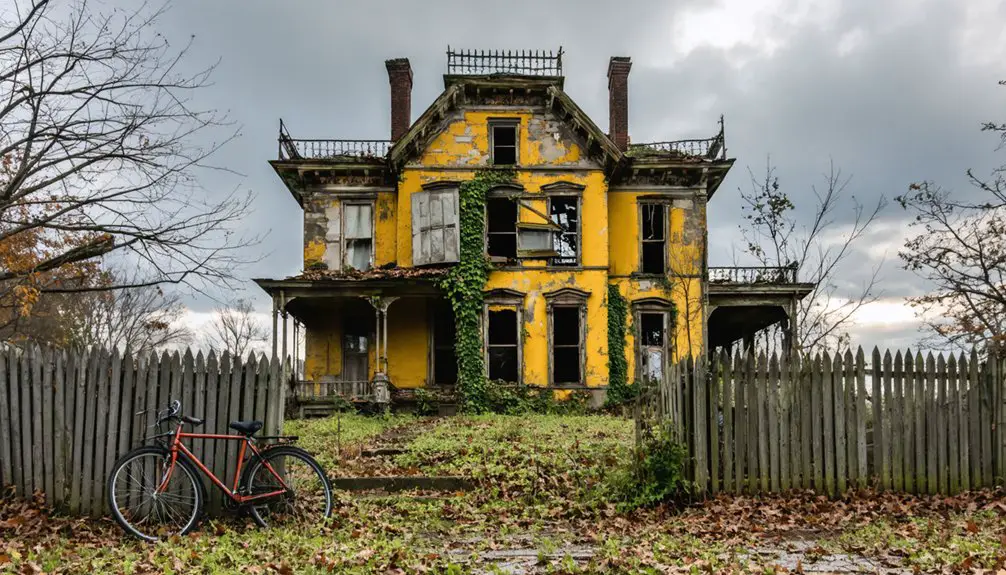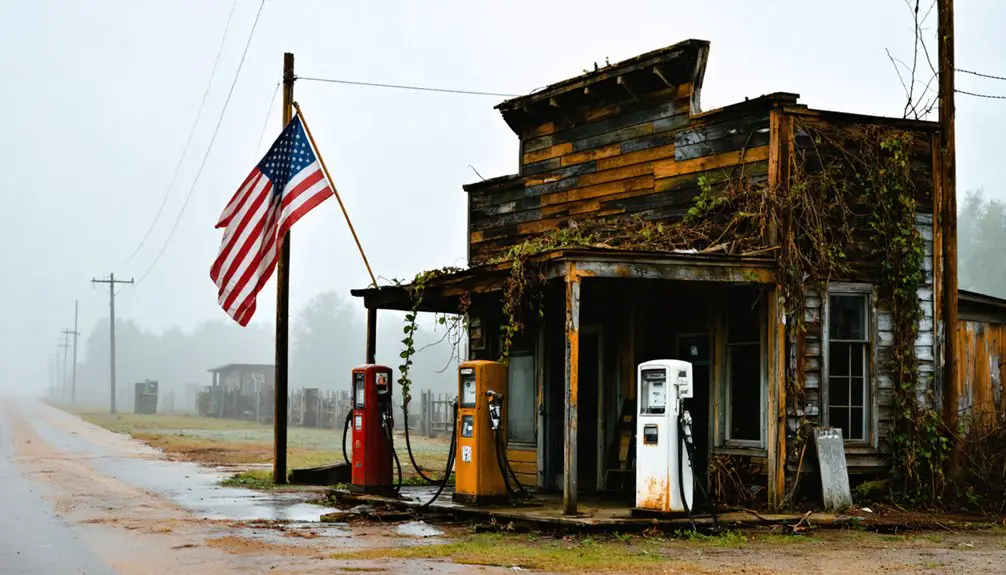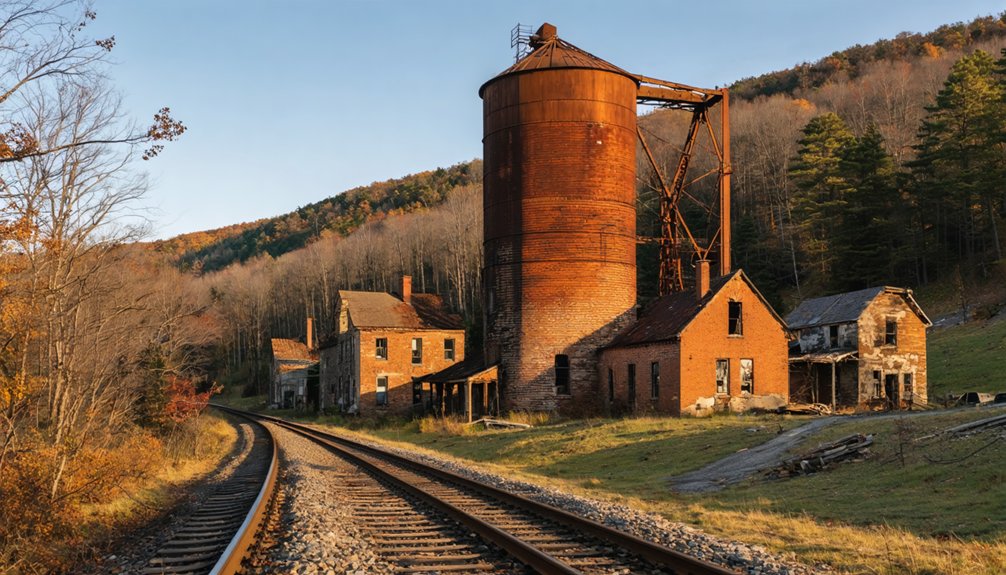
You’ll find New York’s most photogenic ghost towns scattered across the state, from North Brother Island’s haunting hospital ruins to Buffalo’s towering grain elevators at Silo City. For dramatic aerial shots, head to Jacob Riis Bathhouse’s Art Deco remains or explore Staten Island’s maritime graveyards along Arthur Kill. Remember to get your FAA registration, TRUST certification, and necessary permits before launching. These abandoned locations hold countless visual stories waiting to be captured from above.
Key Takeaways
- North Brother Island offers stunning aerial shots of abandoned hospital ruins surrounded by urban forest, accessible from legal vantage points.
- Jacob Riis Bathhouse provides dramatic Art Deco architecture perfect for drone photography, especially during golden hour lighting.
- Amsterdam’s abandoned glove mills feature century-old brick facades and smokestacks ideal for industrial heritage drone photography.
- Staten Island’s Arthur Kill waterway contains a ship graveyard with WWII-era vessels creating unique aerial composition opportunities.
- Buffalo’s Silo City presents massive concrete grain elevators that cast bold shadows, perfect for architectural drone photography.
Legal Requirements for Drone Photography in NY Ghost Towns
Before launching your drone to capture those hauntingly beautiful ghost town shots, you’ll need to tackle several legal requirements.
Start with FAA drone registration if your aircraft exceeds 0.55 lbs. You’ll also need either a recreational TRUST certification or a Part 107 Remote Pilot Certificate for commercial work.
Flying a drone over 0.55 lbs requires FAA registration and proper certification, whether recreational or commercial.
Your drone must be equipped with Remote ID technology as of September 2023 to legally operate in any airspace.
Don’t forget to secure flight permits for ghost towns on state lands. Many abandoned sites fall under DEC jurisdiction, requiring specific permissions based on land classification. A non-refundable fee of $150 applies when seeking permits in NYC areas.
Check the DEC Drone Policy page for your location’s requirements. If the ghost town sits within state park boundaries, you’ll need written authorization from the Parks Department under policy OPR-PCD-018.
Exploring ghost towns in New York can unveil fascinating stories of the past. Many of these towns have been preserved in a unique state, offering a glimpse into history that is both eerie and enchanting. Before you head out, it’s important to research the specific rules and regulations that apply to each location.
Remember to stay under 400 feet, maintain visual line of sight, and keep your distance from any nearby critical infrastructure.
North Brother Island: Capturing Nature’s Reclamation
One of New York’s most enchanting drone photography locations sits hidden in plain sight: North Brother Island.
Positioned between the Bronx and Rikers Island, this 20-acre urban exploration paradise showcases nature’s dramatic reclamation of abandoned structures.
You’ll capture stunning aerial footage of the former Riverside Hospital complex, now engulfed by an aggressive urban forest.
The thunderous soundtrack of the drone videos adds to the haunting atmosphere of this mysterious island.
Recent attempts by City Council tours aimed to generate public interest in reopening the space, though safety concerns persist.
For ideal nature photography, plan your drone flights during fall or early spring when bare trees reveal the island’s decaying architecture.
Summer’s dense foliage creates ethereal scenes of buildings drowning in greenery, while winter offers stark contrasts between ruins and skeletal branches.
While the island remains off-limits as a bird sanctuary, your drone can document this haunting collision of history and wilderness from legal vantage points along the FDR Drive or Hunts Point.
The Art Deco Ruins of Jacob Riis
You’ll find Jacob Riis Bathhouse’s Art Deco ruins casting dramatic shadows across the sand as golden hour transforms its twin octagonal towers and sweeping curves into a photographer’s paradise.
The structure’s geometric patterns, weathered textures, and architectural details create compelling aerial compositions that document both its former grandeur and current state of decay. Completed in 1932 by Plock, the bathhouse remains an architectural marvel despite years of abandonment. The facility was originally designed by urban planner Moses to serve as a premier beachfront destination.
Capturing this coastal sentinel at sunrise or sunset lets you showcase how natural light interacts with its historic features while preserving essential visual evidence of this endangered Depression-era landmark.
Dramatic Coastal Light Patterns
When the morning sun strikes Jacob Riis’s Art Deco bathhouse, photographers discover a masterclass in dramatic coastal lighting.
Built in 1932 by Plock, the iconic structure’s architectural details create perfect interplays of light and shadow against the beachfront setting.
You’ll find the Atlantic-facing orientation delivers golden hour perfection, casting warm rays across weathered façades and creating stunning coastal reflections on wet sand during low tide.
Track the seasonal patterns to maximize your shots.
Winter’s low sun angles produce longer shadows from the octagonal towers, while late autumn’s moody atmospheric conditions – think rolling fog banks and scattered squalls – add layers of drama to your aerial compositions.
Time your visits during nor’easters, when storm-driven tides leave mirrors of water perfect for capturing the building’s reflection.
For the most dynamic contrasts, shoot during blue hour when the diffused light emphasizes the textural details of the building’s deteriorating surfaces.
Designed by Robert Moses in 1929, the park offers a remarkable escape from the urban landscape.
Art Deco’s Geometric Appeal
Symmetrical patterns reign supreme at Jacob Riis’s architectural masterpiece, where Art Deco’s bold geometry creates stunning aerial compositions.
You’ll discover a photographer’s paradise of clean lines and precise angles from above, as your drone captures the monumental bathhouse’s vibrant geometric design against the Atlantic backdrop.
The long, modernist boardwalk stretches out in perfect linear perspective, while the concrete facade’s textural details pop in dramatic contrast to the surrounding dunes.
From your aerial vantage point, you’ll frame the abandoned structure’s symmetrical Art Deco elements against nature’s organic forms – a visual dialogue between human design and coastal wilderness. Just as Riis once used flash powder photography to illuminate the dark corners of tenement life, drone photography now reveals the forgotten grandeur of this coastal landmark.
The vast, unobstructed site between highway and ocean offers unlimited creative possibilities for capturing this decaying icon’s enduring architectural appeal. Like his groundbreaking work documenting Manhattan’s impoverished tenements, these ruins stand as testament to Riis’s enduring legacy of social reform through visual storytelling.
Preservation Through Aerial Documentation
Today’s drone photographers carry forward Jacob Riis’s documentary legacy, capturing the stark reality of his namesake bathhouse’s slow descent into ruin.
Through aerial storytelling, you’ll discover the haunting beauty of this 1932 Art Deco masterpiece from perspectives impossible to achieve at ground level.
Your drone can reveal the full scope of storm damage while documenting the Moses-era alterations that transformed the original design.
Hover above to study the octagonal brick towers, now stripped of their grandeur, and trace the curved façade’s deteriorating concrete.
While preservation ethics demand minimal intervention at this historic site, your aerial footage serves an essential purpose – creating a visual record of the structure’s current state.
Like Riis’s groundbreaking flash photography of tenement life, your drone work immortalizes this architectural tribute to social reform.
Forgotten Industrial Heritage in Upstate New York
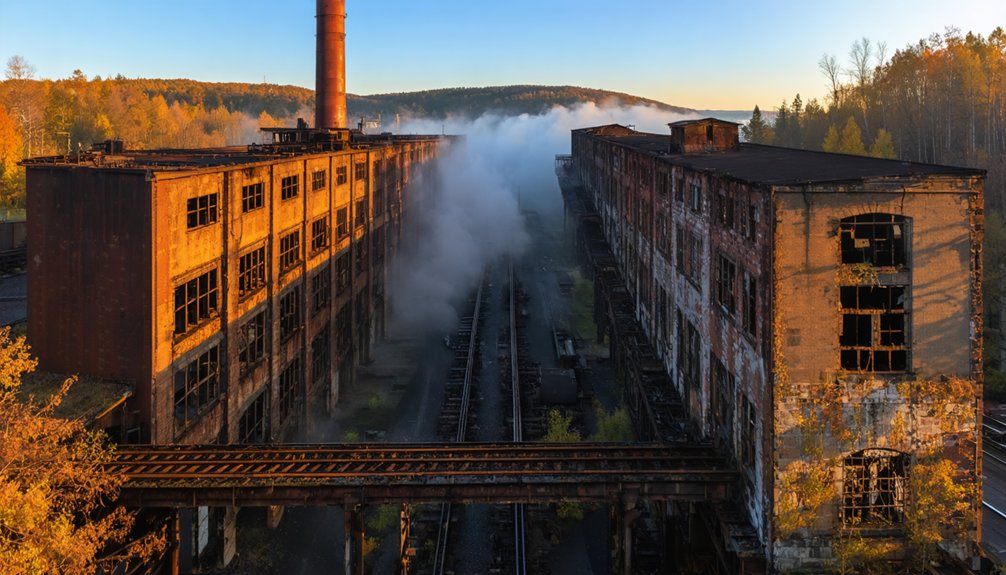
The decaying giants of New York’s industrial past offer drone photographers an unparalleled canvas of architectural complexity and historical depth.
You’ll find prime examples of industrial decay in Amsterdam’s abandoned glove mills, where century-old brick facades and towering smokestacks create compelling linear compositions from above.
For dramatic aerial exploration, head to Buffalo’s Silo City, where massive concrete grain elevators cast bold shadows across the landscape.
Troy and Watervliet’s ironworks present fascinating geometric patterns through their sawtooth roofs and rail sidings, while Beacon’s crumbling hat factories showcase vertical ruins wrapped in reclaiming vegetation.
The riverside power plants, with their massive cooling towers and intake channels, deliver stark industrial textures that’ll transform your drone photography, especially during golden hour when long shadows amplify their architectural details.
Staten Island’s Maritime Graveyards From Above
Maritime ghosts haunt the Arthur Kill waterway, where dozens of deteriorating vessels rest in Staten Island’s most haunting ship graveyard.
You’ll discover abandoned vessels ranging from WWII-era submarines to historic fireboats, each telling a unique story through their decaying hulls. The site’s maritime textures create stunning aerial compositions – from rust-streaked superstructures to skeletal remains emerging from mudflats at low tide.
While the Witte Marine Scrapyard remains private property, you can capture remarkable drone shots from legal vantage points along Arthur Kill Road.
Just remember to follow FAA guidelines and respect site restrictions. For the most dramatic shots, plan your flight during golden hour when the setting sun transforms these industrial relics into silhouettes against the water, revealing patterns and textures that only aerial perspectives can reveal.
Essential Gear and Safety Tips for Abandoned Site Photography

When you’re capturing New York’s abandoned sites from above, you’ll need to protect your drone gear against moisture, debris, and unexpected weather with waterproof cases and silica gel packs.
Your propeller guards become essential safety equipment when maneuvering near unstable structures, while GPS fail-safes help prevent costly crashes if signal interference occurs.
Keep your drone at a safe distance from crumbling walls and rusty maritime equipment, using obstacle avoidance systems and maintaining visual line of sight throughout your flight.
Weatherproof Your Drone Kit
Because abandoned locations often expose your gear to harsh elements, proper weatherproofing becomes crucial for successful drone photography missions.
You’ll need water-resistant backpacks specifically designed to protect your DJI Mini 3 Pro or Mavic Pro during unpredictable weather conditions. Invest in lightweight protective cases that shield your drone while maintaining portability.
For cold-weather operations, focus on battery management. Your drone’s batteries need extra attention when temperatures drop – pack multiple sets and keep them insulated.
Consider how the Mavic Pro performs best in open areas where thermal stability isn’t compromised by dense cover. To maximize your gear’s longevity, implement regular drone maintenance checks and guarantee all equipment stays dry between shoots.
Waterproof storage solutions and proper insulation will keep your kit ready for any ghost town adventure.
Flying Safe Near Ruins
Safe exploration of abandoned sites starts with thorough preparation and proper safety protocols.
When flying your drone near ruins, you’ll need to balance capturing stunning footage while adhering to drone regulations and maintaining equipment integrity. Keep your distance from unstable structures and scout potential hazards before launch.
Deploy your drone as a remote scout to inspect dangerous areas while staying safe. Watch for signal interference from metal structures and plan escape routes if you lose connection.
You’ll want to notify others of your location and bring a companion for backup. Remember to respect preservation guidelines by avoiding direct contact with structures and keeping location details private.
Always maintain visual contact with your drone and listen for unusual sounds that might indicate structural instability nearby.
Seasonal Considerations for Ghost Town Aerial Photography
Although each season offers unique photography opportunities, fall and early spring emerge as prime windows for capturing New York’s ghost towns by drone. These seasonal advantages minimize environmental impacts while maximizing visibility of historic structures through reduced vegetation coverage.
Exploring the best ghost towns in New York can reveal a rich tapestry of history waiting to be discovered. Each town tells a story of its past, complete with abandoned buildings and forgotten roads that speak to a bygone era. Capturing these sites from above offers a unique perspective that showcases both their beauty and their desolation.
In the quest for the best ghost towns in upstate New York, photographers often uncover hidden gems that are steeped in local lore. As the lens captures the intricate details of dilapidated facades and overgrown landscapes, the haunting beauty of these locations becomes evident. Each frame tells a part of the narrative that has shaped the region, inviting a deeper appreciation for its forgotten histories.
- Fall’s leaf drop exposes hidden architectural details and creates clearer flight paths for capturing dramatic ruins.
- Early spring’s pre-leaf period offers crisp light and unobstructed views before summer’s aggressive growth.
- Both seasons provide mild temperatures that optimize battery life and extend flight times.
- Lower vegetation density reduces risks from poison ivy and enables safer low-altitude photography.
Summer’s thick foliage can completely engulf structures, while winter conditions may limit site access.
Always check weather conditions and FAA regulations before launching, staying below 400 feet and avoiding restricted airspace near airports.
Frequently Asked Questions
How Close Can Drones Fly to Active Nesting Birds on Ruins?
You’d love to get that perfect shot, but drone regulations require staying at least 660 feet from nesting birds – it’s actually safest to avoid ruins entirely during nesting seasons.
Which Ghost Town Locations Offer the Best Sunrise Vs Sunset Shots?
You’ll catch dramatic sunrise angles at North Brother Island’s eastern ruins, while Bannerman Castle delivers stunning sunset colors. Hit Doodletown for both, and save Buffalo’s industrial silhouettes for late-day golden light.
Are There Guided Drone Photography Tours of Abandoned New York Sites?
You’ll find several licensed operators offering guided tours of abandoned NY sites, complete with drone instruction, permits, and safety briefings. Book through photography outfitters or Part 107-certified pilots for epic aerial ruins exploration.
What’s the Best Drone Filter Setup for Capturing Detailed Decay Textures?
You’ll want an ND16/PL combo filter for rich textures in shadows, while an ND32 helps capture crisp rust patterns. Pack ND8 for overcast days when detail preservation’s essential.
How Do You Handle Unexpected Security Personnel While Filming Abandoned Properties?
Before you launch, verify filming permits and local regulations. When confronted, stay calm, show credentials, explain your purpose professionally, and be ready to relocate if asked. Don’t argue – preserve your gear.
References
- https://www.6sqft.com/video-drone-footage-shows-rare-views-of-north-brother-islands-abandoned-buildings/
- https://www.whec.com/top-news/photographer-uses-drone-to-shine-light-on-abandoned-historic-buildings-in-rochester-area/
- https://www.timeout.com/newyork/news/these-new-york-photographers-are-capturing-powerful-images-of-the-citys-abandoned-streets-043020
- https://www.untappedcities.com/see-nycs-north-brother-island-from-above-through-dramatic-drone-video/
- https://www.youtube.com/watch?v=IxpKIyNYFW4
- https://www.youtube.com/watch?v=7jYlsRCmnYM
- https://www.scenichudson.org/viewfinder/capturing-great-photography-by-drone/
- https://abjacademy.global/drone-blog/new-york-drone-laws-faa-active-state-laws-city-restrictions-and-pending-bills/
- https://pilotinstitute.com/drones/states/new-york/
- https://uavcoach.com/drone-laws-new-york/