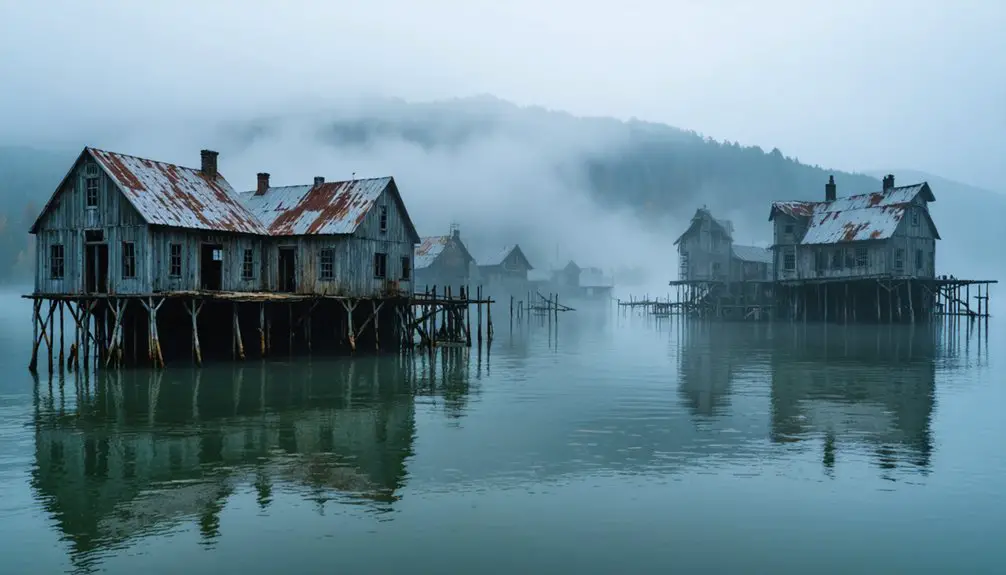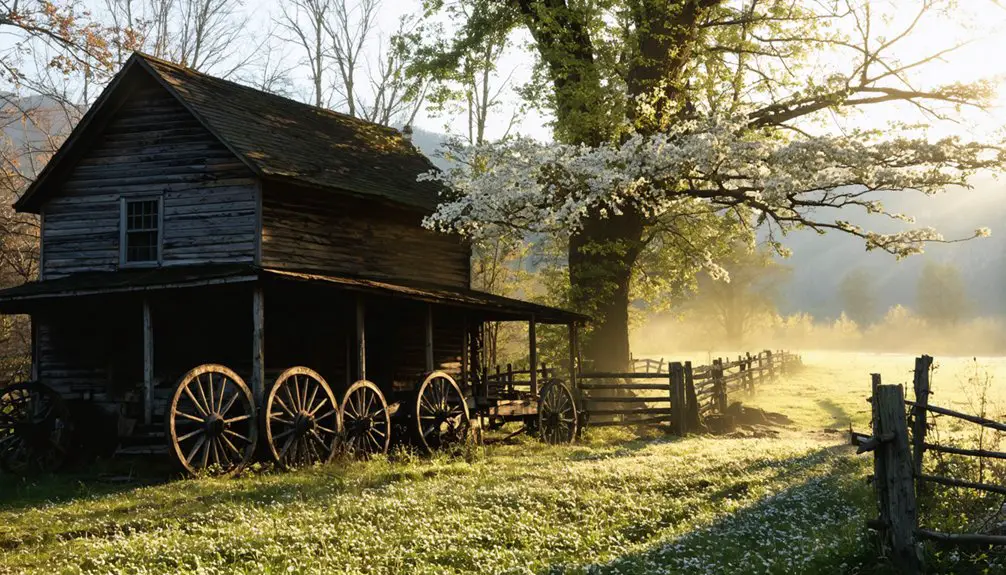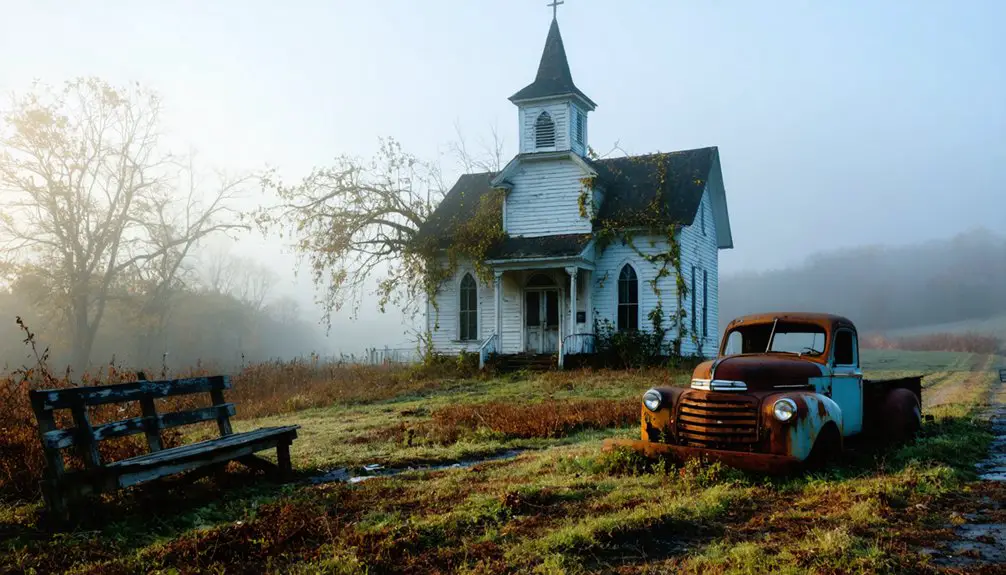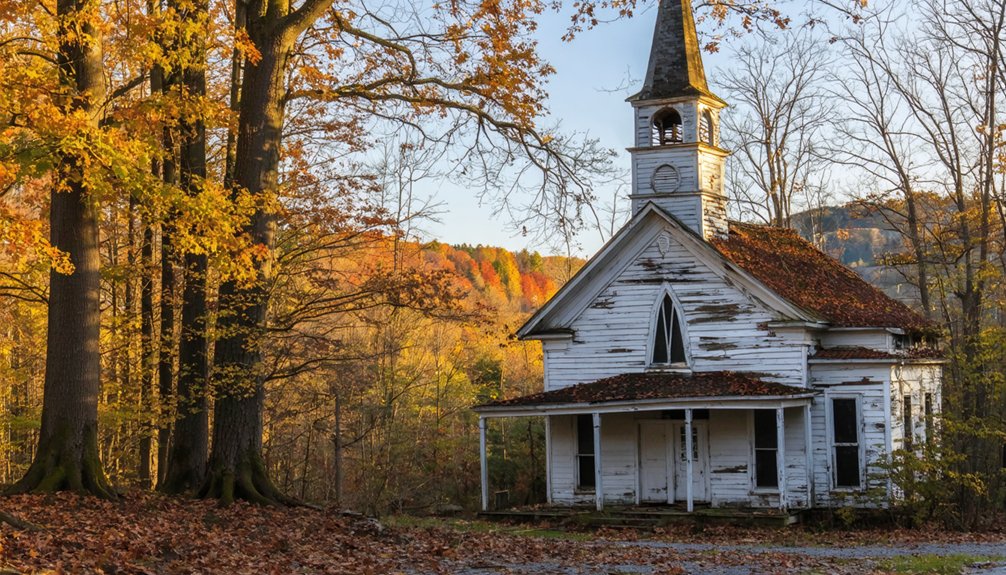
You’ll find Tennessee’s most photogenic ghost towns in Elkmont’s mountain resort ruins, Shakerag’s mining settlement, and Hollow Rock’s rural remains. Each location requires specific permits and adherence to FAA drone regulations, including maintaining 250-foot distances from structures. Pack your DJI Mini 4 Pro or Mavic 2 Pro with polarizing filters for ideal shots, and don’t forget your Part 107 certification for commercial work. Understanding local preservation guidelines and seasonal conditions will reveal these historic sites’ full potential.
Key Takeaways
- Elkmont’s Resort Town Ruins offers exceptional architectural subjects with preserved historic structures, requiring special permits for drone operations.
- Shakerag settlement provides stunning aerial opportunities with stone foundations set against the dramatic Tennessee River Gorge backdrop.
- McFarland’s forest-surrounded remnants in Cherokee National Forest offer seasonal advantages for unique aerial perspectives.
- Hollow Rock features photogenic industrial ruins and architectural remains perfect for dramatic aerial photography.
- Rogersville’s Historic Trade School presents compelling contrasts between abandoned educational structures and surrounding landscapes.
Essential Drone Photography Gear for Ghost Town Exploration
When venturing into ghost towns for drone photography, you’ll need a carefully curated set of equipment that balances portability with professional-grade capabilities.
The DJI Mini 4 Pro‘s ultra-lightweight design and omnidirectional sensing make it ideal for maneuvering tight spaces between abandoned structures, while the Mavic 2 Pro with mounted Lume Cube 2.0 lights excels at dramatic night shots. The DJI Smart Case provides essential charging capabilities for extended shoots in these remote locations. Start your exploration during pre-dawn hours to minimize attention from locals and get the best lighting conditions.
Your drone accessories should include polarizing filters to manage harsh reflections and a power bank for extended shoots.
Pack the Sony A73 for ground-level documentation and the Nikon D810 with its cold-weather performance for dawn missions.
Configure your camera settings to shoot in RAW format, enabling greater control in post-processing.
For stable footage in windy conditions, the DJI Air 3 proves invaluable when capturing Tennessee’s remote ghost towns from above.
Legal Guidelines for Flying Drones in Tennessee Historic Sites
Before launching your drone at Tennessee’s historic sites, you’ll need written permission from the Park Manager if the location falls within state park boundaries.
You must maintain at least 250 feet distance from critical infrastructure and avoid surveillance of private property or individuals, as these actions carry misdemeanor penalties.
Part 107 certification is required for commercial drone photography at historic sites.
For ghost town photography near TVA lands, remember that drone operations are prohibited on developed TVA properties, while undeveloped areas require strict adherence to federal and state regulations. Drone operators must also maintain a 500 foot distance from any designated water surfaces or structures during their flight operations.
Permit Requirements
Operating a drone at Tennessee’s historic sites requires careful navigation of federal, state, and local regulations to guarantee legal compliance.
Before launching your drone, you’ll need to secure your FAA registration for aircraft over 0.55 lb and display the registration number on your drone. For recreational flights, complete the TRUST certification and keep proof with you.
Using apps like B4UFLY or AirMap helps verify airspace classifications and restrictions around historic locations.
With over one million recreational drones now registered nationwide, obtaining proper permits has become increasingly important.
Your permit application must start with the Park Manager’s written permission if you’re flying in state parks or historic sites. You’ll need flight authorization that specifies dates, times, and your credentials.
Don’t forget to check municipal regulations – many cities have specific no-launch zones in historic districts. If you’re planning to capture historic structures, you might need additional permits from local preservation committees.
Restricted Flight Zones
To safely capture Tennessee’s ghost towns by air, you’ll need to navigate a complex web of restricted flight zones across state, local, and federal jurisdictions.
Exploring the best ghost towns in Tennessee offers a glimpse into the past, where history is etched into every crumbling structure and forgotten street. These towns are often steeped in tales of old, inviting adventurers and history buffs alike to uncover their mysteries. As you plan your aerial journey, it’s essential to have a keen eye on the enchanting landscapes and stories that these abandoned places hold.
As you delve into the allure of ghost towns in Tennessee films, you’ll discover how these cinematic portrayals may sometimes romanticize the decay and isolation found in these deserted locations. Each frame captures not just the eerie beauty but also evokes a sense of longing for the vibrant lives once lived. Immersing yourself in this unique cultural representation can enhance your appreciation for the real stories behind these haunted remnants.
Understanding drone regulations before launching your aerial photography mission is essential for avoiding hefty fines and legal issues.
- State parks require written permission from park managers for drone operations, with strict 500-foot buffers around beaches, docks, and piers.
- County-level flight restrictions cover major urban areas like Davidson County’s parks and the Cumberland River banks.
- Federal no-fly zones extend 400 feet over military installations, DOE sites, and designated landmarks – requiring LAANC approval in some cases. The FAA maintains an interactive map online showing all restricted locations for drone pilots to reference.
- Special activity restrictions prohibit drone flights over events with 100+ people, and you can’t interfere with hunting or fishing activities per state law. The Aloft App provides essential pre-flight authorization checks for compliance with local airspace rules.
Capturing Elkmont’s Resort Town Ruins From Above
Although Elkmont’s historic ruins present compelling aerial photography opportunities, drone operators must navigate strict National Park Service regulations when capturing this former resort town from above.
You’ll need special permits to legally photograph Elkmont’s architectural treasures, including the restored Appalachian Clubhouse and 18 other preserved structures that showcase the area’s rich resort-era history.
The remnants of this early 1900s logging settlement offer unique perspectives from overhead – stone chimneys pierce through the forest canopy while foundations trace geometric patterns along Little River and Jakes Creek. When the lifetime leases expired in 1992, these buildings were left to deteriorate in the wilderness. The area played a pivotal role in establishing tourism in the Smokies when open-air observation cars first carried visitors along logging railways in 1909.
To capture these historic elements legally, you’ll need to work through official NPS channels or partner with authorized contractors who hold valid flight permits.
Don’t risk fines or equipment confiscation by attempting unauthorized drone flights within park boundaries.
Port Royal: Aerial Views of Tennessee’s River Settlement
Located along the historic Red River in Tennessee, Port Royal offers drone photographers a compelling blend of cultural significance and scenic opportunity.
You’ll capture Port Royal’s history through aerial compositions of the preserved 18th-century settlement site, where remnants of mill foundations and the Great Western Road create striking visual narratives.
- Position your drone above the exposed historic roadbed to document the 0.18-mile corridor where thousands traveled during the Cherokee encampment of 1838.
- Frame dramatic river-to-structure shots of surviving millrace alignments.
- Capture wide-angle vistas showcasing the contrast between river channels and floodplain textures.
- Utilize low-altitude flights to reveal subtle archaeological features like building foundations and ground depressions.
Remember to coordinate with park management, as this 30-acre site demands sensitivity to both its historical significance and ongoing commemorative events.
Shakerag’s Hidden Stone Foundations Through the Lens
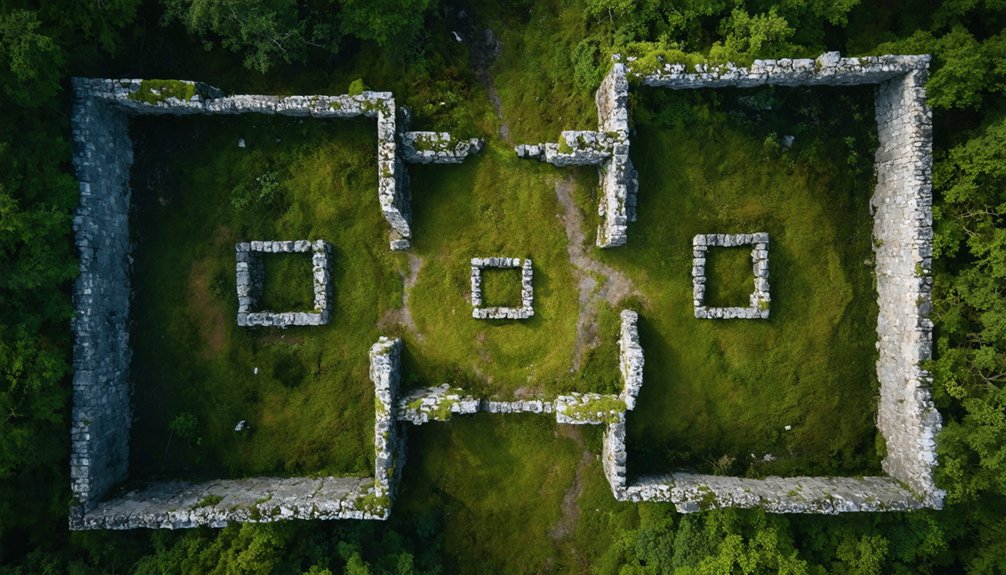
Deep within Tennessee’s Prentice Cooper State Forest, Shakerag’s stone foundations offer drone photographers an exceptional opportunity to document a forgotten 19th-century mining settlement.
You’ll discover the ruins of McNabb Mines’ company town, established in the 1880s, where hidden foundations of the hotel, church, and mining operations emerge through your aerial perspectives.
Launch your drone from accessible points along Mullins Cove Road to capture the dramatic contrast between weathered stone structures and the surrounding forest.
Ascending from the winding path of Mullins Cove, your drone reveals ghostly stone ruins emerging from the verdant wilderness below.
The site’s most compelling feature – a visible trace of the original incline plane – creates striking linear patterns when photographed from above.
With the Tennessee River Gorge as your backdrop, you’ll uncover Shakerag’s architectural footprint against the southern edge of Walden’s Ridge, preserving this abandoned community’s story through your lens.
McFarland’s Forest-Wrapped Remnants by Air
You’ll find prime drone photography opportunities weaving through McFarland’s forest-cloaked ruins, where concrete mixing plants and railroad remnants create stark contrasts against the dense Appalachian canopy.
Your aerial shots can capture the massive three-story concrete structures jutting through the deciduous trees, while following the old L&N railroad path that winds past deteriorating trestles over Turtletown Creek.
The site’s isolation within Cherokee National Forest provides unobstructed flight paths to document both the 1940s TVA-era installations and earlier foundations from the original railway town, now barely visible beneath the encroaching forest.
Isolated Forest Flight Paths
While traversing McFarland’s forest-encased ruins demands careful flight planning, the site’s unique combination of industrial remains and dense canopy creates compelling opportunities for aerial photography.
You’ll need to master isolated flightpaths through mature deciduous forest while maintaining reliable GPS signals for safe forest navigation.
- Utilize natural corridors along creek beds for smooth fly-through shots, but watch for downdrafts in narrow valleys.
- Launch from TVA-era work pads and road pullouts to avoid dense understory interference.
- Plan seasonal flights during leaf-off periods (late fall-early spring) for ideal visibility of concrete structures.
- Follow former railroad beds as linear flight guides, capturing long telephoto passes of scattered industrial remnants.
Consider high-altitude passes above the canopy for overall site documentation, then drop lower through natural openings to capture detailed architectural elements.
Crumbling Walls Through Trees
Through decades of weathering and forest reclamation, McFarland’s cement works have transformed into a photographer’s paradise of stark geometry meets wild growth.
Your drone perspectives will capture massive concrete walls piercing through the canopy, where hardy oaks and maples emerge directly from foundation cracks, creating mesmerizing forest silhouettes against the sky.
You’ll want to time your flights during leaf-off seasons when the ruins reveal themselves most clearly.
Position your drone to catch golden hour light streaming through wall gaps, highlighting moss-draped surfaces and mineral-stained concrete.
The site’s towering gables and exposed interior chambers offer dramatic vertical compositions, while fallen beams create natural leading lines through the trees.
Watch for thermal drafts near the gorge – they’ll affect your flight stability when capturing those low-altitude detail shots.
Ancient Settlement From Above
Hovering your drone above McFarland’s abandoned settlement reveals a compelling tableau of history slowly surrendering to nature.
Through aerial perspectives, you’ll witness how the Cherokee National Forest has reclaimed this railroad-era ghost town, where ancient architecture peeks through dense canopy.
- Navigate your drone along McFarland Road to capture the massive three-story concrete mixing plant that once produced 89,000 tons for TVA projects.
- Track the overgrown W Road switchbacks that showcase the town’s strategic position as a regional hub.
- Follow the still-visible railroad tracks cutting through emerald forest, marking the lifeline that once sustained this community.
- Scout undocumented waterfalls beneath dense foliage while documenting crumbling foundations and spillways that tell tales of industrialization’s retreat.
Hollow Rock: Documenting Rural Decay From Above
Once a thriving railroad hub where four NC&St.L lines intersected, Hollow Rock now stands as a haunting reminder of America’s forgotten railway towns.
You’ll find prime aerial photography opportunities capturing the skeletal remains of its industrial past, from the burned ruins of the Hiram Blow Stave Company to abandoned storefronts that once housed bustling businesses.
Your drone can document the haunting footprint of rural decay where the historic Hollow Rock Roller Mill, cotton gin, and clay mining operations once drove the local economy.
Multiple fires throughout the town’s history have left their mark, creating dramatic architectural ruins perfect for moody black-and-white compositions.
Focus your lens on the abandoned 32-acre tract that hosted revivals, or capture the ghostly remnants of Mrs. Presson’s Hotel against the backdrop of Tennessee’s countryside.
Rogersville’s Historic Trade School From a Bird’s Eye View
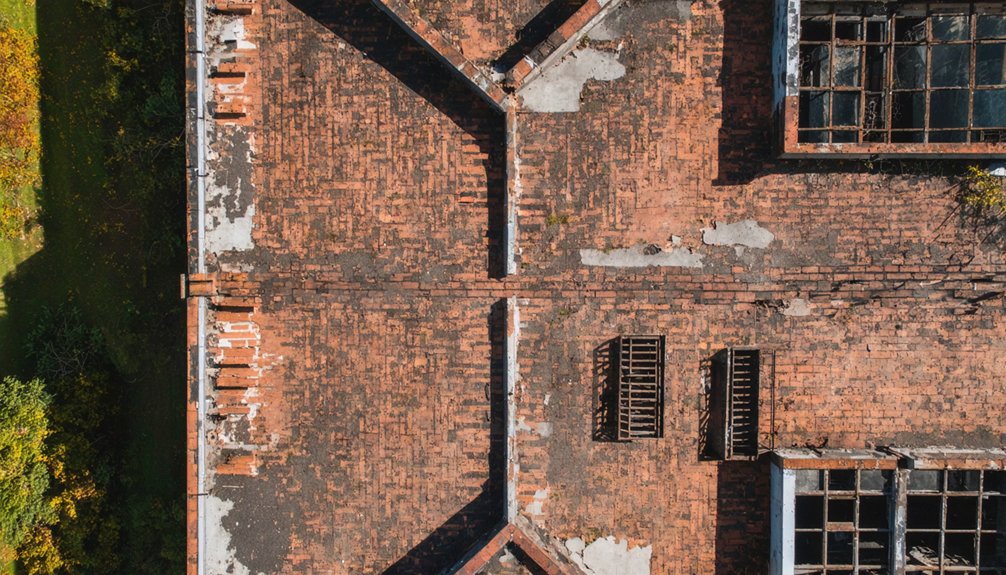
As your drone soars above Rogersville’s historic educational complex, you’ll discover the architectural legacy of Tennessee’s second-oldest town where the Odd Fellows College for Women first took root in 1849.
The aerial perspectives reveal layers of educational history, from the original Synodical College to today’s PreK-8 campus.
- Capture the geometric foundations of the 1929 structure, built after a devastating fire destroyed the original Rogersville College.
- Track the preserved outlines of the historic East and West wings, added in 1853.
- Survey the 52-acre grounds that shifted from private to public ownership in 1919.
- Document the architectural contrast between the abandoned college elements and the active school facilities, showcasing the site’s evolution from prestigious women’s college to modern educational center.
Best Times and Seasons for Ghost Town Drone Photography
When planning your ghost town drone photography expeditions in Tennessee, timing becomes the critical factor that can transform ordinary ruins into extraordinary visual stories. For ideal drone timing, launch during golden hours between 6-8 AM or 5-7 PM, when long shadows accentuate architectural details and textures.
Seasonal patterns reveal mid-October through early November as prime time for capturing Elkmont’s haunting beauty amid peak fall colors.
Winter’s January snowfalls create striking contrasts across abandoned structures, while March through May offers wildflower-dotted foregrounds with unobstructed views. You’ll find clearest visibility during April’s reduced pollen haze and November’s post-leaf drop.
Avoid summer’s restrictive crowds and harsh midday light. For unrestricted access, target weekday mornings before 9 AM, especially during off-season months when ranger patrols are minimal.
Tips for Preserving Tennessee’s Abandoned Places While Filming
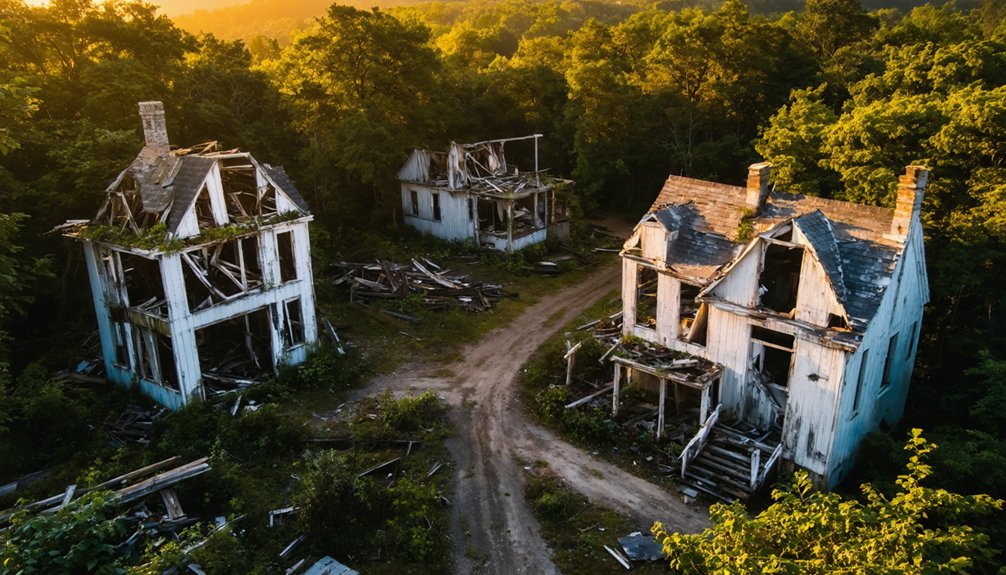
While Tennessee’s ghost towns offer incredible drone photography opportunities, preserving these historic sites requires strict adherence to legal and ethical guidelines.
Ethical considerations extend beyond just getting great footage – they’re about protecting our heritage for future generations. When capturing these haunting locations, follow these preservation techniques:
- Secure written permission from landowners and historical societies before accessing sites, and carry documentation during your shoot.
- Keep your drone at safe distances from unstable structures and implement geofencing to prevent accidental contact with historic buildings.
- Never move or disturb artifacts, and use remote aerial capture instead of entering unsafe structures.
- Document and blur any private property details in published footage, while maintaining detailed logs of your flight plans and permissions.
Frequently Asked Questions
Are There Dangerous Wildlife Encounters When Filming Ghost Towns in Tennessee?
You’ll need serious wildlife safety awareness – bears, rattlesnakes, coyotes, and deer pose real threats. Take filming precautions like avoiding dawn/dusk shoots and maintaining constant situational awareness during your explorations.
How Do You Locate Exact GPS Coordinates for These Abandoned Sites?
You’ll pinpoint exact locations using Google Earth’s GPS Tools for historical satellite views, while specialized Mapping Apps like Pastmaps.com reveal coordinates through seasonal imagery and topographical overlays.
Can You Camp Overnight at These Ghost Town Locations?
You’ll need permits or landowner permission as camping regulations vary by site. Most ghost towns prohibit overnight stays due to safety concerns and resource protection, especially in state/federal managed areas.
Which Ghost Towns Have Cellular Service for Drone Controller Connectivity?
You’ll find reliable cell tower locations near Elkmont and Port Royal, while McFarland and Shakerag may present connectivity issues due to their remote forest settings. Pack a signal booster for backup.
Are Special Permits Required for Commercial Drone Footage of Ghost Towns?
You’ll need specific permits for commercial drone filming – Part 107 certification is required, plus location-specific permits from NPS, USFS, or state agencies depending on which ghost town you’re targeting.
References
- https://www.tnmagazine.org/19-ghost-towns-in-tennessee-that-are-not-underwater/
- https://www.atlasobscura.com/places/elkmont-historic-district
- https://www.rvtravel.com/fort-loudoun-tennessee-historic-site-worth-visit-1150/
- https://www.youtube.com/watch?v=662VXJOgqhM
- https://www.thesmokies.com/abandoned-places-in-the-smoky-mountains/
- https://www.youtube.com/watch?v=pyK41tkr5AE
- https://www.youtube.com/watch?v=qx1zzHpSbyQ
- https://www.youtube.com/watch?v=bLTh_gLI1ro
- https://www.youtube.com/watch?v=P5raE760IZo
- https://www.youtube.com/watch?v=1Vd4pkusiwc