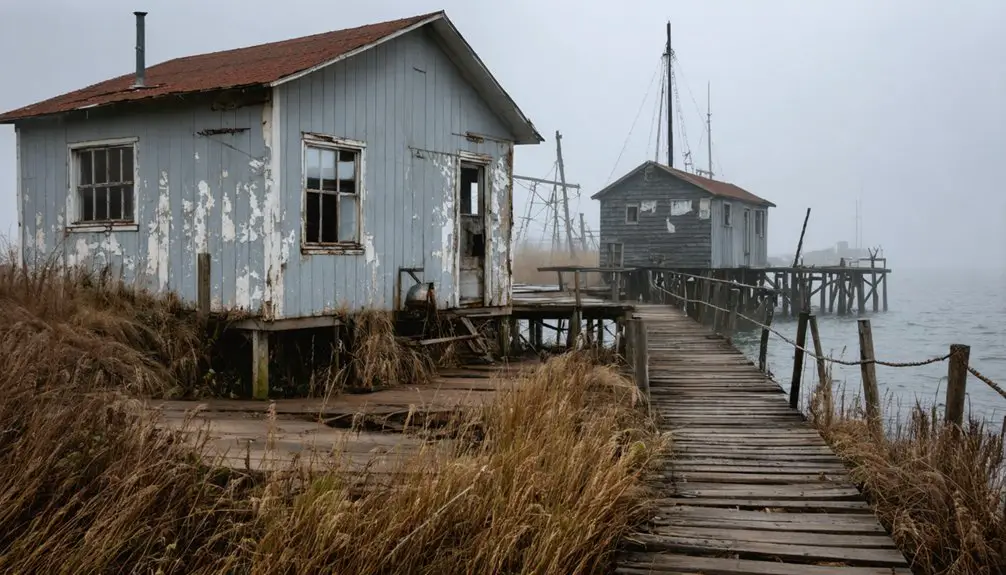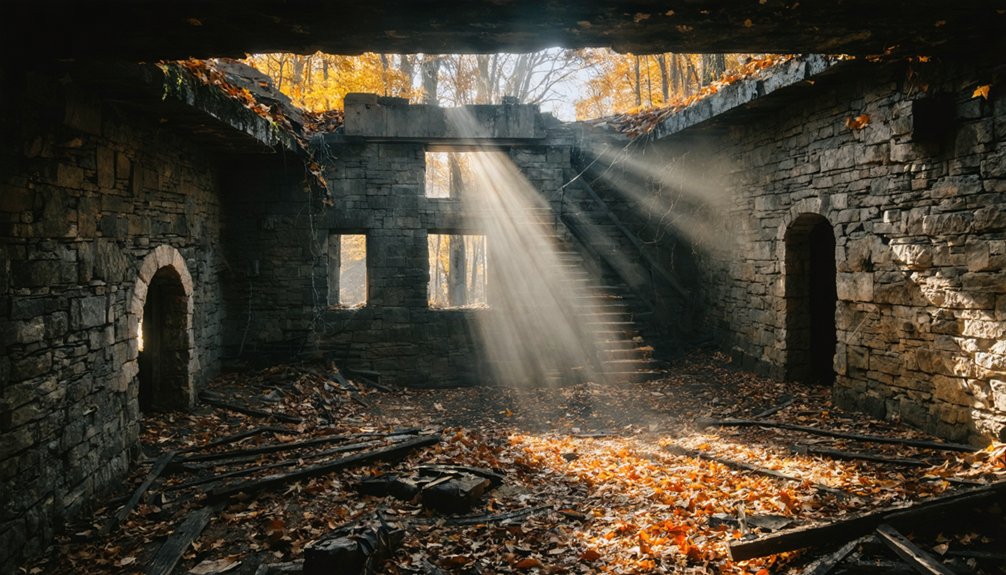
You’ll find exceptional drone photography opportunities at Wisconsin’s ghost towns like Krakow, Gillett, and Imalone, where abandoned churches and industrial ruins create compelling aerial compositions. These sites blend seamlessly with diverse landscapes of forests, farmland, and river valleys while offering clear takeoff zones. Launch during golden hour for ideal lighting, and always verify FAA regulations and property permissions before flying. The seasonal changes across these historic locations reveal hidden photographic treasures waiting to be discovered.
Key Takeaways
- Krakow offers excellent drone photography opportunities with its abandoned churches and symmetrical architectural features for compelling aerial compositions.
- The Krakow-Gillett corridor provides diverse seasonal shots, from snow-covered ruins in winter to lush vegetation in summer.
- Imalone’s riverside location creates unique photography possibilities with water reflections and historical structures against natural backdrops.
- Gillett’s industrial remnants present textural opportunities for drone photography, especially during golden hour lighting conditions.
- Baraboo area ghost towns feature vintage structures amid spring blooms, creating striking aerial contrast between nature and abandonment.
What Makes Wisconsin Ghost Towns Perfect for Aerial Photography
While many abandoned settlements across America offer intriguing subjects for drone photography, Wisconsin’s ghost towns present a uniquely compelling mix of attributes that make them ideal for aerial imaging.
You’ll find dramatic landscape diversity within short distances, where forests, farmland, and river valleys create multiple compositional opportunities from a single launch point.
The state’s ghost town narratives come alive through aerial perspectives that reveal historic site footprints, from town squares to single-main-street layouts. Many locations overlap with ancient effigy mound sites, offering photographers rare glimpses of both recent and prehistoric abandonments.
Seasonal conditions enhance your creative possibilities – winter’s leaf-off period exposes hidden foundations, while autumn colors provide striking contrasts.
Nature’s shifting canvas reveals ghost towns differently each season, from winter’s exposed ruins to fall’s vibrant aerial backdrops.
You’ll benefit from the surrounding agricultural fields that offer clear takeoff zones and unobstructed views.
Plus, with many sites situated near public lands and rural roads, you’ll have reliable access for your drone operations.
In Imalone, photographers can capture the haunting remains of concrete foundations and abandoned structures that tell the story of a once-thriving community.
Essential Drone Equipment and Regulations for Ghost Town Shoots
Before launching your drone at Wisconsin ghost towns, you’ll need to navigate a complex web of regulations and equipment requirements.
Start by obtaining your FAA Part 107 certification for commercial shoots or TRUST certification for hobby flights. You’ll also need to register any drone over 0.55 pounds with the FAA. The state requires proper photo consent when capturing any private spaces.
Your essential gear should include a quadcopter with a stabilized gimbal and RAW-capable camera featuring at least a 1-inch sensor.
Pack multiple batteries, ND filters, and a reliable controller with smartphone mount. Don’t forget your portable landing pad and basic toolkit for remote operations. Operating a drone while under the influence of alcohol is strictly prohibited in Wisconsin.
Remember to check local ordinances, obtain necessary permissions, and verify airspace classifications before each flight.
Wisconsin’s privacy laws strictly prohibit drone photography where people have a reasonable expectation of privacy.
Top Ghost Town Locations and Their Signature Shots
Several abandoned settlements across Wisconsin offer exceptional drone photography opportunities, each with distinct visual signatures and technical challenges. The haunting remains of abandoned churches in Krakow provide perfect symmetrical compositions when shot from above, while Gillett’s decaying industrial remains offer compelling texture studies through close-range hover sequences.
- Krakow’s cemetery and church ruins demand late-afternoon flights to capture long shadows across weathered gravestones.
- Gillett’s warehouse district yields dramatic rust patterns and structural exposures through strategic overhead positioning.
- Imalone’s riverside ruins create unique compositions by incorporating Chippewa River reflections.
- The Krakow-Gillett corridor enables dramatic seasonal comparison shots, from snow-covered winter scenes to summer overgrowth.
Access each location through designated public launch points, keeping safety corridors and property boundaries in mind while capturing these atmospheric sites.
Seasonal Considerations for Wisconsin Ghost Town Photography
You’ll find that winter’s stark lighting and snow cover create dramatic aerial contrasts in Wisconsin’s ghost towns, especially during the shortened daylight hours from December through February.
Spring near Circus World Museum in Baraboo provides unique opportunities to capture vintage structures against blooming landscapes.
When shooting in winter conditions, plan your drone flights between 10 AM and 2 PM to maximize the low-angle sunlight that casts long shadows across snow-covered ruins and foundations.
To capture peak fall colors that frame abandoned structures, schedule your visits between late September and mid-October, when Door County’s maple and oak trees transform into vibrant reds and golds before shedding their leaves to reveal hidden architectural details.
Winter Light and Snow
Wisconsin’s ghost towns transform into striking photographic subjects during winter months, when low-angle sunlight and snow coverage create ideal conditions for drone photography.
Winter shadows stretch dramatically across snow-covered foundations, while snow reflections illuminate normally dark interior spaces of abandoned structures. The village of Almond, with its living ghost town appearance, offers particularly haunting winter compositions. Many buildings show cracked foundations and water damage from past flooding incidents.
- Launch your drone between 8-10 AM to capture golden hour light on sites like Imalone, where 6-12 inches of snow creates pristine white canvases.
- Utilize twilight’s blue hour (4-6 PM) for ethereal effects on northern ruins.
- Plan flights for late December when post-solstice angles maximize dramatic backlighting.
- Pre-heat your drone for 30 minutes before flying in sub-zero temperatures, as battery life reduces to 10-15 minutes in extreme cold.
Remember to adjust altitude for snow drifts and use polarized filters during whiteout conditions to maintain visibility of architectural details.
Fall Color Timing Tips
While winter offers stark beauty, autumn brings a fleeting spectacle of color that demands precise timing for ghost town drone photography.
You’ll find northern Wisconsin’s ghost towns peak first, typically around October 7th, though 2025’s timeline shifts about a week later. Plan your expeditions to capture the vibrant reds and yellows when fall foliage reaches maximum intensity.
Track seasonal changes through Travel Wisconsin’s Fall Color Report to optimize your timing. Shorter days trigger the leaves to begin their color transformation.
Northern sites near Lake Superior, including Chequamegon-Nicolet locations, transform earliest, while southern ghost towns near Kettle Moraine offer extended shooting opportunities into late October. Consider exploring popular destinations like Peninsula State Park for stunning aerial compositions.
Moist conditions in 2025 should intensify color saturation, but warm temperatures might mute vibrancy. Monitor weather patterns closely – excess wind or rain can trigger premature leaf drop, cutting your shooting window short.
Planning Your Ghost Town Drone Flight Path
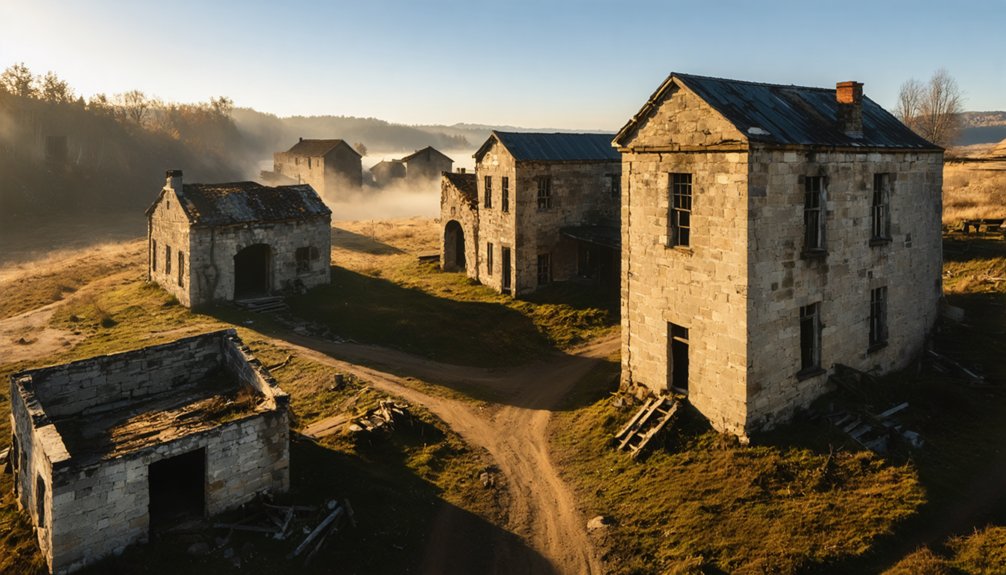
You’ll need to physically scout your access points before flight day to identify safe launch zones and potential obstacles that aren’t visible in satellite imagery.
When evaluating seasonal weather patterns, monitor wind speeds at various altitudes and plan your flight paths to account for crosswinds around structures and tree lines. Watch for Lake Michigan winds when filming near Ulao’s historic port remains.
Your final flight boundaries should respect both legal restrictions and physical barriers, maintaining safe distances from deteriorating buildings while still capturing compelling architectural angles.
Scout Access Points First
Before launching your drone at any ghost town site, thorough access point scouting becomes essential for both legal compliance and ideal flight operations.
Access point logistics require identifying safe launch zones away from deteriorating structures while maintaining visual line-of-sight throughout your flight path. You’ll need to secure property owner permissions and verify you’re operating from public right-of-way or explicitly permitted areas.
- Map multiple landing zones at least 50 feet from structures, prioritizing cleared areas with solid ground conditions.
- Identify your vehicle staging location and secure equipment setup area away from trespass-prone zones.
- Document entry points and property boundaries using county parcel maps to avoid inadvertent trespassing.
- Prepare contingency landing sites in case your primary location becomes unusable due to unexpected obstacles or enforcement.
Weather Impact Assessment
Since weather conditions directly impact drone flight safety and image quality at ghost town sites, careful assessment of meteorological factors becomes critical for mission planning.
You’ll need to track both regional patterns and localized effects that can challenge drone operations.
Watch for prevailing northwest winter winds that create dangerous gusts on exposed ridgelines, and monitor lake-effect breezes near Green Bay that affect hover stability.
Temperature extremes considerably impact battery performance – cold weather can slash flight time by 40%, while summer heat risks thermal throttling.
For ideal image capture, time your flights during golden hour when long shadows dramatize abandoned structures, but be prepared for rapidly changing light conditions.
Always check weather forecasting for precipitation probability and visibility levels before launching, maintaining drone safety standards in these remote locations.
Legal Flight Boundaries
Maneuvering the complex web of drone regulations requires careful attention to both federal and Wisconsin state requirements when photographing ghost towns.
You’ll need to secure proper flight permissions and address privacy concerns before launching your drone at these historic sites.
- Stay below 400 feet AGL and maintain visual line-of-sight unless you’ve obtained specific FAA waivers.
- Check if your intended ghost town lies within controlled airspace (Class B/C/D/E) and obtain LAANC authorization if needed.
- Respect Wisconsin’s 100-foot distance requirement from people and 500-foot buffer from public gatherings.
- Get landowner permission for launch/landing sites, as many ghost towns sit on private property.
Remember that abandoned structures still carry privacy protections, and you’ll need a Remote Pilot Certificate if you’re planning to monetize your ghost town photography.
Capturing Historic Ruins Through the Drone Lens
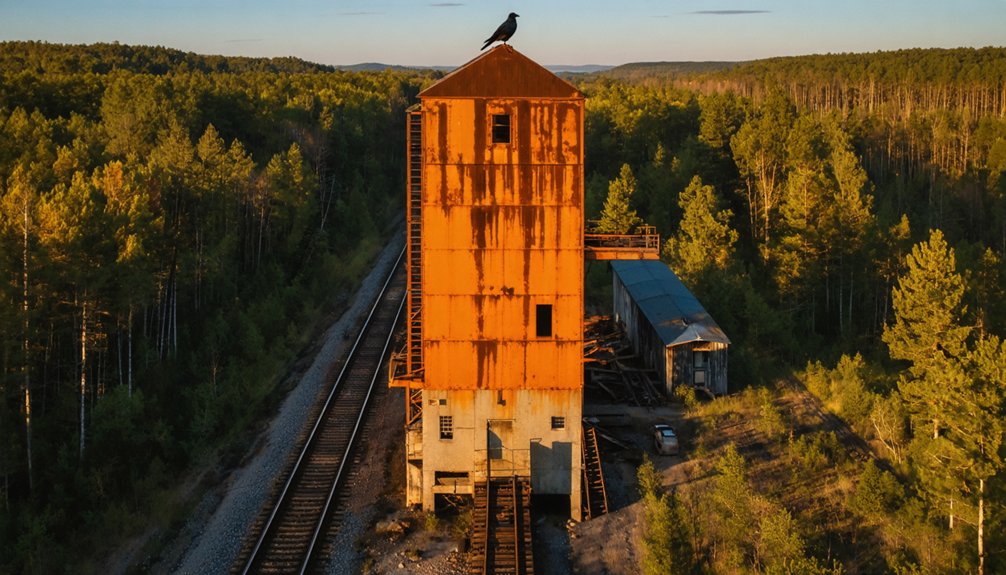
Through Wisconsin’s scattered ghost towns, drone photography reveals hidden historical narratives that ground-level shots can’t capture.
You’ll discover prime opportunities at Clifton’s limestone quarries, where your drone can frame deteriorating structures against dramatic cliff faces and autumn foliage.
At Imalone, aerial perspectives expose forgotten Bible camp foundations along the Chippewa River, while Krakow’s rural ruins offer compelling compositions of isolation and decay.
For ideal drone techniques, position your camera to highlight the contrast between nature and abandonment.
Capture Almond’s empty storefronts and vintage light poles from above to emphasize its living ghost town atmosphere.
Understanding the historical context of these sites – from mining operations to bypassed railroad towns – will help you craft more meaningful aerial compositions that document Wisconsin’s vanishing past.
Tips for Blending Nature and Decay in Aerial Compositions
When capturing ghost towns from above, mastering the interplay between natural elements and abandoned structures creates compelling visual narratives. You’ll want to focus on contrasting textures between weathered buildings and surrounding vegetation, while utilizing color complements like rust against green foliage to make your subjects stand out dramatically.
- Position decaying structures at third-line intersections while letting nature fill the remaining frame for balanced compositions.
- Take advantage of golden hour lighting to emphasize textural details on crumbling surfaces.
- Create depth by layering natural elements in foreground, ruins in midground, and landscape features in background.
- Use high-angle shots to reveal how abandoned structures integrate with surrounding field patterns and tree lines.
Remember to plan your flights around ideal sun angles and consider seasonal timing to maximize the visual impact of nature reclaiming these forgotten places.
Frequently Asked Questions
Are Any Ghost Towns Actively Patrolled or Restricted to Drone Photography?
Among 200+ ghost towns in Wisconsin, you’ll find no active monitoring or restricted areas at Fort Howard, Fort Crawford, Dover, or Cooksville. You’re free to explore and capture aerial shots.
For those looking for the best ghost towns for photography, each of these locations offers unique structures and landscapes that tell a story. The decaying buildings and overgrown paths create stunning backdrops for photographers seeking to capture the essence of abandonment. Make sure to bring your camera and take your time to find the perfect shot in these forgotten places.
Exploring ghost towns in Wisconsin films can also inspire your own creative projects. The haunting visuals and eerie atmosphere found in these abandoned spaces often serve as the perfect setting for storytelling. Whether you’re a filmmaker or simply a lover of intriguing landscapes, these towns provide an abundance of inspiration.
What Wildlife Hazards Should Drone Operators Watch for at These Sites?
You’ll need to watch for territorial raptors, swarming wasps, and den-dwelling mammals. Stay alert for wildlife encounters during dawn/dusk flights, and maintain safe distances from nests and roosts for safety precautions.
Do Any Locations Require Special Permits Beyond Standard Drone Certification?
You’ll need way more than just your Part 107 certification. State parks demand specific permits, private property requires owner permission, and historic sites need preservation office approvals before launching your drone.
Can These Ghost Towns Be Photographed at Night With Drone Lights?
You’ll need FAA-compliant anti-collision lights visible for 3 miles when photographing these sites at night. Set up your drone light system carefully and maintain visual line-of-sight during all nighttime operations.
Which Ghost Town Sites Have the Strongest Cellular Signals for Drone Controls?
You’ll find strongest cell signal strength near abandoned sites close to Tomahawk, Rhinelander, or along US-2/US-8 corridors. For reliable drone control, stick within 2-4 miles of towers on elevated terrain.
References
- https://www.onlyinyourstate.com/experiences/wisconsin/ghost-towns-wi
- http://shunpikingtoheaven.blogspot.com/2016/05/a-wisconsin-ghost-town.html
- https://www.youtube.com/watch?v=JoMbh1o5Q30
- https://www.youtube.com/watch?v=hyvSTpgwddA
- https://www.youtube.com/watch?v=iYxTJVluKbA
- https://pbswisconsin.org/video-stub-for-wisconsin-s-famous-effigy-mounds/
- https://recollectionwisconsin.org/collections/the-changing-landscapes-of-wisconsin-a-digital-archive-of-historic-aerial-photographs
- https://www.milwaukeemag.com/local-photographer-captured-quiet-beauty-wisconsin-winter/
- https://www.onlyinyourstate.com/experiences/wisconsin/first-captol-ghost-town-wi
- https://uavcoach.com/drone-laws-wisconsin/