Alabama’s most intriguing ghost towns include Old Cahawba, the state’s first capital, and Historic Bellefonte, where a solitary chimney stands sentinel over centuries of history. You’ll find well-preserved Civil War earthworks at Blakeley State Park, while St. Stephens offers archaeological treasures from Spanish, French, and early American periods. These abandoned settlements have survived yellow fever epidemics, economic decline, and wartime destruction. Each site holds deeper stories within their weathered ruins.
Key Takeaways
- Old Cahawba, Alabama’s first state capital, offers extensive ruins and archaeological sites within a preserved park setting accessible to visitors.
- Historic Blakeley State Park features Civil War earthworks and cemetery remnants within the largest National Register site east of Mississippi.
- Bellefonte’s ruins showcase a solitary chimney and historic cemetery, telling the story of a once-thriving county seat destroyed by war.
- St. Stephens Historical Park preserves Alabama Territory’s first capital, featuring archaeological sites from Spanish, French, and early American periods.
- Claiborne retains abandoned homes and merchant shops from its prosperous river port days, marking the impact of yellow fever epidemics.
The Rise and Fall of Old Cahawba
While prehistoric Indians first settled the area over 4,000 years ago, Old Cahawba‘s journey as Alabama’s first state capital began in 1819 when surveyors Willis Roberts and Benjamin Clements laid out the town’s distinctive grid pattern for $730.
Cahawba’s significance grew rapidly as it transformed from a frontier capital into a thriving cotton distribution center. Historic landmarks included a brick Capitol building and the bustling port where steamboats carried cotton to Mobile.
You’ll find evidence of the town’s prosperity in its peak population of over 3,000 by 1860, making Dallas County Alabama’s wealthiest. However, the Civil War brought dramatic changes, with the cotton warehouse becoming Castle Morgan prison. Wealthy planters constructed grand two-story mansions throughout the town during this prosperous period.
Following a devastating 1865 flood and the county seat’s relocation to Selma, residents abandoned the town. After the war, the area attracted emancipated African Americans seeking new opportunities. Today, Old Cahawba Archaeological Park preserves these remnants of Alabama’s first capital.
Exploring Historic Bellefonte’s Ruins
When you visit Bellefonte’s ruins, you’ll discover the remains of what was once Jackson County’s first seat of government, established in 1821 with a population of 200 residents.
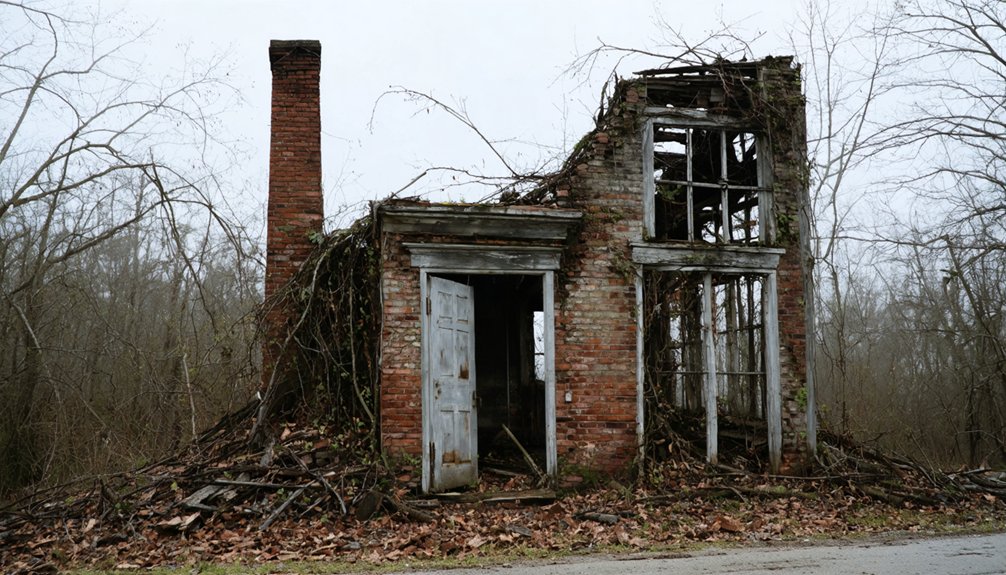
Today, only a solitary chimney from a former inn and the historic cemetery with graves dating to 1826 remain as visible reminders of this once-thriving town. The cemetery contains 229 grave plots based on a survey conducted in 1936. Located two miles southeast of Hollywood, Alabama, the town site is easily accessible for history enthusiasts.
The site’s dramatic decline began during the Civil War when Union forces inflicted severe damage, followed by the town’s fateful decision to reject a railroad connection, which ultimately sealed its fate as one of Alabama’s most significant ghost towns.
Early County Seat History
Shortly after Alabama achieved statehood, the newly formed Jackson County established its first temporary seat at Sauta Cave in December 1819.
As settlers flocked to the region, you’ll find that Bellefonte quickly emerged as a promising location for permanent governance. By 1821, the legislature incorporated the town and appointed commissioners to select it as the temporary seat of justice.
The town’s early governance structure included an intendant and five councillors, elected annually by the people. Dr. George Washington Higgins and Stephen Carter donated land for the county seat, securing Bellefonte’s position through a 100-year contract. A penal bond agreement for $13,000 between James Riley and the donors helped facilitate the town’s founding and initial surveying. Elections were managed by a justice of peace and householders who oversaw the voting process.
The town served as Jackson County’s seat from 1821 until voters approved its relocation to Scottsboro in 1860, marking the beginning of Bellefonte’s gradual decline.
Last Standing Structures
Despite nearly two centuries of abandonment, several haunting remnants of Bellefonte’s once-thriving community still dot the landscape today.
You’ll find the town’s historic cemetery perched strategically on high ground, its weathered gravestones dating back to 1826 bearing evidence to the area’s historical significance. The cemetery, listed on Alabama’s Historic Cemetery Register since 2006, stands as a silent guardian of local history despite years of natural decay and vandalism. By 1844, the town reached its peak with 400 residents living in the area.
Before its decline, the town served as the Jackson County seat until 1868.
A solitary inn chimney rises from the forest floor, surrounded by scattered brick foundations that mark where homes and businesses once stood.
These ruins, located just two miles southeast of Hollywood off County Road 33, offer glimpses into Bellefonte’s past. Local cemetery hauntings and unexplained phenomena have only added to the site’s mystique, drawing history enthusiasts and paranormal investigators alike.
Civil War’s Fatal Impact
The Federal Army’s devastating sweep through Bellefonte during the Civil War marked the beginning of the town’s irreversible decline. Under General John A. Logan’s command, the 34th Illinois Volunteer Regiment burned the courthouse, destroying essential records dating back to 1852. The two-story brick courthouse had stood proudly since 1828 before its destruction.
You can still sense the weight of this destruction when visiting the site today.
The economic ruin that followed proved insurmountable for Bellefonte’s residents:
- Federal troops confiscated resources without compensation to rebel owners
- The courthouse’s destruction eliminated critical land and marriage records
- Business owners and residents abandoned their properties, leading to a mass exodus
The town’s post office closed in 1894, signaling the final chapter in Bellefonte’s transformation from a thriving community into a ghost town.
Arcola: A Lost French Settlement
After Napoleon’s fall in 1815, a group of French Bonapartists fled the Bourbon Restoration and sought asylum in America, ultimately establishing the settlement of Arcola in Alabama Territory.
These French refugees received a congressional land grant of four townships, arriving at the Tombigbee River in 1817. They named their settlement after Napoleon’s victory at the Battle of Arcole.
Despite their hopes, the settlers faced significant agricultural struggles. You’ll find it ironic that their mandated cultivation of grape vines and olive trees failed due to Alabama’s unsuitable climate and their lack of farming expertise.
By the 1830s, most colonists had abandoned their dreams, relocating to New Orleans, Mobile, or returning to France.
Today, all that remains of Arcola’s French heritage is the land where the Arcola Plantation later stood, a memorial to these freedom-seeking settlers’ bold experiment.
Battle-Scarred Blakeley
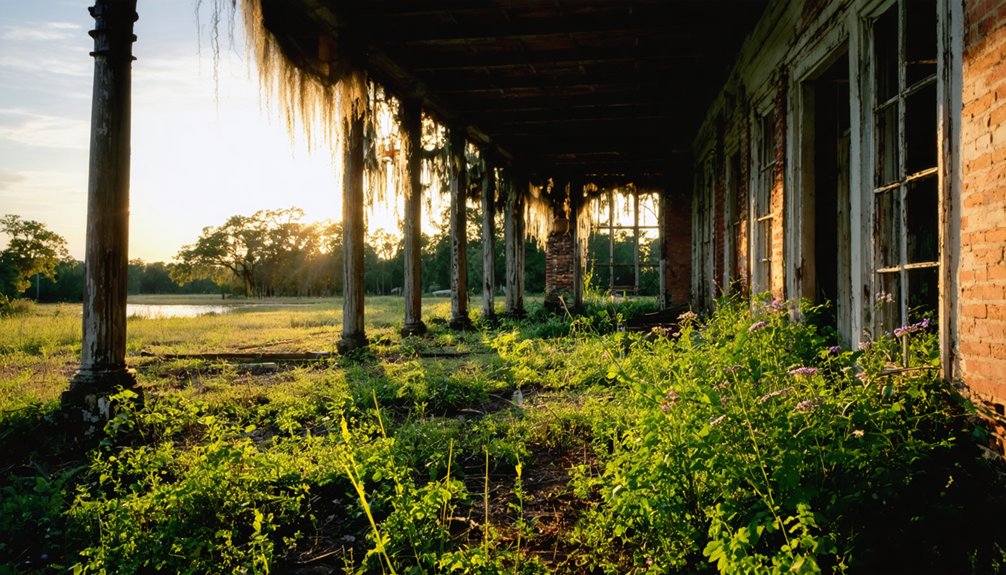
While French settlers abandoned their dreams at Arcola, another ambitious settlement met a different fate along Alabama’s coast. Founded in 1814 by Josiah Blakeley, the town quickly grew to outpace Mobile’s population, becoming a promising commercial hub.
Yet by the 1840s, devastating yellow fever epidemics had transformed this bustling port into a ghost town, leaving only traces of its former glory.
Disease swept through this once-thriving port like a vengeful tide, leaving behind only echoes of prosperity.
- Crumbling foundations of the courthouse and jail stand sentinel among ancient oaks, whispering tales of Blakeley’s history
- Civil War earthworks remain perfectly preserved, marking one of the conflict’s final battles in 1865
- Mass graves in the old cemetery bear silent witness to the yellow fever’s toll
Today, you’ll find these remnants protected within Historic Blakeley State Park, America’s largest National Register site east of the Mississippi.
Prairie Bluff’s River Legacy
Perched dramatically on a limestone bluff overlooking the Alabama River, Prairie Bluff once stood as an essential commercial hub between the historic settlements of Cahaba and St. Stephens.
You’ll find this ghost town‘s geological significance in its Prairie Bluff Chalk formation, reaching depths of 110 feet and preserving invaluable Cretaceous fossils.
At its peak in 1861, the town’s river trade flourished with a massive cotton slide facilitating cargo transport to waiting vessels below.
You can still access the site via Prairie Bluff Landing near Shell Creek, though you’ll find little remains except an old cemetery.
The town’s decline came swiftly after the Civil War, as railroads diverted commerce elsewhere.
St. Stephens: From Territorial Capital to Ghost Town
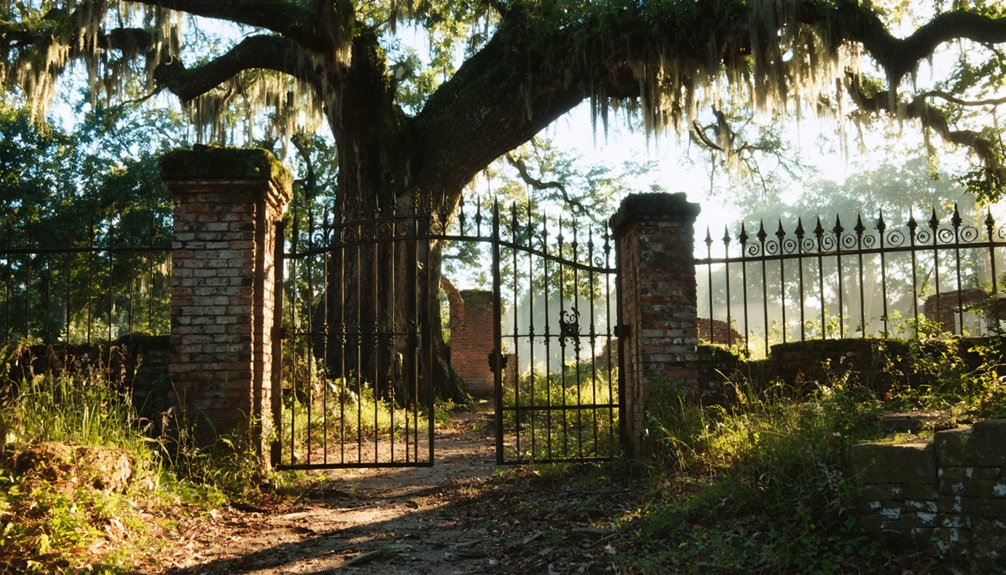
Deep in Alabama’s wilderness, a Spanish fort and trading post established atop a limestone bluff in the late 18th century would become St. Stephens, Alabama Territory’s first capital.
As a critical economic hub along the Tombigbee River, you’ll find the remnants of a once-thriving settlement that played a pivotal role in territorial governance from 1817 to 1819.
Before falling victim to yellow fever outbreaks and changing transportation routes, St. Stephens was the region’s commercial powerhouse.
- Stand where the territorial legislature once convened at Douglass Hotel, making decisions that shaped Alabama’s future
- Explore archaeological sites revealing daily life from the Spanish, French, and early American periods
- Visit the bluff overlook where merchants once watched their cargo float down the Tombigbee River
Today, St. Stephens Historical Park preserves this monument to Alabama’s frontier heritage.
Claiborne’s Yellow Fever Exodus
If you’re exploring Alabama’s most dramatic ghost town transformations, Claiborne’s decline following the 1853 yellow fever epidemic stands as a defining moment.
You’ll find evidence of how the outbreak devastated the once-prosperous river port, claiming numerous lives and prompting a mass exodus of surviving residents and merchants.
The epidemic, combined with declining river trade, transformed this former commercial hub from a bustling town of several thousand into an abandoned settlement whose ruins you can still discover today.
Devastating 1853 Outbreak Impact
Terror gripped Claiborne during the devastating yellow fever outbreak of 1853, sparking a mass exodus that would accelerate the town’s path toward abandonment.
As the epidemic spread northward from Mobile along the Alabama River, social panic took hold when residents learned of the staggering death toll in coastal areas.
You’ll find that Claiborne’s position as a river town made it particularly vulnerable as refugees fled inland, inadvertently carrying the disease with them.
- Abandoned homes stood silent along the once-bustling streets, their windows dark and shuttered against the summer heat.
- Empty merchant shops and warehouses lined the riverfront, their goods hastily packed away.
- The town’s hilltop position, once thought to provide protection, offered little comfort as mosquitoes carried the deadly virus upriver.
River Trade’s Final Decline
The devastating yellow fever outbreak marked only the beginning of Claiborne’s rapid descent into abandonment.
You’ll find that river trade, once the lifeblood of this Alabama town, faced mounting challenges that proved insurmountable. The town’s economic decline accelerated as steamboat traversal struggled against nature’s constraints – low water levels, treacherous shoals, and unpredictable sandbars made river transport increasingly unreliable.
While you might’ve witnessed occasional steamboats traversing the Alabama River’s waters, the railroad’s expansion sealed Claiborne’s fate. The new rail networks offered faster, more dependable shipping options that didn’t depend on seasonal water levels.
As merchants sought more efficient trade routes, they abandoned their riverfront operations. The construction of dams, including Claiborne Dam in 1969, came too late to save the once-thriving port town from its inevitable ghost town status.
Visiting Alabama’s Abandoned Places Safely

When exploring Alabama’s abandoned places, proper safety protocols and legal considerations must be your top priorities. As an urban exploration enthusiast, you’ll need to obtain permission from property owners and research site histories through public records. Avoid trespassing charges by identifying yourself as a photographer when requesting access, and always respect restricted areas.
- Wear reflective gear on wrists and ankles while carrying bright lights to navigate dimly lit structures safely.
- Travel in groups and maintain communication when investigating remote locations.
- Stay alert for structural hazards like unstable floors and contaminated grounds.
Environmental dangers require careful planning, especially during hurricane season from May to October and peak tornado months. Before visiting sites, check weather conditions and bring essential supplies.
Stay weather-aware and well-equipped when exploring, particularly during Alabama’s severe storm seasons from spring through fall.
For historically significant locations like Old Cahawba Archaeological Park, follow posted guidelines and pay required entrance fees to support preservation efforts.
Preserving Alabama’s Ghost Town Heritage
Beyond exploring ghost towns lies the essential work of protecting these irreplaceable historic sites for future generations.
You’ll find several key strategies driving ghost town preservation in Alabama. The National Register listing opens doors to preservation grants and tax incentives, while conservation easements protect archaeological footprints from development.
Community involvement plays a crucial role through descendant-led advisory committees and volunteer programs that expand preservation capacity. You can participate in citizen steward initiatives or support local foundations that fund acquisition and maintenance of historic properties.
Modern documentation methods, including LIDAR and GIS mapping, help monitor site conditions and plan preservation efforts. Through public-private partnerships and strategic funding sources, you’re able to contribute to saving Alabama’s ghost towns while maintaining their authentic character for future generations to discover.
Frequently Asked Questions
Are There Ghost Stories or Paranormal Activities Reported in Alabama’s Ghost Towns?
Through crumbling ruins and overgrown paths, you’ll find Alabama’s ghost towns don’t have documented haunted locations or ghost sightings. Historical records focus on their abandonment rather than paranormal activity.
What Items Can Visitors Legally Collect From Alabama Ghost Town Sites?
You can’t legally collect any collectible artifacts from Alabama ghost towns without explicit permission. Most sites are protected by legal restrictions requiring landowner consent or permits for removal.
Which Ghost Towns Are Accessible During Winter Months and Severe Weather?
You’ll find Old Cahawba’s wheelchair-friendly trails and Claiborne’s vehicle-accessible roads open year-round. Winter accessibility peaks since there’s less flooding, though you’ll want to verify Blakeley’s seasonal operating hours before visiting.
Do Any Ghost Towns Still Have Original Furniture Inside Remaining Structures?
You’ll find original furnishings inside Scull Plantation and Union Springs Mansion, with historical preservation efforts protecting period pieces like East Lake chairs, vintage dressers, oil lamps, and hand-carved mantles.
Are Metal Detectors Allowed at Alabama’s Ghost Town Archaeological Sites?
You can’t use metal detectors at Alabama’s ghost town sites without proper permits and landowner approval. Metal detecting regulations protect these archaeological resources under state law for historic preservation.
References
- https://thebamabuzz.com/5-alabama-ghost-towns-to-put-on-your-bucket-list/
- https://alabamabucketlist.com/ghost-towns-in-alabama/
- https://www.onlyinyourstate.com/experiences/alabama/alabama-ghost-towns
- https://deepsouthurbex.com/2020/01/02/6-south-alabama-ghost-towns/
- https://freepages.history.rootsweb.com/~gtusa/usa/al.htm
- https://www.abandonedalabama.com
- https://www.abandonedalabama.com/old-cahawba/
- https://ahc.alabama.gov/properties/cahawba/cahawba.aspx
- https://alabamamoundtrail.org/mound-site/old-cahawba/
- https://ahc.alabama.gov/CahawbaHistoryFacts.aspx